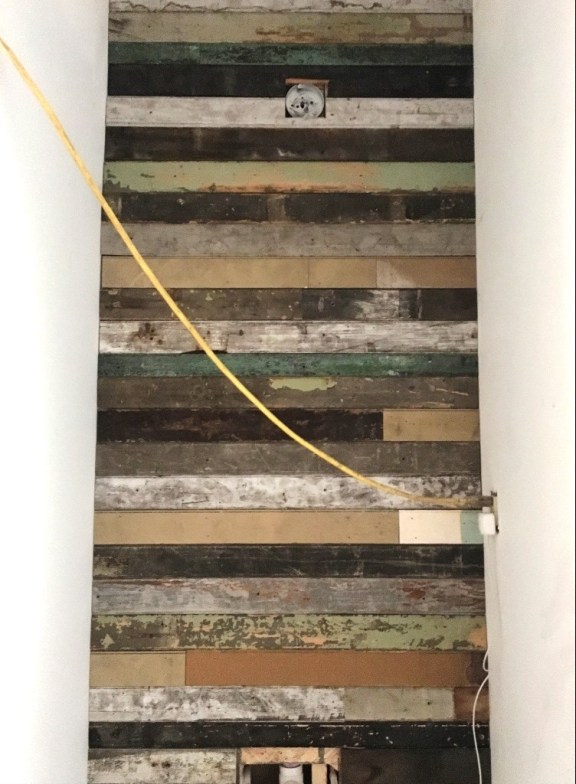
Our story so far: Using reclaimed wood from the basement ceiling, Tyler constructed a unique accent wall for the powder room in the old Methodist church we were turning into our home.
# # #
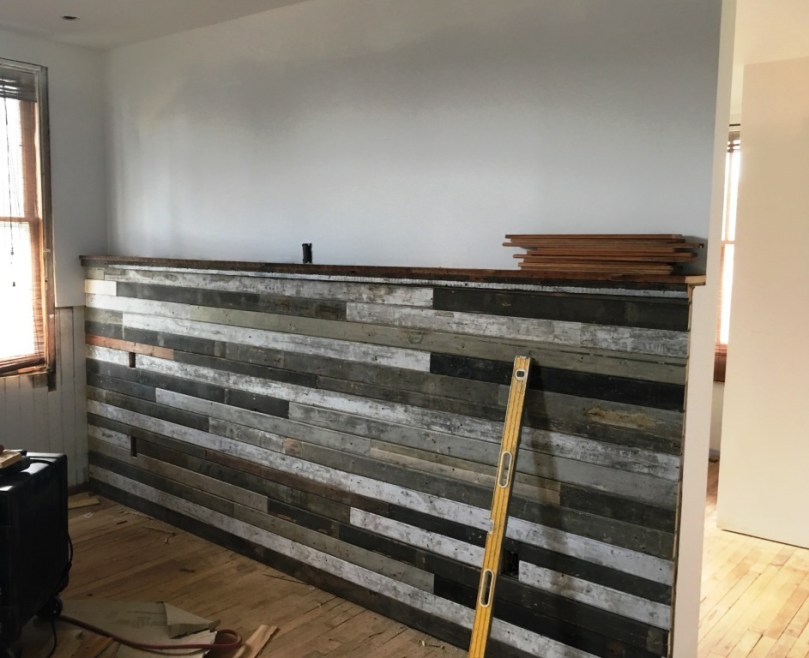
Then Tyler tackled the half-wall in the master bedroom where our king bed and the bank-safe night stands would ultimately be placed.
In our former house, we invested in an enormous bedroom set featuring a grand four-poster bed with marble accents that looked a little like a throne (we got a deal on the floor model). The whole set was so big, I didn’t move it once in the decade we lived there and we sold it when we moved because we figured we’d never have a bedroom big enough for it again. This left us without a headboard in the church for our king mattress, and I decided I wanted something non-standard: The whole wall would become our headboard.
During construction, Tyler and my stepson built a half wall, a la one featured in “The Downtown Loft Challenge” episode of “Fixer Upper,” in which Joanna Gaines created an accent wall with white oak planks and a narrow shelf. She set artwork, a few books and a candle on the shelf above the bed. Instead of white oak, we used the reclaimed basement ceiling boards—a mix of the white, gray and black ones—to decorate the lower half. During one of our antiquing trips last fall, Tyler and I found a set of old arched church windows without glass; that’s the artwork we would display on the shelf.
Now that’s a rustic accent wall!
# # #
Tomorrow: Another bedroom wall gets some love at Chapter 30 closes. See it here.
Our story so far: We were a bit overwhelmed with decisions and budget considerations while determining paint colors and trim for the old Methodist church we were turning into our home.
# # #
Fortunately, we saved a lot of scrap trim and wood when we were taking the church apart during demolition, and at least some of it was not only useable and money-saving, we could recycle it in a beautiful way. And the best part: We were using what we had so it required very little decision-making and no paint.
When Tyler took apart the basement ceiling to save the tin plates, all of it was nailed in place with tongue-and-groove planks. The church builders of old may have used leftover pieces from elsewhere in the church or another location altogether because though it matched in shape, it came in a rainbow of painted and unpainted colors. We saved it and moved it around the basement and then the deteriorating tool shed out back and now finally, we could put it to use—as accent walls, the modern method of featuring one wall in a room for some aesthetic purpose. One of our ten design rules required putting an accent wall in every—or nearly every—room.
First up: The powder room.
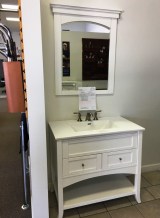
Without sanding, treating or even cleaning the tongue-and-groove boards, Tyler nailed the shortest and most uniquely colored boards to the south wall, on which our sleek, pure white vanity and mirror set would stand out. When he was done, the rustic backdrop added miles of character to the 21-square-foot room, and it would require only a coat of polyurethane to finish it.
Powder room accent wall.
# # #
Tomorrow: If you like this, you’ll love the accent wall Tyler built in the master bedroom. Check out it here.
Our story so far: While the drywallers worked upstairs and the concrete finishers labored outside, I holed up in the basement with creative projects that would find life as soon as Phase Four: Cabinets began.
# # #
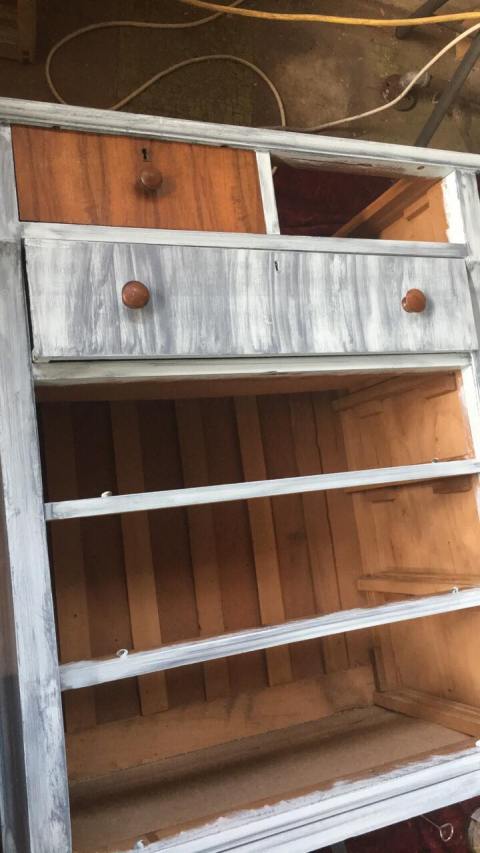
As I finished my last coats of polyurethane on the vanity, I pondered knobs. Initially, I had intended to reuse the original wooden knobs because they matched the veneer I had preserved for the top drawers, but with 90 percent of the wood painted, I considered painting the knobs, too.
So I took to Facebook to poll my friends.
“What do you think of these original knobs,” I asked friends on Facebook. “Should I paint them?”
One might say a lot of negative things about Facebook, but my friends are creative thinkers with good taste. One of them suggested vintage glass or crystal knobs, and a number of people seconded it. It was a great idea I hadn’t even considered.
On my next visit to Home Depot, I found a suitable glass knob to try. Cost: $6. I needed 18 knobs, so this meant I would be spending more on knobs than I did for the whole second-hand dresser set! I liked the look of the single knob which inspired a visit to eBay, where I found a mismatched lot of vintage crystal knobs—enough for the dressers—for only $25. Sold.
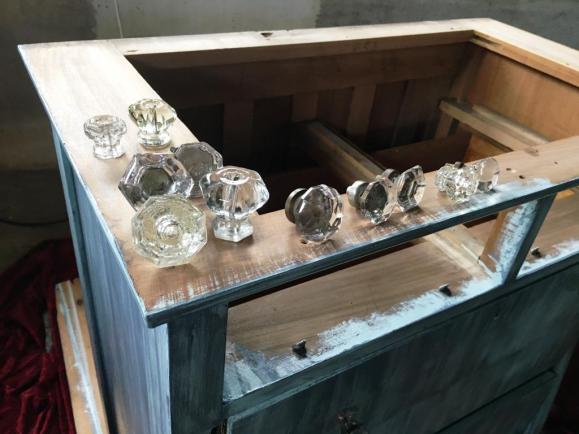
The lot of crystal knobs came in all sizes, but they would work in an eclectic way.
Unfortunately, I discovered after applying the last coat of polyurethane that I had used too heavy a hand on the edges of drawers. Some of them no longer closed. So another round of aggressive sanding was required.
Still, I didn’t mind expending the effort. Including the quartz countertop, my eight-foot custom vanity cost only $1,020.86. And it looked like a million bucks.
The Facebook advice was just another example of the community rooting us on and helping us bring to fruition our vision.
Some people the ability to see for the beauty trapped in ugly things, and some people simply do not.
# # #
Tomorrow: Chapter 28 opens. One step at a time. Check it out here.
Our story so far: After months of effort, we’d arrived at the drywall phase of renovation in the 126-year-old Methodist church we were turning into our home.
# # #
While the drywallers were doing their thing inside the church, Tyler got busy outside. Finally, the weather made the Great Outdoors inviting again, and Tyler began work on his Garage of Dreams.
In the way that other phases overlapped one another, Phase Six: The Garage was overlapping Phase Three: Drywall, Paint & Flooring. This was necessary for two reasons. First, the weather was finally nice again. Second, it was becoming increasingly apparent we weren’t going to be able to move into the church when we elected to wrap up our lease on the nearby rental house. It looked like we were going to have to move back into the camper, which we preferred to park on the cement slab of our future driveway and garage rather than a muddy yard.
This wasn’t an entirely unwelcome development given the nice weather. Recall that we were forced to move out of the camper in mid-November only because of snow and the imminent threat of freezing sewage pipes. On the other hand, it would have been convenient to move directly from the rental house into the church. But without the luxuries of finished flooring, countertops and closet racks in the church, we elected to take up residence in the camper again.
When deciding to purchase this particular church, the size of the lot was as appealing as the location. No churches came with attached garages, and some small churches offered no place to build a garage. When we contemplated the church in Pecatonica, Illinois, the garage we planned would have taken up all the open lot that came with the church. Though there was no parking lot or off-street parking with our 126-year-old Methodist church, the structure itself was situated on the front of a long triangular lot, which left lots of land for a garage with space left for a garden and other green space.
For several weeks, Tyler had been pacing and tracing the outline of his garage and driveway, collecting bids, consulting with the building inspector on setbacks and footings, and pricing creature comforts (like urinals and method of garage heating). Bids on outsourcing all the work ran high, so with his eye on the Tequila Budget, Tyler took on some parts of the project himself. He was ready to break ground.
Or at least break concrete.
The first step in his grand garage plan was to break up part of the concrete stairway from the basement. The straight stairway required a turn in order to be situated completely inside the future garage. The top four steps had to go.
Back steps, post demolition.
So Tyler rented a jack-hammer. And jack-hammered through several feet of concrete. His hired man St. Johnny earned his pay that day, hauling away the heavy chunks and digging a four-foot-deep hole to accommodate a new mid-stairway landing.
Tyler came home of the church that day in a state of exhaustion. After months of demolition and wall construction, he admitted that was only a warm-up. “I haven’t worked that hard in years,” he said at the end of jack-hammer day as he flopped on the couch, soon to be sleeping.
# # #
Tomorrow: Some old dogs do have new tricks. Read about it here.
Our story so far: The building inspector approved the rough-in in our renovation of the old Methodist church into a home.
# # #
As we neared the end of the Framing & Mechanicals phase of construction, Tyler was on box seven of nails for his air nailer. A box, you might recall, had a quantity of two-thousand nails.
And two-by-fours? He estimated we’d used at least one-hundred-and-fifty in constructing walls and ceilings inside the church. The Framing & Mechanicals phase had dragged on nearly twelve weeks, four weeks longer than demolition which had felt like it would never end. We were excited for the phase that signaled the most dramatic physical changes in the church.
Besides nails, lumber and lassitude, a measure of the effort we’d put into our construction project was Tyler’s belt.
During the first three months, he tightened his belt by about a notch a month. By Month Four, he had to bore a new notch in his belt, and that was apparently still not enough. One day, he had one hand on his air nailer and the other on a ceiling joist to hold it in place while he secured it. In front of an audience of St. Johnny, the carpenter helper, our electrician and an HVAC guy, Tyler’s pants fell to his ankles.
He ho-ho-hoed his way through a situation that would have mortified anyone else, but thank goodness he was wearing his new, snugly fitting underwear.
Another measure of our effort? Splinters and gloves.
Tyler picked wooden splinters out of his digits nearly every night as he sat on the couch decompressing from another long day. I wasn’t so rugged; I wore gloves.
Tyler had purchased a big box of cotton brown jersey gloves for me and his hired man to use. They were handy (get it? Handy gloves?) but too big for my slender (some might say bony) fingers. During the demolition phase, I’d run across a pair of work gloves that had belonged to the “DCE,” as evidenced by the Sharpie marker labeling. The only DCE this Lutheran had ever heard of was the Director of Christian Education, so I imagined the Methodist DCE had left them behind. They fit perfectly, so I commandeered them.
Four months and countless nails, pieces of wood and rolls of insulation later, the seams began splitting. I’d never worn out a pair of work gloves before. Before the church, I’d never even owned a pair of work gloves. I was never a gardener, and my hobby involved using writing utensils, not hammers. When more of my fingertips were bare than protected, I complained to the foreman that I needed a new pair of gloves “like these,” I said holding up my threadbare DCE gloves. Two days later, Tyler returned home from another trip to Home Depot with not one, not two but three pairs of work gloves eerily similar to my DCE gloves.
I would not be able to complain about my work gloves again.
My old gloves went into the trash right after I took this picture.
# # #
Tomorrow: Last-minute installation. Read about it here.
Our story so far: Among the light fixtures we procured for the old Methodist church we were turning into our home, we recycled the pendant chandeliers that once hung in the sanctuary by repainting them and installing new glass.
# # #
While we were paying homage to the church’s historical features, Tyler decided to relocate the milk glass ceiling lights he found in various locations in the church during demolition to the Hall of History.
The Hall of History had no windows so no natural light.
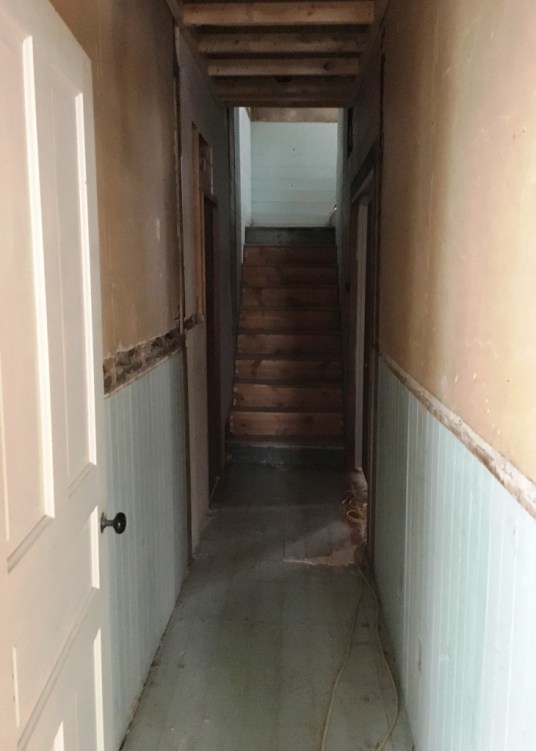
We were maintaining the only hallway that existed in the church. The fifteen-foot-long hall led from the sanctuary to the back stairway up to the second floor and included a closet and the doorway to what would someday be our bedroom. It had a high ceiling (after demo anyway) and beadboard up to the chair rail. He imagined we could hang pictures of the church throughout history on its expansive walls. Thus, he named it the Hall of History.
Vintage light canopies.
He found three milk glass lights of various shapes during demo and a number of rusty canopies (the Lighting Savant taught me this term; a light canopy is the lamp part used to cover ceiling electrical boxes). Though the orbs didn’t match, Tyler thought it would be a nice tip of the hat to history by put them to work in the Hall of History. Once again, I employed spray paint to combat the rust on the canopies and create a uniform element for the disparate orbs. I chose satin black which would stand out against the white ceiling.
Back to the spray paint zone.
And the screws to secure the orbs in the canopies? The old ones were so rusty I could hardly get them out of the canopies, but thanks be to Home Depot, the store offered a whole array of replacement options. Would it surprise you to learn I chose brass? Indeed, bright brass would be the discrete accent to set off the black and white fixture. Because details mattered.
Our story so far: While the plumber, electrician and HVAC guys worked on the old Methodist church we were turning into our home, so did we.
# # #
A week or so later, Tyler loomed over the bed at 5:50 a.m. on a Saturday. “Home Depot opens in ten minutes. Time to get out of bed!”
Did I mention Tyler was an early riser?
I complied. Fortunately, Starbucks was on the way to Home Depot and Tyler deigned to stop. So at least I got some coffee.
We proceeded to Home Depot where I watched him walk the insulation aisle, checking packages.
“This is the one! Grab that cart.”
We took only one pink loaf of blow-in insulation back to the tool rental desk.
“How many packages come on a pallet?”
“Eighteen.”
“I’ll take two pallets.”
No kidding. That earned us the bulk discount, but we still invested four figures in insulation.
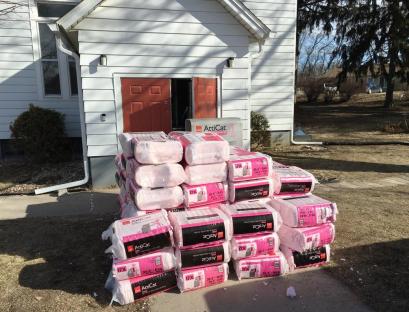
Insulation pallet Number One.
Two pallets of insulation did not both fit into the back of the truck. So I drove one pallet back to the church and went right back to Home Depot for the second one.
Just about the time Tyler had cut all thirty-six loaves of insulation in half in our front yard, Reroofer arrived.
Reroofer, the trusty roof expert who worked on our belfry, didn’t know he was going to be helping with insulation, but he was game for anything (apparently he had had his coffee, too).
That’s a lot of insulation.
The assembly line began. Reroofer climbed into the space between the sanctuary ceiling and roof with one end of the hose, while I fed insulation a half loaf at a time into the blower outside the front door. Tyler supervised (more than once he reassured me that Reroofer was upright and ambulatory inside the attic rather than being buried by a mound of pink insulation—“He’s fine! Now get back out there and mind the blower!”).
This was me, feeding insulation into the blower. Yes, I wore my pink work boots and a sly look on my face.
I found the job strangely satisfying. As the blower consumed half-loaf after half-loaf, the enormous pile of pink insulation slowly but consistently disappeared.
Four hours later, plus or minus a couple of breaks, we were done.
Or at least I was.
I went home to shower.
Before blow-in insulation.
After blow-in insulation.
# # #
Tomorrow: Not everyone hit the showers. Reroofer wasn’t done yet as Chapter 21 concludes. Read it here.
Our story so far: We worked on ceilings ad infinitum during the renovation of the 126-year-old Methodist church.
# # #
Before sealing up ceilings and walls, I got to install insulation.
The pink stuff.
This job required no expertise, only perseverance. So I got tagged.
I suited up in Tyvek, safety goggles, gloves and a breathing mask, and set to work on the first area requiring insulation: The attic eaves.
It was like wrestling with Tyler if my king-sized husband were cotton candy—the insulation was bigger that I was, and there was no way I was gonna win this fight. I resisted, I poked and I punched when called for, and eventually I got the pink rolls stuffed between the studs.
The worst part was the height of the attic eaves—exactly short enough that I couldn’t stand and tall enough that I couldn’t reach the top when I was kneeling. I didn’t have quadriceps for this.
After wrestling with insulation for two days and thinking I was finished, I learned properly installed insulation requires a vapor barrier. So I spent an afternoon wrestling with plastic to cover the insulation and a staple gun (one of the few power tools I was comfortable operating).
When I finished, I was reminded of a mantra that circulated in the scrapbooking circles I once traveled. Scrapbookers rarely lack raw material because life and the photos one takes while living life keep happening. It can become overwhelming if one agonizes about every single detail on every single page so sometimes scrapbookers power through an imperfectly decorated scrapbook page just to be able to move on to the next one: Done is better than perfect.
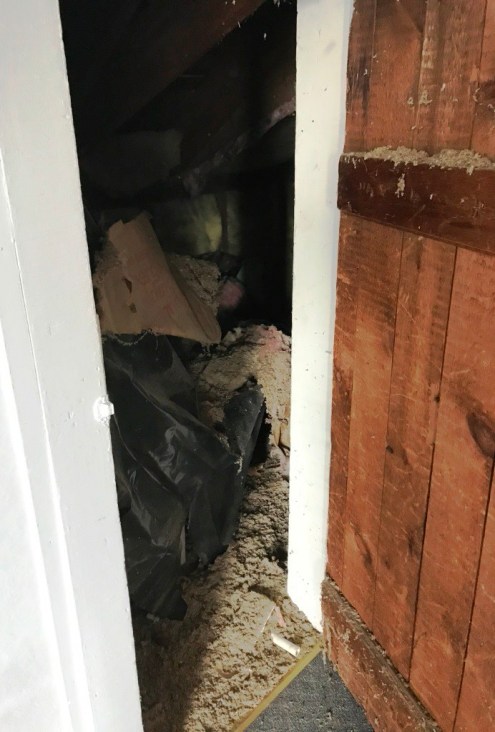
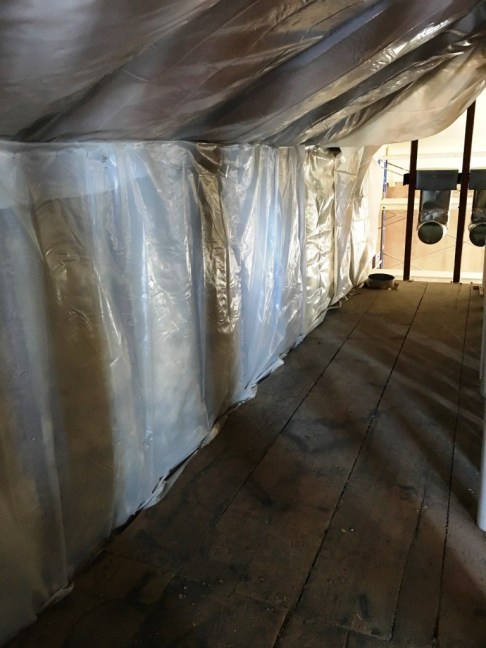
This is a shot of the attic when we bought the church. The door to the eaves had a sign that said “do not open.” We opened it anyway, and the eaves were filled with junk and dust.After: Is this the finest insulated attic eave you’ve ever seen?
# # #
Tomorrow: Oh, we’re not done with insulation yet, missy! Nosirree! Da-dum, da-dum, da-dum da-dum da-dum, da-dum da-dummmmm. Can you hear that saxophone? Read about it here.
Our story so far: During the demolition phase of renovating the 126-year-old Methodist church into our home, Tyler discovered the choir loft, and we decided to open it up to a balcony into the sanctuary, our future great room.
# # #
The Village People
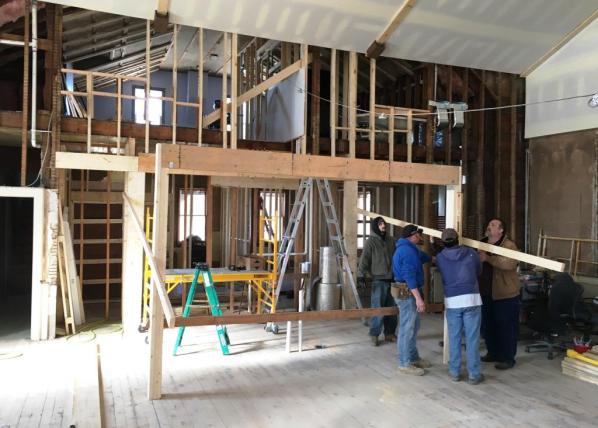
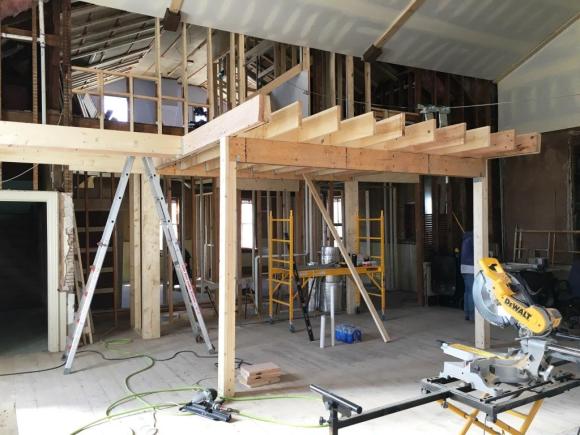
Once the header supporting the second floor was installed, Tyler built the archway upon which the floor joists of the balcony would rest. He enlisted the help of the HVAC guys to raise the arch (witnessing this, all I could think about was an old-fashioned barn raising—it takes a village to build a balcony). Then Tyler—with St. Johnny’s muscle—began nailing great big two-by-tens into place. Pretty soon he had a pergola built above what would someday soon be our kitchen.
The floor joists of the balcony in place.
Putting a layer of plywood over the floor joists was easy—after the first piece. I was glad I wasn’t around to watch Tyler straddling floor joists nine feet off the floor to juggle that first piece of plywood and nail it on. He arrived home in one piece that day, so success had been secured.
To wrap up the balcony, Tyler constructed cross joists from the pergola to the north and south walls of the church. These were narrower than the center part of the balcony in order to clear the spiral stairway on the north side and the front window on the south. With the science part complete, a bit of art was necessary to draw the main part of the balcony together with the narrow part; Tyler planned a dramatic scallop and swoop to soften the edges of the balcony.
“Aren’t you impressed that I got that balcony built basically by myself?” Tyler asked me a few days later. He did not have to ask me this question because he knew very well I was impressed with his knowledge of construction and ability to carry out the plan. He asked this question out loud because after all he had built throughout his life, even he was impressed with this particular project.
# # #
Tomorrow: What do we do with all that square footage? Read about it here.
Our story so far: Things were looking up in the old Methodist church we were turning into our home.
# # #
The grand plan to open up the choir loft required Tyler to construct a balcony for the loft to open up to.
This project began with two steps. To clear the edge of the sanctuary ceiling, we needed two steps down from the second story onto the balcony. This was a big math problem in order to get the step and run measurements correct and beginning in the right place.
After measuring twice (or thrice), he cut once—a hole in the floor. Then he constructed the steps themselves. For the most part, he worked from underneath the two steps, standing on a ladder.
Ta-da! Two steps.The steps are just as impressive from the underside, where one can see all the support structure. At some point, all of this will be hidden away in our bedroom closet.