Like Chinese water torture

Our story so far: With four bathrooms planned for the old church we were converting into our home, we juggled a lot of details in the mechanicals phase of our project.

# # #

One afternoon when I arrived at the church after a day filled with exciting errands like picking up rough-in valves for Glimfeather the plumber and more paint for the drywallers who were making like Michelangelo and painting the cathedral ceiling, Tyler put me to work handing him tools for the construction of a form to contain the floor-leveling compound in which the upstairs shower stall would nestle.

Tyler built sides for the form; the bottom was simply the century-old pine flooring. Leveling compound is similar to concrete, only soupier. After adding water to the dusty compound, Tyler poured the goop into the form.

Immediately, we could hear the dripping.

“Is it leaking?” Tyler said, then more urgently when it was clear it was indeed leaking, “Where is it leaking?”

I ran down the steps and looked in horror at the rainfall of gray, pasty soup dripping through the floor, through the form, through the shower drain hole.

“Everywhere!”

One of the HVAC guys, who had been working in the basement, appeared out of nowhere to rescue a big roll of aluminum foil bubble wrap covered in pasty drips of leveling compound. “What is that?”

“Leveling compound,” I answered.

“Well, it’s leveling all the way to the basement.”

I shoved a tray and a bucket in place to catch drops.

“Get back up here!” Tyler bellowed.

He’d filled in a couple of the holes but we’d lost so much compound through the cracks, we needed more to fill the form. Tyler began mixing again. “Hand me bottles of water.”

Remember, we didn’t have running water in the church yet. The first batch of soup was made with a jug of water collected that morning at the rental house.

Tyler mixed up another batch of soup and dumped it in the form. “Is it still dripping?”

I ran downstairs again to look even though we both knew it was because we could hear it.

“Yup.”

But the waterfall had slowed to a trickle.

When Tyler came downstairs, I asked, “Did you know that was going to happen?”

“Well, they’re old floors. There’s bound to be a few holes.”

“It was pretty holey.”

“Well, that’s right. We live in a church. It’s a holy floor.”

# # #

Tomorrow: Things are looking up as Chapter 21 begins. Read it here.

The price of beauty

Our story so far: In the midst of the framing and mechanicals phase of renovating the 126-year-old church into our home, we were called upon to make some decisions about the bathrooms.

# # #

Chapter 20

Showers, as it turns out, are expensive. And we planned to have three of them in the church, one on every floor.

Even while discussing the Tequila Budget, we agreed we weren’t going to be tiling our own showers. Oh, we were happy to do demolition, sand the wood floors, install our own kitchen cabinets, but tiling? Forget it.

tile job
Not the worst tile job. But not the funnest project either.

Tyler and I had attempted a tiling project in our former home, replacing the carpeting (yuck!) in the master bathroom. It turned out OK, but it was difficult work and perfect corners were tricky to accomplish. Perhaps ironically, Tyler was not a tiler. For the church, we knew we wanted an expert to handle the tiling.

Then we saw acrylic showers at a home show, and we were intrigued. No seams to leak, easy to clean and long-lasting. But when we got the quote on the showers—$19,050 plus plumbing and fixtures for all three—we learned they cost as much or more than tiling. The bottom line forced us to confront our means and the end: How much was beauty worth?

# # #

Tomorrow: We explore other options. Read about them here.

This $46.25 deal has the potential for greatness

Our story so far: I was stressed out about bathroom vanities for the church. When we finally chose a plumber, he needed to know where to rough in the vanity faucets, and to determine that, we needed three vanities quickly. I checked the master bathroom vanity off the list by investing in online cabinets.

# # #

We scored vanity Number Two for the upstairs bathroom at a second-hand store.

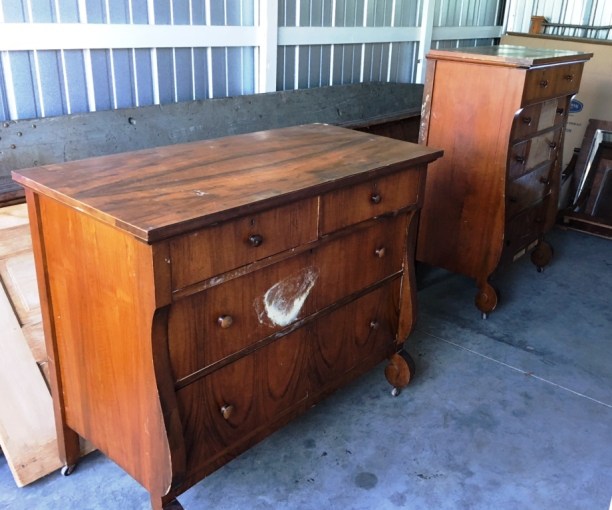
My brother-in-law had once turned a dresser into a vanity for a basement bathroom, and I loved the combination of an old piece of furniture with a sleek stone countertop. I had also once converted an ugly old dresser into a beautiful credenza with several coats of paint. I couldn’t use this idea in the master bathroom because it would have been impossible to find a eleven-foot-long piece of furniture. Likewise, the wall assigned to the upstairs bathroom vanity was eight feet long—it would take a very special piece of furniture to fill that space.

One Saturday, after spending hundreds of dollars on lumber and loading it into our truck, Tyler and I arrived for a lunch date a few minutes early, so we explored the nearby second-hand store. We couldn’t pass one without looking for something we might need for the old church, and here we found not one piece of furniture but two.

upstairs vanity furniture
They’re a little (a lot) beat up, but I see potential.
mirrors
The mirrors, unattached.

The first dresser was the ideal height for a vanity with an undermount sink. Tyler confirmed it would work. It even came with a mirror. But it was only about forty inches wide. The second, taller dresser also came with a mirror; it was about thirty inches wide.

Together, they were about twenty-five inches short of the expanse we needed to fill.

But the price was right—$185 for the pair.

veneer to save
Maybe the wood-grain veneer on the top drawers could be saved?

Oh, they were beat up, all right. The shorter dresser has a terrible stain on the front, and the taller one was missing veneer, but I intended to paint it all anyway. Some of the intact veneer had a beautiful wood grain look I thought I might be able to preserve by painting around it. The mirrors themselves were in good condition, but the frames needed paint, too.

As I stood in front of them debating whether the work required to redeem these dressers was worth it, the proprietress sensed my interest and struck up a conversation.

“Oh, that would make a beautiful vanity,” she said, describing how she’d turned other pieces of furniture into vanities. “And they’re 75 percent off today.”

The frugal Midwesterner in me couldn’t pass up a deal that good. “Well, I could throw them away for that price,” I said.

The proprietress wrinkled her nose. “Oh, you wouldn’t want to do that.”

“I mean I can’t pass up such a good deal,” I said. “But what do you think I could put between them to fill the space? A basket maybe?”

“Hmm, let me think about that,” the proprietress said.

checkbook drawing
More chicken scratch, this time on the back of a checkbook.

I went to lunch and chewed on this dilemma. I mean, I had to figure out how to make the $46.25 deal work. I couldn’t pass this up. And then suddenly I knew: If I removed the mirror from the taller vanity, it would fit perfectly under the sloping eave on the second-story, and then I could create a little make-up space—complete with mirror and stone to match the top of the sinked vanity—between the two pieces of furniture.

I returned to the second-hand store with a less money than we paid for lunch and asked the proprietress to hold them until we could return with an empty truck. A few days later, we added the beat-up dressers to the rental unit. At some point in the near future, the HVAC guys would be done haunting the basement so I could do some painting.

This left the guest half-bath, aka the powder room. The vanity in there would be most used by guests, so the pressure was on.

# # #

Tomorrow: Vanity Number Three wasn’t as good a deal as Vanity Number Two, but it still was meant to be. Read about it here.

Is it still free if you’re paying to store it?

Our story so far: We were in the building and buying phase of converting an old Methodist church into a home. And picking up stuff for free.

# # #

After we sprang for the rental unit, we justified buying things when the price merited it because we could store them away from the commotion of the church.

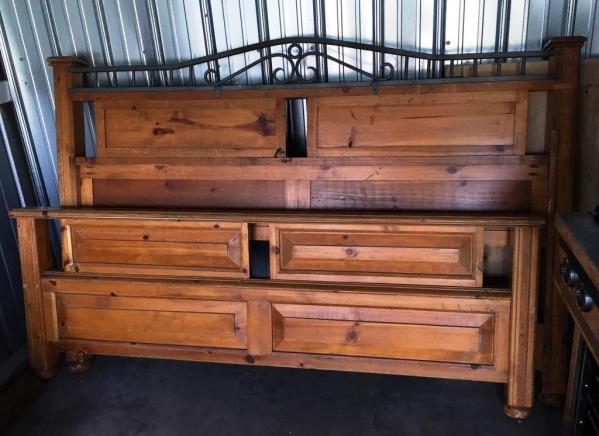
One morning when we were on our way to breakfast, eagle-eyed Tyler spied a raft of furniture on the boulevard a block from our rental house. We drove by slowly and stopped—the beat-up headboard looked promising.

headboard
This probably looks very familiar to one of my neighbors.

The low-profile of the headboard would be perfect on the bed we planned upstairs, where the ceilings sloped. It was solid wood, not veneer. It would need paint, but the iron work added style. And it came with a footboard. And it was free!

We loaded it into the pickup, and dropped it off at the rental unit. Celebrated not with a toast, but with toast. And eggs.

# # #

Tomorrow: Vanity of vanities. All is vanity. Read about it here.

Sawing wood is what she was intended for

Our story so far: We were deep into the construction phase of converting a 126-year-old church into our dream home.

# # #

By now, Tyler had finished constructing the walls on the main floor and upstairs. We were ready to think about the second floor ceiling.

Unlike the main floor’s drywalled ceiling decorated with beams, we chose something with a bit more farmhouse flavor for the upstairs, which would house a bathroom, bedroom and my office: Pickled, planked plywood.

We’d seen Tyler’s cousin’s husband turn plain old plywood into beautiful planked flooring when we were camped in their yard (was that only last year?), and we thought we could copy the idea on our ceiling.

Pickling and installing the ceiling was a multi-step process that began with a good day’s work ripping boards on the table saw. Tyler chose to do this with me on an otherwise quiet Saturday.

The table saw is not my favorite piece of equipment since it carried with it the threat of cutting off one’s digits. But the boards were too big for Tyler to cut straight without help, so the foreman tagged me as his crew.

sawdust.jpg
Check out that mountain of sawdust.

I caught on quickly when to push, when to pull and when to catch newly sawn pieces of lumber, but let me tell you, 20 pieces of plywood is a lot of 5.75-inch planks. And a half a bagel for breakfast wasn’t enough to fuel the manual labor. We took a couple of water breaks, but by the end, my self-talk sounded like this (if you could have heard it over the whine of the saw):

“Think about sawing, not about lunch. Don’t let Tyler’s fingers get cut. Seventeen planks to go. Who left the front door open? Concentrate on the saw. Tyler, be careful. Don’t slip in the sawdust. Don’t pull too fast. Watch Tyler’s fingers. Sixteen planks to go. Do I want tacos or a bratwurst for lunch? Don’t think about lunch. Step over the pile of sawdust. Watch Tyler’s fingers. Is that fifteen or fourteen? Keep the plank straight. Don’t push too hard. Watch Tyler’s fingers.”

Finally, the stacks of plywood were piles of planks.

ceiling planks
Stacks of planks. With the table saw looming in the shadows.

We still had days of sanding and painting and nailing ahead of us before we’d have a finished ceiling, but Step One was complete and so were Tyler’s hands.

Time for lunch.

# # #

Today’s headline comes from Mark Twain: “Write without pay until someone offers pay. If nobody offers within three years, the candidate may look upon this as a sign that sawing wood is what he was intended for.”

Tomorrow: Chapter 17 opens with a day in the life of an inexpert renovator. Read about it here.

Straight, perpendicular and level … or pay the consequences

Our story so far: Purchase of the 126-year-old Methodist church to turn into a home: Check. Interior demolition: Check. Building begins: Check.

# # #

Here’s what I didn’t understand about walls until I helped build some: They’re three dimensional.

This should be self-evident, but it wasn’t, at least to me. A wall should be perpendicular to the floor, perpendicular to other walls and level. If you don’t get things perfectly square, you’ll end up with a fun house maze.

I imagine this feat requires skill when one builds a house from scratch, but it’s a real trick when you’re building walls between 126-year-old floors and ceilings that may or may not be level.

Tyler took great pains to jack up the second floor to level, but “level” did not mean it was even. Every wall stud was a different length.

I helped build the closet walls on the main floor by performing a role as human tool holder. “Hand me the square.” “I need the level.” “Give me the power nailer.” (Let’s be honest, Tyler usually dispensed with pleasantries and placed orders with nouns only: “Nailer.” “Level.” “Hammer.”). Sometimes, I was promoted to two-by-four transport specialist or measurement expert (by expert, I don’t mean that I was responsible for measuring the length of the stud, but I did climb the ladder and hold the zero end of the tape measure securely to the ceiling).

In this manner, we (i.e., Tyler) built the walls to our walk-in closet which, conveniently also were supporting walls to the second floor.

# # #

Tomorrow: Pocket doors. Uffda. Read about it here.

Beams of dreams

Our story so far: The drywallers were making quick, satisfying progress on the ceiling of the sanctuary of the Methodist church we were turning into our home.

# # #

Along with the Sheetrock panels, the drywallers erected on the sanctuary ceiling the two-by-sixes to which our faux beams would be attached.

faux beam extreme closeup
In this extreme close-up of our faux beam, you can see the wood grain and the foam interior.

Tyler had decided to have a look at rigid polyurethane foam beams—lighter and more durable than actual wood beams and more affordable, they were advertised as being “virtually indistinguishable from real wood.” But seeing was believing. Ordering a couple of one-foot samples of the faux beams, like choosing any finishing details in a house, was an odyssey. We ordered them online, of course (because that was Tyler’s mall of choice), where the array of options was dazzling.

L beam or U beam?

Rough sawn or hand hewn (or any of eight other textures)?

How wide? How high? How long? Do you need endcaps?

What color? We knew we wanted “brown” but we could choose from among eleven shades of brown. We finally settled on samples of pecan and antique cherry.

faux beam faroff
The antique cherry sample beam is on the left, pecan on the right.
faux beam closeup
This close-up shows how the faux beam attaches to the two-by-six on the ceiling.

A couple of weeks later, our sample beams arrived, and Tyler stuck them on the two-by-sixes on the ceiling of the sanctuary (from the safety of the choir loft).

Remarkable. They were virtually indistinguishable from real wood beams. And they were as light as cappuccino foam, which would make them easier to install.

The beams would add just the distinction we wanted in the centerpiece of our great room: Our cathedral ceilings.

# # #

Tomorrow: Wall of fame. Or possibly shame. Read it here.

Nailed it

Our story so far: My husband and I bought a 126-year-old Methodist church to turn into our dream home, and we–with a little help–spent nine weeks demolishing the interior.

# # #

Chapter 16

Activity at the church began to accelerate, as evidenced by the number of checks being written and the volume of building materials accumulating in the church.

2000-nails.jpg
This is what 2,000 nails looks like

One day, a relatively small box—Amazon’s smallest shipping box—was delivered to the front door. I tried to bring it inside, but I discovered abruptly I couldn’t lift it.

“What is that?” I asked Tyler later. “It’s as heavy as a thousand screws.”

“Two thousand, actually. Two thousand nails,” he replied nonchalantly.

So we were embarking on a construction phase requiring at least two thousand nails.

# # #

Tomorrow: “Wood”n’t it be nice? Read it here.

The solution to sag: Structural support

Our story so far: We took steps to be careful as we demoed the interior of the old Methodist church, including hiring a structural engineer to look at the building’s support system and prescribe a fix.

# # #

Tyler and Reroofer with sag
Tyler and Reroofer preparing the space for the new header in the space between the sanctuary and the overflow area.

In the space of about eight hours over two days, Tyler and his help, Reroofer, got the header constructed and put in place, and they reconstructed the choir loft wall (I helped by renting a couple of heavy-duty adjustable floor jack posts and transporting them to the church—I’m handy like that). When they jacked up the floor, the wood gave a great creak and wail, but it cooperated. The second floor was suddenly a lot more level and the opening where the kitchen would be constructed was no longer saggy.

header after
Here’s the space after the new header was installed. You can also see the doorway, above center, where one will exit the second floor onto the to-be-built balcony.

With that task completed, I could put to bed my nightmares of bathing in the upstairs tub—me in my birthday suit relaxing among a cloud of bubbles and a hundred gallons of water—and falling through the ceiling. We were structurally sound now. But we still had to demolish the 20-foot sanctuary ceiling without killing our project foreman.

# # #

Tomorrow: Chapter 15 concludes with a solution to the sanctuary ceiling problem. Read it here.

Well, I have good news and bad news

Our story so far: We tried to be careful and responsible as we demolished the interior of the old Methodist church we intended to turn into our home.

# # #

We also were warned we had asbestos in the walls.

If one thought lead and mold were bad, exposure to asbestos was known to cause lung cancer. And eliminating it was expensive. In fact, it was asbestos that had scared us off from going through with the purchase of a church in Pecatonica at one time.

On this project, however, we’d gotten such a good deal on the church, we figured if we found asbestos, we could afford to pay to get rid of it.

One former parishioner reassured us that only love flowed from those walls, and we believed her. But unlike some matters related to a church, this one we could test. We sent three samples to the laboratory: main floor ceiling tile, main floor wall sample and basement flooring, which looked a little suspicious to us. Within twenty-four hours, we’d learned the ceiling and walls on the main floor were mostly cellulose with no asbestos. Cause for celebration!

basement floor tile
This was an attractive and durable floor covering in its time. But it was not “rustic transitional” and would have to go.

The avocado green basement floor tiles lovingly installed by a couple who were active members of the church when avocado green was in vogue, however, were 3% chrysotile, a Category 1 asbestos-containing material. Category 1 was the least bad of the three types of asbestos, that is, not brittle, breaks by tearing rather than fracturing and does not easily release asbestos fibers upon breaking.

We got a reasonable quote for professional asbestos abatement, but since our structure was now privately owned, we could legally get rid of it ourselves. When we were ready to refloor the basement, we had the Tyvek suits, goggles and respirators to scrape up the flooring if we decided to go that route. But in the meantime, as long as we didn’t disturb the floor tile, we’d be fine.

# # #

Tomorrow: Hey, this testing business is fun! Read about it here.