Our story so far: Tyler scored a deal on enough polyurethane to cover the floors of the converted church and then some.
# # #
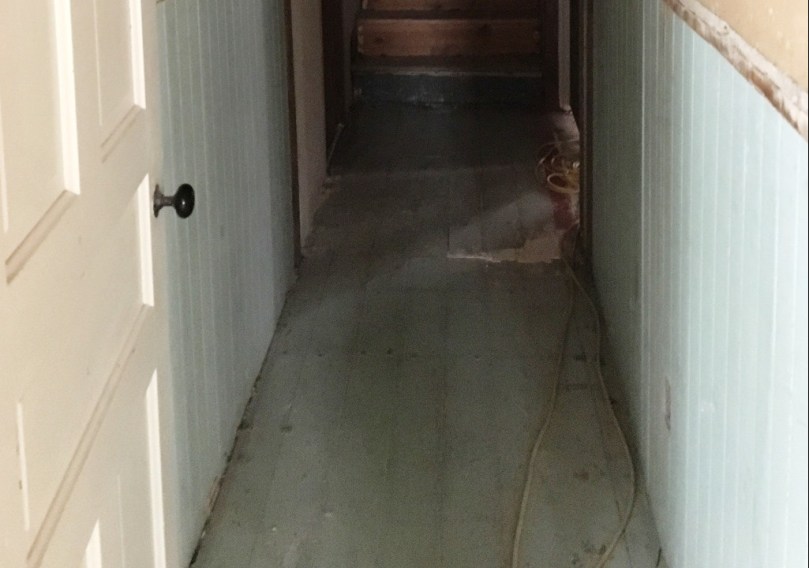
Here’s a look at the original flooring in the hall of history, including a putty-filled patch job there on the right.
The floor of the Hall of History presented a unique challenge. The Hall of History, you’ll remember, was the fifteen-foot-long hall that led from the sanctuary to the back stairway where we imagined we could hang pictures of the church throughout history on its expansive, now drywalled walls.
But, oh the floor. The pine planks were certainly original to the 1894 construction of that portion of the church and had once been part of the entryway. Count how many feet crossed that threshold on the way to Sunday school or worship services! Imagine the Sunday best shoes worn by parents holding newly baptized babies or couples freshly married! Several repairs and patches in the flooring were evident. Besides ground-in dirt, it was covered in paint of various colors—yellow, red and aqua—and sported huge gashes, divots and seams. One had to squint hard to see the potential.
We considered an affordable wood-like tile or perhaps carpeting, but we hesitated spending good money on a hallway floor that would most certainly be mostly covered by a rug runner. So Tyler tried sanding it, only his goal on this floor was to reveal its history (appropriate to the Hall of History) and even it out.
It wasn’t exactly attractive (or perfectly level) when he was done, but we found the character we hoped to feature. With new thresholds and baseboards, the rustic floor might be described by a forgiving critic as charming.
The hallway after two coats of polyurethane. It will need a new threshold into the great room (bottom of pic), but you won’t look perfect when you’re older than 100 either.
# # #
Tomorrow: Chapter 33 opens. The beginning of the end. Read it here.
Our story so far: A couple of coats of clear polyurethane was all we needed to show off the wood floors in the master suite and on the second floor of the old Methodist church we were turning into our home.
# # #
In the sanctuary-slash-great-room, we had a lot going on already. Between the ceiling beams, the fireplace and the kitchen cabinets, the floor played only a supporting role. Plus, its rustic patina didn’t need any more attention being called to it. So we went with a driftwood stain that had a hint of green in it; this would tone down the red in the Douglas fir planks creating a neutral backdrop.
Now after days of sanding, we would be spending days applying stain and polyurethane. The hardest part about this was enduring the odor. Do you remember what the school hallways smelled like on the day the janitors applied vanish to the gymnasium floors? Sort of a pungent chemical stench crossed with a tobacco barn? The church stunk to high heaven, but it lasted only a day or two. Tyler’s obsession with industrial sized fans played in our favor here. He threw open the doors of the church and invited the fresh summer air in.
A feud between Minwax and Home Depot over which Big Box retailer could have exclusivity on the Minwax brand proved to be a windfall for us. One day when Tyler was renting a floor sander yet again, he spied an endcap display offering polyurethane for half price. He bought every last can.
This is not a story display; this is Tyler’s stash of half-price polyurethane in our great room.
# # #
Tomorrow: How we paid tribute to history with the Hall of History floor. Read about it here. And you might be pleased to learn it’s the last installment of Chapter 32 about sanding floors.
Our story so far: After sanding floors for months at the old Methodist church, we spent a little time filling the seams.
# # #
Our next hurdle was stain. Fortunately, choosing a stain color proved to be much easier than choosing paint colors for the trim and walls. We decided to go without stain on the maple in the master suite and on the pine on the second floor. A couple of coats of clear polyurethane was all we needed to show off the hardwood.
Here’s how the master bedroom floor look at the beginning of the sanding process.Here’s how the master bedroom floor looked after Tyler filled the seams and applied one coat of polyeurethane.Here’s a picture of the second floor after half of it had been sanded the first time. This was even before drywall was up.This is the second floor after one coat of polyurethane.
# # #
Tomorrow: Luck equals preparation plus opportunity. Read about it here.
Our story so far: We spent one hot, sawdusty Saturday morning sanding the second floor of the old church we were turning into our home.
# # #
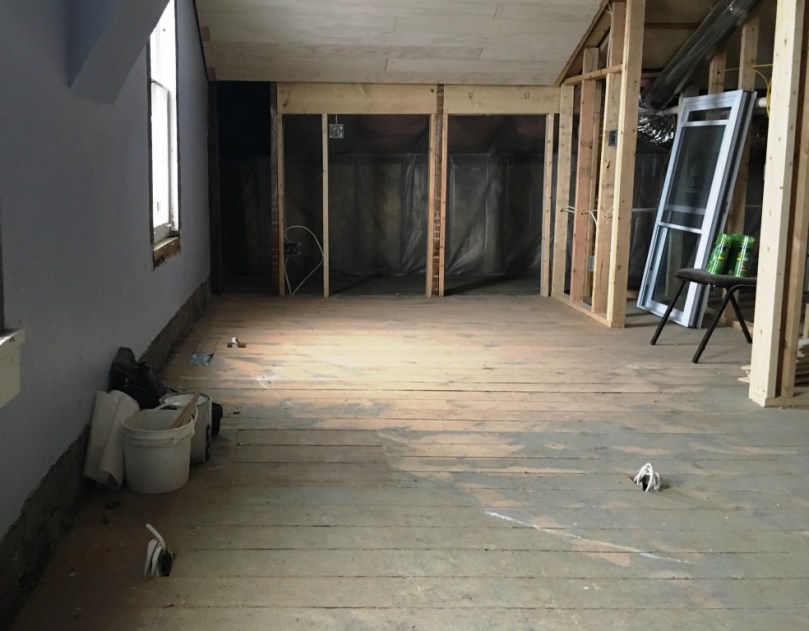
The second floor, post sanding, in the afternoon sun.
After our showers, we were so exhausted we fell back into bed (we got up early, remember) and napped. It was one of those glorious naps during which you sleep so hard that when you wake, you are still paralyzed with slumber. I just lay there for a few minutes savoring my job-well-done accomplishment. Tyler roused, and we determined a late lunch at the nearby Mexican joint would solve our hunger problem most quickly. It was as I attempted to get out of bed that I realized my lower back ached. Not a little I-know-I-worked-hard-today ache, but a big I-think-I’ve-hurt-myself ache.
“Oh, my back hurts,” I said.
“Oh, my back always hurts,” my compassionate husband said.
I was able to get out of bed, get dressed with some trouble and make it to the Mexican joint for lunch, but I couldn’t bend over or babysit for a week because I didn’t trust myself to be able to pick up my granddaughter. My husband quickly realized I was not suffering from any run-of-the-mill back pain and handled sanding duties solo for a long while after that. It took three weeks for my back to return to normal operation. I determined it wasn’t actually the work of sanding that hurt my back but the effort of lifting the super-heavy industrial sander up the steps. This underscored the safety reminder every manual laborer since the age of Doan’s Pills learns: Lift with the legs, not the back.
# # #
Tomorrow: The price of sandpaper. Read about it here.
Our story so far: My husband and I got up early one Saturday in June to “eat our vegetables first.” We figured we could sand floors on the second floor of the old church for four hours, then enjoy the rest of the day. But we were stymied by a long breakfast and quickly rising temperatures.
# # #
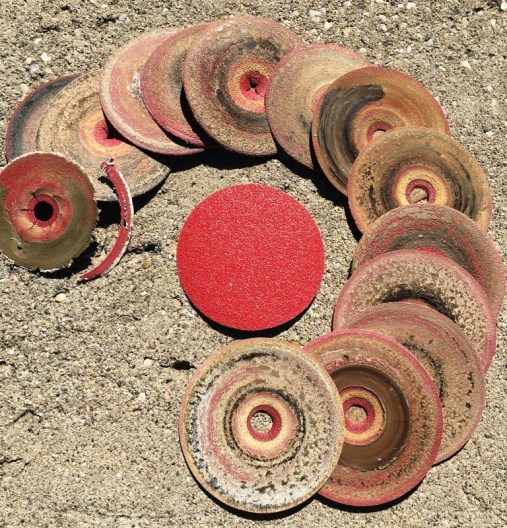
A new sanding disc surrounded by mastic-encrusted used ones.
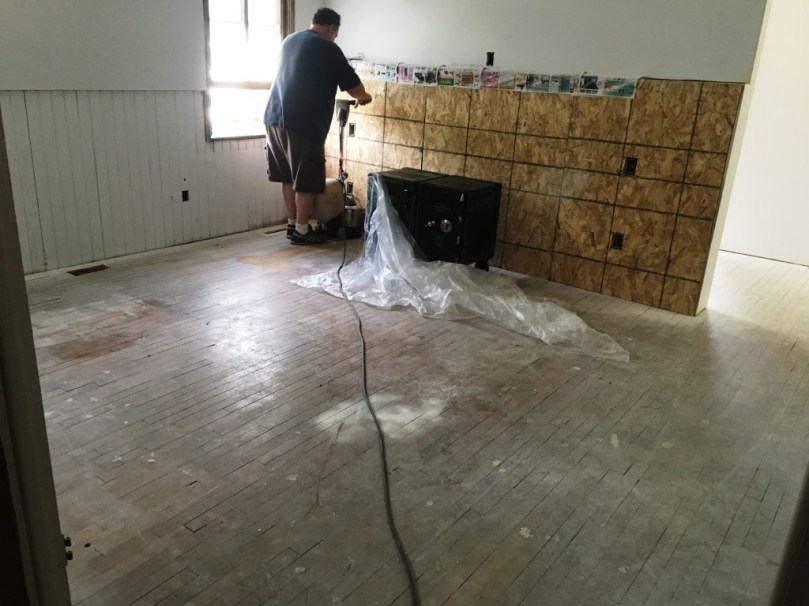
The center of the floor was in pretty good shape after the previous sandings, but the edges were thick with mastic. No sooner would I install a new sanding disk on my edger than it would be gummed up with glue, unable to remove any more layers. Up to retrieve another disk, then down on my knees to install it and proceed a few more inches along the edge of the floor.
No sound can be heard above the buzz of one sander let alone two. So there was no music, no conversation, only attention to detail.
I took as few breaks as possible, besides the disk replacement, with the intention of finishing the edges upstairs and then tackling the Hall of History and the mud room on the main floor before having to return the sanders. But I ran out of sanding disks before I got downstairs. And Tyler ran out of energy.
Still, we had to drag the sanders down the stairs, blow clean the devices, hoist them into the truck and haul them back to the rental desk by 11:30. All in the searing high-noon heat and humidity. The pancakes and eggs we had during our extra-long breakfast break provided just enough fuel to meet our deadline. As we climbed back into the truck, Tyler said, “where to for lunch?”
Tyler had no shame, apparently, but we looked a fright. Sweaty, covered in sawdust, my hair all askew from wearing a ventilator and ear muffs all morning.
“I’m not going anywhere for lunch,” I said. “I’m going home to take a shower!”
Tyler obliged my vanity, and I indulged in the best shower of my entire life.
# # #
Tomorrow: Mexican with a side of aspirin. Read about it here.
Our story so far: We had 2,200 square feet of hardwood to refinish in the 126-year-old Methodist church we were turning into our dream home.
# # #
We’d pretty much agreed, Tyler and I, that we’d do something other than work on the church on weekends—shopping, chores, socializing, resting—but the pressure of finishing the floors began to eat away at our best intentions. We couldn’t install cabinets until we finished the floors, and we couldn’t install countertops until we had cabinets, and we couldn’t have sinks until we had countertops, and we couldn’t have running water until we had sinks.
So one Saturday morning in June, I agreed to sand floors for four hours. If we returned the sander within four hours, we paid less than using it all day. It seemed a good way to get an unappealing chore out of the way first and then enjoy the rest of the day. Plus, we figured to be done before the hottest temperatures of the day, predicted to be in the nineties.
So we got out of bed at 5:30 a.m. and rewarded ourselves with breakfast out. Only the diner we settled on was a cook short and experiencing problems with its electronic ordering system. A thirty-minute treat turned into seventy-five minutes of Chinese water torture. So we didn’t get the sanders rented and into service until eight o’clock.
This is an edge sander. The black parts are handles. Imagine finding a place between your legs for the inflated sawdust-catching bag.
We donned ventilators, safety glasses and ear protection. Tyler used the orbital sander on the second floor, and I used the edger. The sander had so much power and I so little core strength, I could only control it by leaving one knee on the ground and using the other leg and both arms to propel it in the direction I wanted it to go. I probably looked like some sort of middle-aged spider trying to control a panicked fly.
# # #
Tomorrow: Which has higher priority? Hunger or vanity? Read about the dilemma here.
Our story so far: The first step in sanding hardwood floors in the church we were turning into our home required a drum sander and 24-grit sandpaper.
# # #
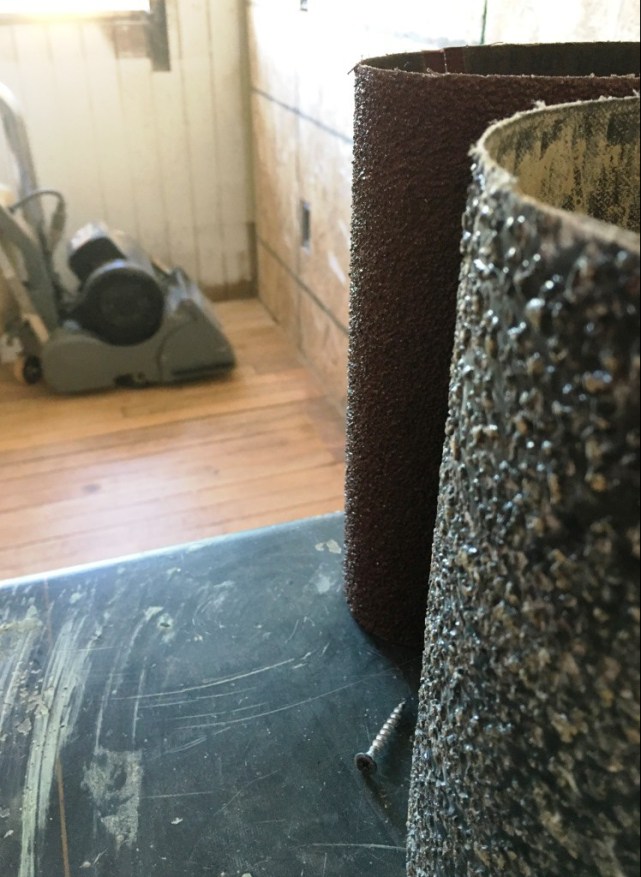
That’s a drum sander in the background; 24-grit sandpaper nearest, and 36-grit right behind.
Have you ever seen 24-grit sandpaper? I hadn’t. I’d only used the relatively even sheets of sandpaper to smooth edges and surfaces on furniture I painted. How cute. Twenty-four-grit sandpaper is the wicked sumo wrestler of finishing materials—it looked like it had gravel on it and if you got in its way, you’d be flattened.
At this point, I used a floor edger to sand right up to the walls in the sanctuary; this step required the operator to kneel, and since I still had my natural joints, I was elected. Then someone (usually Tyler, but sometimes St. Johnny) used the orbital sander with 60-grit sandpaper going with the grain.
On ordinary wood floors, one might be finished sanding. But we didn’t have ordinary wood floors; we had 126-year-old wood floors. Over the course of a century, the floor had settled everywhere except where the beams in the basement supported the structure. This left narrow grooves in the sanctuary floor that remained untouched by the stand-up sanders. Seated on a rolling flat cart low to the floor, Tyler used a belt sander and a hand-held oscillating sander to smooth out those grooves.
Final pass was with an orbital sander and 80-grit sandpaper.
Of course, vacuuming was required after each sanding step.
And that was just the sanctuary floor. We had to do the whole thing all over again in the master suite (with maple flooring, which is much harder than pine), in the Hall of History and on the second floor. In total, we had about 2,200 square feet of hardwood to finish.
# # #
Tomorrow: Sanding the second floor. Read about it here.
Our story so far: Having accomplished basic prep on the hardwood floors of the sanctuary of the old Methodist church, it was time to try sanding it.
# # #
Looks like cotton, feels like it weighs a ton.
It was still winter that first day Tyler tried sanding the floors. The morning dawned with five inches of heart attack snow on the ground and an early morning wake-up call.
The day before, Tyler called Home Depot to inquire about renting a floor sander. He was told they were rented on a first-come, first-served basis; he couldn’t reserve one. But he asked the guy at the rental desk if he might give him a call that night to confirm a floor sander was available when the store closed, which would indicate if one might be available in the morning. The guy agreed to give Tyler a call, but Tyler didn’t actually expect him to do it, given our experience at that point with flaky contractors and our inexperience with the folks employed at the local Home Depot. But indeed, at 8:15 p.m., the guy called and confirmed not one but two floor sanders would be available the next morning.
So Tyler woke up, made coffee, drove to Home Depot to pick up the floor sander, grabbed breakfast at Starbucks and was back at our rental house by seven o’clock, where I was groggily brushing my teeth and making coffee.
“Mission accomplished?” I asked.
“Yup! Today’s the day we take the top layer of grunge off the floor.”
He was excited. I was just waking up.
But I got dressed while he snowblowed the sidewalk in front of our rental house. We’d sold our enormous high-powered snowblower a year before when we embarked for a life on the road, never dreaming we’d be living in the snowy Midwest again so soon.
But lucky us: Among the strange and varied items the congregation left behind at the church was a little snowblower. It didn’t work, but Tool-Time Tyler was never deterred but such details. He fiddled with some element or another of the small engine, filled it with gas, and voila, we were the proud owners of a snowblower again.
The winter so far had called more often for a shovel than a blower, but that morning’s snow was deep and heavy. So when we were ready to head to the church, we loaded the little snowblower alongside the big floor sander in the back of the truck, and the first task was clearing the sidewalks over there.
Remember the church so many months ago? Notice the former doors on the front and the dumpster outside.There’s a sidewalk under all that snow!
Blowing snow, as it happens, is a lot like sanding floors. Move slowly, walk in a straight line, generate a lot of snowdrifts (or sawdust drifts). I didn’t appreciate the act of shoveling all that much, but I liked looking back over a well-shoveled sidewalk and feeling satisfied.
With a lot of foot traffic from a parade of contractors ahead of us, we weren’t interested in finishing the hardwood floors just yet, but Tyler took the opportunity presented by the wide-open spaces to sand off the top layer of glue and mastic with a drum-type floor sander and 24-grit sandpaper.
Wow, talk about a feeling of satisfaction! Our 126-year old Douglas fir flooring in the main sanctuary was beautiful under all that gunk. Some people might object to the knots and seams, but with a rustic transitional design scheme, it was perfect for us.
Here’s how the Douglas fir of the sanctuary floor looked after the first sanding.
# # #
Today’s headline was appropriated from English novelist J.B. Priestly who once wrote, “The first fall of snow is not only an event, it is a magical event. You go to bed in one kind of a world and wake up in another quite different, and if this is not enchantment then where is it to be found?”
Tomorrow: Oh, the sanding has just begun. You thought a stairway had a lot of steps. Read about them here.
Our story so far: Sanding hardwood floors in the old Methodist church we were turning into our home was dirty work.
# # #
Sanding hardwood is hard work. To the elbow grease, add a flurry of sawdust and you’ve got good reason to hire out the work.
But we didn’t. We hired out the duct work, we hired out the electrical, we hired out the plumbing, we hired out the drywall and we hired out the painting. Unlike those other tasks, sanding didn’t require any particular expertise, only numerous trips to the Big Box rental desk, attention to detail and a willingness to endure dust (a lot of dust). It’s the job you often see novices attempt on DIY Network’s “First Time Flippers”; viewers see about ninety seconds of effort, even though the rehabbers probably spent weeks doing the work. Though the investment in time is big, the investment in cash is small, and the return is potentially huge. Everyone likes the sound of “original wood floors.”
And so, we found ourselves sanding floors in the old church during cold days in February and hot days in June.
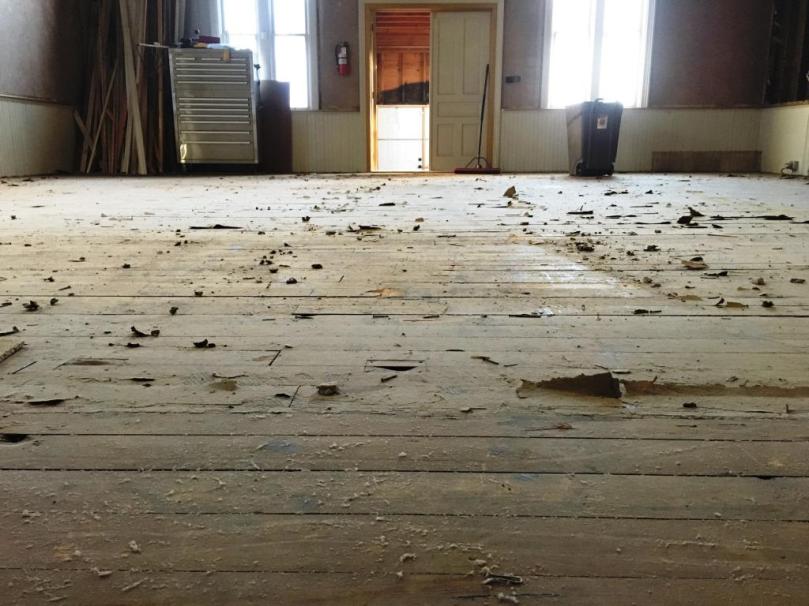
Fundamentally, sanding is granular demolition and despite labeling it the “flooring phase,” the truth of the matter was we were still demoing the flooring seven months after we purchased the old Methodist church to turn into our home. The layers of flooring and gunk covering the original wood floors were beginning to feel as if they would never end. During the official demo phase we peeled back the old carpeting and padding that was two decades old if it was a day. Then there were the thousands of carpet staples and hundreds of nails covering every square foot of the sanctuary.
We knew there was beautiful wood somewhere under all that ugly mastic.
# # #
Tomorrow: Oh, you can’t sand yet. Look out for the tin! Check it out here.
Our story so far: We were in the midst of Phase Three of construction: Drywall, Paint & Flooring at the old Methodist church we were renovating into our dream home.
# # #
Chapter 32
I used to believe no shower felt better than the one you took after a thirty-hour trans-Pacific plane flight.
At one point in my marketing career, I took such flights regularly. I began the trip, usually before dawn, wrangling a huge suitcase and heavy computer bag. I’d drive or take a shuttle to the airport. Stand in lines, handle dirty money (all cash is dirty, even someone who’s not a Virgo knows), touch doorknobs and hand rails already touched by the thousands of other members of unwashed humanity, dine off of filthy seatback trays, drool on myself as I tried to sleep on the plane, change planes at least twice, usually four times (because there were no direct flights from St. Cloud, Minnesota, United States of America to Mount Ku-ring-gai, New South Wales, Australia), wait in the sunshine for another shuttle or cab to my hotel, stand in line to check in at the hotel and finally arrive at my destination a day and half after I began. If I could summon the energy, the first thing I did was take a shower. Oh that shower was sweet, washing off hours of exhausting traveling and disgusting germs, and I exited the shower a new woman.
I used to believe that shower was the best shower ever.
Until I sanded hardwood floors.
No shower feels as good as the one a rehabber takes after sanding 126-year-old wood floors for a few hours on the second story of an old church in 90-degree temps.








 At one point in my marketing career, I took such flights regularly. I began the trip, usually before dawn, wrangling a huge suitcase and heavy computer bag. I’d drive or take a shuttle to the airport. Stand in lines, handle dirty money (all cash is dirty, even someone who’s not a Virgo knows), touch doorknobs and hand rails already touched by the thousands of other members of unwashed humanity, dine off of filthy seatback trays, drool on myself as I tried to sleep on the plane, change planes at least twice, usually four times (because there were no direct flights from St. Cloud, Minnesota, United States of America to Mount Ku-ring-gai, New South Wales, Australia), wait in the sunshine for another shuttle or cab to my hotel, stand in line to check in at the hotel and finally arrive at my destination a day and half after I began. If I could summon the energy, the first thing I did was take a shower. Oh that shower was sweet, washing off hours of exhausting traveling and disgusting germs, and I exited the shower a new woman.
