Our story so far: We were attending to myriad small tasks in our church conversion project.
# # #
Like so many other elements of house construction, doors do not come complete.
Take the fireplace, for instance. We bought a fireplace, really just the firebox. We also needed to purchase stone for the chase. And a hearth. And a mantelpiece.
Or a shower. Once you find a shower head, you also need the handle. And the trim parts.
Find cabinets you love, and you still must invest in hardware.
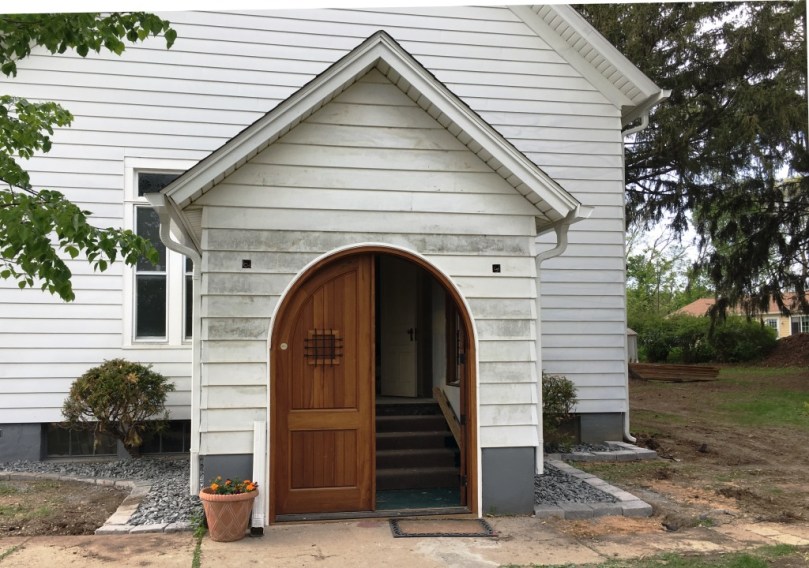
So it is with doors. Our front doors were a steal on Craig’s List, but they came without door knobs. Or locks.
The options available at the Big Box home improvement store were too mass-market for our distinctive castle doors. So Tyler did what he does best and took to eBay, where he found wrought iron hasps and handles.
When my dad, an accomplished carpenter who wasn’t afraid to work with expensive pieces of wood, paid us a visit and noticed we hadn’t yet installed knobs on our doors, he remarked, “Better measure six times and cut once on that project.” Our impressive doors were heavy solid wood; Tyler had only one chance to get the handles right.
But we couldn’t continue to open the doors with the tiny handles for the speak-easy portals as we took to doing early on, so Tyler did what he had to with his chance and installed the distinctive handles and locks. Cutting once.
Open sesame.
# # #
Tomorrow: How to choose a backsplash. Read about it here.
Our story so far: As the drywallers and the concrete finishers worked, we crossed things off our to-do list in our church conversion project.
# # #
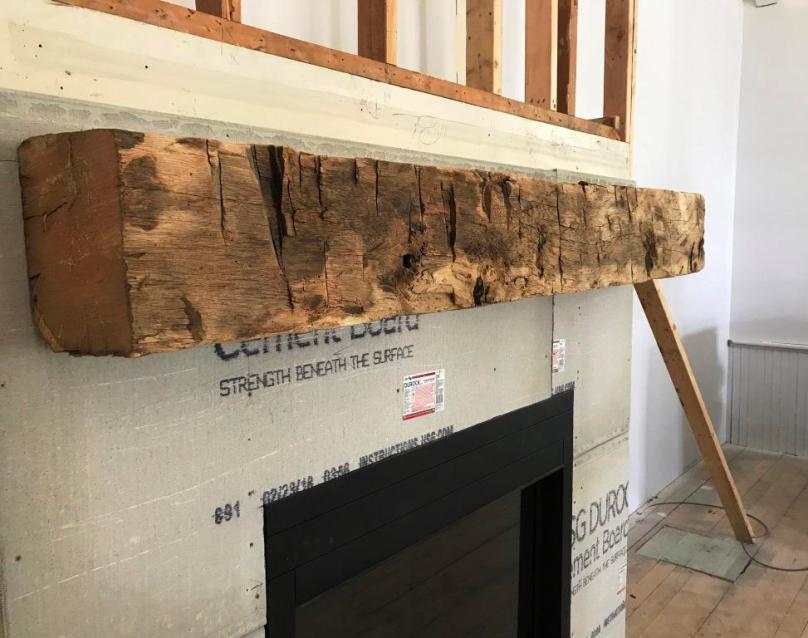
With the drywall up and the driveway complete, Tyler returned his attention to the church interior. It was time to get another beam out of the way: The two-hundred-pound barn-beam mantelpiece he’d found on Craig’s List. Unlike the polyurethane beams on the ceiling, this project required a heavy-duty approach to fastening it.
Tyler determined the optimal height of the mantel by researching the firebox manufacturer’s recommendations. The beam was real wood after all, and wood is combustible. Then he enlisted You-Can-Call-Me-Al’s carpentry skills; this was no one-man job.
First they reinforced the mounting area behind what would be the stone by installing two four-by-sixes stacked on top of each other as a mounting plate. Then they drilled holes in the backer plate for eight ten-inch lag bolts.
That’s rough hewn, baby.
As he handled the beam, Tyler admired it. The Iowa barn from which the beam was removed was 122 years old, according to the Craig’s List seller, but the beam itself could have predated our 126-year-old church. Either the steam-powered saw mill hadn’t been invented yet or it wasn’t available, so the beam had been hand hewn from a red oak log with a broad axe.
Because the beam was so thick (eleven inches square), Tyler cut it to length with a chain saw. Inside the church. In any other circumstance, a chain saw wielded inside a building was the stuff of horror movies, but in this case it was simply convenient.
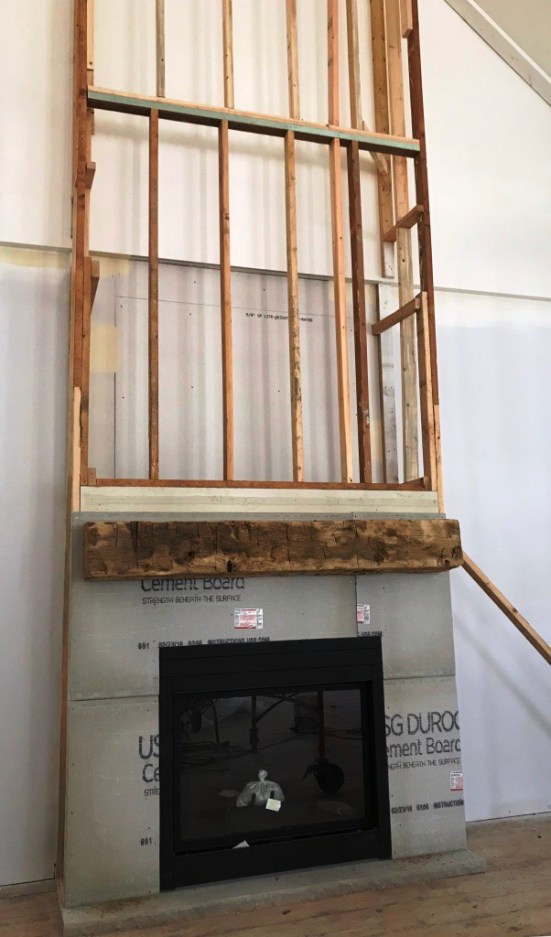
You-Can-Call-Me-Al and Tyler created temporary wooden brackets to prop up the beam in which they partially predrilled holes for the lag bolts. Once they secured the mantelpiece in place, You-Can-Call-Me-Al tested their work by standing on it. You-Can-Call-Me-Al might be described as wiry, but still, this was a good test.
Built solidly, indeed.
This shot gives you an idea of where we’re going with this.
# # #
Tomorrow: Hardware for the front door. See it here.
Our story so far: As my husband walked the new foundation of his garage, describing in grand detail how it would someday look, I got a tingle in my chest just to see him so happy.
# # #
I would feel that embodiment of excitement again a few days later when the drywall team and You-Can-Call-Me-Al joined forces to install the faux beams in the sanctuary of the church (a.k.a. great room) (read here about the purchase of the faux beams). I couldn’t bear to hang around during the day, listening to debates about angles and watching the men teeter on scaffolding, but when Tyler and I surveyed their work at the end of the day, I could barely speak.
The mood lighting of early evening without the benefit of electric lights doesn’t do this shot justice, but it gives you an idea of how our ceiling now looks.
Finally, our home was beginning to look like I imagined it would when we first toured the church eight months before. Even without light fixtures and fans, our fake beams looked finished and majestic. The beams were everything I’d hoped they’d be.
This artsy angle on the beams was taken from the balcony.
Our story so far: The concrete finishers completed their careful work on our driveway at the old Methodist church we were turning into our home.
# # #
Window wells, in process.
While he had the concrete mixer’s attention, Tyler had him pour the air conditioning pad. I’d enjoyed air-conditioned homes all through my adult life, but this would be one of those details to which I’d never paid attention. Not Tyler; he preferred concrete pads to the pre-fab plastic ones, and I didn’t even realize an air conditioner requires a pad at all.
Tyler also chose to install window wells around the basement windows on that side of the church so he could spread around all that fabulous black dirt he’d collected from the school across the street and coax drainage water away from the foundation.
# # #
Today’s headline is a quote from Edmund Burke, an 18th century Anglo-Irish statesman, author and philosopher. Now that’s the kind of resume I’d like to have someday.
Tomorrow: Dreaming of a mancave. Read about it here.
Our story so far: Among projects we ticked off our to-do list was installing tons of drywall inside the old Methodist church we were turning into our dream home.
# # #
Meanwhile, our concrete finishers completed their careful work on our driveway. A little like our dramatically swooping balcony, our driveway incorporated some graceful curves as well; cars would turn in from the street and curve around to enter the garage. The concrete finishers made the wood forms obey and figured out how to jigsaw the seams, and when they were done, they accomplished the twin goals of smooth conveyance and proper water drainage.
Our back yard before the garage foundation and driveway were poured.Our back yard AFTER the foundation and driveway were poured. Look at how green everything got in a few weeks!
# # #
Tomorrow: Hey, as long as you’re here and you have concrete in your mixer … Read about what Tyler calls for here.
Our story so far: Many months into the renovation of the old Methodist church into our home, it seemed as though nothing was getting accomplished, but it was a big project with a lot of moving parts. In fact, we were ticking off a number of items on our to-do list.
# # #
Our A team of drywallers was as dedicated as they were talented. Day after day, they showed up to hang heavy sheets of drywall and then mud all the seams and then sand it all down and then prime all the walls and finally paint the ceilings. Some in-between days, huge fans circulated the air to dry surfaces.
One afternoon I showed up to drop off something (probably another package from Amazon filled with some odd construction materials or tool), and the chief of the A team stood on our front porch (also know as the public sidewalk, seeing as our front door opened nearly onto the street). He was taking in the fresh air during a break, joking around with Tyler.
As I joined the conversation and looked into his eyes, I came to understand what step of the project we were into: Ceiling paint. The chief was dusted from head to toe in a thin film of paint. His normally dark eyelashes were alabaster. As he laughed and blinked, he looked alien.
Thank goodness for our drywallers. Just as promised, and right on time, they completed their work. When they were done, the interior of the church never looked so neat and clean. Now we were getting somewhere.
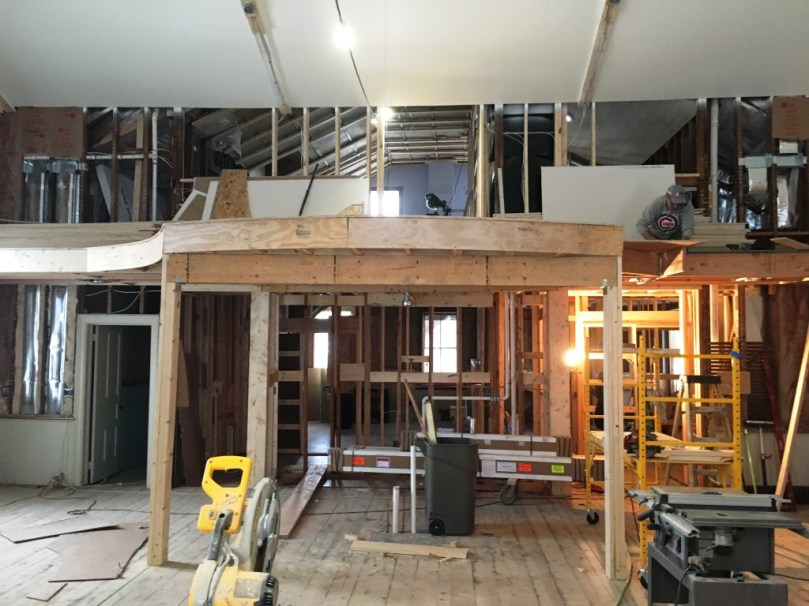
The entryway BEFORE drywall.The entryway AFTER drywall.The Hall of History BEFORE drywall.The Hall of History AFTER drywall.The second story BEFORE drywall.The second story AFTER drywall.The balcony and kitchen BEFORE drywall.Our balcony and kitchen AFTER drywall.
# # #
Today’s headline is a quote from 15th century artist and inventor Leonardo da Vinci.
Tomorrow: Like our balcony, our new driveway has graceful curves, too. See them here.
Our story so far: While the drywallers were working inside the old church that would someday soon become our home, Tyler & Crew were pouring concrete outside the church for the future garage.
# # #
Chapter 27
As the lilacs faded and May transformed into June, much activity was occurring inside, outside and around our church-sweet-home project.
The conversations Tyler and I had sounded more like a corporate project manager’s Monday morning update meetings than a conversation between husband and wife.
“I need an update on how much we’ve spent on the garage so far.”
“Do you know when the drywallers are coming today?”
“When are you going to pick up that replacement siding?”
“When will you have a few minutes to look at that bathroom vanity with me?”
“Find the fireplace receipt—I need to return those parts.”
“I need the key to the rental unit so I can drop off the lights.”
“Listen to this voicemail from the carpet guy and let’s discuss.”
“What did the spiral stairway manufacturer say about the timeline?”
“Did You-Can-Call-Me-Al finish grouting the shower today?”
“Remind me to buy window wells tomorrow.”
“Have you heard from the guy who’s supposed to measure the shower?”
“Did you pay the concrete company?”
“You need to get back to the spiral stairway manufacturer about the stairway railing material.”
“Did the carpet guy call you back?”
The first time I finished with this message, I realized I forgot a “not,” completely confusing the meaning. Dumbhead typos.
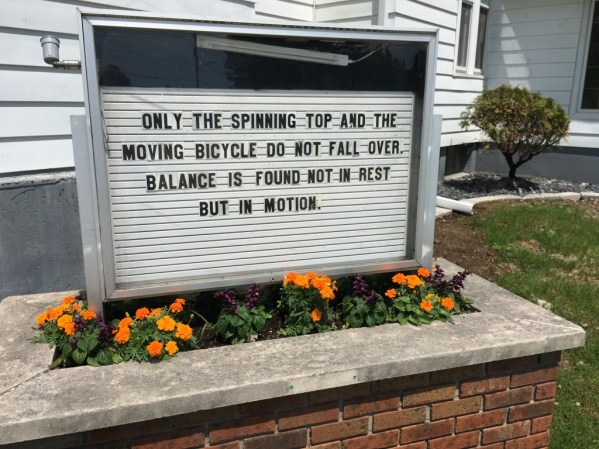
We were spinning like tops, just trying to keep our equilibrium.
It seemed as though nothing was getting accomplished, but it was a big project with a lot of moving parts. In fact, we were ticking off a number of items on our to-do list. If we had been remodeling only the bathroom or building only a garage, these “little” tasks would have been big steps to completion. They only seemed small in the face of the mountain of all we had yet to get done.
# # #
Today’s headline comes from author Deepak Chopra.
Tomorrow: Ticking another little task off the list. Check out the dramatic changes here.
Our story so far: My husband and I had spent months transforming a 126-year-old Methodist church into a home.
# # #
Chapter 26
All the screen time Americans had been accumulating over the years has had a toxic impact not only on our attention spans but in our landfills.
We inherited—or bought, I guess—an old tube television when we acquired the old Methodist church. It sat in the basement in all its bloated 1980s glory, who knew if it worked anymore. We planned sleek flat-screen televisions in our new space, and even if the old TV worked, it didn’t work for us. I was reminded of a college art project in which we students removed the tube screens from old console televisions and created dioramas inside that made high-minded cultural statements of one sort of another. We recycled and learned something at the same time. Win-win.
That was 1987. The television landscape had changed in thirty years.
All the locations that accepted our old housewares like Goodwill and Restore wanted nothing to do with old electronics. Old televisions were as desirable as old cassette tapes. Ancient technology.
OK, so we’d recycle it. I did a little checking around.
Would the garbage man take it away? Nope.
How about the scrap metal yard where we’d hauled several truck loads of heating ducts, aluminum siding and copper-studded hunks of metal? We would leave there with enough jingle in our pockets for lunch. Alas, no. A big sign declared “No TVs.”
I recalled recycling a number of electronics in the past at Best Buy. Would the Big Box store take our TV?
Sure. For a price: Twenty-five dollars to recycle one old TV.
Wow.
Old television sets are filled with toxic components like lead, mercury, flame retardants, cadmium, beryllium and other terms one hasn’t heard since eighth grade chemistry. The value of the good stuff—platinum, gold, silver and copper—doesn’t outweigh the trouble of responsibly getting rid of the bad. It’s a huge problem in a society where its citizens upgrade their computers and TVs more often than they observe leap year. Think about how many television sets you’ve owned in your lifetime. Where are they now? The landfill?
I wasn’t the only one struggling to dump a TV. Once I realized how difficult it was to get rid of an old TV, I began seeing them everywhere. One of our neighbors left eight—eight! I counted!—televisions and computer monitors on the curb for four months, through drifting snow and falling rain. We wrinkled our noses in disgust every time we drove by. Then we left for a getaway one weekend, and when we returned, they were gone.
These old TVs were loved once. But no more.
Other folks in town had less obvious eyesores in their yards. A TV here, a couple there. Our rental house had a TV in the dungeonesque basement. I fantasized about playing the village TV fairy—taking all of them away and paying the reverse ransom to get rid of them.
Though troubled by the problem of excess and the resulting detritus, I was too cheap to play fairy.
We didn’t have the space to keep even one junk TV in the basement of the church, and we had too much pride to leave it sitting on the curb indefinitely. I sacrificed a lunch one day and ponied up the cash to let Best Buy take the dinosaur TV off our hands.
Part of me felt morally superior for getting rid of the old TV responsibly. And part of me felt guilty for coveting the flashy flat-screen models on display.
# # #
Tomorrow: Some old things get more valuable over time. Read about it here.
Our story so far: As we renovated the old Methodist church into our home, we chose stone for the fireplace and the counter tops, and we were pleased with the poured concrete for the garage.
# # #
The easiest stone to install at the church was the decorative rock we purchased to border the exterior.
The gravel that was there was old, tired and indistinct. Tyler wanted to freshen up the look, so he took me to the nearby landscaping supply store (where we had ordered a fireplace hearth) to browse the options. In the past, we might have used fresh mulch next to the foundation of the church, but we did that with the first house we owned together, and it just invited bugs inside. So we left the mulch to insulate the roots of the bushes on the perimeter of the church property.
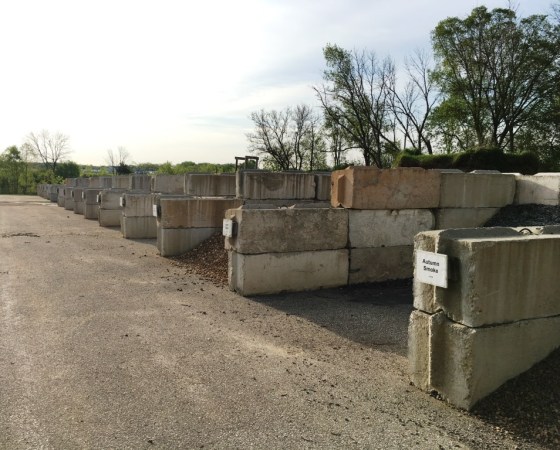
Concrete bins as far as the eye could see offered up gravel options.
Until that morning, I had no idea there were so many different gravels, rocks and crushed stones with which to decorate a yard. Like to many things in my life, I just wasn’t paying attention. We could choose from every shade of gray and brown, plus a few blues and reds, in every size from pea gravel to boulders.
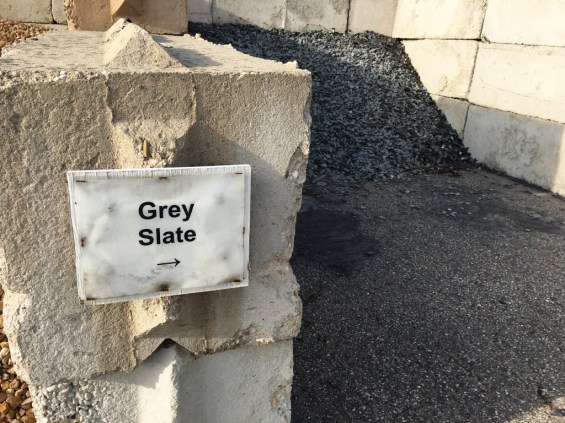
Grey Slate: Hmm, that would be a great nom de plume for a romantic novelist.Gravel with flare.
We were drawn to the grey slate with its rocks shaped to skip across a pond. It glittered in the sun with fifty shades of grey, mind you, not gray. I liked the cool blue hue which I didn’t know at the time but was very pleased to realize coordinated perfectly with the color the foundation was already painted.
We also chose some edge stones. Tyler and his hired man St. Johnny sweated it out to place the stones and spread the slate, and when they were done, it rocked.
The church, in her new grey slate flounce, is winking at you.
# # #
Tomorrow: Chapter 25 opens with the story of another construction project. Read about it here.
Our story so far: We were in the midst of the heavy lifting—it was all things stone—for the old Methodist church we were turning into a residence.
# # #
The footings had been poured. Untold loads of gravel hauled in. The steps formed.
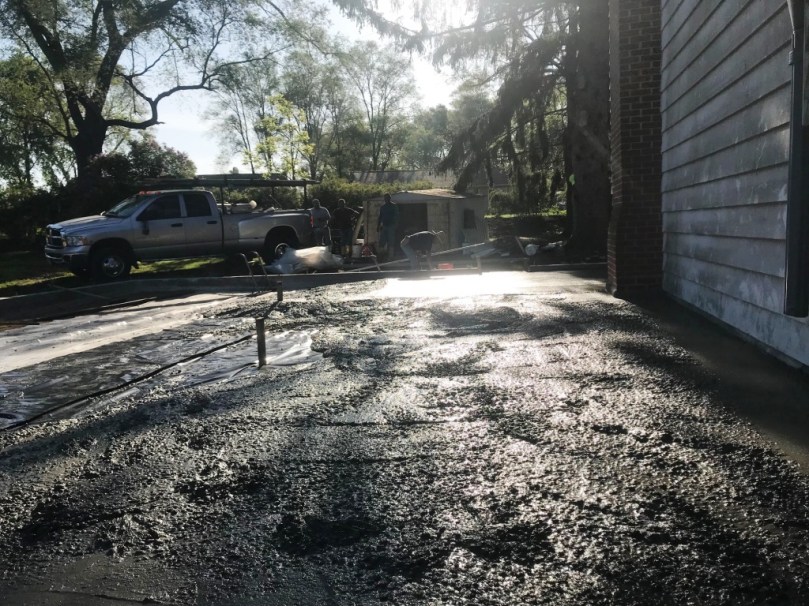
After a couple of rain delays, it was time to pour the foundation for the garage.
Tyler was so excited that day, he got up even earlier than normal. He couldn’t wait for me to provide breakfast. He left before I got out of bed and pressed McDonald’s into service.
Dawn breaks over the foundation job.
Tyler had ordered 6-1/2 bag mix concrete, the importance of which, like nuances of 5/8-inch drywall versus half-inch drywall, escaped me. The higher the number of cement bags added to the mix, the stronger it is and the better it performs when exposed to freeze-thaw cycles, as our garage would be on the north side of a southern Wisconsin house. Something about how the finishers finished the edges of the concrete also pleased Tyler.
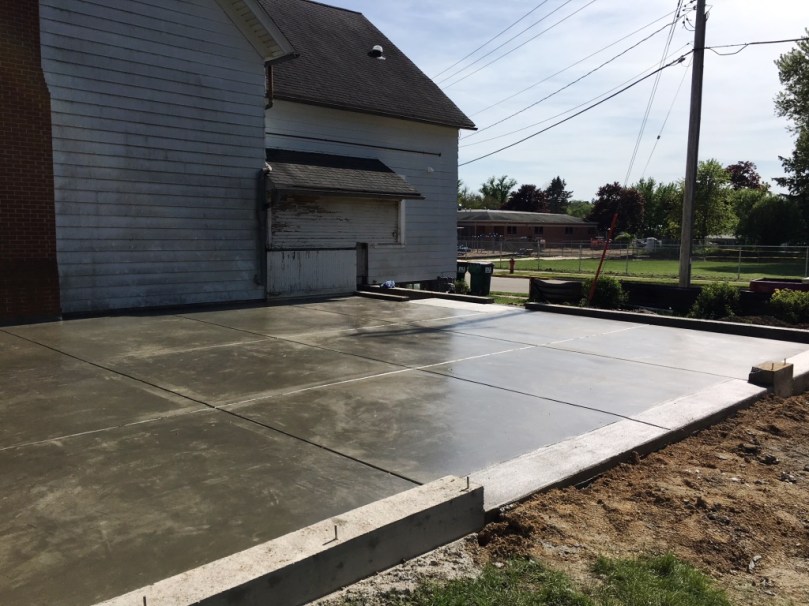
All I knew was that it looked mighty smooth and flat when the day was done, which is all you can ask for in a good floor.
So smooth you can see your reflection.
# # #
Tuesday: Chapter 24 concludes with a few chips off the old block. Read it here.










 Church Sweet Home