Our story so far: We made coffee at our beverage bar for the first time on the morning we woke up in the church we renovated into our dream home.
# # #
I spent the rest of the day hanging clothes. Clothes that had been in the rental house. Clothes that had been in the RV. Clothes that had been in storage for two years. So many clothes. It was a good thing we’d created so much hanging space. While I hung clothes, I also washed them. How novel! My new washer and dryer hummed quietly in the background as I unpacked long forgotten dresses, suits and sweaters.
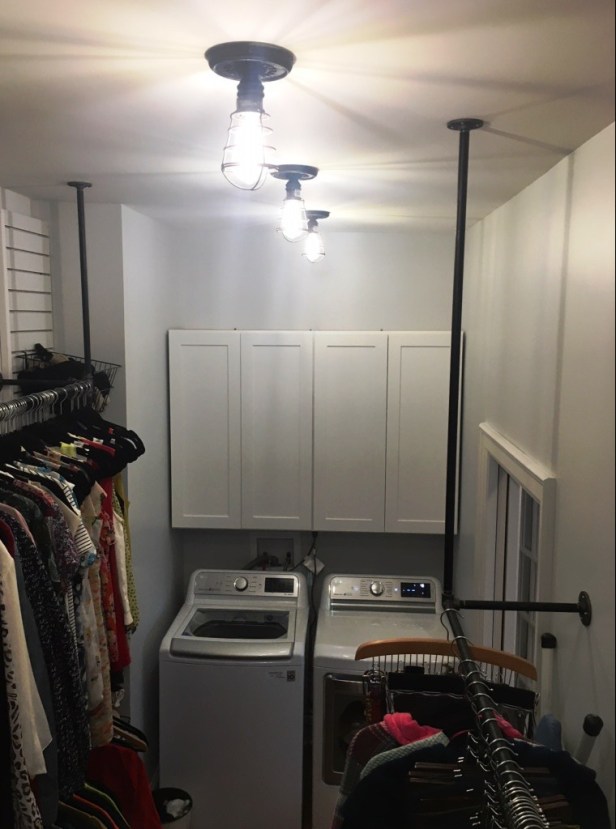
Here’s an After shot of my closet after I finished hanging clothes in it. It shows the new lights, which Tyler described as “prison lights.” But he’s not the one who does laundry, and I love how they coordinate with the plumbing pipe closet rods.
# # #
Today’s headline is a quote from British fashion designer Vivienne Westwood.
Tomorrow: The movers haul in the stove, among other things. Read about it here.
Our story so far: The finishing phase in our church conversion project was where the rubber hit the road. We encountered so many challenges, our wry son-in-law joked he was going to start a competing blog called “Everything Wrong With the Church” and reveal all our mistakes.
# # #
The finishing detail that made me thunk my forehead with my palm came not with an element of the church, but with a piece of furniture. It was a project that spread itself over a couple of weeks and required attention from both me and Tyler.
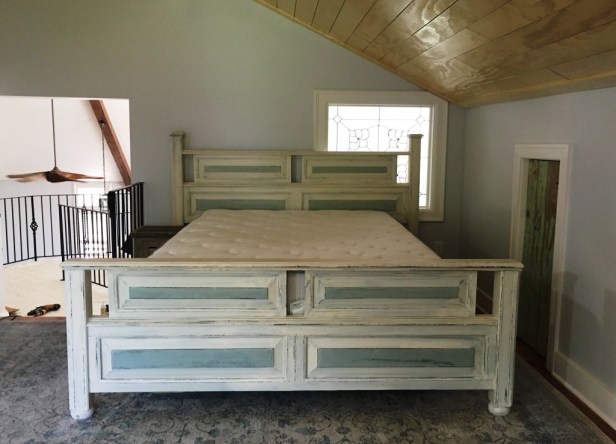
Beat up maybe, but this abandoned headboard and footboard had potential.
The beat-up headboard and footboard we found on the side of the road in early spring? We would need a guest bed sooner rather than later, so I spent a weekend painting it. The project put me in the way of any number of contractors who required space or basement access, but it needed to be done. I ran out of paint before I finished so I used some leftover paint in a close match to finish the back (no one would ever know—unless they read the blog about Everything Wrong With the Church). When it was dry, St. Johnny and I hauled it upstairs taking care not to ding the drywall.
Via a friend, we sourced a barely-used mattress set that came with a bed frame. We counted ourselves lucky because our benefactor of the headboard and footboard did not bestow us with the frame. Tyler and I hauled it to the church, and as we were about to shove the box spring up the back stairs, we realized it wasn’t going to fit (this was a throughway designed for Sunday schoolers, not queen-sized box springs). OK, so we enlisted a few contractors to help shove it over the balcony railing the next morning.
As we set to assembling the bed frame, we realized it was designed for a headboard only. There was no way to attach the footboard. OK, so Tyler jerry-rigged a solution, spray painted it out in the yard and hauled it upstairs. Because it was jerry-rigged, it required an inordinate amount of grunting and number of screws to assemble. OK, Tyler grunted and succeeded. He and St. Johnny lugged the box spring into place …
And Tyler called me upstairs.
“Your bed doesn’t fit,” he said in summons.
“Okayyyy,” I said slowly. “Whaddya mean ‘my bed doesn’t fit’?” I had measured the headboard and knew it would be a tight fit for nightstands, but I also figured I could find a creative solution (what’s Pinterest for anyway?). I joined him at his side, looking at the bed.
“It’s not a queen headboard,” Tyler said. “It’s a king.”
Um, yeah. That’s not a queen size headboard and footboard. Nice paint job though.
We had plucked it from the street. Unloaded it into our rental unit. I had moved it to the church to paint, and touched every square inch of it. St. Johnny and I had moved it upstairs. I had measured it to determine what kind of nightstands would fit. Tyler built a frame on it to fit a queen mattress. And not until the mattress was in place did we realize the headboard was king sized.
Do you suppose we were a little distracted?
The queen mattress with the king headboard looked ridiculous. It was all wrong.
“Well, I guess we’ll be moving this down to the basement when we finish a bedroom down there,” I shrugged. There was no modifying it. “One of our guest beds in the basement will be a king, I guess.”
When we looked back upon all these finishing mistakes, they were small things. The oven fit perfectly. The kitchen sink worked like a dream. The chandeliers in the bedroom were beautiful. The shower drained like it should and felt like a luxury to use. So many things fell into place, even without a documented plan.
So the headboard was the wrong size. It made for a good story. Who’s to say it wasn’t meant to be?
# # #
Tomorrow: Move-in day. See the master bedroom here.
Our story so far: In the finishing phase of renovating the 126-year-old Methodist church into a home, a quarter inch—or foot—made the difference between something fitting or not. We found out the hard way missing steps meant going back to retrace them.
# # #
The upstairs bathroom was particularly vexing.
When the lights I’d ordered months ago were delivered, I unpacked the fixtures for the vanity, and a knot formed in my stomach. What I had unpacked was beautiful, but I knew instantly the wiring—around which had been drywalled and painted—was in the wrong place. The electrician did the best he could with the direction he got—from me—but I was wrong. The wall would need to be ripped into, re-drywalled and repainted.
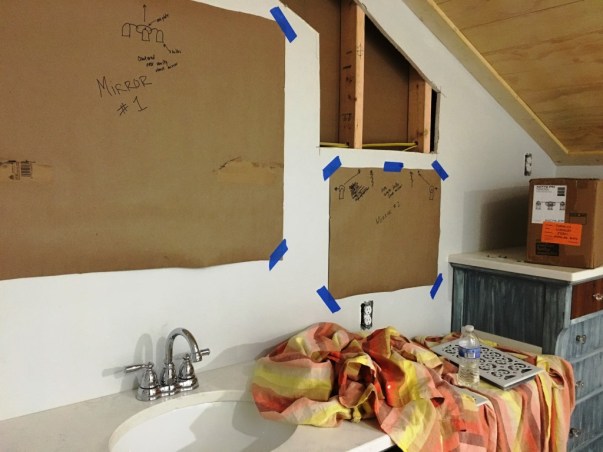
In order to get the lighting fixtures in the right place the second time, I made templates of the mirrors to show exactly where they would hang. No more by guess or by golly. Note the exposed two-by-fours that should be behind drywall.
We had invested in a standard shower stall for that bathroom, and a standard glass door. Both had been delivered in March so the stall could be installed before we built walls around it. When You-Can-Call-Me-Al got to installing the door, he realized it was too tall. After rummaging around in an inches-deep pile of receipts, we remembered we’d purchased it at Lowe’s. Tyler made a phone call. Thank goodness, the Big Box store had a lenient return policy. I boxed the door back up, drove a half hour to Lowe’s, stood in line twenty minutes to return it, purchased a new door with Tyler’s specs and drove back to the church. You-Can-Call-Me-Al set to installing the new door, and he determined it was now the correct height but the wrong width. Back to Lowe’s. Apparently, “standard” comes in a variety of sizes.
On the last day of our plumber Glimfeather’s work, he brought two helpers and powered through a lot of plumbing details. In the last hour of his work, he announced he was nearly done; he had only to install the bathtub faucet. Where did I want it to be installed again? We surveyed the tub, and I fixed the point. I went about some other task, leaving him to his work, only to be called to the tub a few minutes later. The faucet—a beautiful one we’d coveted, ordered and paid for in April—was designed for a vanity sink, not a tub. “It’ll take forty minutes to fill your tub with that faucet,” Glimfeather said. “The water will be cold before you’re done.” Alas, the plumber’s work was not done after all. We’d have to track down the correct faucet, and he’d have to come back.
# # #
Today’s headline is a quote from author Amine Ayad.
Tomorrow: A litany of little snafus pops up. Read about them here.
Our story so far: My husband celebrated his birthday with a litany of complaints about the enormity of the church conversion project we had taken on.
# # #
Tyler’s birthday wasn’t the only occasion that week overshadowed by work at the church. A few days after Tyler aged another year, we celebrated a milestone wedding anniversary: Ten years.
Since we were buying things for the church like Home Depot shopping addicts, we agreed we didn’t need to exchange gifts for our anniversary, but I requested earlier in the month that we mark the occasion by going out to eat. Tyler obliged by making dinner reservations.
When our anniversary arrived, I realized I would be spending the entire day on my hands and knees. Hand-washing every square foot of wood floors in the church so Tyler could apply the last two coats of polyurethane before we left for the weekend.
If I didn’t do this, all the dust and tiny paint splatters on the floors would be forever encased in a layer of shellac, reminding me of my sloth and sloppiness.
I donned a pair of kneepads and began on the second floor. It was about 10 o’clock, and at this point, I was sure we would not achieve our goal because the floor of the sanctuary was still covered in ram board, miscellaneous cabinets and tools. But while I washed the pine upstairs, Tyler and his hired man St. Johnny cleared and vacuumed the sanctuary so by 1:30 when I finished the upstairs and the main floor master suite, I moved to the enormous empty open-floor-plan great room.
I earned a repetitive-stress strain in my shoulder by performing the same sweeping wiping motion with a wet rag a thousand times. Hand mopping sawdusty floors required me to refill my wash bucket several times for each room. Remember, at that point, the only running water in the church was in the basement. So I made many trips up and down two flights of stairs. I also scraped off paint splatters where I found them, so I carried sharp implements in my pockets (which, not infrequently, poked me, too). Fortunately, our painter prepped well, so there were few drops of paint to remove.
I finished washing at 4 o’clock, just in time for a much-needed shower before dinner, while Tyler wrapped up the first coat of polyurethane (to be specific, it was the third coat in total, but it was the first of the final two coats—if you’re counting down, which believe me, we were).
We dined on steak and pasta, which we most definitely earned.
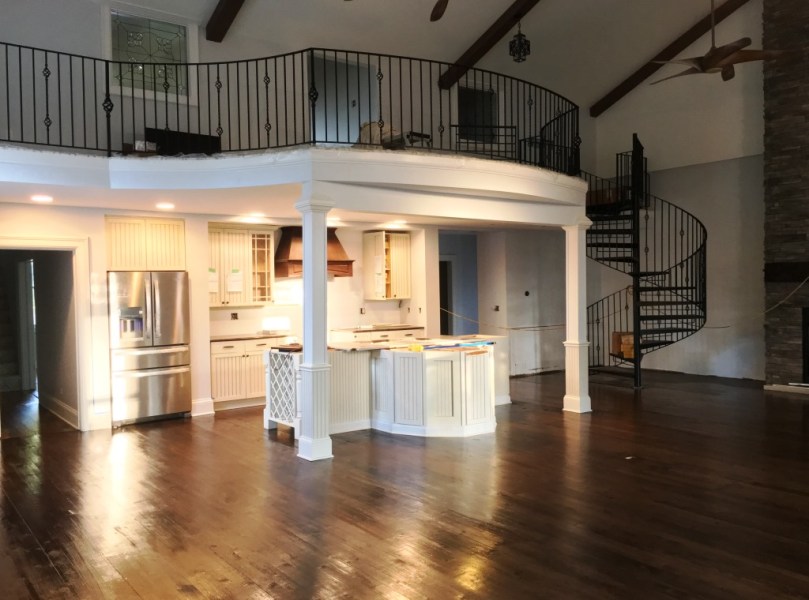
The granite counter top on the island hadn’t been installed yet.
The next morning, we surveyed the results before Tyler applied the final coat of polyurethane and we decamped elsewhere and left it all to dry. The way everything looked was the best anniversary gift ever. In the morning sun with the lights on, the kitchen literally glowed. The sawdust and tools were gone, and the floors gleamed.
I tiptoed around in my bare feet, taking pictures like a pro with both our phones so we could share the results with every last person we might encounter over the long weekend. We were so proud of ourselves. The pain and effort were worth it.
# # #
Tomorrow: What time is it? No more guessing. Read about about it here.
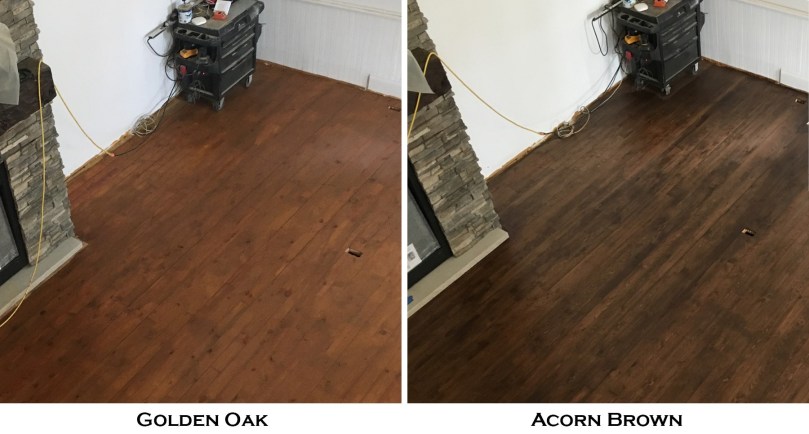
Our story so far: After much equivocation, my husband and I chose an alternative stain color to the Golden Oak we first stained the sanctuary floor in the old Methodist church we were turning into a home.
# # #
And then Tyler and I spent ninety minutes on a Saturday afternoon applying Acorn Brown to the sanctuary floor. Unlike stain alone or polyurethane alone, this stain + poly was a two-person job. Tyler smeared on the stain with a lamb’s wool mop, and I followed behind him with a synthetic deck paint pad making sure it was evenly applied (and sometimes I just held the dripping lamb’s wool mop over the bucket while he used the paint pad—because he was not interested in doing this a third time). The stain-poly was a little tricky to work with because unlike clear polyurethane, you see exactly where you got sloppy. If you miss a spot or drip it, you will see it.
But we turned on an eclectic mix of ‘80s pop and classic rock music, embraced the sweat and used only two gallons of Acorn Brown on the floor. It was dark. But brown. Not golden. Not red. And thank goodness, not orange.
I thought we were done (finally!), and I planned to relax the next day—a Sunday. We had just finished using a product that described itself as 1-Step, after all.
As usual, Tyler got up before me and inspected our work in the quiet morning with sunlight pouring into the windows. I stayed in bed, thinking about how good my first cup of coffee would taste.
He returned to the bedroom and announced that we would have to apply another coat. Right. Now.
I tried to talk him out of it. The rest of the world was going to church or sleeping off a hangover or reading the Sunday paper, and I wanted to join the rest of the world in a typical Sunday morning activity. But after pouring the first cup of coffee, inspecting the floor myself and consulting the fine print which clearly stated two coats might be required (1-Step, ha!), I agreed. Our showplace wood floor needed another careful coat.
So Tyler turned up the music again (jazz this time), and we commenced getting sweaty. I never got breakfast—only coffee so I was extra grumpy when we finished. But we were really and truly finished. It looked pretty good.
Ta da!
# # #
Tomorrow: When out from the church there arose such a clatter! Read about it here.
Our story so far: While taking a breath from finishing floors, we admired some finished details—balcony railing, fireplace, window—at the old Methodist church we were turning into our home.
# # #
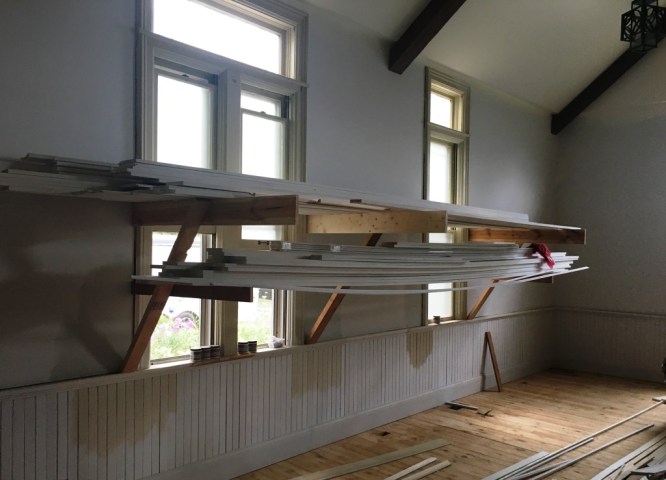
We were keeping You-Can-Call-Me-Al busy. Tyler wanted all the trim on the sanctuary floor out of the way in order to finish sanding, so You-Can-Call-Me-Al’s orders were to start using it up.
You-Can-Call-Me-Al solved some of Tyler’s sense of urgency by building a shelf in the sanctuary for all that 16-foot-long trim that would have been a bear to haul to the basement. You can see the baseboard installed over the wainscoting where I tested paint colors.
# # #
Tomorrow: Trimmed out linen closet doors. See them here.
Our story so far: We returned the scaffolding that had been crucial for finishing the ceiling of the sanctuary in the old Methodist church were turning into our dream home, and we finally had an unobstructed view of the fireplace.
# # #
Tyler also wrapped up another project that, like the scaffolding, had been sitting around for months: The pickled, planked plywood for the second floor ceiling. Tyler started the project when we had the Solatubes installed in the roof (months ago), and then work lapsed for more pressing priorities. I finally finished painting the planks, and Tyler wanted them out of the way, so he and a helper nailed wood to the ceiling all day.
The original second floor ceiling was nondescript.
The original ceiling (by original, I mean the way it was when we bought the church) was some sort of beat-up ceiling tiling boards. The new shiplap-ish planks, even untrimmed, were a vast improvement.
The new second floor ceiling is pickled, planked plywood. The windows were replaced, and trimmed out (but they still need paint).
Meanwhile, You-Can-Call-Me-Al replaced the old windows and trimmed them out. With the refinished floor, the vision for the second floor was finally materializing.
Our story so far: Tyler scored a deal on enough polyurethane to cover the floors of the converted church and then some.
# # #
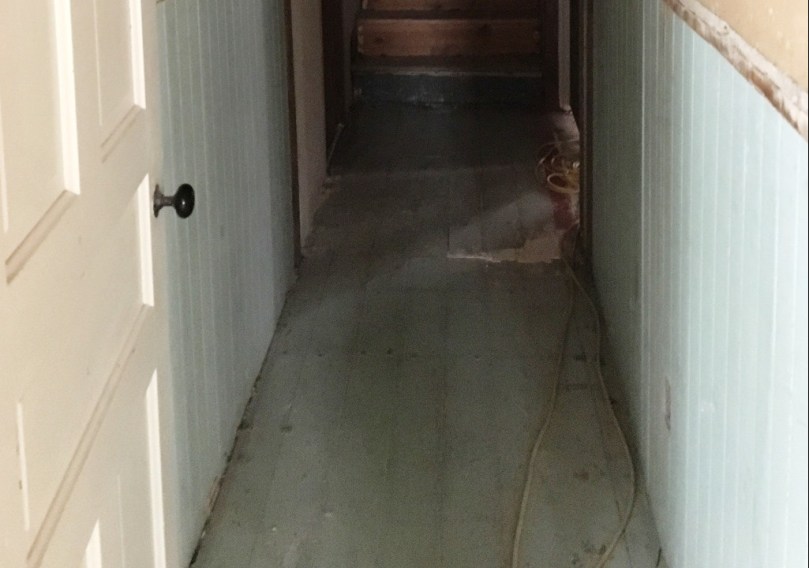
Here’s a look at the original flooring in the hall of history, including a putty-filled patch job there on the right.
The floor of the Hall of History presented a unique challenge. The Hall of History, you’ll remember, was the fifteen-foot-long hall that led from the sanctuary to the back stairway where we imagined we could hang pictures of the church throughout history on its expansive, now drywalled walls.
But, oh the floor. The pine planks were certainly original to the 1894 construction of that portion of the church and had once been part of the entryway. Count how many feet crossed that threshold on the way to Sunday school or worship services! Imagine the Sunday best shoes worn by parents holding newly baptized babies or couples freshly married! Several repairs and patches in the flooring were evident. Besides ground-in dirt, it was covered in paint of various colors—yellow, red and aqua—and sported huge gashes, divots and seams. One had to squint hard to see the potential.
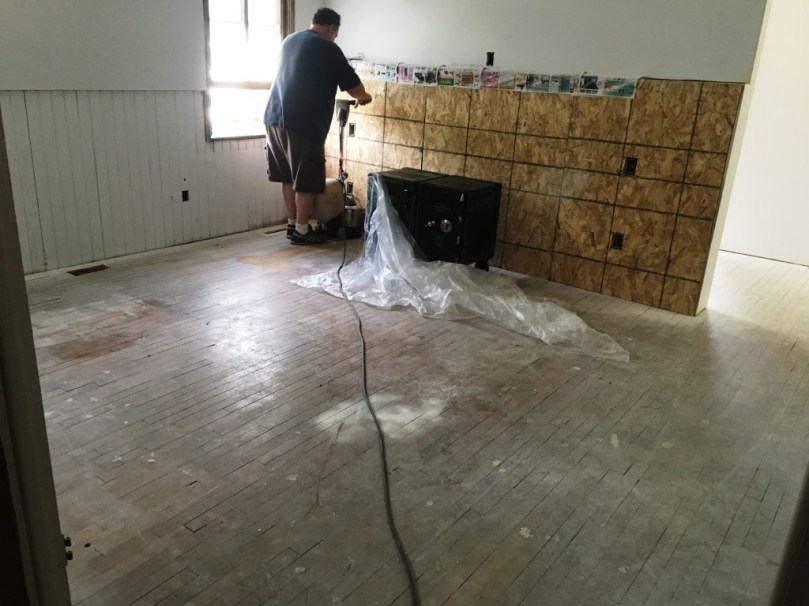
We considered an affordable wood-like tile or perhaps carpeting, but we hesitated spending good money on a hallway floor that would most certainly be mostly covered by a rug runner. So Tyler tried sanding it, only his goal on this floor was to reveal its history (appropriate to the Hall of History) and even it out.
It wasn’t exactly attractive (or perfectly level) when he was done, but we found the character we hoped to feature. With new thresholds and baseboards, the rustic floor might be described by a forgiving critic as charming.
The hallway after two coats of polyurethane. It will need a new threshold into the great room (bottom of pic), but you won’t look perfect when you’re older than 100 either.
# # #
Tomorrow: Chapter 33 opens. The beginning of the end. Read it here.
Our story so far: A couple of coats of clear polyurethane was all we needed to show off the wood floors in the master suite and on the second floor of the old Methodist church we were turning into our home.
# # #
In the sanctuary-slash-great-room, we had a lot going on already. Between the ceiling beams, the fireplace and the kitchen cabinets, the floor played only a supporting role. Plus, its rustic patina didn’t need any more attention being called to it. So we went with a driftwood stain that had a hint of green in it; this would tone down the red in the Douglas fir planks creating a neutral backdrop.
Now after days of sanding, we would be spending days applying stain and polyurethane. The hardest part about this was enduring the odor. Do you remember what the school hallways smelled like on the day the janitors applied vanish to the gymnasium floors? Sort of a pungent chemical stench crossed with a tobacco barn? The church stunk to high heaven, but it lasted only a day or two. Tyler’s obsession with industrial sized fans played in our favor here. He threw open the doors of the church and invited the fresh summer air in.
A feud between Minwax and Home Depot over which Big Box retailer could have exclusivity on the Minwax brand proved to be a windfall for us. One day when Tyler was renting a floor sander yet again, he spied an endcap display offering polyurethane for half price. He bought every last can.
This is not a story display; this is Tyler’s stash of half-price polyurethane in our great room.
# # #
Tomorrow: How we paid tribute to history with the Hall of History floor. Read about it here. And you might be pleased to learn it’s the last installment of Chapter 32 about sanding floors.
Our story so far: After sanding floors for months at the old Methodist church, we spent a little time filling the seams.
# # #
Our next hurdle was stain. Fortunately, choosing a stain color proved to be much easier than choosing paint colors for the trim and walls. We decided to go without stain on the maple in the master suite and on the pine on the second floor. A couple of coats of clear polyurethane was all we needed to show off the hardwood.
Here’s how the master bedroom floor look at the beginning of the sanding process.Here’s how the master bedroom floor looked after Tyler filled the seams and applied one coat of polyeurethane.Here’s a picture of the second floor after half of it had been sanded the first time. This was even before drywall was up.This is the second floor after one coat of polyurethane.
# # #
Tomorrow: Luck equals preparation plus opportunity. Read about it here.








 Church Sweet Home