When you bring effort every single day, that’s where transformation happens

Our story so far: The building inspector approved the rough-in in our renovation of the old Methodist church into a home.

# # #

As we neared the end of the Framing & Mechanicals phase of construction, Tyler was on box seven of nails for his air nailer. A box, you might recall, had a quantity of two-thousand nails.

And two-by-fours? He estimated we’d used at least one-hundred-and-fifty in constructing walls and ceilings inside the church. The Framing & Mechanicals phase had dragged on nearly twelve weeks, four weeks longer than demolition which had felt like it would never end. We were excited for the phase that signaled the most dramatic physical changes in the church.

Besides nails, lumber and lassitude, a measure of the effort we’d put into our construction project was Tyler’s belt.

During the first three months, he tightened his belt by about a notch a month. By Month Four, he had to bore a new notch in his belt, and that was apparently still not enough. One day, he had one hand on his air nailer and the other on a ceiling joist to hold it in place while he secured it. In front of an audience of St. Johnny, the carpenter helper, our electrician and an HVAC guy, Tyler’s pants fell to his ankles.

He ho-ho-hoed his way through a situation that would have mortified anyone else, but thank goodness he was wearing his new, snugly fitting underwear.

Another measure of our effort? Splinters and gloves.

Tyler picked wooden splinters out of his digits nearly every night as he sat on the couch decompressing from another long day. I wasn’t so rugged; I wore gloves.

Tyler had purchased a big box of cotton brown jersey gloves for me and his hired man to use. They were handy (get it? Handy gloves?) but too big for my slender (some might say bony) fingers. During the demolition phase, I’d run across a pair of work gloves that had belonged to the “DCE,” as evidenced by the Sharpie marker labeling. The only DCE this Lutheran had ever heard of was the Director of Christian Education, so I imagined the Methodist DCE had left them behind. They fit perfectly, so I commandeered them.

Four months and countless nails, pieces of wood and rolls of insulation later, the seams began splitting. I’d never worn out a pair of work gloves before. Before the church, I’d never even owned a pair of work gloves. I was never a gardener, and my hobby involved using writing utensils, not hammers. When more of my fingertips were bare than protected, I complained to the foreman that I needed a new pair of gloves “like these,” I said holding up my threadbare DCE gloves. Two days later, Tyler returned home from another trip to Home Depot with not one, not two but three pairs of work gloves eerily similar to my DCE gloves.

I would not be able to complain about my work gloves again.

old and new gloves
My old gloves went into the trash right after I took this picture.

# # #

Tomorrow: Last-minute installation. Read about it here.
Better to recycle light fixtures in a church than to curse the darkness

Our story so far: Among the light fixtures we procured for the old Methodist church we were turning into our home, we recycled the pendant chandeliers that once hung in the sanctuary by repainting them and installing new glass.

# # #

While we were paying homage to the church’s historical features, Tyler decided to relocate the milk glass ceiling lights he found in various locations in the church during demolition to the Hall of History.

Hall of History
The Hall of History had no windows so no natural light.

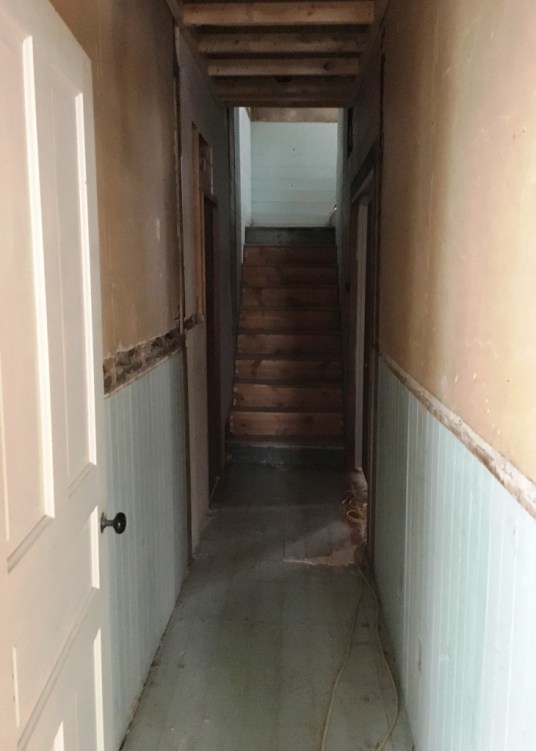
We were maintaining the only hallway that existed in the church. The fifteen-foot-long hall led from the sanctuary to the back stairway up to the second floor and included a closet and the doorway to what would someday be our bedroom. It had a high ceiling (after demo anyway) and beadboard up to the chair rail. He imagined we could hang pictures of the church throughout history on its expansive walls. Thus, he named it the Hall of History.

canopies rusty
Vintage light canopies.

He found three milk glass lights of various shapes during demo and a number of rusty canopies (the Lighting Savant taught me this term; a light canopy is the lamp part used to cover ceiling electrical boxes). Though the orbs didn’t match, Tyler thought it would be a nice tip of the hat to history by put them to work in the Hall of History. Once again, I employed spray paint to combat the rust on the canopies and create a uniform element for the disparate orbs. I chose satin black which would stand out against the white ceiling.

canopies black
Back to the spray paint zone.

And the screws to secure the orbs in the canopies? The old ones were so rusty I could hardly get them out of the canopies, but thanks be to Home Depot, the store offered a whole array of replacement options. Would it surprise you to learn I chose brass? Indeed, bright brass would be the discrete accent to set off the black and white fixture. Because details mattered.

# # #

Tomorrow: Odds and ends. Read about them here.

Pink isn’t just a color

Our story so far: While the plumber, electrician and HVAC guys worked on the old Methodist church we were turning into our home, so did we.

# # #

A week or so later, Tyler loomed over the bed at 5:50 a.m. on a Saturday. “Home Depot opens in ten minutes. Time to get out of bed!”

Did I mention Tyler was an early riser?

I complied. Fortunately, Starbucks was on the way to Home Depot and Tyler deigned to stop. So at least I got some coffee.

We proceeded to Home Depot where I watched him walk the insulation aisle, checking packages.

“This is the one! Grab that cart.”

We took only one pink loaf of blow-in insulation back to the tool rental desk.

“How many packages come on a pallet?”

“Eighteen.”

“I’ll take two pallets.”

No kidding. That earned us the bulk discount, but we still invested four figures in insulation.

insulation pallet
Insulation pallet Number One.

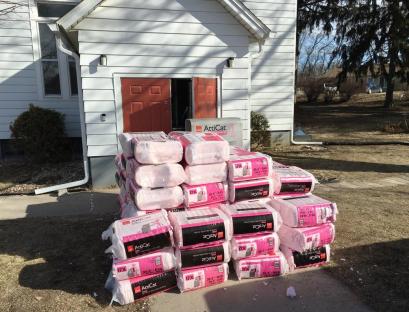
Two pallets of insulation did not both fit into the back of the truck. So I drove one pallet back to the church and went right back to Home Depot for the second one.

Just about the time Tyler had cut all thirty-six loaves of insulation in half in our front yard, Reroofer arrived.

Reroofer, the trusty roof expert who worked on our belfry, didn’t know he was going to be helping with insulation, but he was game for anything (apparently he had had his coffee, too).

insulation yard
That’s a lot of insulation.

The assembly line began. Reroofer climbed into the space between the sanctuary ceiling and roof with one end of the hose, while I fed insulation a half loaf at a time into the blower outside the front door. Tyler supervised (more than once he reassured me that Reroofer was upright and ambulatory inside the attic rather than being buried by a mound of pink insulation—“He’s fine! Now get back out there and mind the blower!”).

pink panther
This was me, feeding insulation into the blower. Yes, I wore my pink work boots and a sly look on my face.

I found the job strangely satisfying. As the blower consumed half-loaf after half-loaf, the enormous pile of pink insulation slowly but consistently disappeared.

Four hours later, plus or minus a couple of breaks, we were done.

Or at least I was.

I went home to shower.

# # #

Tomorrow: Not everyone hit the showers. Reroofer wasn’t done yet as Chapter 21 concludes. Read it here.

Insulation against glamour

Our story so far: We worked on ceilings ad infinitum during the renovation of the 126-year-old Methodist church. 

# # #

Before sealing up ceilings and walls, I got to install insulation.

The pink stuff.

This job required no expertise, only perseverance. So I got tagged.

I suited up in Tyvek, safety goggles, gloves and a breathing mask, and set to work on the first area requiring insulation: The attic eaves.

It was like wrestling with Tyler if my king-sized husband were cotton candy—the insulation was bigger that I was, and there was no way I was gonna win this fight. I resisted, I poked and I punched when called for, and eventually I got the pink rolls stuffed between the studs.

The worst part was the height of the attic eaves—exactly short enough that I couldn’t stand and tall enough that I couldn’t reach the top when I was kneeling. I didn’t have quadriceps for this.

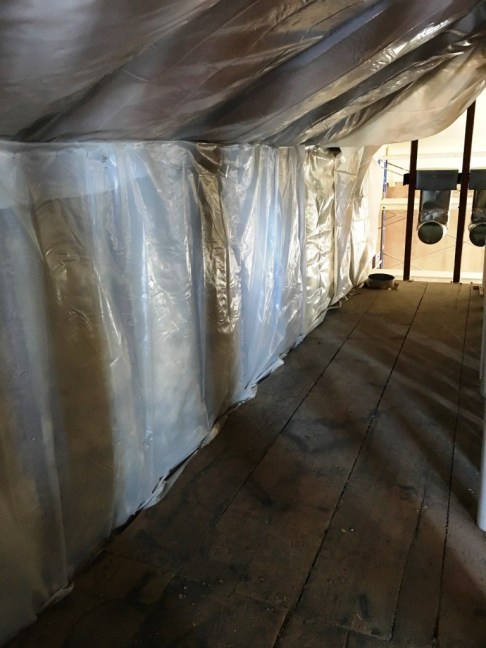
After wrestling with insulation for two days and thinking I was finished, I learned properly installed insulation requires a vapor barrier. So I spent an afternoon wrestling with plastic to cover the insulation and a staple gun (one of the few power tools I was comfortable operating).

When I finished, I was reminded of a mantra that circulated in the scrapbooking circles I once traveled. Scrapbookers rarely lack raw material because life and the photos one takes while living life keep happening. It can become overwhelming if one agonizes about every single detail on every single page so sometimes scrapbookers power through an imperfectly decorated scrapbook page just to be able to move on to the next one: Done is better than perfect.

attic eave before
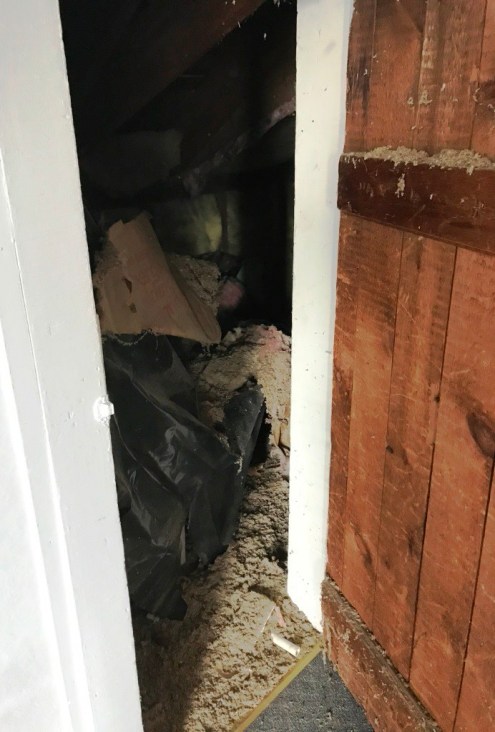
This is a shot of the attic when we bought the church. The door to the eaves had a sign that said “do not open.” We opened it anyway, and the eaves were filled with junk and dust.
insulated attic eave
After: Is this the finest insulated attic eave you’ve ever seen?

# # #

Tomorrow: Oh, we’re not done with insulation yet, missy! Nosirree! Da-dum, da-dum, da-dum da-dum da-dum, da-dum da-dummmmm. Can you hear that saxophone? Read about it here.


Baby, I’m amazed

Our story so far: During the demolition phase of renovating the 126-year-old Methodist church into our home, Tyler discovered the choir loft, and we decided to open it up to a balcony into the sanctuary, our future great room.

# # #

village people
The Village People

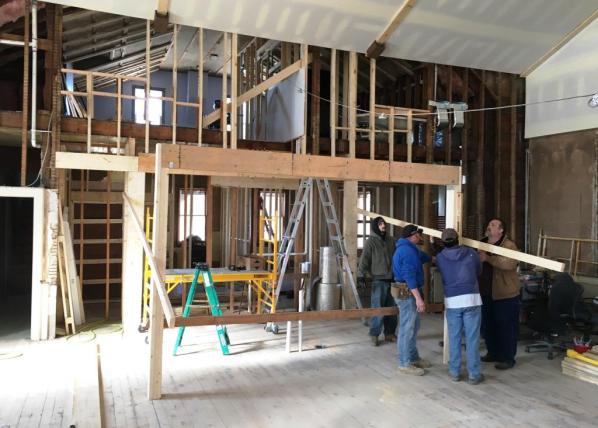
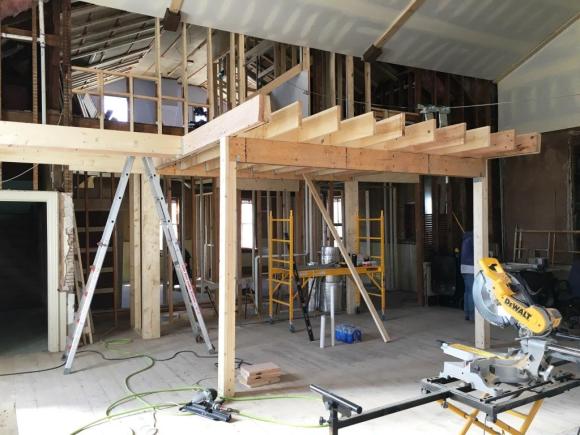
Once the header supporting the second floor was installed, Tyler built the archway upon which the floor joists of the balcony would rest. He enlisted the help of the HVAC guys to raise the arch (witnessing this, all I could think about was an old-fashioned barn raising—it takes a village to build a balcony). Then Tyler—with St. Johnny’s muscle—began nailing great big two-by-tens into place. Pretty soon he had a pergola built above what would someday soon be our kitchen.

pergola balcony
The floor joists of the balcony in place.

Putting a layer of plywood over the floor joists was easy—after the first piece. I was glad I wasn’t around to watch Tyler straddling floor joists nine feet off the floor to juggle that first piece of plywood and nail it on. He arrived home in one piece that day, so success had been secured.

To wrap up the balcony, Tyler constructed cross joists from the pergola to the north and south walls of the church. These were narrower than the center part of the balcony in order to clear the spiral stairway on the north side and the front window on the south. With the science part complete, a bit of art was necessary to draw the main part of the balcony together with the narrow part; Tyler planned a dramatic scallop and swoop to soften the edges of the balcony.

“Aren’t you impressed that I got that balcony built basically by myself?” Tyler asked me a few days later. He did not have to ask me this question because he knew very well I was impressed with his knowledge of construction and ability to carry out the plan. He asked this question out loud because after all he had built throughout his life, even he was impressed with this particular project.

# # #

Tomorrow: What do we do with all that square footage? Read about it here.

Every long journey begins with a single step (or two)

Our story so far: Things were looking up in the old Methodist church we were turning into our home.

# # #

The grand plan to open up the choir loft required Tyler to construct a balcony for the loft to open up to.

This project began with two steps. To clear the edge of the sanctuary ceiling, we needed two steps down from the second story onto the balcony. This was a big math problem in order to get the step and run measurements correct and beginning in the right place.

After measuring twice (or thrice), he cut once—a hole in the floor. Then he constructed the steps themselves. For the most part, he worked from underneath the two steps, standing on a ladder.

steps to balcony
Ta-da! Two steps.
steps from bottom
The steps are just as impressive from the underside, where one can see all the support structure. At some point, all of this will be hidden away in our bedroom closet.

Now he was ready to build the balcony itself.

# # #

Tomorrow: It takes a village. Read about it here.

Like Chinese water torture

Our story so far: With four bathrooms planned for the old church we were converting into our home, we juggled a lot of details in the mechanicals phase of our project.

# # #

One afternoon when I arrived at the church after a day filled with exciting errands like picking up rough-in valves for Glimfeather the plumber and more paint for the drywallers who were making like Michelangelo and painting the cathedral ceiling, Tyler put me to work handing him tools for the construction of a form to contain the floor-leveling compound in which the upstairs shower stall would nestle.

Tyler built sides for the form; the bottom was simply the century-old pine flooring. Leveling compound is similar to concrete, only soupier. After adding water to the dusty compound, Tyler poured the goop into the form.

Immediately, we could hear the dripping.

“Is it leaking?” Tyler said, then more urgently when it was clear it was indeed leaking, “Where is it leaking?”

I ran down the steps and looked in horror at the rainfall of gray, pasty soup dripping through the floor, through the form, through the shower drain hole.

“Everywhere!”

One of the HVAC guys, who had been working in the basement, appeared out of nowhere to rescue a big roll of aluminum foil bubble wrap covered in pasty drips of leveling compound. “What is that?”

“Leveling compound,” I answered.

“Well, it’s leveling all the way to the basement.”

I shoved a tray and a bucket in place to catch drops.

“Get back up here!” Tyler bellowed.

He’d filled in a couple of the holes but we’d lost so much compound through the cracks, we needed more to fill the form. Tyler began mixing again. “Hand me bottles of water.”

Remember, we didn’t have running water in the church yet. The first batch of soup was made with a jug of water collected that morning at the rental house.

Tyler mixed up another batch of soup and dumped it in the form. “Is it still dripping?”

I ran downstairs again to look even though we both knew it was because we could hear it.

“Yup.”

But the waterfall had slowed to a trickle.

When Tyler came downstairs, I asked, “Did you know that was going to happen?”

“Well, they’re old floors. There’s bound to be a few holes.”

“It was pretty holey.”

“Well, that’s right. We live in a church. It’s a holy floor.”

# # #

Tomorrow: Things are looking up as Chapter 21 begins. Read it here.

The price of beauty

Our story so far: In the midst of the framing and mechanicals phase of renovating the 126-year-old church into our home, we were called upon to make some decisions about the bathrooms.

# # #

Chapter 20

Showers, as it turns out, are expensive. And we planned to have three of them in the church, one on every floor.

Even while discussing the Tequila Budget, we agreed we weren’t going to be tiling our own showers. Oh, we were happy to do demolition, sand the wood floors, install our own kitchen cabinets, but tiling? Forget it.

tile job
Not the worst tile job. But not the funnest project either.

Tyler and I had attempted a tiling project in our former home, replacing the carpeting (yuck!) in the master bathroom. It turned out OK, but it was difficult work and perfect corners were tricky to accomplish. Perhaps ironically, Tyler was not a tiler. For the church, we knew we wanted an expert to handle the tiling.

Then we saw acrylic showers at a home show, and we were intrigued. No seams to leak, easy to clean and long-lasting. But when we got the quote on the showers—$19,050 plus plumbing and fixtures for all three—we learned they cost as much or more than tiling. The bottom line forced us to confront our means and the end: How much was beauty worth?

# # #

Tomorrow: We explore other options. Read about them here.

This $46.25 deal has the potential for greatness

Our story so far: I was stressed out about bathroom vanities for the church. When we finally chose a plumber, he needed to know where to rough in the vanity faucets, and to determine that, we needed three vanities quickly. I checked the master bathroom vanity off the list by investing in online cabinets.

# # #

We scored vanity Number Two for the upstairs bathroom at a second-hand store.

My brother-in-law had once turned a dresser into a vanity for a basement bathroom, and I loved the combination of an old piece of furniture with a sleek stone countertop. I had also once converted an ugly old dresser into a beautiful credenza with several coats of paint. I couldn’t use this idea in the master bathroom because it would have been impossible to find a eleven-foot-long piece of furniture. Likewise, the wall assigned to the upstairs bathroom vanity was eight feet long—it would take a very special piece of furniture to fill that space.

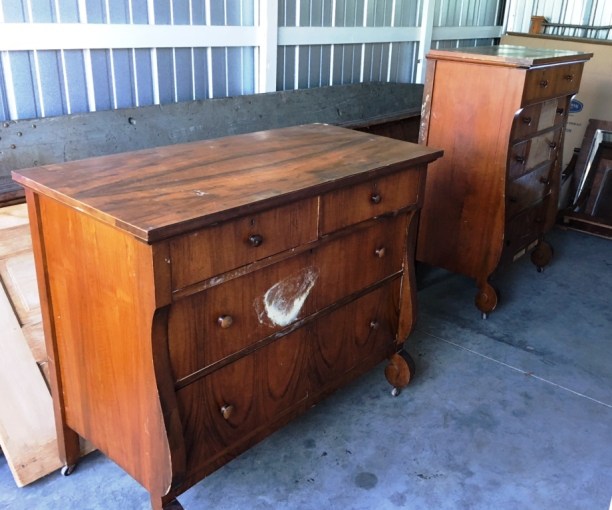
One Saturday, after spending hundreds of dollars on lumber and loading it into our truck, Tyler and I arrived for a lunch date a few minutes early, so we explored the nearby second-hand store. We couldn’t pass one without looking for something we might need for the old church, and here we found not one piece of furniture but two.

upstairs vanity furniture
They’re a little (a lot) beat up, but I see potential.
mirrors
The mirrors, unattached.

The first dresser was the ideal height for a vanity with an undermount sink. Tyler confirmed it would work. It even came with a mirror. But it was only about forty inches wide. The second, taller dresser also came with a mirror; it was about thirty inches wide.

Together, they were about twenty-five inches short of the expanse we needed to fill.

But the price was right—$185 for the pair.

veneer to save
Maybe the wood-grain veneer on the top drawers could be saved?

Oh, they were beat up, all right. The shorter dresser has a terrible stain on the front, and the taller one was missing veneer, but I intended to paint it all anyway. Some of the intact veneer had a beautiful wood grain look I thought I might be able to preserve by painting around it. The mirrors themselves were in good condition, but the frames needed paint, too.

As I stood in front of them debating whether the work required to redeem these dressers was worth it, the proprietress sensed my interest and struck up a conversation.

“Oh, that would make a beautiful vanity,” she said, describing how she’d turned other pieces of furniture into vanities. “And they’re 75 percent off today.”

The frugal Midwesterner in me couldn’t pass up a deal that good. “Well, I could throw them away for that price,” I said.

The proprietress wrinkled her nose. “Oh, you wouldn’t want to do that.”

“I mean I can’t pass up such a good deal,” I said. “But what do you think I could put between them to fill the space? A basket maybe?”

“Hmm, let me think about that,” the proprietress said.

checkbook drawing
More chicken scratch, this time on the back of a checkbook.

I went to lunch and chewed on this dilemma. I mean, I had to figure out how to make the $46.25 deal work. I couldn’t pass this up. And then suddenly I knew: If I removed the mirror from the taller vanity, it would fit perfectly under the sloping eave on the second-story, and then I could create a little make-up space—complete with mirror and stone to match the top of the sinked vanity—between the two pieces of furniture.

I returned to the second-hand store with a less money than we paid for lunch and asked the proprietress to hold them until we could return with an empty truck. A few days later, we added the beat-up dressers to the rental unit. At some point in the near future, the HVAC guys would be done haunting the basement so I could do some painting.

This left the guest half-bath, aka the powder room. The vanity in there would be most used by guests, so the pressure was on.

# # #

Tomorrow: Vanity Number Three wasn’t as good a deal as Vanity Number Two, but it still was meant to be. Read about it here.

Is it still free if you’re paying to store it?

Our story so far: We were in the building and buying phase of converting an old Methodist church into a home. And picking up stuff for free.

# # #

After we sprang for the rental unit, we justified buying things when the price merited it because we could store them away from the commotion of the church.

One morning when we were on our way to breakfast, eagle-eyed Tyler spied a raft of furniture on the boulevard a block from our rental house. We drove by slowly and stopped—the beat-up headboard looked promising.

headboard
This probably looks very familiar to one of my neighbors.

The low-profile of the headboard would be perfect on the bed we planned upstairs, where the ceilings sloped. It was solid wood, not veneer. It would need paint, but the iron work added style. And it came with a footboard. And it was free!

We loaded it into the pickup, and dropped it off at the rental unit. Celebrated not with a toast, but with toast. And eggs.

# # #

Tomorrow: Vanity of vanities. All is vanity. Read about it here.