Our story so far: In the midst of the framing and mechanicals phase of renovating the 126-year-old church into our home, we were called upon to make some decisions about the bathrooms.
# # #
Chapter 20
Showers, as it turns out, are expensive. And we planned to have three of them in the church, one on every floor.
Even while discussing the Tequila Budget, we agreed we weren’t going to be tiling our own showers. Oh, we were happy to do demolition, sand the wood floors, install our own kitchen cabinets, but tiling? Forget it.
Not the worst tile job. But not the funnest project either.
Tyler and I had attempted a tiling project in our former home, replacing the carpeting (yuck!) in the master bathroom. It turned out OK, but it was difficult work and perfect corners were tricky to accomplish. Perhaps ironically, Tyler was not a tiler. For the church, we knew we wanted an expert to handle the tiling.
Then we saw acrylic showers at a home show, and we were intrigued. No seams to leak, easy to clean and long-lasting. But when we got the quote on the showers—$19,050 plus plumbing and fixtures for all three—we learned they cost as much or more than tiling. The bottom line forced us to confront our means and the end: How much was beauty worth?
# # #
Tomorrow: We explore other options. Read about them here.
Our story so far: Consumed with all things related to HVAC, plumbing and electrical, we were deep into the mechanicals phase of renovating the 126-year-old Methodist church we hoped to turn into our dream home.
# # #
Chapter 19
Few people go through life without hearing the old maxim, “When God closes a door, he always opens a window.” It’s the line a friend uses to impart hope in the face of loss, which appears on the scene in every life occasionally.
Entry on the outs
This was the case in the old Methodist church, too, literally if not metaphorically. We were going to seal off one of the doorways. Instead of opening a window, though, we were creating a new doorway.
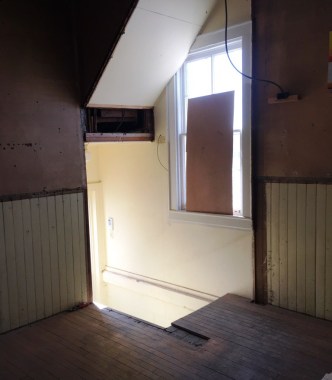
The doorway on the outs was the side entry to the main floor. While we were keeping the exterior entrance which opened to the basement, the three steps up into the main floor were going to become part of our master bedroom which allowed us to incorporate another window into the boudoir. Tyler would have to weave in a new oak floor over the steps, but we salvaged flooring from the other side of the room where we were installing the master shower. When he poked around into the stairway above the departing entrance, he discovered where the stair stringer was cracked, which explained why that stairway was uneven. It would have to be replaced in the reconstruction process.
Can you see the screw holes from the coat hooks? They look like little faces.
Just inside that entrance, one could see a peculiar row of nail holes in the beadboard. It didn’t take much imagination to realize those holes were for coat hooks, where generations of Sunday School kids probably hung their jackets. I hoped to keep that beadboard and add more along the new wall where the door was removed; I weighed whether to use of wood putty in the holes or keep that little tribute to what the room used to be.
Imagine a doorway here, one that will someday lead to Tyler’s mancave.
Meanwhile, we were going to build a door in the north wall of the church to the garage in an area Tyler called the mudroom. But since it was February, and the garage wasn’t going to be built for months, this door would be just a little spray paint and imagination for a while.
# # #
Tomorrow: As in our renovation project, February brought closing and opening doors in real life, too. Read about it here.
Our story so far: Among the finds we made while shopping to outfit the old Methodist church we were turning into a home was a pair of leaded glass windows to decorate the interior balcony.
# # #
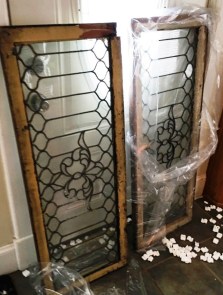
Meanwhile, Tyler found another set of leaded glass windows on eBay. Unfortunately, they didn’t survive transport; they arrived in the open package Brown left on our doorstep.
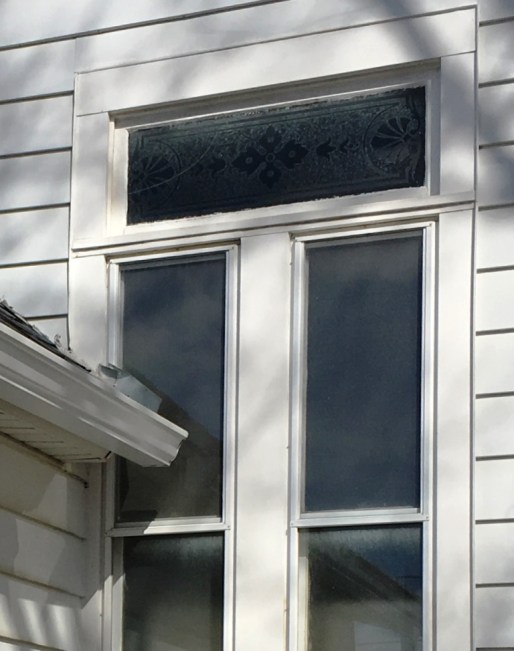
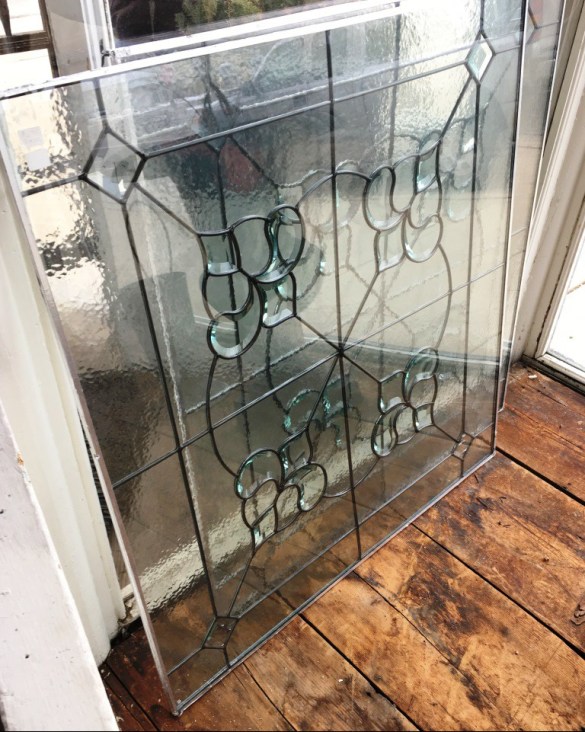
Our church did not have stained glass windows, but the transoms in the sanctuary were etched glass. This one, however, was cracked.The leaded glass windows we had hoped to use as replacements to two of the etched glass transoms arrived broken.
The second set of leaded glass windows were intended to replace the etched glass transoms on the front of the church. One of those windows had a crack in it. The eBay windows were exactly the right dimensions and, coincidentally, they were salvaged from a church in Michigan twenty years ago. The seller never put them to use so she put them on auction. Tyler secured a great deal and we paid $118 to have them shipped and insured, but we kicked ourselves for not driving to Michigan to pick them up ourselves. When they arrived on our front doorstep, nine panes in the two windows were cracked.
We had them insured, but Brown insisted on collecting the windows before paying the insurance. What? To throw them away? We wanted the insurance to pay for repairs.
After wrangling with Brown via email, the shipping behemoth agreed to let us keep the windows and send us a check. Now we had to find an artisan to make repairs on a pair of decades-old windows.
Which we added to our long to-do list. But we had another open window distracting us.
# # #
Coming up: Chapter 19 opens with the truth of a maxim. Read about it here.
Our story so far: From fans to faucets, we were accumulating pieces and parts to install in the old Methodist church we were turning into a home.
# # #
One Saturday while junking, we found a pair of leaded glass windows we couldn’t do without. Every other antique store we’d happened across sold stained glass windows in all kinds of strange rectangles, decorated with gaudy oranges and red glass, and almost always as singles. Nothing was quite right.
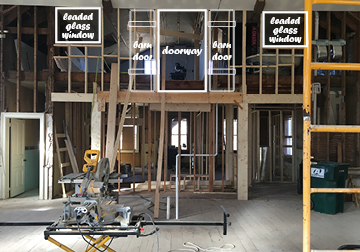
Here’s an illustration of how the balcony might look when we’re done.
We were looking for a matched pair we could install on either side of the balcony doorway. In this way, they would be interior windows and we wouldn’t have to worry about weather-proofing leaded glass. The windows would add decoration to the balcony wall while adding natural light from the second story to the sanctuary.
Our windows were on display in the shop window.
“Our” windows were on display in an a well-curated antique shop less than ten miles from the church. The leaded glass seemed so much classier to me than so many stained glass windows we had seen; they fit our aesthetic perfectly.
The next weekend, Tyler built a frame for transport from waste lumber accumulated at the church. When we picked up the windows, he sealed the custom-built frame on the sidewalk in front of the store, and then we added them to our collection in the rental unit to await installation with so many other pieces we had collected.
# # #
Tomorrow: Chapter 18 closes with a pair of windows that didn’t travel as well. Read about them here.
Our story so far: While the mechanicals were being installed in the old Methodist church we were turning into our home, my husband Tyler and I were buying things to outfit the house. Chapter 18 continues…
# # #
Fans were a bone of contention in our house. Tyler loved the white noise and breeze created by ceiling fans, but I preferred the still air often accused of being more like that found in, say, a coffin. But I conceded the sanctuary probably needed fans in order to move air around the twenty-foot high space.
The church came with standard functional ceiling fans, but Tyler wanted bigger ones, more along the lines of jet engine turbines. The ones he found, I loved for the design. The blades were sleek. The finish was described as “distressed koa with tea stain finish” (koa is a large Hawaiian forest tree), and it closely matched the color of the beams we planned for the ceiling.
Here’s how the box says our fan will look.
With five 62-inch blades, one fan would move 8,200 cubic feet of air per minute. Tyler bought two. (Drawing on a little tenth-grade geometry, I figured the sanctuary had a volume of 16,400 cubic feet, so both fans together would move all the air in one minute; Tyler would be in heaven.)
As for a deal, he saved $100 off retail when he located one for sale online in an open box.
Both fans arrived within days of each other and, like our other deals, they went to the rental unit to await installation.
# # #
Tomorrow: We find a pair of leaded glass windows. Read about it here.
Our story so far: The old Methodist church we were turning into a home came only with a toilet, not even a sink. To outfit the place, we planned four bathrooms, and that meant a lot of shopping for vanities.
# # #
Earlier, long before we closed on the church, Tyler got an amazing deal on a modern-looking faucet I was trying to work into my vision for the powder room vanity, but I didn’t think it was tall enough for a vessel sink, and I wasn’t sure if I would have the time and energy to repurpose another piece of furniture for an undermount sink.
I was stymied.
In the way the universe delivers what one needs exactly when one needs it, Tyler and I visited a nearby plumbing wholesaler not long after we chose a plumber to select fixtures for the master bathroom.
All it needs is lighting.
On display was a white vanity, the ensemble complete from head to toe with the countertop, brand name faucet and even the mirror. It was distinctive in its indistinctiveness; it would look dynamite against an accent wall, maybe an accent wall of reclaimed wood from a church, for instance. And it was on sale, for 70 percent off. I pulled Tyler’s tape measure out of his jacket pocket.
“It’s 37 inches wide,” I said. “Didn’t we just build the powder room to be 37 inches wide?”
Sure enough, we did.
While we were there, we bought power-flushing toilets for all three bathrooms.
Our story so far: We looked for deals as we outfitted the old Methodist church we were turning into a home.
# # #
I suppose it’s called a vanity because one admires oneself in a vanity mirror. But Carly Simon might say a vanity earned its name because of its bad attitude. A vanity thinks the bathroom is all about it—it is, after all, the defining architectural design element and center of attention of a well-appointed lavatory.
I was a fan, however deadly the offense, nodding along with Al Pacino in “The Devil’s Advocate when he said “Vanity is my favorite sin.” From the lights and the mirrors to the cabinets and sinks, I couldn’t wait to find vanities for the four bathrooms in the church that sent messages like “Guests are valued here” and “This is special place.”
Special, naturally, came with a price. I coveted Robern medicine cabinets—sleek ones with built-in lighting, defoggers and stereo systems—but when I priced one in the four-figure range, the look on my face was anything but flattering.
Back to planet earth where people spend only twenty minutes in a day in front of the bathroom mirror. “Vanity can easily overtake wisdom,” musician Julian Casablancas once said. “It usually overtakes common sense.” I reminded myself that we weren’t building a house in a posh suburb or a gentrified downtown locale. We were restoring a century-old church in a small town. We could not be tempted by top-end accessories or we would never recoup our investment.
So then I got stressed out about our bathroom vanities. We needed four of them, three of them quickly. The basement vanity could be determined later, when we finished the basement (Phase, oh, Eight or so). But when we finally chose a plumber, he needed to know where to rough in the vanity faucets, and to determine that, we needed vanities.
I had a good idea of what I wanted for the master vanity, thanks to hours on Pinterest. I wanted double sinks along a 130-inch expanse (go big or go home, remember). Custom or semi-custom cabinets would probably be required in order to get matching cabinets for each sink.
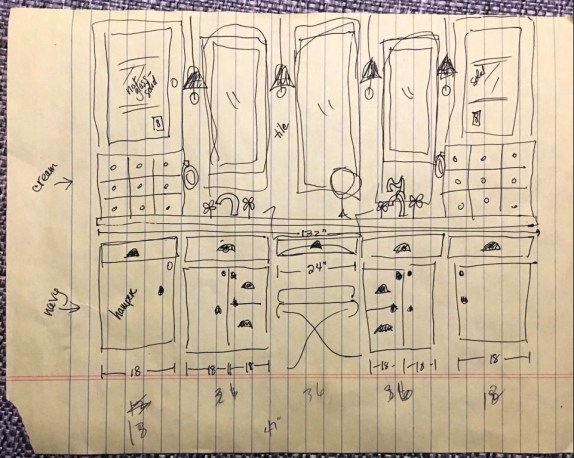
Here’s a rendition of our master bath vanity. (On HGTV, you get high-end graphics to prophesy the renovation plans; on Church Sweet Home, you get chicken scratch on legal pads.)
After pricing custom cabinets (with price tags similarly deflating as luxury medicine cabinets), we decided to purchase standard-dimension cabinets online. Tyler had the skills to install them, and we could incorporate those little drawers that were of little use in the display kitchen. Positioned lower in a bathroom vanity, they could house all kinds of little hygiene odds and ends. At first, I wanted light-colored upper cabinets (to go with the drawers) and navy blue lowers, but after incorporating navy blue into my beverage bar design, we went with dark brown lowers.
After committing to new cabinets for the master bath, we sought to find ways to save money on vanities for the powder room and upstairs bathroom.
Our story so far: My husband, an expert at stalking Craig’s List for another man’s trash, found a display kitchen that would fit our space in the old Methodist church just right if we could find appliances in the right sizes and finish.
# # #
Tyler went to work without delay looking for a 36-inch-wide used range. We’d decided we wanted a new refrigerator, but we could live with a used stove. Craig’s List came through for us right away. Tyler found a “luxury” Jenn-Air six-burner convection oven in stainless steel (our finish of choice). And it was only eight years old.
As with the castle door deal, we drove ninety minutes south, this time in lightly falling snow. We arrived at an enormous house set among several blocks of bungalows. The seller told us he added a second story when he remodeled his entire house, and now he was replacing his luxury stove with a countertop cook-top and set of double ovens.
Though he looks like a car that got stripped while parked in the ghetto, our stove takes a chill while awaiting reassembly in our rental unit (a stove is a he, right?).
We removed the door, knobs and burners for transport, and the seller and two young men who looked like they’d rather be playing Call of Duty or Grand Theft Auto helped us load the range into our beat-up pickup truck. We drove straight to the rental unit we’d secured a few days earlier (because our five-thousand-square-foot church wasn’t big enough, I guess), and our new appliance became the first resident—on a short-term basis, we hoped.
Stove, check.
# # #
Tomorrow: Early-morning dumpster diving yields rewards. Read about it here.
Our story so far: We scored an amazing Craig’s List deal on a display kitchen that, with a little improvisation, would fit perfectly in the church we were converting into a home.
# # #
Never used. And half price!
And we wheedled the sellers out of the stainless steel two-drawer dishwasher on display with the cabinets for half price. It was a two-drawer dishwasher designed for empty nesters; one could wash a few dishes in one drawer (which saved precious water) or a lot of dishes in both drawers. We also bought the bar stools around the island for $75 each. We were thrilled.
Comfy. And affordable!
# # #
Tomorrow: Kitchen appliance Number Two, check. Read about it here.
Our story so far: Tyler located a display model kitchen on Craig’s List that matched the style we were looking for inside the church we were turning into our home.
# # #
The Craig’s List kitchen wasn’t perfect, but it was darn close. And the price? We were buying the whole kit and caboodle for about 25 percent of the retail cost of the cabinets alone. Coincidentally, the remodeling firm had just sold a different display kitchen to another woman who was renovating a church into a home. It was a trend.
But what would we have to jerry-rig?
A few things.
We needed another six inches in width, which we could get with a bigger stove and vent. And those drawers were nonfunctional.
We’d need to find a 36-inch wide stove in order to fill the back wall of our kitchen space which was six inches wider than the display. But we already had an extra wide stove vent we could switch out with the display vent.
These glass-fronted doors could flank the stove vent, in place of the little drawers and bookshelves.
And the little drawers in the upper cabinets—supremely bad design. Even I, a 5-foot-10 woman, could not see inside the top drawers. Those would have to be replaced, but I had an idea we could reuse the little drawers in the master bath vanity. To fill the spaces next to the stove, we could use the glass-fronted doors on the hutch at the end of the island.
The tongue of our island stuck out about thirteen inches too far.
The tongue of the island was a bit too long for our space. We would need to have that shortened so it wouldn’t stick out from beneath our balcony. We decided to invest in having the countertop professionally disassembled, moved and reassembled. The countertop experts could shorten the tongue and smooth the other rough edges as part of the move.
The wine rack would have to go on the other end of the counter. (Man, that granite has a polish to it, dontcha think?)
And we’d have to flip the lower cabinets on either side of the sink so the wine rack would be on the side nearest the beverage bar.
We’d also have to invest in a new matching cabinet above the refrigerator and a few doors for the island so we could use it for storage. While we were adding, we could get coordinating cabinets for the beverage bar.
Even with the changes, we were scoring a budget-saving deal on a high quality kitchen.
# # #
Tomorrow: Kitchen appliance Number One, check. Read about it here.