Our story so far: We installed cabinets like mad when we could finally tackle this phase in the conversion project of the 126-year-old Methodist church.
# # #
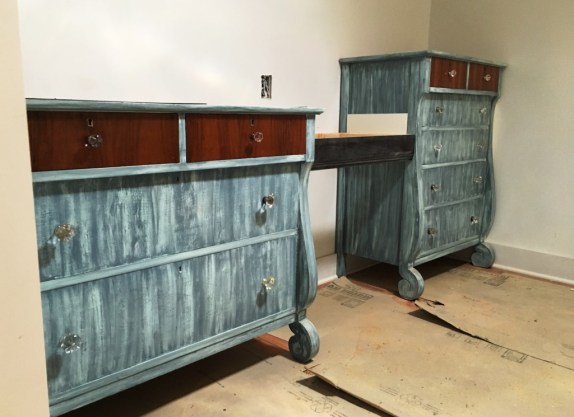
Meanwhile, I had been working on the dressers that would become the vanity for the upstairs bathroom. After I painted them, most of the drawers wouldn’t close anymore, so I spent one morning sanding edges. I also dragged my lot of eBay crystal knobs to the hardware store to find appropriately sized screws.
You-Can-Call-Me-Al installed the dressers in the bathroom, created fillers and built a ledge for the makeup table in the center. More work would be necessary; Tyler would have to modify the drawers for the sink, I would have to paint all the added bits and pieces, and we needed mirrors, but like the kitchen, this vanity was ready to be measured for counter tops.
Crystal knobs: Good call, readers.
# # #
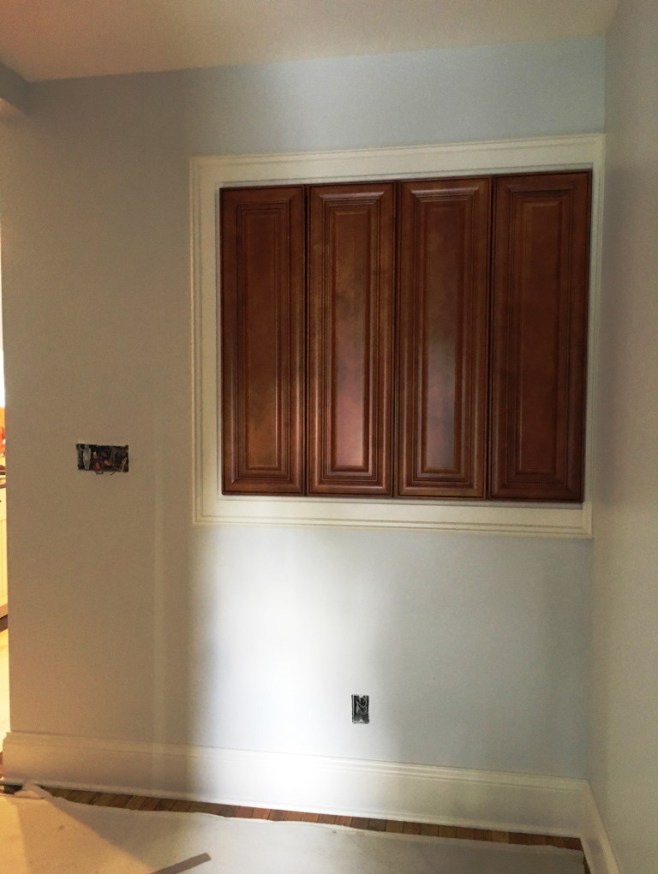
Tuesday: Cabinets for the mudroom. Wait, there’s cabinets in the mudroom? Check them out here.
Our story so far: The main refrigerator was installed with just an inch to spare in the old Methodist church we were turning into our home.
# # #
Past experience taught us that one refrigerator wasn’t enough. In our previous home, we made liberal use of a used refrigerator in the garage, especially when we entertained. So this time around, we designed room for not one but two additional refrigerators—one for beer and pop and one for wine. Once we added our Drinkpod water cooler and a coffee maker, surely we would have enough space for beverages for everyone. Including a beverage bar in the kitchen design was one of my favorite design ideas.
As was his wont, Tyler ordered both refrigerators online, and they arrived packed in multiple layers of plastic and cardboard. The beer cooler was dented (slightly), and the wine cooler’s door was awry.
A little bit of complaining yielded discounts on both. Tyler fixed the wine cooler door with 57 cents in new screws. We were happy with this result. It meant every appliance in our new kitchen was purchased used, at a discount or on sale. Given the extras required for the Craig’s List stove hood, this was good for the Tequila budget (with plenty of space to ice tequila in the future!).
Can I offer you a drink?
Both refrigerators were installed with only a little bit of finagling.
We were finally ready for counter tops. Tyler called the counter top company to come and measure.
# # #
Tomorrow: Cabinets for the upstairs bathroom. Check them out here.
Our story so far: As we installed cabinetry and appliances in the kitchen of the old Methodist church we were converting into our home, a bit of creativity and old-fashioned ingenuity were required.
# # #
And then there was the refrigerator.
There had been no refrigerator in the display kitchen. I guess display people don’t need cold food. But we were real people, and ice cream was a requirement, not a negotiable.
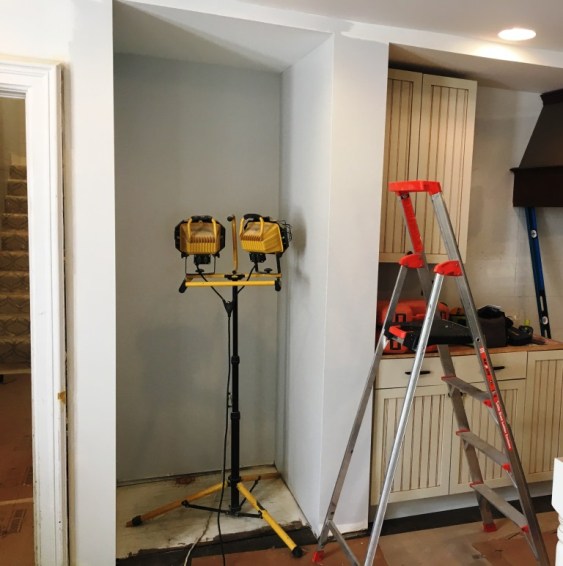
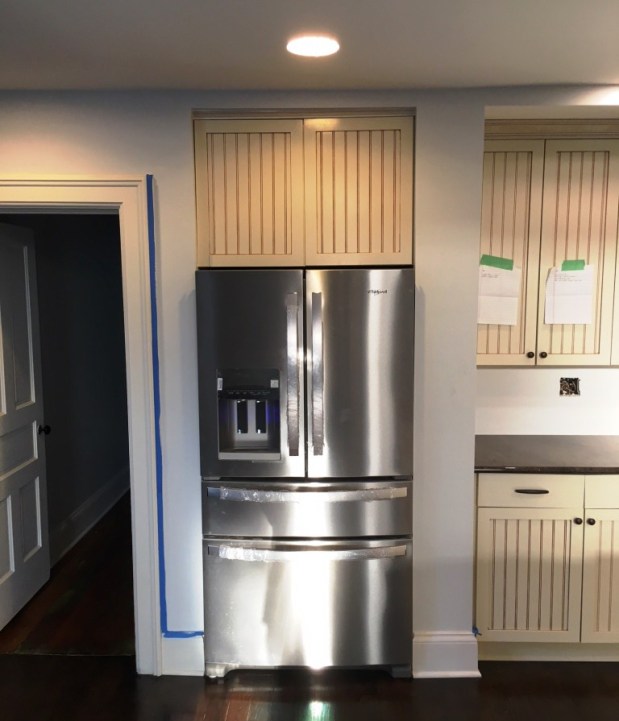
When we designed our kitchen in the chome, there was a perfect 37-inch-wide nook on the left side of the back wall of the kitchen; the congregation had a custom cabinet in the space which we imagined might have stored bread and wine. This slot was maintained when Tyler installed the header to support the balcony. The drywallers drywalled the space, and we were set to shop. Only with five-eighths-inch drywall, our slot ended up 35-and-three-quarters-inch wide. A 36-inch refrigerator would not fit.
That’s OK, refrigerators come in a variety of widths. We knew we’d find one. And while we were shopping for the washer and dryer, we did find one. It was 35-and-five-eighths-inches wide. We liked it because it had more capacity than some 36-inch-wide ones (so much more than a skinny 32-inch-wide or 34-inch-wide refrigerator). It would be snug fit perhaps, but hey, we had an eighth inch to spare. We signed the dotted line and committed to a delivery date.
I suppose you know where this story is headed.
We will never speak of this wall that is crooked by an eighth inch again.
Back at the church we measured the twice we should have measured the first time.
We did indeed have 35-and-three-quarters inches at the top of the opening. But we had only 35-and-a-half inches at the bottom.
At one point, Tyler, who has used brute force in the past on obstinate inanimate objects, said he’d shove it in one way or another. I’m sure he could have.
But he reconsidered.
And he called the drywallers.
Who came by a few days later to replace the five-eighths-inch drywall with quarter-inch drywall, thereby buying us a whole inch of play, top and bottom.
Our painter Low Talker painted the slot just in time for delivery of our refrigerator.
No brute force required.
If it looks like the slot was designed for this refrigerator, it was!
# # #
Tomorrow: More appliances. More issues. Read about it here.
Our story so far: We had finally progressed to the cabinets phase of renovation in the old Methodist church project.
# # #
What a hood! What a deal!
We had purchased the stove hood as part of the castle door deal. The door seller had a strange variety of stuff in his garage, including the enormous wood stove hood. Tyler got him to throw it into the deal. This was long before we found the display kitchen and long before we purchased the 36-inch wide stove on Craig’s List, so we tiptoed around it in the basement for months.
It seemed like an incredible deal to me.
Until I saw the tab for the vent. The hood was just decoration. To make it operational, we needed a vent. In the correct size. Tyler found a new one he liked. Cha-ching.
No matter how good your vent, you need ducting to transfer the smoke (or whatever it coming off your cook top) to the outdoors. During the mechanicals phase, Tyler thought ahead enough to get ducting from the hood to the outdoors. Cha-ching.
The vent needed to be inside the hood, and that required You-Can-Call-Me-Al’s expertise. Cha-ching.
And to make a vent operate, we needed electricity.
So we put the electrician to work on the project. Cha-ching.
Of course, it wasn’t a simple connection. It didn’t work on the first try, so we would need to remove the vent, problem solve, and try again.
Cha-ching.
The incredible deal was actually a money pit. Or money vent, I guess. Poof, money floating out of the chome through the stove vent ducting.
# # #
Tomorrow: Hmm, the stove hood isn’t the only challenging appliance in the kitchen. Read about the other one here.
Our story so far: The display kitchen cabinets we found on Craig’s List for an incredible price to install in the church we were converting were a Rubik’s Cube without instructions.
# # #
That’s the problem with doing it the way we did. We had a lot of jerry-rigging to do.
When a regular homeowner purchases a custom kitchen, someone comes to measure everything, draws up plans with illustrations and sends instructions to the installer. We measured, more than once, but our installation prep ended there. Which left of a lot of loose ends:
We switched cabinets on either side of the sink so the wine rack would face the beverage bar.
We ended up with a leftover drawer. You-Can-Call-Me-Al noted it would fit perfectly on the floor beneath the wine rack. It would be perfect for wine corks.
We eliminated the shelves and drawers and moved the glass-fronted cabinets to either side of the stove. The cream-colored shelves were moved to the blue beverage bar, so they required painting.
We shortened the tongue of the island and added cupboard doors so we could use the storage space. When cabinet doors in the wrong color arrived, our painter Low Talker spray painted them, and I glazed them. Ditto for the cupboard above the refrigerator.
I painted yards of kick plate and quarter round to match both the cream-colored cabinets and the blue ones.
We planned for a wider stove than in the display kitchen making the stove vent obsolete. Fortunately, we acquired a different one. But it was brown. We couldn’t decide if we wanted to leave it or paint it.
Oh, the stove vent. What a deal.
The kitchen cabinets, topless, but in place.
# # #
Today’s headline is a quote from 20th century novelist Zelda Fitzgerald and wife of author F. Scott Fitzgerald.
Tomorrow: Penny wise and pound foolish. Read about our folly here.
Our story so far: My husband and I had toiled nearly nine months to transform a 126-year-old Methodist church into our residence.
# # #
Chapter 37
We were stuck on Phase Three of our project—drywall, paint and flooring—for so long, I’d forgotten what Phases Five, Six, Seven and Eight were, but I remembered clearly what had been working toward during all those long days sanding wood floors: Cabinets! Finally, we’d arrived at Phase Four of our project: Cabinets & Appliances.
Oh, we had been picking around the edges for some time. We bought the display kitchen and gotten a quote for having it delivered. When we heard the number, Tyler and I agreed it was much cheaper to rent a U-Haul and perform the heavy lifting ourselves. That day back in March was filled numerous references to Devo and “Lost in Space.”
“Crack that whip!”
“Danger, danger, Will Robinson!”
We whipped it good, and we didn’t bust anything; we earned our soup that day.
In the time between buying the display kitchen and picking it up, I worried I didn’t have enough storage space, but handling every single cupboard and drawer disavowed me of that notion. Since the church wasn’t ready for cabinet installation when the remodeling firm was ready to get rid of their display kitchen, so we handled every single cupboard a drawer again when we moved them from the rental unit to the church, but that was an exciting day that signaled we were done sanding floors (did I say “done”? We weren’t done, exactly, but instead of churning the ice cream, the next time we sanded we would be putting a cherry on top the sundae).
This is our kitchen looked for most of the summer (this wide-angle photo makes it look a more crooked than it was in real life).
Installing the laundry cabinets and the master bath vanity were the other bites we’d taken on the cabinet phase, but really, nothing compared to that kitchen. We had diddled with the upper cabinets and the additions we’d purchased during the rainy week of the longest days of summer but by the end of August, we were still waiting for the replacement cabinets in the right color (oh, that retailer was not going to like the review we planned to write—the firm epitomized recalcitrant).
Um, where do we start?
In total, our kitchen cabinets were a Rubik’s Cube without instructions. We were moving around parts of the display kitchen, and we’d added a few pieces drawn from various sources, and now we had to figure out how to put them back together. And get them level. Tyler, You-Can-Call-Me-Al and I conferred several times that day, poring over the pictures we’d taken of the display kitchen when it looked like it was supposed to, instead of how it looked in pieces on the floor our church sanctuary.
Our story so far: Tyler struck a deal with Reroofer, our belfry repairman, to barter for the fire escape, which Reroofer wanted for a deer stand. The deal required Reroofer to dismantle and haul away the two-story solid steel fire escape himself.
# # #
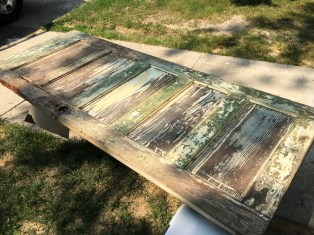
My project: A door with character. And a lot of peeling paint.
While Reroofer and his compadre conferred to determine a plan, I worked on a different project in the front yard assigned by the foreman: Removing the paint from one of the doors we found in the church so it could be painted by Low Talker, our painter. This was an effective distraction from the ruckus occurring around the corner of the house.
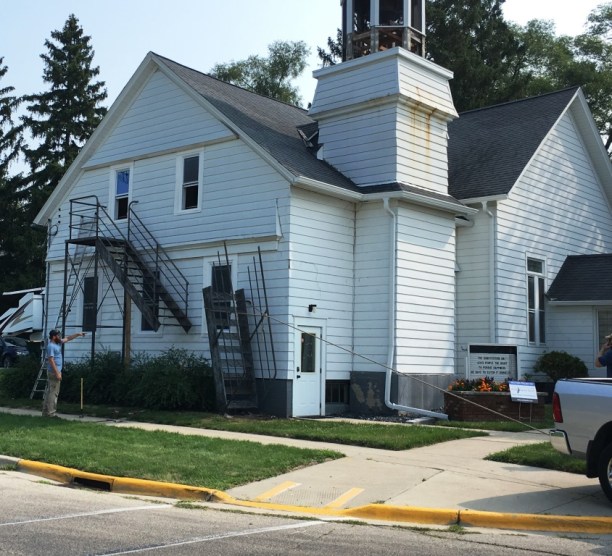
Reroofer and his friend cut the stairway into three pieces. At one point, a truck and a rope were employed to pull things apart, but I couldn’t tell you what other tools were employed. For the most part I didn’t really want to know how they were accomplishing this task so I didn’t ask questions and I didn’t hover.
Presto! Step one complete.
I prayed. I prayed no one would get hurt and my house would remain standing.
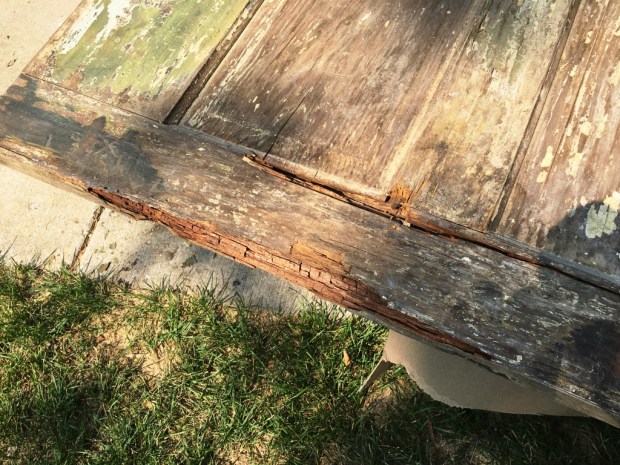
Uffda! Too much rot.
Pretty quickly, I realized my project was a no-go. Too much of the door was rotted to salvage it. A few hours later, my prayers about the fire escape were answered.
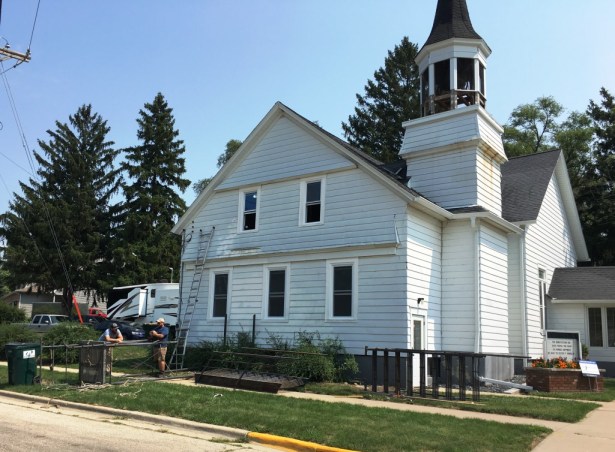
There you go. Fire escape becomes deer stand in three steps.
You win some, you lose some.
# # #
Tomorrow: Chapter 36 was a quick one. It closes with a look at the west side of the church, then and now. Check it out here.
Our story so far: The windows in the sanctuary of the old Methodist church were reglassed so we could see our yard.
# # #
About this time, I witnessed the strange details one must pay attention to when one is renovating a hundred-year-old church, and in this case, rehabbing the doors.
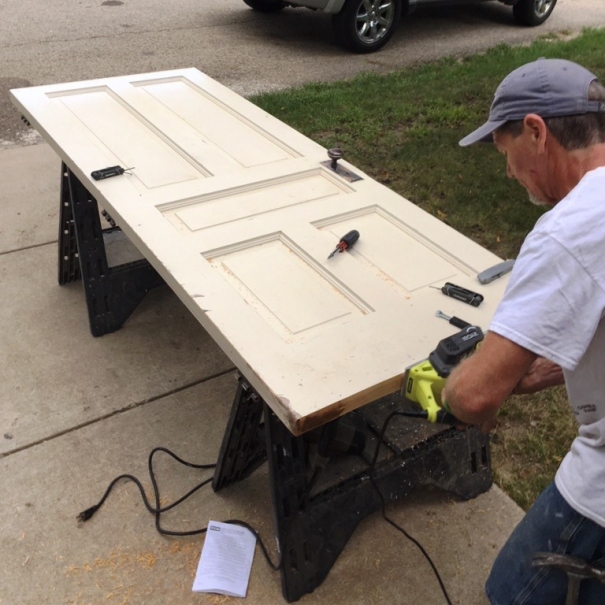
These doors, too, had to be painted. We had replaced the exterior doors to the entryway, but a second set of double doors divided the entryway from the sanctuary. At one time, when there was no entryway, only exterior steps, these doors now between rooms might have been the exterior doors so they were one-and-three-quarters inch thick. We wanted to remove the top wood panels and replace with glass, so we could see our entryway from the sanctuary. But like so many wishes that weren’t horses, this was not easily done. The door was a single solid piece of wood, and even You-Can-Call-Me-Al with all his carpentry experience and tools was skeptical he could cut out these holes. And even if he succeeded in doing that, he wasn’t sure about trimming out the glass again.
Much debate ensued. We shopped for alternative doors and discovered quickly we would have to buy (and wait for) custom ones because our ancient doors were extra thick and two inches taller than modern doors. You-Can-Call-Me-Al, who didn’t want to ruin our doors with a mistaken cut, reminded us how much more insulating modern doors would be.
But we didn’t want to wait (or waste perfectly good doors) so we urged You-Can-Call-Me-Al to try cutting holes in the doors so Low Talker could paint them with the rest of the doors.
You-Can-Call-Me-Al at work on one of the entryway doors (apparently, the bottom required planing, too).
You-Can-Call-Me-Al gamely tried.
And succeeded. (“It wasn’t easy!” he told me later. “I knew you could do it,” I said.)
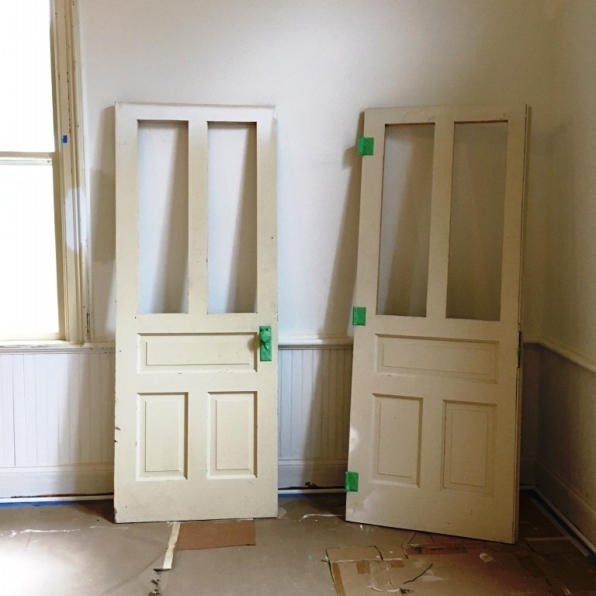
Our original doors could be painted with everything else and glassed. Another reuse project on track.
Our doors, cut, taped and ready to be spray-painted.
# # #
Tomorrow: Chapter 36: Instead of an addition, a deletion. Read it here.
Our story so far: As we continued renovating the old Methodist church into our home, my husband began most days by flinging open the double front doors and leaving them open all day to clear dust and cool the men working inside. The open doors had an ancillary benefit: They welcomed visitors.
# # #
While neighbors were dropping by to get a peek inside, we were thinking about looking outside.
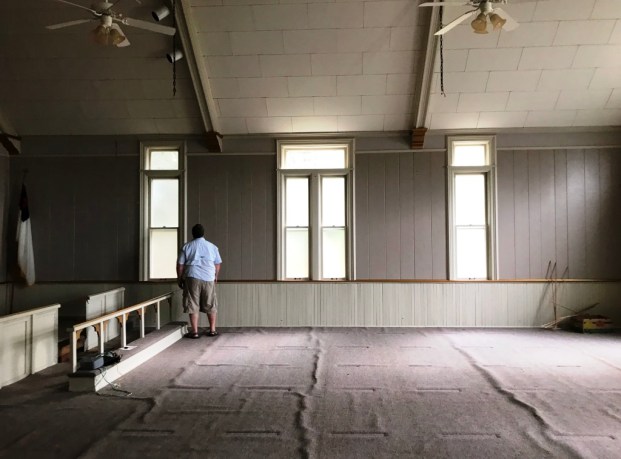
Here’s a shot of Tyler evaluating at the windows in the sanctuary the second time we looked at the church when it was on the market. It wasn’t a foggy day; you can see clearly how unclear the glass in the windows was.
When we purchased the church, all the windows in the sanctuary had obscured glass. Not frosted, exactly, but some sort of cloudy glass that prevented parishioners from daydreaming during sermons. Conveniently, it also prevented thieves and other marauders from peering inside the church, too, so we left it in place during many months of demolition and restoration.
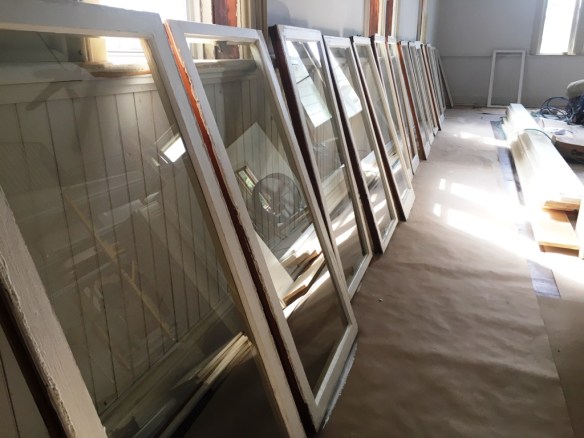
It was time to replace the obscured glass with clear glass and let the sunshine in. Also, we wanted the sashes painted, and we might as well replace the glass first. So every window in the sanctuary was removed and hauled to the glass guy’s workshop where he replaced the glass. Meanwhile, You-Can-Call-Me-Al added quarter round to the frame edges, and Low Talker caulked the cracks. They discovered decades of dust and pine needles stuck in the top of the frames, easily twelve feet off the floor, and they shop-vacced it up. Surely, no church member had ever bothered to dust up there since the 1940s when the orientation of the sanctuary changed from east-west to north-south.
This might be the cleanest this glass will ever be again.
The windows came back to us with sparkling clear glass, and Low Talker lined them up along with wall like sentries in order to paint them.
# # #
Tomorrow: Chapter 35 wraps up with a little door trouble. Read about it here.
Our story so far: Room by room, our painter transformed semi-finished spaces into finished ones in the old Methodist church we were converting into a home.
# # #
In order for Low Talker to paint the rest of the second floor, You-Can-Call-Me-Al got busy installing trim. I’d chosen a simpler trim style for the second floor than what we were using in the sanctuary; I wanted more of a farmhouse look up there.
If you look carefully, you can see the ghostly figure of You-Can-Call-Me-Al working behind the leaded glass window.
Among the items You-Can-Call-Me-Al trimmed out was the interior leaded glass windows Tyler and I selected months before to add decoration to the balcony wall while adding natural light from the second story to the sanctuary. Tyler was quickly emptying one of our rental units, and these carefully packed leaded glass windows were transferred to the church to be installed. The windows had the simple farmhouse trim on the inside and more ornate trim on the balcony side. The glassy artwork transformed the gaping holes in the drywall into light-dancing features over the tub in the second floor bathroom and along the balcony wall, and their installation confirmed we were making progress, yes, beautiful progress.
The trim on the balcony side of the leaded glass window required clever use of crown moulding on top to accommodate the angle of the sanctuary ceiling.The trim on the bathroom-bedroom side of the leaded glass window was simpler.Here you can see how the leaded glass windows flank the doorway of the second story. Eventually, barn doors will decorate that doorway.
# # #
Tomorrow: We should have considered a revolving door. Read about it here.