Sawing wood is what she was intended for

Our story so far: We were deep into the construction phase of converting a 126-year-old church into our dream home.

# # #

By now, Tyler had finished constructing the walls on the main floor and upstairs. We were ready to think about the second floor ceiling.

Unlike the main floor’s drywalled ceiling decorated with beams, we chose something with a bit more farmhouse flavor for the upstairs, which would house a bathroom, bedroom and my office: Pickled, planked plywood.

We’d seen Tyler’s cousin’s husband turn plain old plywood into beautiful planked flooring when we were camped in their yard (was that only last year?), and we thought we could copy the idea on our ceiling.

Pickling and installing the ceiling was a multi-step process that began with a good day’s work ripping boards on the table saw. Tyler chose to do this with me on an otherwise quiet Saturday.

The table saw is not my favorite piece of equipment since it carried with it the threat of cutting off one’s digits. But the boards were too big for Tyler to cut straight without help, so the foreman tagged me as his crew.

sawdust.jpg
Check out that mountain of sawdust.

I caught on quickly when to push, when to pull and when to catch newly sawn pieces of lumber, but let me tell you, 20 pieces of plywood is a lot of 5.75-inch planks. And a half a bagel for breakfast wasn’t enough to fuel the manual labor. We took a couple of water breaks, but by the end, my self-talk sounded like this (if you could have heard it over the whine of the saw):

“Think about sawing, not about lunch. Don’t let Tyler’s fingers get cut. Seventeen planks to go. Who left the front door open? Concentrate on the saw. Tyler, be careful. Don’t slip in the sawdust. Don’t pull too fast. Watch Tyler’s fingers. Sixteen planks to go. Do I want tacos or a bratwurst for lunch? Don’t think about lunch. Step over the pile of sawdust. Watch Tyler’s fingers. Is that fifteen or fourteen? Keep the plank straight. Don’t push too hard. Watch Tyler’s fingers.”

Finally, the stacks of plywood were piles of planks.

ceiling planks
Stacks of planks. With the table saw looming in the shadows.

We still had days of sanding and painting and nailing ahead of us before we’d have a finished ceiling, but Step One was complete and so were Tyler’s hands.

Time for lunch.

# # #

Today’s headline comes from Mark Twain: “Write without pay until someone offers pay. If nobody offers within three years, the candidate may look upon this as a sign that sawing wood is what he was intended for.”

Tomorrow: Chapter 17 opens with a day in the life of an inexpert renovator. Read about it here.

Straight, perpendicular and level … or pay the consequences

Our story so far: Purchase of the 126-year-old Methodist church to turn into a home: Check. Interior demolition: Check. Building begins: Check.

# # #

Here’s what I didn’t understand about walls until I helped build some: They’re three dimensional.

This should be self-evident, but it wasn’t, at least to me. A wall should be perpendicular to the floor, perpendicular to other walls and level. If you don’t get things perfectly square, you’ll end up with a fun house maze.

I imagine this feat requires skill when one builds a house from scratch, but it’s a real trick when you’re building walls between 126-year-old floors and ceilings that may or may not be level.

Tyler took great pains to jack up the second floor to level, but “level” did not mean it was even. Every wall stud was a different length.

I helped build the closet walls on the main floor by performing a role as human tool holder. “Hand me the square.” “I need the level.” “Give me the power nailer.” (Let’s be honest, Tyler usually dispensed with pleasantries and placed orders with nouns only: “Nailer.” “Level.” “Hammer.”). Sometimes, I was promoted to two-by-four transport specialist or measurement expert (by expert, I don’t mean that I was responsible for measuring the length of the stud, but I did climb the ladder and hold the zero end of the tape measure securely to the ceiling).

In this manner, we (i.e., Tyler) built the walls to our walk-in closet which, conveniently also were supporting walls to the second floor.

# # #

Tomorrow: Pocket doors. Uffda. Read about it here.

Beams of dreams

Our story so far: The drywallers were making quick, satisfying progress on the ceiling of the sanctuary of the Methodist church we were turning into our home.

# # #

Along with the Sheetrock panels, the drywallers erected on the sanctuary ceiling the two-by-sixes to which our faux beams would be attached.

faux beam extreme closeup
In this extreme close-up of our faux beam, you can see the wood grain and the foam interior.

Tyler had decided to have a look at rigid polyurethane foam beams—lighter and more durable than actual wood beams and more affordable, they were advertised as being “virtually indistinguishable from real wood.” But seeing was believing. Ordering a couple of one-foot samples of the faux beams, like choosing any finishing details in a house, was an odyssey. We ordered them online, of course (because that was Tyler’s mall of choice), where the array of options was dazzling.

L beam or U beam?

Rough sawn or hand hewn (or any of eight other textures)?

How wide? How high? How long? Do you need endcaps?

What color? We knew we wanted “brown” but we could choose from among eleven shades of brown. We finally settled on samples of pecan and antique cherry.

faux beam faroff
The antique cherry sample beam is on the left, pecan on the right.
faux beam closeup
This close-up shows how the faux beam attaches to the two-by-six on the ceiling.

A couple of weeks later, our sample beams arrived, and Tyler stuck them on the two-by-sixes on the ceiling of the sanctuary (from the safety of the choir loft).

Remarkable. They were virtually indistinguishable from real wood beams. And they were as light as cappuccino foam, which would make them easier to install.

The beams would add just the distinction we wanted in the centerpiece of our great room: Our cathedral ceilings.

# # #

Tomorrow: Wall of fame. Or possibly shame. Read it here.

Nailed it

Our story so far: My husband and I bought a 126-year-old Methodist church to turn into our dream home, and we–with a little help–spent nine weeks demolishing the interior.

# # #

Chapter 16

Activity at the church began to accelerate, as evidenced by the number of checks being written and the volume of building materials accumulating in the church.

2000-nails.jpg
This is what 2,000 nails looks like

One day, a relatively small box—Amazon’s smallest shipping box—was delivered to the front door. I tried to bring it inside, but I discovered abruptly I couldn’t lift it.

“What is that?” I asked Tyler later. “It’s as heavy as a thousand screws.”

“Two thousand, actually. Two thousand nails,” he replied nonchalantly.

So we were embarking on a construction phase requiring at least two thousand nails.

# # #

Tomorrow: “Wood”n’t it be nice? Read it here.

The solution to sag: Structural support

Our story so far: We took steps to be careful as we demoed the interior of the old Methodist church, including hiring a structural engineer to look at the building’s support system and prescribe a fix.

# # #

Tyler and Reroofer with sag
Tyler and Reroofer preparing the space for the new header in the space between the sanctuary and the overflow area.

In the space of about eight hours over two days, Tyler and his help, Reroofer, got the header constructed and put in place, and they reconstructed the choir loft wall (I helped by renting a couple of heavy-duty adjustable floor jack posts and transporting them to the church—I’m handy like that). When they jacked up the floor, the wood gave a great creak and wail, but it cooperated. The second floor was suddenly a lot more level and the opening where the kitchen would be constructed was no longer saggy.

header after
Here’s the space after the new header was installed. You can also see the doorway, above center, where one will exit the second floor onto the to-be-built balcony.

With that task completed, I could put to bed my nightmares of bathing in the upstairs tub—me in my birthday suit relaxing among a cloud of bubbles and a hundred gallons of water—and falling through the ceiling. We were structurally sound now. But we still had to demolish the 20-foot sanctuary ceiling without killing our project foreman.

# # #

Tomorrow: Chapter 15 concludes with a solution to the sanctuary ceiling problem. Read it here.

Well, I have good news and bad news

Our story so far: We tried to be careful and responsible as we demolished the interior of the old Methodist church we intended to turn into our home.

# # #

We also were warned we had asbestos in the walls.

If one thought lead and mold were bad, exposure to asbestos was known to cause lung cancer. And eliminating it was expensive. In fact, it was asbestos that had scared us off from going through with the purchase of a church in Pecatonica at one time.

On this project, however, we’d gotten such a good deal on the church, we figured if we found asbestos, we could afford to pay to get rid of it.

One former parishioner reassured us that only love flowed from those walls, and we believed her. But unlike some matters related to a church, this one we could test. We sent three samples to the laboratory: main floor ceiling tile, main floor wall sample and basement flooring, which looked a little suspicious to us. Within twenty-four hours, we’d learned the ceiling and walls on the main floor were mostly cellulose with no asbestos. Cause for celebration!

basement floor tile
This was an attractive and durable floor covering in its time. But it was not “rustic transitional” and would have to go.

The avocado green basement floor tiles lovingly installed by a couple who were active members of the church when avocado green was in vogue, however, were 3% chrysotile, a Category 1 asbestos-containing material. Category 1 was the least bad of the three types of asbestos, that is, not brittle, breaks by tearing rather than fracturing and does not easily release asbestos fibers upon breaking.

We got a reasonable quote for professional asbestos abatement, but since our structure was now privately owned, we could legally get rid of it ourselves. When we were ready to refloor the basement, we had the Tyvek suits, goggles and respirators to scrape up the flooring if we decided to go that route. But in the meantime, as long as we didn’t disturb the floor tile, we’d be fine.

# # #

Tomorrow: Hey, this testing business is fun! Read about it here.

Rehab involves four-letter words: Lead and mold

Our story so far: We proceed with caution as we renovate a 126-year-old Methodist church into our home.

# # #

Immediately after putting in the offer on the church, our real estate agent sent us a seventeen-page brochure, “Protect Your Family From Lead in Your Home.”

“Many houses and apartments built before 1978 have paint that contains high levels of lead,” the pamphlet warned. The list of health hazards read like a drug ad in an AARP publication: Lead from paint, chips and dust can cause high blood pressure, nerve disorders, muscle and joint pain, memory and concentration problems and digestive problems.

Eek.

So when we finally got inside the church, we tested a number of surfaces. No lead.

Then more than one former parishioner in the church suggested we had a mold problem. The list of symptoms from mold allergies was worse than lead exposure: Everything from runny nose and coughing to internal bleeding and death.

Tyler scoffed at this notion that we had anything more than a pedestrian mold problem, but we disposed of anything porous that was in the basement (where we had witnessed a water problem). One warm December day, early in the demolition process, Tyler donned his Tyvek suit, a respirator and safety goggles and power-washed the entire basement, including the furnace room which once in its history had a coal chute.

Only a Virgo.

# # #

Tomorrow: We get the results of an asbestos test. Read about it here.

Safety doesn’t happen by accident

Our story so far: Despite what people might have assumed about the recklessness of a pair of 50-somethings in purchasing a 126-year-old building to turn into a home, Tyler was a businessman who’d heard too many horrific insurance claims to pursue a daredevil approach to construction.

# # #

The hazards of remodeling a building as old as the church were many, and we were warned by many well-intended bystanders.

nails and tin
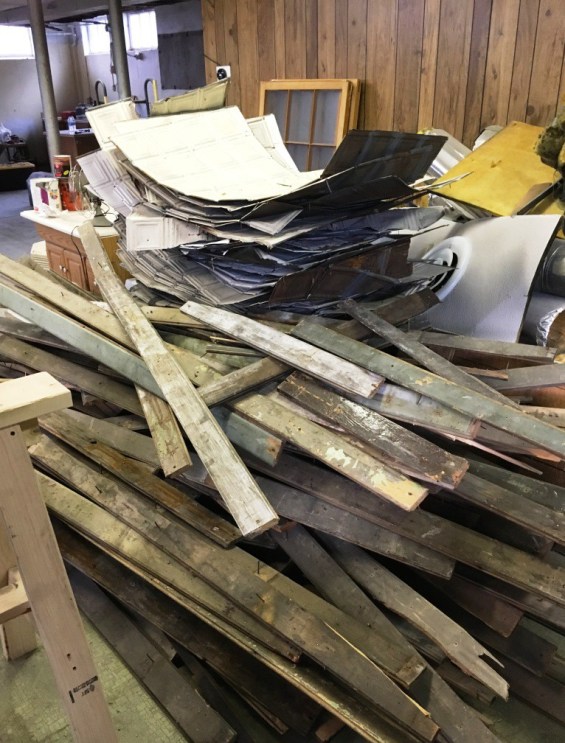
That’s a pile of tin ceiling on the pile of scrap wood.
one million nails
You think I’m kidding about removing a million nails.

Long before we’d closed, Tyler had already made investments in face masks and safety glasses, purchased in bulk. These came in handy as we removed millions of nails from trim and crown molding (I might be exaggerating about the volume of nails, but not much). Tyler also bought work gloves for the hired man and for me. One of the pairs for me were Level 5 cut-resistant rated; I didn’t even know such a thing existed, but I was grateful for them as we loaded and unloaded scrap metal into the pickup. All this safety equipment was de rigueur when Tyler and St. Johnny removed the tin ceiling in the basement. Since we hoped to reuse the material again, someone standing on a ladder had to peel off each piece of sharp-edged, dust-covered tin, sheet by sheet. The basement was already expansive in square footage, but it gained space in our minds as they spent hours on this task. And I was amazed at the debris that must have fallen from the ceiling (and elsewhere) as I went through Tyler’s jacket pockets on laundry days.

As one might expect of a building constructed only twelve years after the invention of the electric light bulb, the wiring Tyler discovered in the church was like a trip through time. Cloth-wrapped 12-gauge copper wire in conduit and ArmorFlex wiring was mingled with current code-approved Romex wiring. With an abundance of caution (we certainly didn’t want all of our hard work to burn to ashes), all of it would be replaced. And the existing 100-amp circuit breaker box? It would be exchanged for 200-amp service (Tyler confided he could reuse the 100-amp box in the garage).

# # #

Tomorrow: Do they have a test for that? Read it here.

The pitfalls of a cathedral ceiling

Our story so far: We purchased a 126-year-old Methodist church to turn into our home, and all through the demolition process we found a lot to love in the literal corners of the building and encountered supporters in various metaphorical corners.

# # #

Chapter 15

The final 10 percent of a project is the hardest, and this was true of the demolition phase of ours.

The first 90 percent was no cakewalk. Sure, we revealed some beautiful architectural elements of the church, and that was rewarding, but it required back-aching work. And then there was the suspended ceilings, plaster and lathe, old carpeting, basement pass-through, walls, doorways. Well, it amounted to two thirty-yard dumpsters worth of debris.

ceiling prior to demo
Tyler demolished the choir loft side of the sanctuary ceiling, but that left the other side. And those decorative beams.

But that still left the ceiling of the sanctuary. The twenty-foot ceiling of the sanctuary.

Shortly after we’d closed on the church and realized we’d thrown out the remote controls for the ceiling fans in the sanctuary, Tyler climbed on top of a six-foot rolling baker’s scaffold in order to install pull-chains to the fans to get them to operate. It didn’t work. But Tyler did learn something: His baker’s scaffold shook something awful as he stood there fiddling with his arms above his head, and he didn’t like it. And besides, a six-foot-three man standing on a six-foot scaffold was still eight feet short of the top of the ceiling. (This is probably why most standard family homes don’t have such high ceilings, but I didn’t think of that when I fell in love with the open space.)

As he demoed the rest of the church from a safe altitude, Tyler pondered how he might safely take apart the sanctuary ceiling and put it back together again. Despite what people might have assumed about the recklessness of a pair of 50-somethings in purchasing a 126-year-old building to turn into a home, Tyler was also a businessman who’d heard too many horrific insurance claims to pursue a daredevil approach to construction.

# # #

Tomorrow: We take action to combat potential dangers. Read about it here.

Man caves are like black holes: What happens there, stays there

Our story so far: We entered the utilities and mechanicals phase of our home renovation project.

# # #

Demolition had revealed the bones of our old Methodist church, and now we needed to run the veins and arteries and intestines through the structure.

This required detailed planning in order to know where to put sinks and drains, electrical boxes and outlets, heating vents and cold-air returns. Tyler and I had been scheming and debating for eight weeks (well, and two and half months before that), and by now, we had a fairly complete plan in place, both on paper and in spray paint on the floors of the church. By “fairly complete,” I mean we would show a plumber providing a bid exactly where we wanted a shower, and then he would ask us, “what kind of shower head do you want?” and we’d look at each other like, “Hmm, what kind of shower heads are there?” Or the electrician would ask, “Are you going to light your bookshelves?” and we’d look at each other like, “What a great idea! Lighted bookshelves!”

Our floor plan had another missing piece, I learned at a regional home improvement show one weekend in January.

A home and garden show is like a chocolate chip cookie. The boring but necessary ingredients like vendors for basement waterproofing, excavators and roofing materials are punctuated by the chocolate chip hucksters of granite countertops, acrylic shower stalls and designer garage doors. Real DIYers like us passed on the booths populated custom home builders, but we were impressed with innovations on otherwise boring details such as solar tubes, remote control operated shades and automatic lawn mowers.

It was at the garage door vendor where I learned Tyler was planning a thirty-six-foot bar along one side of the garage with a clear glass garage door opening. (Didn’t I mention he was a “go big or go home” kind of guy?).

“What?!” I said, my mouth falling open. “This is the first I’ve heard of this!”

“Some things are on a need-to-know basis,” Tyler said, and resumed discussing the options in tempered glass for garage doors and related costs with the salesman.

Over dinner, I pressed Tyler for details on his man cave and encouraged him to draw up a detailed plan. He obliged, and I learned what he thought I needed to know. (A week later, he was forced to rethink his fantasy garage plans. Alas, the zoning set-back requirement would mean a smaller garage would be necessary; a thirty-six-foot bar might not make the cut.)

In any case, we had some semblance of a plan, so now we would spend weeks running plumbing, wiring and all-new ductwork for the heating and air conditioning through the exposed floors and ceilings of the church. The work of all these skilled laborers would commit us to the floor plan and certain fixtures. We’d better know what we wanted, because once all the mechanicals were sealed behind drywall, changes would be costly. We needed a style book and design plan in order to help us make good decisions, and fortunately, I’d had plenty of time to develop one.

# # #

Tomorrow: Chapter 13 opens with the background to our design plan. Read about it here.