Our story so far: Nearly every day, we checked finishing details off our long to-do list at the old Methodist church we were turning into a home.
# # #
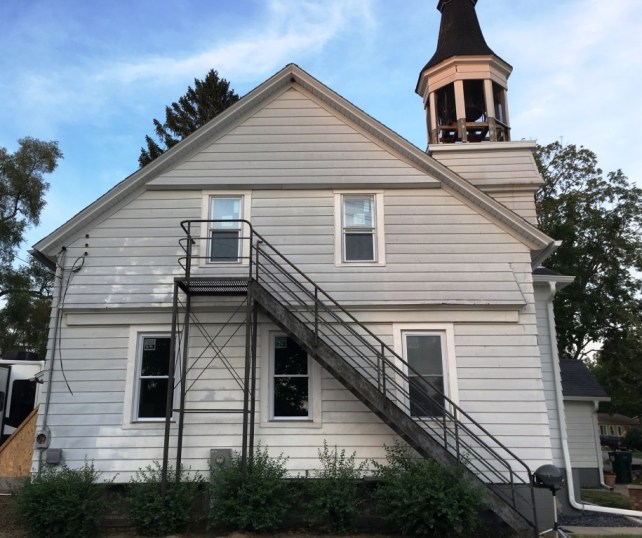
In fact, during the preceding month, You-Can-Call-Me-Al had replaced all the windows on the west side of the house plus the only one on the north side. Tyler guessed the old ones might have been in place as long as seventy years or more. The seals and gaskets were shot, and the wind blew right through them. The new ones looked virtually the same, only the new ones had two panes instead of four, but their insulation value was vastly improved.
Here’s how the west side of the church looked when we purchased it in November.Here’s a shot of the new windows. The fire escape, an eyesore, remains attached to the church, but we think we’ve found a home for it. One of our contractors needs a new deer stand, and he’s willing to barter work for it. So it should be gone by deer season.
# # #
Today’s headline is a partial quote from Elisabeth Kübler-Ross, author of “On Death and Dying.” The full quote is “People are like stained-glass windows. They sparkle and shine when the sun is out, but when the darkness sets in, their true beauty is revealed only if there is a light from within.”
Our story so far: We returned the scaffolding that had been crucial for finishing the ceiling of the sanctuary in the old Methodist church were turning into our dream home, and we finally had an unobstructed view of the fireplace.
# # #
Tyler also wrapped up another project that, like the scaffolding, had been sitting around for months: The pickled, planked plywood for the second floor ceiling. Tyler started the project when we had the Solatubes installed in the roof (months ago), and then work lapsed for more pressing priorities. I finally finished painting the planks, and Tyler wanted them out of the way, so he and a helper nailed wood to the ceiling all day.
The original second floor ceiling was nondescript.
The original ceiling (by original, I mean the way it was when we bought the church) was some sort of beat-up ceiling tiling boards. The new shiplap-ish planks, even untrimmed, were a vast improvement.
The new second floor ceiling is pickled, planked plywood. The windows were replaced, and trimmed out (but they still need paint).
Meanwhile, You-Can-Call-Me-Al replaced the old windows and trimmed them out. With the refinished floor, the vision for the second floor was finally materializing.
Our story so far: Finally, we had a few things to admire at the end of the day during construction at the old Methodist church.
# # #
Back in January, Tyler spent the month demolishing the rest of the interior of the church and wringing his hands about how he was going to take apart the twenty-foot ceiling of the sanctuary. But then he found our drywalling team who came to the rescue by demoing the ceiling and putting it back together again. They also lent us some scaffolding which were used to install the faux beams, the ceiling fans and the restored sanctuary chandeliers.
Oh, and the stone on the fireplace to the ceiling.
Tyler poses for a shot of the fireplace chase he and You-Can-Call-Me-Al built. Plus the scaffolding which made it possible. (Tyler would have me tell you that what you can’t see is the hole he cut in the fireplace behind, and it was no easy task.)
Thank God (and the drywallers) for that scaffolding.
The fireplace, half done, peeking through the scaffolding.
But finally, months later, it was time to get it out of our great room. It obstructed the view.
You-Can-Call-Me-Al deconstructed it (single-handedly, which was a trick) and piled it into the back of the pickup. Tyler returned it to the owner, and now we could see the finished fireplace in all its glory. Ironically, or perhaps just as it should be, the fireplace occupied the same place the red velvet curtain did behind what was once the altar, the symbolic representation of the place where worshippers throughout history burned sacrifices (and probably enjoyed the resulting barbecued animal flesh). We would burn natural gas and enjoy the dancing flames just as much.
The finished fireplace, minus the scaffolding (but not the ladders).
# # #
Today’s headline is a quote from Marcus Tullius Cicero, a second century Roman statesman, orator and writer.
Tomorrow: Another finishing touch. Read about it here.
Our story so far: As we coasted down the side of the mountain that was finishing the floors at the old Methodist Church we were turning into a residence, we admired the perennials left behind by the church gardeners.
# # #
Meanwhile, the annuals Tyler planted in the old church sign flourished even as I let the sign itself languish. His marigolds and purple salvia looked like well-dressed Hollywood ingenues in front of the marquee that I hadn’t updated since the Fourth of July.
Priorities.
# # #
Tomorrow: Check out what replaced the red velvet curtain. See it here.
Our story so far: We were in a good place, figuratively as well as literally in the renovation of the old Methodist church into our home. As we coasted down the side of the mountain that was finishing the floors, we admired a new detail on many days.
# # #
Turk’s cap lily growing in the flower garden.
Among the discoveries we made as summer progressed was an abundance of perennials in our yard. Surely these beautiful flowers blooming in the warm summer sun had been planted and tended to by members of the church at one time. We had demolished what we heard were vegetable gardens in the back yard when we poured the foundation for the garage, but a small flower garden on the side of the church continued to grow and displayed new color every month. In April and May, yellow tulips and yellow-white daffodils showed off their finery. In June and July, it was orange lilies and purple phlox.
Tyler planted his “garden art” compass in the flower garden before we knew how many beautiful blooms would be thriving there.Tyler’s uncle took this bottom-up photo of the turk’s cap lily in our garden.
Tyler’s uncle paid us a visit and the lilies caught his eye. He knew their species well, having had them in his own garden at one time.
“They are called turk’s cap lilies,” he said. “They look like little turbans. If you fertilize them and take care to replant their seeds, they will be an even deeper color and grow huge!”
The garden, truth be told, had probably gotten no attention at all in at least two years, when the congregation vacated the building. Now it was surrounded by mounds of dirt and construction materials. But soon, if not this season, it would receive more than Tyler’s glancing attention.
# # #
Today’s headline is a quote from French poet Gérard de Nerval.
Our story so far: My husband and I spent many months renovating a 126-year-old Methodist church into a residence, and we were getting close to wrapping up refinishing the original wood floors.
# # #
Chapter 33
We had spent so many months thinking of the church as a work site, a project, a financial puzzle and unending to-do list, we had forgotten it was our home.
Home. The very word makes a person breathe easier. This place—this sawdusty, tool-infested, unfinished blank slate—was going to be our home, a place of refuge, a thing of beauty, a space to put up our feet and enjoy a roasty cup of coffee or an ice cold beer.
There was a moment at the beginning of summer after we’d finally squished the spiral stairway into the church and erected it in the corner, a moment when I was reminded, ah, yes, this place was going to be something special.
And then we went back to sanding floors.
When we were gone for a long weekend, the metalworkers brought the almost-finished railing to the church for final measurements. You can see the basket spindles are still unpainted here.
But, as fortune had it, we went with the same spiral stairway company to fabricate our balcony railing. And when they installed the railing at few weeks later, those same feelings came rushing back. I think it was the instant gratification. Instead of building 150 walls or applying twenty coats of paint or driving back and forth to Home Depot, the railing got installed in less than two hours, and then it was finished. All that was left for us to do was dust it.
“This is really ours,” Tyler said to me as we sat by ourselves in our rolling office chairs in the great room at the end of the day.
“It’s going to be beautiful,” I said.
“Yup.”
We were in a good place, figuratively as well as literally. As we coasted down the side of the mountain that was finishing the floors, we had something finished to admire at the end of many days.
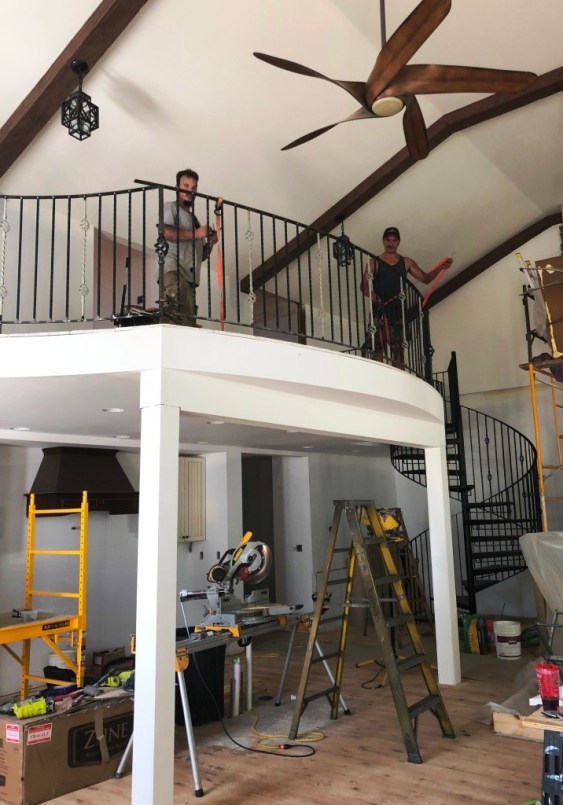
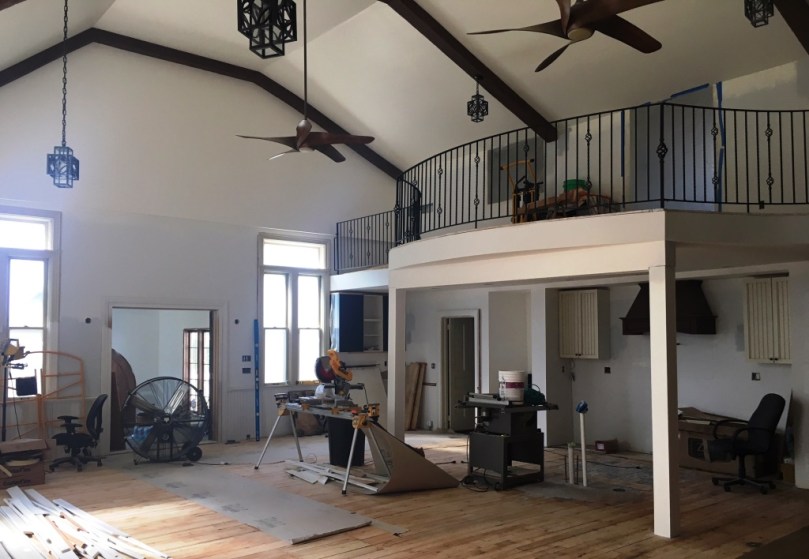
Here’s a shot of the finished balcony railing. If you look closely in this “Where’s Waldo” picture, you’ll find the two office chairs in the great room Tyler and I frequently used to admire our work at the end of the day.
Our story so far: Tyler scored a deal on enough polyurethane to cover the floors of the converted church and then some.
# # #
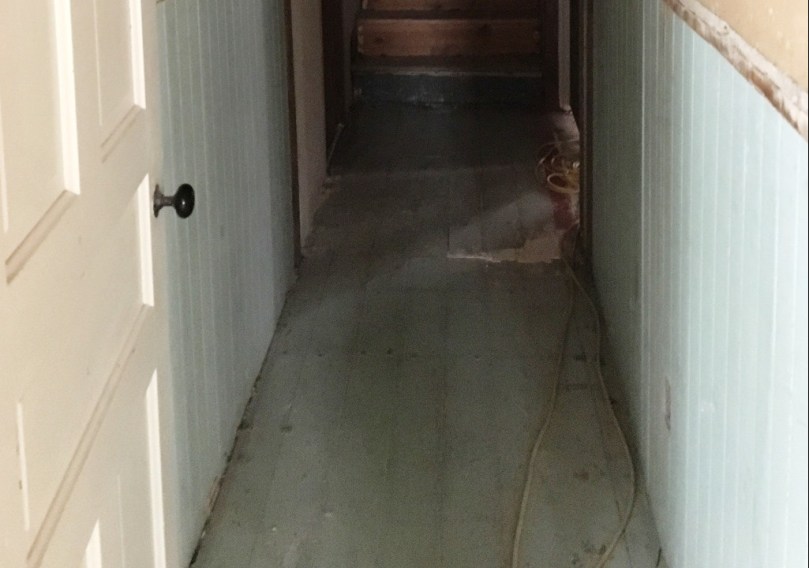
Here’s a look at the original flooring in the hall of history, including a putty-filled patch job there on the right.
The floor of the Hall of History presented a unique challenge. The Hall of History, you’ll remember, was the fifteen-foot-long hall that led from the sanctuary to the back stairway where we imagined we could hang pictures of the church throughout history on its expansive, now drywalled walls.
But, oh the floor. The pine planks were certainly original to the 1894 construction of that portion of the church and had once been part of the entryway. Count how many feet crossed that threshold on the way to Sunday school or worship services! Imagine the Sunday best shoes worn by parents holding newly baptized babies or couples freshly married! Several repairs and patches in the flooring were evident. Besides ground-in dirt, it was covered in paint of various colors—yellow, red and aqua—and sported huge gashes, divots and seams. One had to squint hard to see the potential.
We considered an affordable wood-like tile or perhaps carpeting, but we hesitated spending good money on a hallway floor that would most certainly be mostly covered by a rug runner. So Tyler tried sanding it, only his goal on this floor was to reveal its history (appropriate to the Hall of History) and even it out.
It wasn’t exactly attractive (or perfectly level) when he was done, but we found the character we hoped to feature. With new thresholds and baseboards, the rustic floor might be described by a forgiving critic as charming.
The hallway after two coats of polyurethane. It will need a new threshold into the great room (bottom of pic), but you won’t look perfect when you’re older than 100 either.
# # #
Tomorrow: Chapter 33 opens. The beginning of the end. Read it here.
Our story so far: A couple of coats of clear polyurethane was all we needed to show off the wood floors in the master suite and on the second floor of the old Methodist church we were turning into our home.
# # #
In the sanctuary-slash-great-room, we had a lot going on already. Between the ceiling beams, the fireplace and the kitchen cabinets, the floor played only a supporting role. Plus, its rustic patina didn’t need any more attention being called to it. So we went with a driftwood stain that had a hint of green in it; this would tone down the red in the Douglas fir planks creating a neutral backdrop.
Now after days of sanding, we would be spending days applying stain and polyurethane. The hardest part about this was enduring the odor. Do you remember what the school hallways smelled like on the day the janitors applied vanish to the gymnasium floors? Sort of a pungent chemical stench crossed with a tobacco barn? The church stunk to high heaven, but it lasted only a day or two. Tyler’s obsession with industrial sized fans played in our favor here. He threw open the doors of the church and invited the fresh summer air in.
A feud between Minwax and Home Depot over which Big Box retailer could have exclusivity on the Minwax brand proved to be a windfall for us. One day when Tyler was renting a floor sander yet again, he spied an endcap display offering polyurethane for half price. He bought every last can.
This is not a story display; this is Tyler’s stash of half-price polyurethane in our great room.
# # #
Tomorrow: How we paid tribute to history with the Hall of History floor. Read about it here. And you might be pleased to learn it’s the last installment of Chapter 32 about sanding floors.
Our story so far: After sanding floors for months at the old Methodist church, we spent a little time filling the seams.
# # #
Our next hurdle was stain. Fortunately, choosing a stain color proved to be much easier than choosing paint colors for the trim and walls. We decided to go without stain on the maple in the master suite and on the pine on the second floor. A couple of coats of clear polyurethane was all we needed to show off the hardwood.
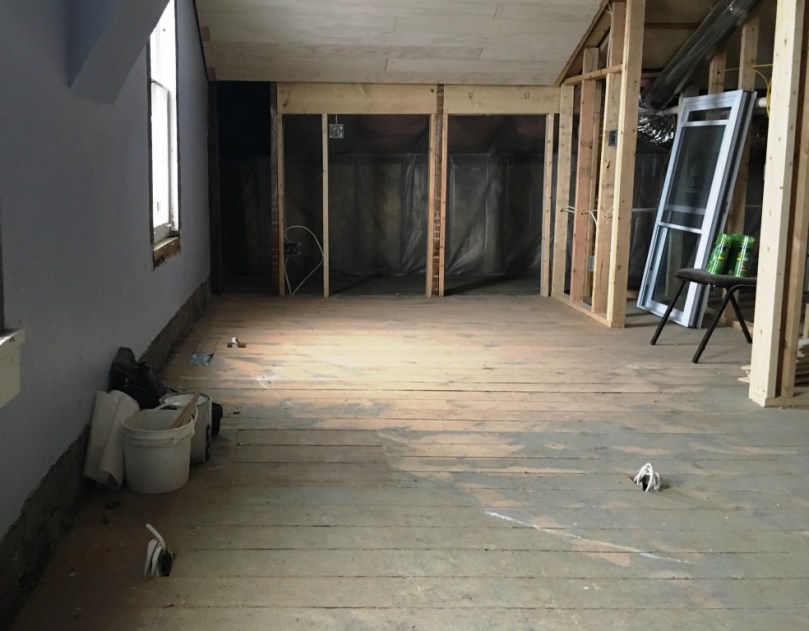
Here’s how the master bedroom floor look at the beginning of the sanding process.Here’s how the master bedroom floor looked after Tyler filled the seams and applied one coat of polyeurethane.Here’s a picture of the second floor after half of it had been sanded the first time. This was even before drywall was up.This is the second floor after one coat of polyurethane.
# # #
Tomorrow: Luck equals preparation plus opportunity. Read about it here.
Our story so far: We spent lots of time and money sanding the floors of the 126-year-old Methodist church we were turning into our home.
# # #
Now that we could see finally see the raw wood, it was time to fill some of the seams. On newer wood floors, polyurethane alone would do just fine, but as our floors aged, some of our seams had widened.
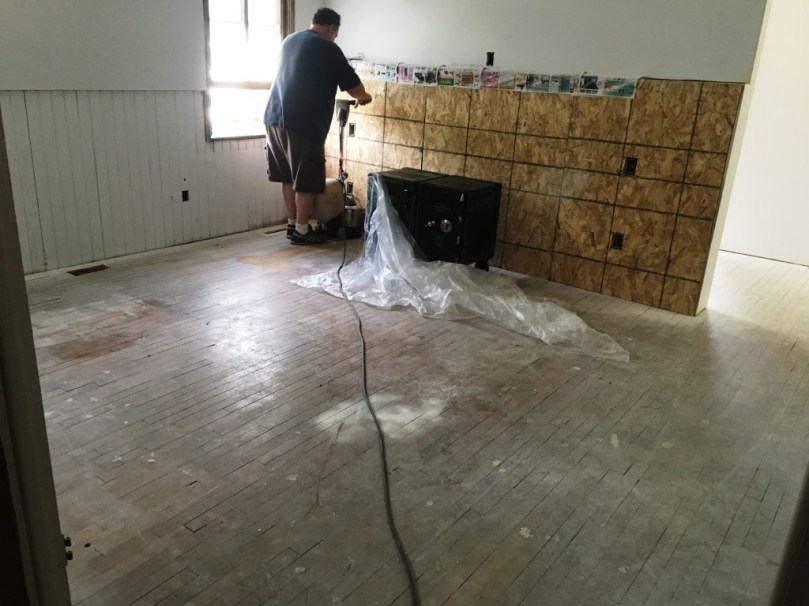
Tyler inspected literally every inch of flooring as we proceeded. Ever the Virgo perfectionist, he was a harsh task master. Near the end of the sanding phase, he directed me to remove all the dried water putty in the seams of the maple flooring in the master suite. Someone had used putty as some point to fill some of the wider seams, and it appeared white against all the wood. Still “wide” was less than an eighth of an inch. Leaning on my knees while seated on a rolling office chair, I used chisels and tiny screwdrivers to pry the plaster out of every last seam in those two rooms.
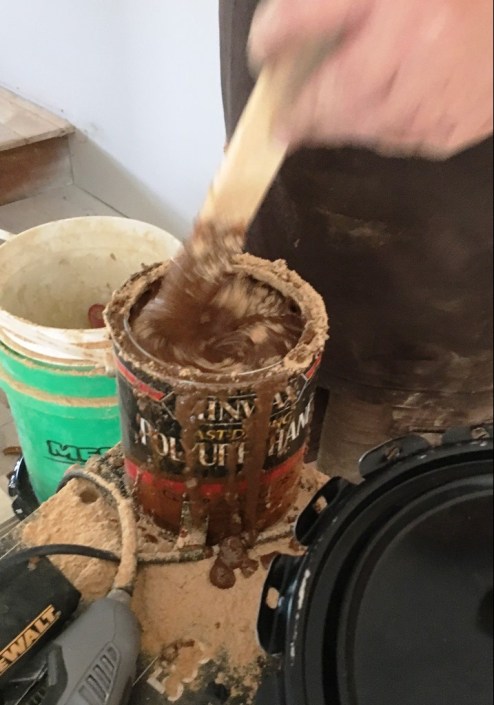
Boil, boil, toil and trouble, sawdust mix and cauldron bubble.
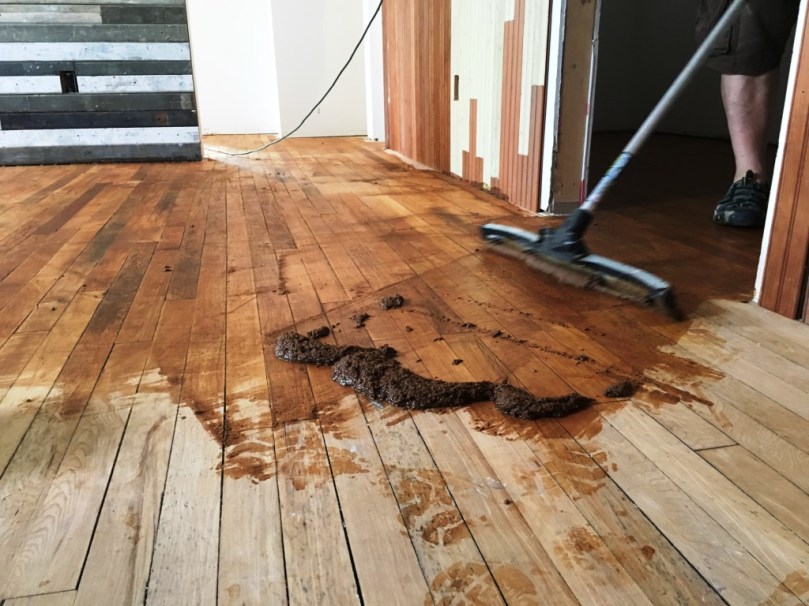
Instead of using water putty, Tyler used a trick he’d learned on an earlier project: He mixed the last layer of sawdust (which was little bits of wood, not that horrible glue and varnish) with clear polyurethane and squeegeed the goop over the floors (maple sawdust mix on the maple floors, pine sawdust mix on the pine floors, and never the twain shall meet). Some of it had to be sanded off again, but the seams were therefore filled with a sawdust mixture that was essentially the same as the planks.
Tyler with a squeegee, pushing sawdusty polyurethane over the bedroom floor.
For the very worst seam on the second floor, more than a quarter inch in width, Tyler stuffed twine before filling it with sawdusty polyurethane. It couldn’t be hidden so we went with the theory that it added character.
It’s not pretty, but it’ll do.
# # #
Tomorrow: Choosing stain. See how it turns out here.











 Church Sweet Home