Was I the angel on his shoulder? Or a devil?

Our story so far: Everyone thought we were crazy to renovate such an old structure, let alone a church, into our home.

# # #

I spent a little time talking Tyler into rehabbing a church.

“This is the only way to get what we really want. Otherwise, we’re just buying someone else’s foolhardy decorating decisions.”

“Imagine how awesome our great room will be. We can buy an 18-foot tall Christmas tree. Our children will love it!”

“It’ll be a great workout. Why buy a membership to a gym when we can work out in our own house?”

“We’ll never find a property so cheap. Heck, even the land itself is worth what we’re paying.”

“We can get this done without a mortgage. It’ll be all ours in two years!”

Honestly, that’s all it took to convince Tyler. He liked challenges. In the business world, I called him the dragon slayer because the bigger the account, the more hair on it, the more he liked it. Big risks reaped big rewards.

Plus he wanted to please me. He’s a great husband like that.

# # #

Tomorrow: Buying a church spooks some naysayers. Click here to read.

We’re committed. Or we oughta be

Our story so far: A 126-year-old church for sale is the right location for the right price at the mostly right time.

# # #

When we told people we were buying a church, sometimes they reacted with envy. “Oh, that sounds like an absolute dream!”

Sometimes they reacted with horror. “Why would you want to live in a church?”

Whether they verbalized it or not, everyone thought we were crazy. “Sounds interesting. Good luck.”

“Interesting” was the Minnesota Nice way of saying “scarier than three feet of wet snow on Oct. 30 when the snow blower’s broken.” Even if they didn’t say “interesting,” I could see in their eyes they thought we were crazy.

We were a couple in our 50s who were enjoying a second marriage. Which is to say, we had already thrown a couple of partners to the curb for various infractions. If a remodeling project was capable of breaking up other marriages, ours was not immune. And maybe we weren’t up to the task physically. Tyler had tackled a similar whole-house remodeling project decades earlier, and he triumphed with a palatial result. But he wasn’t 20something anymore and not all of his body parts were natural. And I had never been able to lift more than 30 pounds at a time. Our joints crackled like crisped rice cereal and our butts had spread like so much peanut butter.

Of course, besides the collateral damage to our relationship and our bodies, there was the financial risk. What if there were termites? What if the foundation was cracked? What if the wiring was so ancient it would have to be completely updated? These sorts of dilemmas cost money. A lot of money.

Maybe we were crazy.

But I didn’t think so.

# # #

Tomorrow: How I talked my husband into buying me a church. Click here to read.

A remodeling mantra only a Tom Hanks fan could love

Our story so far: The owners of the church struggle to come up with the paperwork to sell it.

# # #

When our offer was about to expire on Halloween, the seller ominously requested two more weeks. All Hallows’ Eve, or the evening before All Saints’ Day known popularly as Halloween is the time in the liturgical year dedicated to remembering the dead, including saints (“hallows”), martyrs and all the faithful departed. Though frustrated, we didn’t want our deal to die. We were faithful. But the “two more weeks” sounded like a warning.

Home remodeling fans surely recall the infamous line from Tom Hanks in the movie “The Money Pit.” Everything was going to take two weeks. Construction. Reconstruction. Repairs. Finishing. Everything was “two weeks.” In the beginning, the unfortunate home owner played by Hanks asks a contractor, “When I do get the permits, how long will the job take?”

“Two weeks,” the contractor says.

“Two weeks? Two weeks?”

“You sound like a parakeet there. ‘Two weeks! Two weeks!’” the contractor mocks.

“Well, two weeks. It—it’s amazing,” says Tom Hanks’ character, shaking his head.

“’It’s amazing’ nothing,” the contractor says under his breath as he drives away in a pickup truck. “It’ll be a regular miracle.”

At this point in the game, we were depending on that miracle. Because without it, our water lines in the camper were going to freeze and we’d be two shivering homeless grandparents-to-be.

# # #

Tomorrow: Chapter 2 opens with a meditation on the meaning of crazy. Click here to read.

Patience is only a virtue on balmy breezes

Our story so far: We make an offer on the church and set a closing date of no later than Oct. 31.

# # #

exciting picture of ceiling
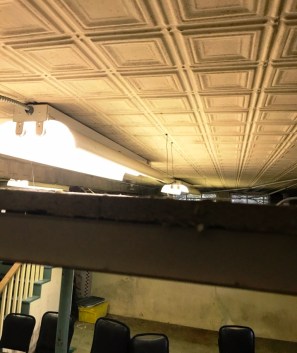
One of the “exciting pictures” Tyler studied shows the tin ceiling in the basement hidden behind a suspended ceiling.

We spent days dreaming of lighting fixtures and polished hardwood floors and furniture layouts. Truth be told, my husband also spent many hours studying the pictures we’d taken of the interior of the church and thinking up ways to run the plumbing and electrical. Because he was the real brains of this operation. I was just the grunt labor and, on good days, the window dressing. He even met with the building inspector and talked about rezoning regulations and building permits and water meters.

But as good as he was at construction projects, he was no good at waiting. We were living in a camper, and the nights in northern Illinois were getting cooler. And then colder. If we couldn’t get into the church and make it habitable, we would have nowhere to live while we worked. As the days turned to weeks, he began calling every day our real estate agent (who was earning only a tiny commission on our miniscule offer). And then he began calling the title company. And finally, he called the pastor directly.

Tracking down the proper paperwork to sell a 126-year-old building that been owned by a church that’s changed affiliations at least once and then merged with another congregation abandoning the building is tricky, it turns out. How tricky? About two months and half months of tricky.

# # #

Tomorrow: Chapter 1 concludes with an ominous request that feels like a warning. Click here to read.

Asbestos be damned

Our story so far: We figure renovating a 126-year-old Methodist church would be worth the return on investment.

# # #

The afternoon of the Tequila Budget had been six weeks before the snowflakes in the RV on Oct. 28. What had transpired in the interim was a second visit to the church, and an offer with no contingencies was made that day (asbestos be damned!), requesting a response in twenty-four hours. The church, being a church, took three days to respond, but it came in the affirmative. We were thrilled. They had accepted an offer $30,000 below asking price. We were saving money already! We had requested a closing date of no later than Oct. 31, but we emphasized we could close immediately; we had cash.

# # #

Tomorrow: The waiting is the hardest part. Click here to read.

Tequila math

Our story so far: A real estate agent showed us the 126-year-old Methodist church for the first time.

# # #

As so many others do, we left the church that afternoon with a mission. Instead of counting souls, our mission was to count our pennies. We had an hour before we were to meet my brother- and sister-in-law for dinner, so I brought a piece of paper and a pencil along with the budget from the folder of dreams we’d created a year before for the Pecatonica church. We bellied up to the bar and Tyler ordered tequila shots for two.

Tequila is my hard liquor of choice. And Tyler must have believed he needed some liquid courage.

We wrote down what would soon become known as the Tequila Budget. We estimated we’d need $5,000 to re-do the ceiling, $30,000 for an awesome kitchen, $20,000 to improve the landscaping and on and on. We talked about everything from the bell tower to the basement flooring, and when in doubt, we guessed high. And when we added it all up (I used the old-fashioned method because I didn’t have a calculator), the total sum—including 126-year-old church and brand-new attached three-car garage—came to $248,600. Which was more than $100,000 less than we’d spent on our first home together a decade previous. If we did it right, our church would have 100,000 times more character than the cardboard box in the suburbs we bought the first time.

That cardboard box served its purpose. It was in a good school district and a village with low crime so it was a good choice for our needs then: We raised Tyler’s teen-age son in it. But when my adored stepson grew up, we no longer needed such a characterless structure. We craved something unique.

A quick look at comparables in the neighborhood revealed we had enough margin to make money if we had to sell it. But by now, I had fallen in love with the beautiful bell tower and the planned quartz countertops and the warehouse-inspired bathroom makeover. I already didn’t want to sell it.

“We need to take another look at it,” my practical husband said.

And then he ordered another shot of tequila.

# # #

Tomorrow: We make an offer. Click here to read.

Like the moments between buying a lottery ticket and learning you’d lost

Our story so far: We decided to give up the nomadic life, and an old Methodist church appears in the real estate listings. Chapter 1 continues …

# # #

I had wanted to buy and renovate an old church for ages. Not as long as I had been playing office as a little girl, but for at least a couple of decades. The cathedral ceilings, wide-open loft-like layout and character details like stained glass appealed to me.

In fact, my husband Tyler and I had looked seriously at a church only a year ago. It was on tree-lined street in Pecatonica, Illinois. At the time, we had been serious enough about buying the 125-year-old structure and converting it to our home that we’d met with an electrician, a plumber, a plasterer and a window installer getting guesstimates on renovation costs; it was a zoo that day with contractors crawling around inside and outside the building. We were what they call in the trade, “serious buyers.” I wanted that church so bad then. I thought it would be the perfect answer to a wish I’d made 10 years before.

I was living a tumultuous year then. One so ridiculous and unbelievable, I wrote a book about it. But to summarize, it was the year I moved out of the house I shared with my husband of 16 years; eventually, we divorced.

Among the entries in a diary I’d kept during that time was a page where I described in list form (of course) how I envisioned the rest of my life. What is important to know is that I made this list when I was no longer coupled and before I met Tyler, the man to whom I am now married, so theoretically, this list reflected my true wishes, unaffected by anyone else with whom I might be living.

Near the top of the list, I wrote that I wanted to live in a loft in the city.

Well, that didn’t happen.

When we were considering the church in Pecatonica, we lived in a big box of a house in the suburbs. It had 9-foot ceilings and what some might consider an open floor plan, but no one would consider it loft-like.

The church in Pecatonica was a smokin’ deal, and by hot I mean it would have cost less than most cars. Let’s just say, it needed a lot of work, otherwise known as a blank canvas to take on every Pinterest dream associated with “loft,” “barn,” “converted church” and “open floor plan.” And the church was located in the center of, well, I think technically Pecatonica was a village, so “city” is a stretch, but to be fair, it was within walking distance of the post office, hardware store and local watering hole. And I thought it was destiny that I might be Monica from Pecatonica.

messy filesI kept everything about the church in a neatly labeled accordion file with folders for “flooring,” “taxes,” “real estate” and “budgets.” As we made our offer, contingent on an inspection, we also salvaged a chunk of the flooring to get it tested for asbestos. Asbestos, as you may or may not know, was commonly used in building materials in the mid-20th century. And it causes cancer.

The church flooring was full of the stuff.

So we rescinded our offer.

I was disappointed, no denying it. But for about three weeks, it was like the time between buying a lottery ticket and learning you’d lost. Those 48 hours when you might win $400 million dollars is filled with extravagant fantasies, and fantasizing is fun. So I was like, “better to have loved and lost than never to have loved at all,” you know the drill.

Back then, a year ago, we decided that instead of buying a church, we would sell our home and travel the country in our RV. So I threw my disappointed energy into cleaning out the house in anticipation of selling it. I dumped literally a ton of paperwork and went to the Goodwill at least seventeen times donating accumulated junk we would no longer need. What we valued but couldn’t bring with us in the camper, we packed into a cargo trailer.

One of the things that made its way into the storage trailer was that folder with information about a church we had decided not to buy. By every account, it was meaningless and I should have thrown it away. But I still had a secret desire for a church. I believed words had real power in the universe, and I think there’s a big difference between praying “God, just get me through tomorrow” and “God, please bless me.” One is a desperate plea and one is hopeful prayer. Words matter. Intentions have power.

Now, in the moments between looking at the Methodist church online and getting to see it in person, I remembered that folder of information about the Pecatonica church. And I thought I remembered precisely where I’d stored it. So I dug up the key to the cargo trailer, and I put my hands on that folder within five seconds of opening the door. Between the shadeless lamps and tubs labeled “winter clothes,” I’d filed the paperwork of dreams right inside the door.

# # #

Tomorrow: Our first in-person look at the old Methodist church. Click here.
Why now? And why a church?

Chapter 1

Tiny flakes of snow fell on the northern Illinois landscape when we woke on Oct. 28, 2017.

“What are doing here?” I asked out loud, not expecting any answer.

We were squatting in my husband’s second cousin’s yard, a green square acre surrounded by harvested corn fields. Our home was the 40-foot fifth-wheel camper we had been living in since January. The first six months on the road, we traveled America’s west coast visiting some of the country’s most picturesque national parks, stopping at iconic roadside sites and imbibing on coastal vineyards’ most delicious offerings.

Until the proverbial good news and bad news was delivered.

The good news was we were going to be grandparents! We were thrilled, but we also suspected our unmoored status would prove to be problematic in forging important bonds with our new granddaughter.

The bad news came in the form of a resignation. Tyler’s long-time and highly valued assistant in his business quit to pursue a full-time career. I was tapped to handle the agency’s paperwork and customer service. As a little girl, I played office at a desk with a notebook, a pencil, a telephone (connected only to thin air back then; sometimes now I wish it were still unconnected) and a stapler, so theoretically, I’d just been hired for my dream job. But juggling dozens of account and reams of files was troublesome—at best—in a 358-square-foot camper.

So we’d decided to give up the nomadic life and once again become homeowners. Weeks of scouring online real estate listings and several showings revealed only this: We couldn’t afford what we really wanted. And what we could afford would require tens of thousands of dollars in renovations to remove the previous owners’ bad taste.

Finally, we came close enough to making an offer to schedule a second showing on a tiny-but-could-be-renovated house with a miles-off view of a lake. But the showing fell through when someone else beat us to an offer.

Ugh.

That very afternoon, my discouraged-but-ever-persistent husband found an interesting listing in the commercial category of a nearby real estate firm.

An old Methodist church was for sale only a few miles from where my stepdaughter resided.

church in all its glory
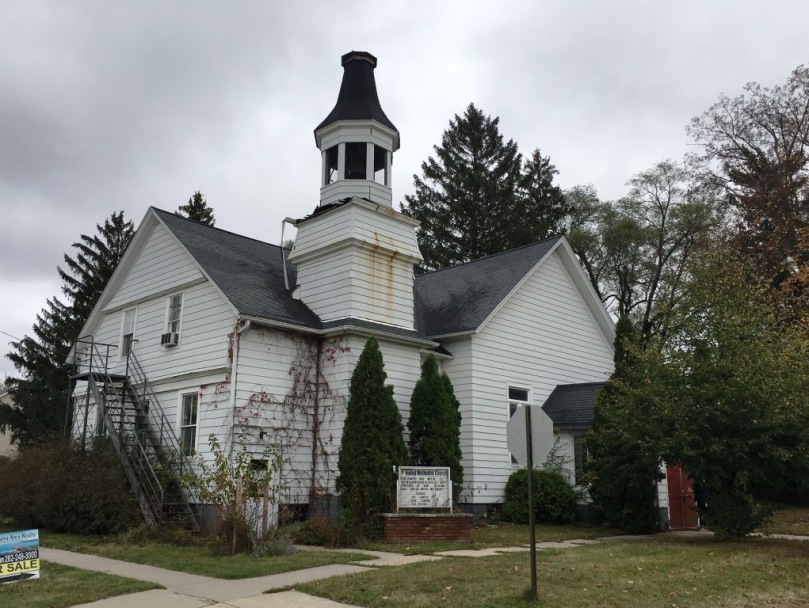
The church, in all its “for sale” glory.

# # #

Tomorrow: Chapter 1 continues with a description of a different church we almost made into a home. Click here.

And so it begins: A real-time memoir about renovating a 126-year-old church into a home

Well, we’re committed now.

Or should be.

We bought a 126-year-old Methodist church that’s been vacant for sixteen months, looks like it’s had water in the basement on a regular basis and has holes in the roof of the belfry. The pews are gone. The altar has been removed. The pulpit? Gone. (But if you need a cassette tape of an old sermon or a print of Jesus, we can hook you up.)

The church is going to be an awesome sanctuary of warmth and family at some point, but first we have to demolish the paneling, fix the leaks, install miles of PEX and wiring, and redecorate.

And I’m going to write about every last up and down. Right here. Beginning right now.

If you’re addicted to HGTV, you’re gonna love this. If you think an afternoon of “First-Time Flippers” is high entertainment, you absolutely need to subscribe. Right now. Right there–on the right. Click the “Follow Blog via Email” button.

If you think we’re nuts, we’re either going to prove you wrong, or you’re right and you’ll find this whole story amusing.

Here’s how it’s going to go down: I’m writing this blog like a memoir. It’s going to be an odyssey, no doubt about it, so someone ought to benefit from our one-way journey to house heaven or hell, I figure. But I’m doing it in more-or-less real-time. So unlike most memoirs, where the protagonist thinks about all the things she’s learned and benefits from some perspective before finishing her story, this tale will be written as it happens. Because it’s a blog afterall, and rubberneckers love a good accident. My goal is to write at least a few sentences every day.

You’re in the right place today, because the first paragraphs of Chapter 1 will be published tomorrow, and the rest of the story will unfold in serialized fashion. Future subscribers might want to begin at the beginning, but I’ll try to make that easy.

I’ve already invested in work boots, and I’m putting on my work gloves. Join me for the ride.