If it’s the right chair, it doesn’t take long to get comfortable in it

Our story so far: During a visit to see the transformation, my father installed more than fifty knobs on various cabinets in the old Methodist church we had rehabbed into our home.

# # #

Mom proved her prowess, too. She helped me unpack a dozen boxes of office supplies (yes, you might say we had an obsession with them), and she made an apple bundt cake for a pair of friends, one of whom spent her birthday paying a visit to see me and the church. I was grateful for the bundt pan I had unpacked, for my evenly heating gas stove and for the decorative cake plate on which to serve it—things I didn’t have in the camper for nearly two years.

meal and memories
Almost too pretty to wipe my hands on.

My friends gave me a housewarming gift of a candle and a hand towel that said, “Meals & Memories are made here,” an appropriate sentiment for my new kitchen.

The evening before they returned home, Mom and Dad helped us remove the super sticky plastic wrap from our balcony carpeting. Removal was as farcical as the application, but we persevered. Mom helped me assemble the legs for the balcony chairs, which I had gallantly retrieved from the store weeks before but hadn’t had a chance to put together. The engineering student working part-time at the furniture store put his know-how to use to get both balcony chairs and six dining room chairs (all in boxes) into the back of my pickup so I had to make only one trip.

balcony view
Nice view.

Mom and I recovered our breath while trying out the new chairs and taking in the balcony view.

“Now I have to find a lamp for up here,” I said.

“Where are you going to plug it in?” Mom asked.

“We have an outlet in the floor,” I said, looking down to locate it. “At least, I think we do.”

We looked between the chairs. We looked under the chairs. No outlet.

“Oh my goodness, they carpeted over it,” I said, feeling the floor to see if I could locate the outlet through the carpeting.

We couldn’t find it that way either.
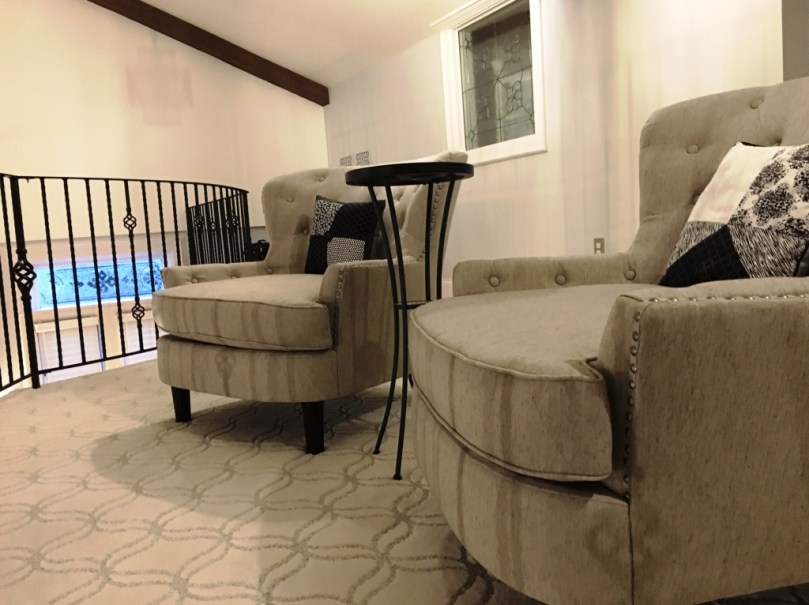
balcony without plastic
The chairs from the front side. Just makes you want to grab a cup of tea and a book, doesn’t it?

I mentioned the omission to Tyler later. “Oh, the electrician forgot that outlet,” he said. “The carpeting installers wouldn’t have known to leave a hole for it. We’ll have to do it later.”

Ah, later. Another “later” project.

First, Tyler was determined to finish his garage. But Mother Nature had other plans.

# # #

Tomorrow: Rain provides a musical break. Read about it here.
The fondest memories are made when gathered around the table

Our story so far: Room by room, the old Methodist church we’d renovated into our home was taking shape.

# # #

Once the movers completed their work, boxes literally everywhere surrounded me. I chose to start unpacking in the dining corner of our great room because we expected visitors: My stepdaughter, our son-in-law and our granddaughter were coming for dinner, and I wanted to entertain on new dining room table.

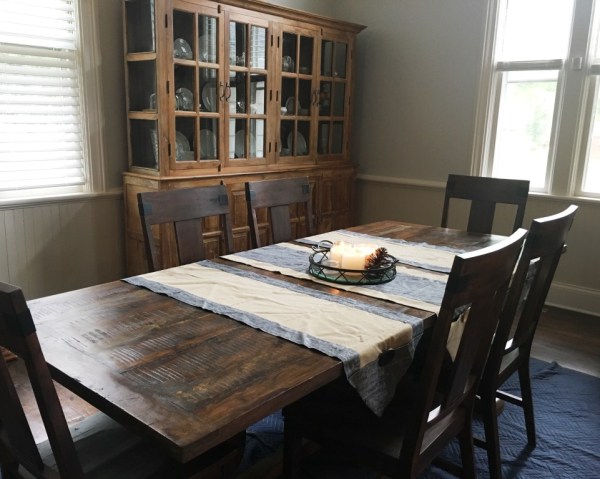
The table and a china hutch had been delivered a week before. Both were enormous, and I was glad I wasn’t one of the guys hauling it inside. We found them at a nearby importer situated on a farm in the middle of nowhere. Most of their goods were imported from Asia, so the farm had a wide selection of stone Buddas and Hindi gods, but it also offered unique jewelry, colorful dishware, one-of-a-kind furniture, hand-woven rugs and cotton bedding.

dining room table
We’ll call this the dining corner, instead of the dining room.
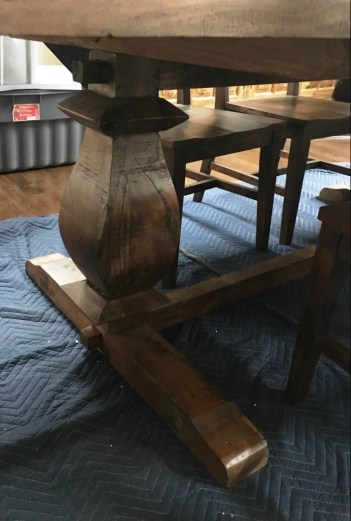
table legs
Pay no attention to the furniture pads acting as temporary rugs in the dining corner.

When we moved out of our old house, we’d vowed never to buy new unupholstered furniture again after selling off so many pieces for chump change, but the legs on the teak table at the importer were just the unique touch we wanted in a rustic table. We’d never find something so cool on Craig’s List.

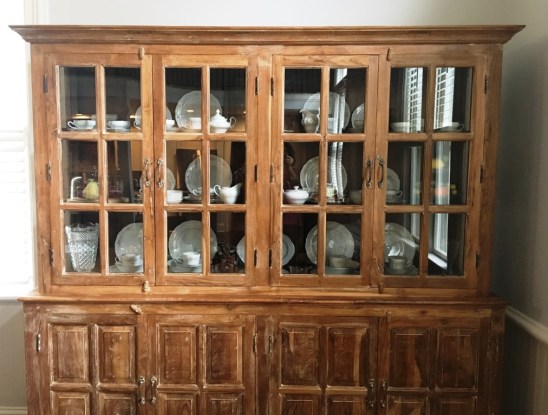
china hutch
This is the grand sight that greets me every morning as I walk out of my bedroom, and it impresses me still.
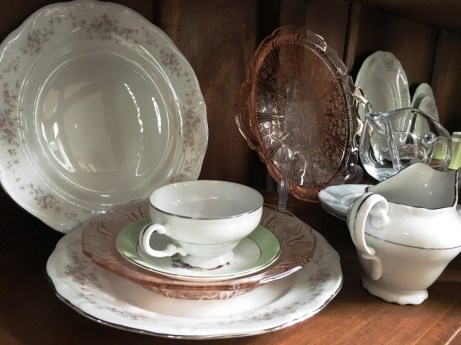
china
My china has the flowers; grandma’s has the simple silver rim.

Ditto for the china cabinet which was the perfect size for the corner of the great room. I’d never owned a piece of furniture like it, and I longed to display the china I inherited from my grandmother when she moved out of her home. As I unpacked the box of her china, a box of my own china and a box of pink Depression glassware my mother gifted me, I realized: This was a big china hutch. I had more than enough display space.

We found six dining room chairs on sale at a nearby mass market retailer. Tyler picked them out, and I was amazed at how well these chairs matched our teak table, which I dressed in table runners my mother sewed just for this purpose and a tray of candles I found among my packed dishes.

# # #

Tomorrow: Guests! Read about their visits here.


Your paperwork has been approved

Our story so far: We found an old Methodist church we wanted to turn into our home in September 2017, we took possession in November, we finished demolition in January and we spent the next seven months renovating the first and second stories from top to bottom.

# # #

Chapter 40

Tyler placed a call into the building inspector and asked him to drop by when he had a few minutes to inspect the church.

“We’re hoping to move in this week,” Tyler said.

Move. In.

We had a flushing toilet and a shower. The bedroom needed only a bed. The kitchen had a sink, a fridge and a hole for the stove. We were within a hair’s breadth of having the operational bathroom, kitchen and bedroom the building inspector told us nearly a year before that we would need before he would allow us to occupy the church.

Very early the next morning before the sun had completely risen above the horizon of the village, Tyler and I were standing in our master bedroom gazing at the ceiling where he was showing me the wonders of the high-tech rope lighting that had been tucked into the crown molding of the tray. Tyler was fiddling with the app on his phone, changing the colors like he was operating a disco ball. I spied movement out of the corner of my eye. The building inspector was standing in the doorway to the hall of history.

“Come on in,” I said. “Check out our ceiling lighting.”

He gamely observed our superfluous bedroom lighting. The last thing the building inspector cared about was our disco vibe.

I skeedaddled, leaving the foreman to show off our work and acquire a permit.

Which he did. A few minutes later, Tyler handed me a piece of paper that specified we were the proud recipients of a temporary habitational permit. All that was outstanding was listed as “life safety,” that being smoke detectors (which were installed later that afternoon) and hand rails on the stairways.

We could move in! We could move in! I carefully folded and filed our permit, smiling ear to ear.

This was the relay handoff for which we had been sprinting.

That was a Tuesday. We were allowed to sleep in the church/home, but we didn’t yet have our big, beautiful king-sized Sleep Number bed in it. With all the distractions of construction, finishing and cleaning, it would take until Saturday to move all the pieces of the bed into the chome and assemble them.

We tackled the job in relative privacy on Saturday and accomplished the task. Planning ahead, we rolled out a new rug and dressed the bed in new bedding.

With our gleaming chandeliers, the rustic feature wall and our funky night stands made out of safes, our master bedroom looked like one straight out of Pinterest.

Church Sweet Home Master Bedroom
Now doesn’t that looking inviting? We found those rustic church windows at an antique store months ago, and they’re just the right accent on that half-wall headboard. (Feel free to Pin this.)
Church Sweet Home Tray Ceiling
You’re just going to have to trust me on the tray lighting. You can’t see it in this picture, but it’s ethereal after dark.


# # #

Tomorrow: First shower. Read about it here.

You will never ‘find’ time for anything; if you want time, you must make it

Our story so far: We were seeing the pay off of months of hard work in the renovation of an old Methodist church into our home.

# # #

clock
Time will tell.

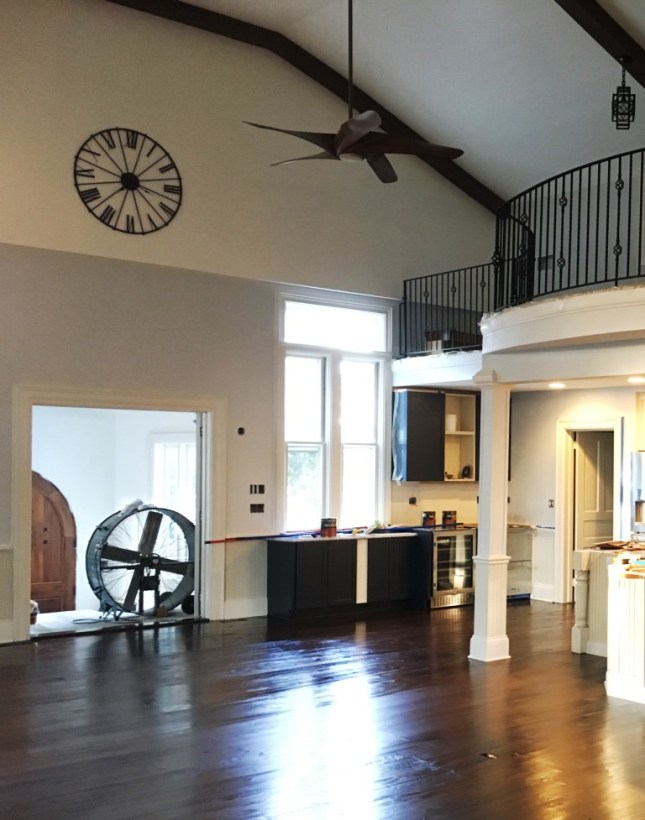
Another small detail that caught the eye of a lot of people who looked at images of our floors was the clock we put up above the interior entryway doors.

I coveted a clock like this even before we purchased the church. If you watch “Fixer Upper” even a couple of times, you’re bound to see a clock—usually with hard-to-decipher Roman numerals because it doesn’t even matter if you’re using it to tell time—in the After reveal; “oversized clock” was listed in our design style. When I found an airy, wrought-iron clock in the showroom of our glass guy, I purchased it on the spot.

Originally, I had planned to put it up on the fireplace, but we decided we had enough going on up there. We enlisted You-Can-Call-Me-Al, who could be depended on for straight-and-level installation, to put it up inside the interior entryway doors. Many more items would be hung on the walls in future weeks, but this one went up while we still had tall ladders at the ready.

# # #

Tomorrow: Blinds. Read about them here.

This porridge is too hot, this porridge is too cold but this one’s juuusssst right

Our story so far: A chance encounter led me to a tiler who was willing to take on our extra-large master bathroom shower in the old Methodist church we were turning into our home.

# # #

After a little back and forth over the course of a week or two, we agreed to provide all the materials per You-Can-Call-Me-Al’s specs, and he would perform the work to be paid by the hour.

This meant we would have to buy a custom glass door and have it installed. Which meant visiting with another contractor. One lead led to another, but after I defined my wishes with a glass expert, he sent me a quote. Besides the door, another half wall was included which was more affordable than two glass walls but still lux.

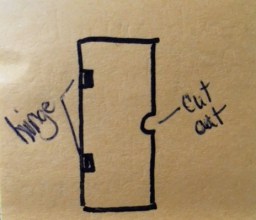
shower door sketch
Top-notch graphics.

In the middle of these negotiations, we saw a “Fixer Upper” episode in which the shower door had a cut-out in the glass instead of the handle. Very trendy. I inquired about this, and by gum, the glass expert could do such a thing. For a price, of course.

In the end, we’d have nearly exactly the master shower we’d envisioned: Extra-large and airy.

The only do-it-yourself part would be the shopping.

You-Can-Call-Me-Al suggested buying tile at a Big Box store because if he ran short, it would be easy to get more. If, on the other hand, we found something special-order from Spain, well, then we might have problems.

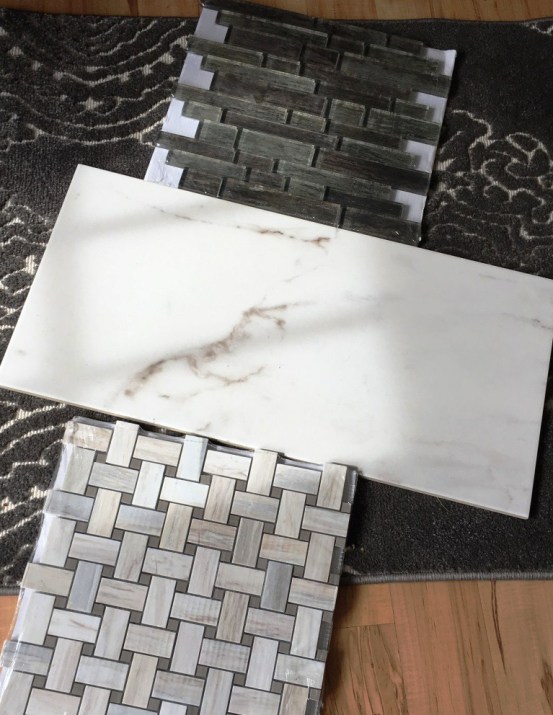
So I went to Home Depot (again) and made like Christina El Moussa from “Flip or Flop.” I juggled samples on the floor of the store and settled on three: One for the floor of the shower, one for the walls, and one as ribbon accent. I bought one of each and brought them home to the rental house to sell the salesman on them. He was no Tarek, but then he had no reason to gripe—let’s be honest, I choose options available at a Big Box store—Tyler agreed to my vision.

tile choices
This is definitely one project I can’t wait to see finished. From top: accent ribbon, wall tile, floor tile.

All told, our extra-large master shower would cost us about $7,000. Plus plumbing and fixtures.

# # #

Tomorrow: Ah, the fixtures. Like everything else in a home remodeling project, the choices can overwhelm. Read about it here.

Tell me a (color) story

Our story so far: My husband and I created a design plan for the renovation of the old Methodist church we planned to turn into our home.

# # #

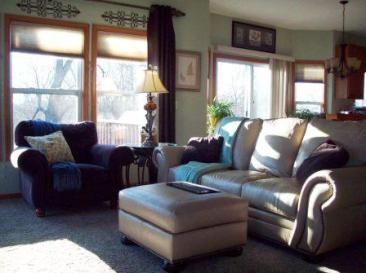
sofa-blog
Our former living room: Purple chairs, purple curtains, purple pillows (and that doesn’t even count the purple wall which didn’t make it into the picture).

And finally, I defined our color story. Color was the easiest way to create a cohesive space, and this part of the design dossier was probably most important in keeping us (me) on task. When we moved out of our previous home, I was appalled at how many purple home décor items I’d accumulated. It all began with a pair of microfiber purple chairs we’d chosen for the living room. They wore like steel and lasted through a redesign of the room, which included a purple wall in the kitchen. After that, I’d unconsciously chosen a purple rug, purple placemats, a purple bedspread and purple candles. Too much of a very distinctive color!

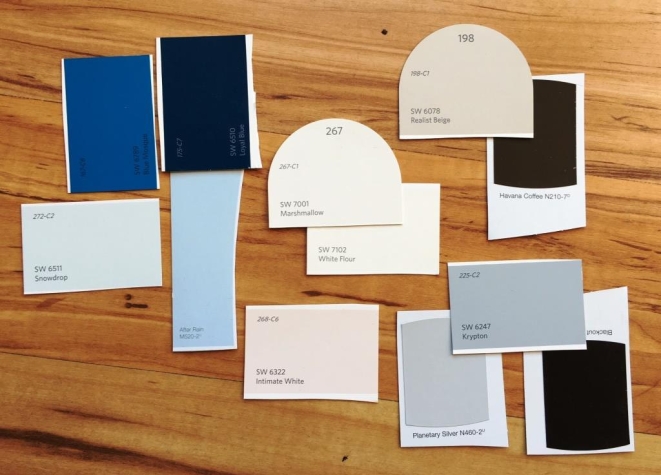
color story
Paint chip mania!

When I thought about our church, I wanted a more neutral background. Though I used words (“black and white, cream and chocolate brown, grays, light blues and aqua with occasional turquoise”), I knew actual color samples would be most useful in practice, so I cut apart a paint chip book (several, actually) to create a visual. The chips I chose had evocative names like marshmallow, snowdrop, planetary silver, Havana coffee, after rain and blue mosque. I decided a limited color palette would be most interesting with an array of textures: Metal, glass, wood and fur.

We referred to this document many times as we determined our floor plan, and we would be referring to it many times more as we made decisions about flooring, fixtures and furniture. The fun was beginning.

# # #

Tomorrow: What’s the buzz? Tell me what’s a-happening. Read it here.

If it’s not in the mission statement or the summary, check the 10 commandments

Our story so far: As we pondered how to wire and plumb the old Methodist church we planned to turn into our home, we created some guidelines for designing it.

# # #

Our brand personality would be a balance of necessity and luxury, of industrial and homemade, of modern and classic, of masculine and feminine, leaning toward economical, casual and subdued.

And then I wrote down ten design rules:

  1. Details matter.
  2. Rest Room Signed door
    This door, formerly on the basement bathroom, could be reused as the powder room pocket door on the main floor. After it gets some TLC. That’s the plan anyway.

    Recycle, reuse and repurpose whenever possible.

  3. Natural lighting brings the outdoors indoors.
  4. Build storage into every room. Two closets, two cupboards, two hooks, two nooks are better than one.
  5. Accent walls create a center of focus.
  6. Doors and doorways should be beckoning and give some clue as to what’s behind them (think: frosted glass with the word “laundry” and design that reflects the room within).
  7. Artwork should be graphic, realistic (think: photographs) or abstract. Large object art and quote art—words, saying and verses—should be used liberally.
  8. Flooring should be hardwood and/or tile with durable rugs made of natural fiber, jute and sisal.
  9. The two rooms we spend the most time in—kitchen and master suite—should be most luxurious and elegant.
  10. Curb appeal is worth spending money on. The front door sends a message. Our entryway should be functional and welcoming.

# # #

Tomorrow: We wrap up Chapter 13 with the color story. Read about it here.

Some places speak distinctly

Our story so far: We developed a mission statement for our design style in the converted church that emphasized comfort and order.

# # #

After researching interior designs styles on the internet and being tempted but ultimately rejecting words like bohemian and eclectic, I settled on this summary of our style:

Our decorating style is
rustic transitional
punctuated with elements of
warehouse,
farmhouse,
barn house and
house of worship.

Rustic transitional: Note that transitional is the noun, rustic the modifier. Transitional is defined as bridging contemporary and traditional design with inspiration from the industrial era, heavy emphasis on an open floor plan and leaning toward clean, straight lines but incorporating thoughtful details. Refined would be balanced by raw. The adjective rustic suggests elements such as exposed bricks, stone, raw steel, rough-hewn or distressed wood and metal, especially tin, aluminum and wrought iron or rusted metal.

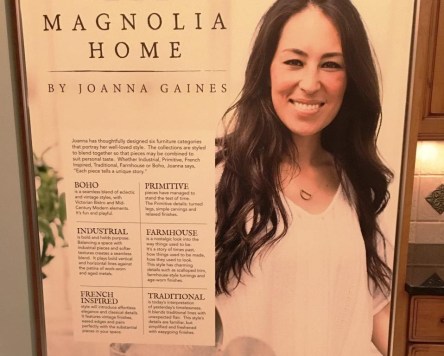
Joanna Gaines Furniture Style
“Fixer Upper” star Joanna Gaines combines a variety of distinctive styles in her furniture line, I discovered in this banner at a furniture store I happened by.

What was warehouse? Think of a warehouse loft with open space, exposed steel, exposed brick and industrial light fixtures. Salvaged architectural pieces, especially antique doors. What parts of warehouse did I want to avoid? Nothing cold, greasy or noisy.

For me, farmhouse was an antique flea market look showing signs of wear. Distressed wood. Oversized clocks. Vintage mirrors. Candlesticks. Elements needed to be functional but should be soft and opulent. Not: Mason jars, cute cows or country tchotchkes.

Converted barns had that same open space as lofts and warehouses, but barns also had exposed wood beams, hearths, barn doors and large chunky pieces. Oh, and animals, which I would incorporate with faux animal hides. What of barns did I reject? Anything dirty. Not our aesthetic. Especially not for a Virgo.

And naturally, the inside of our home would have to reflect the outside. It was a house of worship, so we would adopt the belfry and bells of all kinds, organ and piano elements, pews, niches, large windows, stained glass and flowing water (which brings to mind to baptism and new beginnings). Crucifixes were OK, I decided, but not to excess; no Virgin Mary statues in the garden.

# # #

We can thank poet Robert Louis Stevenson for today’s post title.

Tomorrow: Our design style even had a personality. And ten commandments. Read about them here.

The mission, should you choose to accept it, is to create a home

Our story so far: On the verge of making irreversible decisions about everything from lighting to flooring, I set out to write a design guide for my husband and I to follow as we transform the old Methodist church into our home.

# # #

I began with a mission statement:

We strive to create a comfortable sanctuary in the modern world, built solidly and maintained orderly.

Comfort was the first adjective for a reason; my husband and I didn’t want an art house that required ramrod posture and scared visitors away. Sanctuary was a good word with two meanings: Churches had sanctuaries, and sanctuaries were places of peace. With this intention, I created my first mantra to carry me through the construction phase when things got tough: “We live in a church. Let’s practice peace.”

After living in what we repeatedly referred to as a cardboard box for a decade, Tyler and I both lusted for solidity. Hollow-core doors, paper-thin walls and plain vanilla details were created for the masses; we wanted something a craftsman from a century ago would have created to persevere through a F5 tornado.

Though I was a slob to my core, I knew my husband was a Virgo who valued order so creating an orderly home with lots of storage and easy ways to hide away mess was important.

# # #

Tomorrow: Our design style, summarized. (I tell you, it’s like poetry.) Read it here.

How to create a style guide for your home remodeling project

Our story so far: My husband Tyler and I bought an old Methodist church to renovate into our home, and after the lion’s share of interior demolition to create a blank slate, we are faced with ten thousand decisions about finishes.

# # #

Up until I turned 50, I was happy to let my first husband decorate the house during my first marriage, and then with Tyler, we literally outfitted the first home we purchased together in the space of six weeks by shopping mostly at big-box stores. We were busy people then, and raising a teenager was our priority.

Now, as I pondered the design of our new home, I decided a vision board was in order. The array of options on display at Home Depot, Overstock.com, lighting stores and the various architectural salvage warehouses we visited overwhelmed us. We needed a method of narrowing down our options so we could actually make decisions when the time came. While Tyler pondered ways to install plumbing and electrical when we began our project, I meditated on the finishing details.

I began with my tool of choice: Words.

When I was a brand manager for a major scrapbooking company some two decades before, I had created style guides for logo use, brochure creation and scrapbook page design. These guides helped far-flung marketers and designers all over the world adhere to a coherent brand message about the company’s products. So I drew on that experience to write a style guide for our new house that would help Tyler and I create a home with a unified design.

First, I channeled my inner Joanna Gaines. She was the design guru behind HGTV’s “Fixer Upper” who managed to infuse her modern farmhouse spaces with clean lines, airy color palettes and recycled shiplap. Her “less is more” attitude inspired me, and her home design jibed with the way I had learned to design newspaper pages back when I was a newspaper copy editor: Form follows function. This principle says the shape of something (a building or a brochure or whatever) should be primarily related to its intended function or purpose. In other words, regarding architecture, don’t design a ballroom for a couch potato, and do build bookshelves for a bibliophile.

Then I invested in an armload of home decorating magazines and spent hours flipping through ideas on Pinterest [I have a Church Sweet Home board on Pinterest you can follow if you’re interested—just click on the Pinterest logo in the right column].

With my concepts in mind, I interviewed Tyler. After all, he was going to live here, too. A focus group is simple to assemble when there are only two people in the group. I asked him questions like “How do you want your kitchen to look?” “How to you want to feel when you walk in the front door?” “What colors do you hate?” and “What one word would you use to describe your style?”

Then I put pen to paper (fingers to keyboard, actually), and began.

# # #

Tomorrow: The mission statement of our home style. Read it here.