Now here’s a home contractor you’ve probably never heard of before

Our story so far: My husband Tyler agrees with me that his DIY solution to the disintegrating belfry in the church we planned to convert into our house was ill-conceived.

# # #

First Tyler called three area roofers. Roofers have no fear of heights. Or, at least, they have the equipment to mount such a repair on a 30-foot high belfry. Keep in mind, we didn’t even officially own the property yet. Tyler, with his salesman-like charm, persuaded the roofers to have a look. One of them actually followed through, submitting a quote by email for reroofing the entire church.

Um, that’s not what we want. We wanted you to reroof the belfry.

Tyler was undeterred (which is what we would need if we ever hoped to finish this project). He discovered an entire profession created for just such a project: Steeplejacks.

A steeplejack is a craftsman who scales tall buildings to carry out repairs on chimneys, church spires, cupolas, clock towers and, fortunately for us, bell towers. And they have an association, too. Alleluia!

The first steeplejack Tyler contacted looked at the pictures of the belfry and provided a highly detailed quote within a week for ten times what we’d estimated in our Tequila Budget.

We wanted to cry. That figure was more than we were paying for the entire church building!

Tyler didn’t give up, though, and the second steeplejack—a pro with a mission who signed his quote with “in His Service”—confessed he couldn’t promise he could do it for less than the first quote until he could climb up there and see what was going on. Just erecting the scaffolding would take a day to accomplish. Besides paying for him and two assistants (at $2,400 a day), we’d have to shell out for the materials of course.

Of course.

But we loved our bell tower (or, at least, the bell tower that would soon be ours). And I loved my husband. Avoiding having his broken body at the bottom of a set of rickety steps was worth $2,400 a day to me.

And, as if guided by a divine scheduler, the pro with a mission would be available in November.

This coincidental schedule opening only made us more impatient to close on the church. But perhaps the divine scheduler could see a bigger picture than we could.

# # #

Tomorrow: Chapter 4 opens with a debate about our plan to get the church livable. Read it here.

Real DIYers don’t shy away from rotted belfries

Our story so far: A cursory inspection reveals the roof of the belfry in the church we planned to buy was in terrible, possibly dangerous condition.

 # # #

stairs
Stairway to heaven? These were the exterior stairs Tyler described using to repair the belfry.

Initially, in the privacy of our bed in the early morning hours as we dreamed of our church, Tyler cooked up the idea that he could use the emergency stairs that were attached to a different side of the house to repair the belfry himself. He described in alarming detail how he could move the stairway around the building, climb up twenty-five feet, deconstruct the belfry piece by piece around the bell and rebuild the roof.

In November.

I forced him to recount his brilliant plan in excruciating detail to both of our children in the hopes that they would dissuade him of such lunacy (again with the crazy!).

The light of day and after the encounter with Stan the mummified squirrel when Tyler had gotten a good look at the damage, he realized we needed to get professionals involved.

# # #

Tomorrow: A mummified squirrel is nothing compared to the terror of a quote on belfry repair. Read it here.


Tools required to check for rot in a belfry: Haz-mat suit and courage

Our story so far: The seller of the church we wanted to buy and convert into our house disclosed the belfry was “rooted.”

# # #

On our third showing of the church, which occurred while we were still waiting for the title to clear and we talked our real estate agent into letting us in again despite the prospect of the tiny commission, my enterprising husband packed a hazardous materials suit, goggles, a face mask and a big flashlight. Oh, and a hammer.

He donned his apparel—what a dashing figure, not too unlike the Stay Puft Marshmallow Man—and climbed a step-ladder in the closet on the second floor that led to the belfry. A couple of whacks at the trap door, and he was inside.

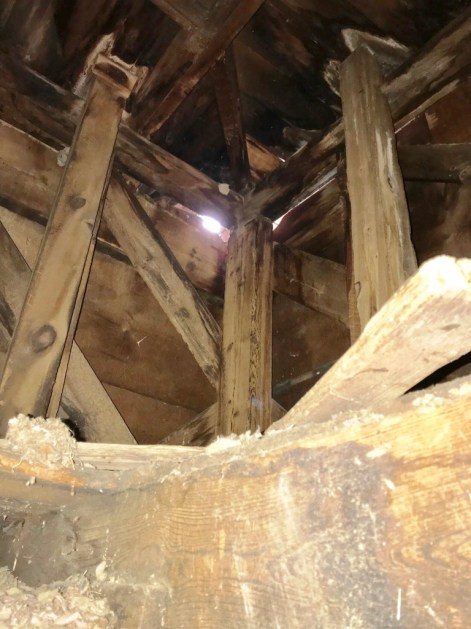
daylight in the belfry
Here’s what the inside of a very old belfry looks like. That bright light in the center of the picture? Daylight shining through the roof beneath the bell.

Unfortunately, he could see the sky. Coffee-can sized holes dotted the perimeter of the roof around the bell. On days with worse weather, rain was probably pouring into those holes. And who knows what else!

Well, we found out what else.

Stan
Here’s what a very mummified squirrel looks like.

Stan the squirrel.

The mummified and dust-covered rodent’s wide-open mouth betrayed the terror he must have felt in his last moments.

The real estate agent and I were standing along the far wall while Tyler poked around. We had no interest in coming face to face with a bat.

Tyler found Stan. But he didn’t find any bats.

Oh, joy! We didn’t have bats in our belfry after all! (I told that joke ad nauseam for days afterward. And I’m not promising I won’t use it again.)

# # #

Tomorrow: Tyler cooks up a plan to repair the belfry. Read it here.

Not every dream home features a belfry, but ours did

Our story so far: We found the home of our dreams, only it was a 126-year-old Methodist church that needed a lot of work, so much work, in fact, our friends thought we had bats in our belfry.

# # #

Chapter 3

The belfry had the potential to be our first money pit.

A belfry is the part of a bell tower or steeple in which bells are housed.

Ask not for whom the bell tolls. It tolls for thee.

Bells toll. Pay the toll. Bad things take a toll. Was there a message here?

Originally, the seller wanted the bell excluded from the sale of the church building. But with a little bit of research on eBay, my husband convinced the congregation that removing the bell would probably cost more than it was worth. So when they accepted our offer, which included the bell, we were thrilled to become its new owners. But it was going to exact a toll.

our-rooted-belfry.jpg
Our “rooted” belfry was in visibly poor condition, especially the roof just beneath the octagonal bell tower.

Without any inspection, we knew the belfry had problems. The seller had disclosed it was “rooted.” We hoped it was “rooted,” actually. My husband, ever the insurance agent, had visions the tower would fall down and we’d be liable for killing someone. Being solidly rooted is what we wanted in a good belfry.

But the roof of the belfry was indeed problematic, which was obvious even from 25 feet away on the ground. Shingles were curling all around the edges, and a piece of flashing was tearing away.

# # #

Tomorrow: A closer inspection is in order. Click here to read.

As it turns out, a fatalist finds a home in this church

Our story so far: Despite the raised eyebrows of our friends, I was sure a converted church would make a divine home, and I talked my husband into taking on the project.

# # #

I especially scoffed at the notion that a church might be haunted. One naysayer asked if I was going to burn sage.

Harumph. Sage. No.

Why would ghosts want to haunt a church? Only someone who didn’t attend church would suggest such a thing.

Church buildings are places of joy. Babies get baptized in churches. Couples get married. Children sing songs, and people celebrate holidays and anniversaries. Yes, people have funerals in churches, too. Funerals are sad. But people who have church funerals believe they’re going to heaven; they’re not going to hang around a church pissed off about the afterlife. And we had established, as definitively as you can without breaking ground, that no cemetery had ever been part of the property so we were confident we wouldn’t have a Poltergeist incident.

(Then I looked up what a sage smudging ritual involved. Sage smoke absorbs conflict, anger, illness or evil, according to Google. Couldn’t hurt to take an metaphysical shower, right?)

I have been accused of being naïve Pollyanna, so maybe when I said I was convinced we could successfully tackle this job, save money in the process and love our new digs, well, maybe I was wrong.

But I was also a fatalist who believed it did no good to resist the inevitable. Any house we purchased, or any lifestyle we adopted for that matter, could get us killed or cost us money or make us miserable if that’s what the future had in store for us. Not to mix my metaphors, but if we were going to go down in flames, we were going down in a church.

# # #

Tomorrow: Chapter 3 opens with a look into the maw of our first potential money pit. Click here to read.

We’re committed. Or we oughta be

Our story so far: A 126-year-old church for sale is the right location for the right price at the mostly right time.

# # #

When we told people we were buying a church, sometimes they reacted with envy. “Oh, that sounds like an absolute dream!”

Sometimes they reacted with horror. “Why would you want to live in a church?”

Whether they verbalized it or not, everyone thought we were crazy. “Sounds interesting. Good luck.”

“Interesting” was the Minnesota Nice way of saying “scarier than three feet of wet snow on Oct. 30 when the snow blower’s broken.” Even if they didn’t say “interesting,” I could see in their eyes they thought we were crazy.

We were a couple in our 50s who were enjoying a second marriage. Which is to say, we had already thrown a couple of partners to the curb for various infractions. If a remodeling project was capable of breaking up other marriages, ours was not immune. And maybe we weren’t up to the task physically. Tyler had tackled a similar whole-house remodeling project decades earlier, and he triumphed with a palatial result. But he wasn’t 20something anymore and not all of his body parts were natural. And I had never been able to lift more than 30 pounds at a time. Our joints crackled like crisped rice cereal and our butts had spread like so much peanut butter.

Of course, besides the collateral damage to our relationship and our bodies, there was the financial risk. What if there were termites? What if the foundation was cracked? What if the wiring was so ancient it would have to be completely updated? These sorts of dilemmas cost money. A lot of money.

Maybe we were crazy.

But I didn’t think so.

# # #

Tomorrow: How I talked my husband into buying me a church. Click here to read.

A remodeling mantra only a Tom Hanks fan could love

Our story so far: The owners of the church struggle to come up with the paperwork to sell it.

# # #

When our offer was about to expire on Halloween, the seller ominously requested two more weeks. All Hallows’ Eve, or the evening before All Saints’ Day known popularly as Halloween is the time in the liturgical year dedicated to remembering the dead, including saints (“hallows”), martyrs and all the faithful departed. Though frustrated, we didn’t want our deal to die. We were faithful. But the “two more weeks” sounded like a warning.

Home remodeling fans surely recall the infamous line from Tom Hanks in the movie “The Money Pit.” Everything was going to take two weeks. Construction. Reconstruction. Repairs. Finishing. Everything was “two weeks.” In the beginning, the unfortunate home owner played by Hanks asks a contractor, “When I do get the permits, how long will the job take?”

“Two weeks,” the contractor says.

“Two weeks? Two weeks?”

“You sound like a parakeet there. ‘Two weeks! Two weeks!’” the contractor mocks.

“Well, two weeks. It—it’s amazing,” says Tom Hanks’ character, shaking his head.

“’It’s amazing’ nothing,” the contractor says under his breath as he drives away in a pickup truck. “It’ll be a regular miracle.”

At this point in the game, we were depending on that miracle. Because without it, our water lines in the camper were going to freeze and we’d be two shivering homeless grandparents-to-be.

# # #

Tomorrow: Chapter 2 opens with a meditation on the meaning of crazy. Click here to read.

Patience is only a virtue on balmy breezes

Our story so far: We make an offer on the church and set a closing date of no later than Oct. 31.

# # #

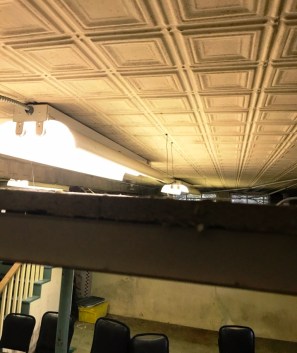
exciting picture of ceiling
One of the “exciting pictures” Tyler studied shows the tin ceiling in the basement hidden behind a suspended ceiling.

We spent days dreaming of lighting fixtures and polished hardwood floors and furniture layouts. Truth be told, my husband also spent many hours studying the pictures we’d taken of the interior of the church and thinking up ways to run the plumbing and electrical. Because he was the real brains of this operation. I was just the grunt labor and, on good days, the window dressing. He even met with the building inspector and talked about rezoning regulations and building permits and water meters.

But as good as he was at construction projects, he was no good at waiting. We were living in a camper, and the nights in northern Illinois were getting cooler. And then colder. If we couldn’t get into the church and make it habitable, we would have nowhere to live while we worked. As the days turned to weeks, he began calling every day our real estate agent (who was earning only a tiny commission on our miniscule offer). And then he began calling the title company. And finally, he called the pastor directly.

Tracking down the proper paperwork to sell a 126-year-old building that been owned by a church that’s changed affiliations at least once and then merged with another congregation abandoning the building is tricky, it turns out. How tricky? About two months and half months of tricky.

# # #

Tomorrow: Chapter 1 concludes with an ominous request that feels like a warning. Click here to read.

Asbestos be damned

Our story so far: We figure renovating a 126-year-old Methodist church would be worth the return on investment.

# # #

The afternoon of the Tequila Budget had been six weeks before the snowflakes in the RV on Oct. 28. What had transpired in the interim was a second visit to the church, and an offer with no contingencies was made that day (asbestos be damned!), requesting a response in twenty-four hours. The church, being a church, took three days to respond, but it came in the affirmative. We were thrilled. They had accepted an offer $30,000 below asking price. We were saving money already! We had requested a closing date of no later than Oct. 31, but we emphasized we could close immediately; we had cash.

# # #

Tomorrow: The waiting is the hardest part. Click here to read.

Tequila math

Our story so far: A real estate agent showed us the 126-year-old Methodist church for the first time.

# # #

As so many others do, we left the church that afternoon with a mission. Instead of counting souls, our mission was to count our pennies. We had an hour before we were to meet my brother- and sister-in-law for dinner, so I brought a piece of paper and a pencil along with the budget from the folder of dreams we’d created a year before for the Pecatonica church. We bellied up to the bar and Tyler ordered tequila shots for two.

Tequila is my hard liquor of choice. And Tyler must have believed he needed some liquid courage.

We wrote down what would soon become known as the Tequila Budget. We estimated we’d need $5,000 to re-do the ceiling, $30,000 for an awesome kitchen, $20,000 to improve the landscaping and on and on. We talked about everything from the bell tower to the basement flooring, and when in doubt, we guessed high. And when we added it all up (I used the old-fashioned method because I didn’t have a calculator), the total sum—including 126-year-old church and brand-new attached three-car garage—came to $248,600. Which was more than $100,000 less than we’d spent on our first home together a decade previous. If we did it right, our church would have 100,000 times more character than the cardboard box in the suburbs we bought the first time.

That cardboard box served its purpose. It was in a good school district and a village with low crime so it was a good choice for our needs then: We raised Tyler’s teen-age son in it. But when my adored stepson grew up, we no longer needed such a characterless structure. We craved something unique.

A quick look at comparables in the neighborhood revealed we had enough margin to make money if we had to sell it. But by now, I had fallen in love with the beautiful bell tower and the planned quartz countertops and the warehouse-inspired bathroom makeover. I already didn’t want to sell it.

“We need to take another look at it,” my practical husband said.

And then he ordered another shot of tequila.

# # #

Tomorrow: We make an offer. Click here to read.