Our story so far: Choosing rugs to cover the hard-earned refinished wood floors in the old Methodist church proved difficult.
# # #
I agonized for weeks leading up to the move about the color scheme for our master bedroom, mostly because I was too cheap to buy new sheets. We had good quality sheets for the king-sized bed in khaki and in a white-and-blue print. Either would work just fine in our master, but I didn’t have a decent quilt to match. (I was the sort of woman who liked to match her bra and underwear to match, too, even though almost no one but ever saw them.) I ended up with an all-white bed-in-a-bag with a comforter, knowing I still wanted a lighter quilt to fold at the foot of the bed (eventually, I found a great deal on a navy blue one). Maybe later I’d invest in some more printed pillow cases.
I settled on a mottled gray, black and turquoise rug. We also bought a matching runner for the Hall of History, which was right outside the bedroom. The runner was so wide, it covered up all the interesting paint we left on the floor, so I moved it into the bedroom as a path to the bathroom (so main rug was right size, runner was wrong size, at least for its intended purpose). Of course, this meant making another choice for the Hall of History at some point—ugh.
Our story so far: My husband and I had renovated an old Methodist church into our home, and now worked to make it cozy.
# # #
Floor coverings. Oh, you’d think we had the most difficult part done once Tyler applied the last coat of polyurethane to the refinished floors, but no. Wood floors are oh, so chic, but they are not cozy. Rugs are de rigueur, and choosing rugs is not for the timid. Google “how to choose a rug,” and you’ll get 113 million pieces of advice. Tips on finding the right size sift to the top, so anyone with access to the internet and a few minutes of time can figure that out. Choosing a material, a design and a color proved to be paralyzing for me. These were not towels or curtains that could be easily changed if they were wrong—a properly sized rug covered a lot of real estate. And if I didn’t like what I purchased, cha-ching. Good rugs weren’t cheap.
The first rooms to get rugs were the bedrooms (which saved us the trouble of having to move beds). Tyler’s favorite approach—shopping Amazon—led him to Houzz, where he found the rugs for the second floor guest room and our master suite. He parsed through hundreds of options, narrowing them to three, and made me choose.
On the second floor, where the trim was white and the walls were gray as in the rest of the church, my accent color was seafoam green. I knew I wanted to use a handmade quilt I’d won in a raffle on the bed (it was quite a prize for $5 in raffle tickets), and its main color was crimson, so a version of green would complement it. I also planned to put my antique steamer trunk at the foot of the bed, and Tyler had once had it painted for me by a Rockford, Illinois artist as a gift; the color scheme was cream and blue and seafoam green. For the rug, I chose a muted tradition design in gray and greenish, big enough to cover the floor beneath the bed and the walkway to the bathroom.
Here’s a look at how the second story looked when we first took ownership of the church.And here is how it looks now, complete with rug. The door on the left leads to the bathroom, the little door on the right leads to the playhouse under the eaves and the white door on the far right is the belfry. (A different headboard is in store.)
# # #
Tomorrow: A rug for the master. Read about it here.
Our story so far: We moved into the old Methodist church we renovated, and commenced with installing creature comforts.
# # #
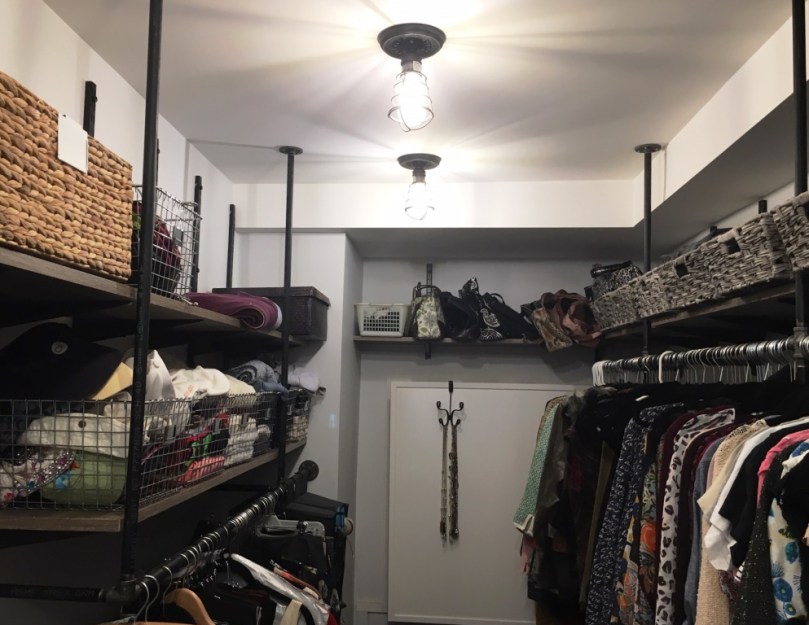
One weekend morning, Tyler and I installed shelving inside our master closet. The closet rods were great, but only half the story. Shelving was necessary to make the space above our heads useful. Much measuring, sawing and drilling ensued, but we accomplished this necessary project, too, with only one mishap. While sawing a hunk of shelving on a table saw, Tyler lost his grip and the hunk hurled itself into his stomach. “Ooph,” he exclaimed in a manner eerily similar to Skipper on “Gilligan’s Island”; for a week, he had a perfectly rectangular bruise across his torso (fortunately for me, I earned no blame in this). Just another badge of honor earned by renovating a 126-year-old church.
With shelving and coordinating baskets installed, my master closet could now neatly contain all my purses, scarves, workout gear and swimwear.
# # #
Today’s headline is a line from the ’60s television show “Gilligan’s Island” uttered by Skipper, to which Gilligan replied, “I do know one thing. You take up more of it than I do.”
Tomorrow: Choosing a rug is hard. Read about it here.
Our story so far: We continued to make ourselves at home as we added cozy and convenience touches to the living space inside the former Methodist church, now our residence.
# # #
As all of our cabinets were brand new, none of them had any sort of sophisticated organizers beyond shelving. One evening, early in our residency, Tyler and I addressed the storage situation inside the kitchen island.
That space beneath the tongue of the island would have been a lot of square footage to leave empty. See one of the cabinet doors we installed on the right.Lazy Susan, at your service.
As a display kitchen, the supporting structure to the tongue of granite that was a seating area was nothing more than pretty support. But in our real kitchen, where we had no lack of serving bowls and trays, that space could serve as storage—if only we could get to it. Tyler installed three cabinet doors, but the interior was so deep, even I with my freakishly long arms could not reach the back of the cabinet. So he ordered a two-deck lazy Susan. It was a bit of a trick getting the pieces through the narrow cabinet doors and reassembling it again inside, but we triumphed, and all that hidden space became useable.
Dad also helped a lot when he visited by installed the tip-out trays in the bathroom vanity and a number of wire racks inside various cupboards to contain spices, glassware and rolls of tin foil and plastic.
Not too high, not too low–Dad installed these racks juuuuust right so the spice bottles would fit and the door would still close.
# # #
Tomorrow: Master closet shelving. Read about it here.
Our story so far: Having moved into the old Methodist church we had renovated into a residence, we now were working on making it a cozy home.
# # #
I began establishing cozy in my office. Guests wouldn’t be using this space, but I would—every day.
In our previous house, my office occupied the smallest bedroom. It was usually filled to the top with paper of all sorts—books, magazines, files, notebook paper, printing paper, loose papers, mail, greeting cards I treasured, greeting cards to send and stationery … I was a papyrophiliac. And it drove Tyler just a little bit crazy. He successfully encouraged me to upgrade from newsprint to digital editions of my favorite newspapers (yes, I subscribed to two), but I still adored paper anything and hesitated to let it go.
When we moved out of that house, I trashed and shredded a literal ton of paper. The experience was freeing. I felt so much lighter in a physical sense and a spiritual one, too, but I getting rid of a lot of paper didn’t mean I wanted to get rid of all paper.
I stored some of that treasured paper (books, primarily) and lugged around the rest of it in the RV we lived in for nearly a year. My desk in the RV was a corner desk—literally a triangle that had enough space for my computer and a pen caddy. It was difficult working that way, and when we finally moved into the church I got grumpy having to unpack and put together other rooms before doing my office. I longed to have my own paper-centric space back.
We chose the back corner of the second floor for my office because most of the time, no one but me would ever see it (paper piles everywhere—how fun!). My nook had a window overlooking the elementary school playground across the street. The sound of children’s voices made me happy and reminded me of how the window in my old office overlooked the basketball court in our former neighbor’s driveway where children frequently spent time throwing baskets.
When I finally had time to assemble my desk, the hardest part was finding all the parts. My desk was actually two desks made of sheets of glass and a whole lot of metal tubing. At first I feared I was missing some of the legs but a little digging revealed the missing parts in the closet—maybe the movers stashed them there, or maybe I did and I forgot. So many moving parts.
I spent the day with an Allen wrench and successfully reassembled both desks and they fit in a perfect L-shape in the corner. When my mom visited, we unpacked a dozen boxes labeled “office supplies” into the eaves behind my desk, and ta da, I had a real office again with a real desk and plenty of room to pile up paper. I was in heaven. Well, if not heaven, I was enjoying the rarefied air of the second story of an old church, and that was just fine.
Here is how the space my office is now looked back when we first bought the church.And here’s my office now.
# # #
Today’s headline is a quote credited to genius physicist Albert Einstein.
Tomorrow: Where will the books go? Read about it here.
Our story so far: My husband worked on an attached garage for the old Methodist church we had turned into a residence.
# # #
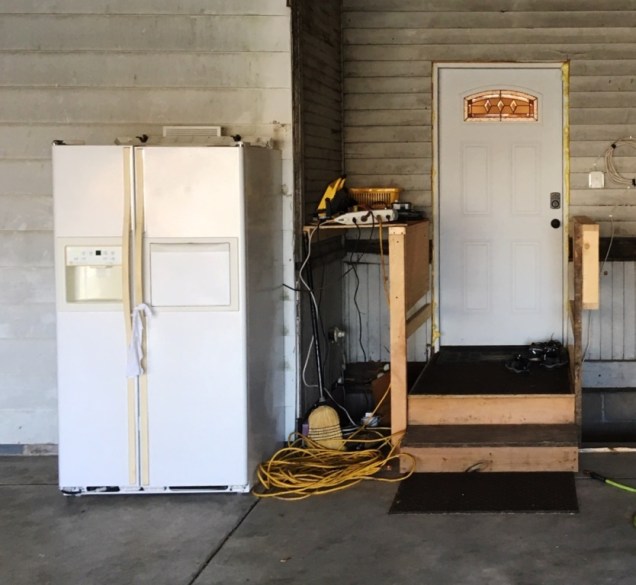
Is this the most stylist fridge you’ll ever see? Probably not. But it’s the best value.
What’s a mancave without a refrigerator, right? During a trip to Menards to acquire nails or Typar or some other construction material (I lost track of what he was buying; so many trips to acquire more construction materials), Tyler ran across the deal of the century. Menards was peddling a used refrigerator. For months, he had been sending me to the Dollar Store to get another bag of ice for the cooler which housed the beer for the contractors happy hour he hosted when the heavy lifting was finished. “Another bag of ice?” I complained, not infrequently. When Tyler called me and asked if he should buy the refrigerator on sale for nineteen bucks, I never uttered a faster “yes!” We paid for the fridge by saving on three weeks of ice.
Our story so far: Tyler constructed an attached garage for the old Methodist church we turned into our house.
# # #
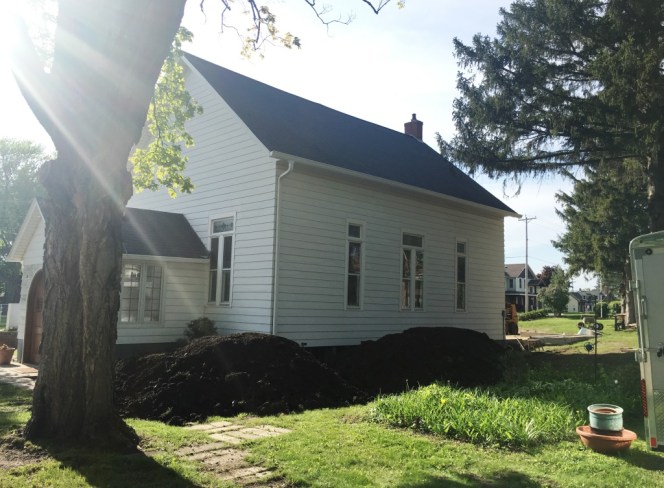
These piles of dirt, delivered in May, sat in the yard for four months while Tyler focused on other priorities.
On a sunny autumn day a week or so later, Tyler rented an earth mover so he could finally redistribute all that glorious black dirt he acquired months before when the school across the street got a new parking lot. He also spread around a load of gravel in the lawn outside the future porch. This layer of gravel would settle over the winter and be ready for the installation of pavers for a patio off the garage porch. He planned a cozy fire pit, too. This patio would one day provide access the church lacked to the beautiful outdoor space. The garden planted by parishioners on the side of the church could be seen through the windows, but as a church, there was no porch, no patio, no deck— even the front door spilled out onto the public sidewalk. This three-season porch and outdoor patio was designed to remedy this lapse.
That lighter area on the ground outside the garage is gravel where the patio will be built next year.
# # #
Tomorrow: Deal of the century. Read about it here.
Our story so far: Tyler and his crew of assorted tradesmen built a modern attached garage for the 126-year-old Methodist church we had turned into our home.
# # #
The west side of the garage now has three windows facing the street. The doorway that used to exit out of the “lean-to” was moved north to provide an exit at the top of the rebuilt basement stairs.
The men installed some of the windows and exterior doors of the garage. The largest garage doors hadn’t yet been purchased, and the window openings of the planned three-season porch in the fourth stall of the garage were simply boarded up. Those windows would be installed later, probably springtime. Tyler had grand plans for this mancave porch, but he would be attending to it when the weather was getting warmer again instead of colder. In the meantime, he and his hired man St. Johnny built shelves to hold all the reclaimed wood in the basement.
Here’s where you need to use your imagination: Windows will be installed where you now see shelves of wood and headers.
Our story so far: My husband and I bought an old Methodist church to turn into our home. After we got it renovated enough to move in, he started work on an attached garage before winter settled in.
# # #
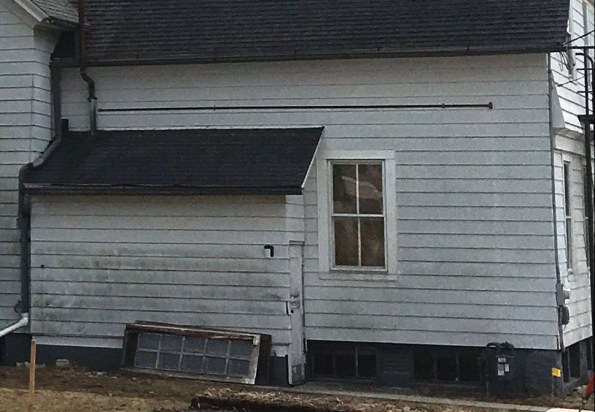
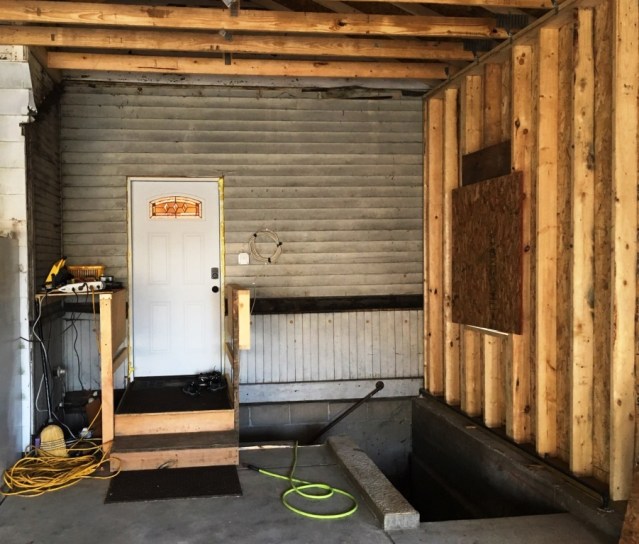
At one point, it became necessary to finally demolish the structure that had protected the back stairway (I sometimes called it a lean-to, but it wasn’t strictly leaning against anything—it was the cover for the back stair). I was inside the church in the moments it was razed, and at first, I thought something terrible had happened. There was a mighty clatter. Then another. The men pried great hunks of roofing material and siding from the church, leaving behind the welded back-door walkway over the back stair. After clean-up and a bit of sweeping, all evidence of the lean-to was gone. The main floor back door and the basement door exited into the garage as if that’s the way they had always been. All that was missing was a railing around the steps going downstairs.
Here is how the back entry looked when we purchased the church a year ago.Here’s how the “lean-to” looked when we were pouring the garage foundation and building concrete steps into the basement.Here’s how the back entryway looked after Tyler installed a back door on the main floor and put in a wood-sheathed steel walkway over the back steps.Here’s how the back entryway looked inside the garage after the “lean-to” was razed.
# # #
Today’s headline is a partial quote from Malaysian singer Kamahl. His full quote is, “Anyone can admire creation. Only a barbarian sees the beauty in demolition.”
Our story so far: The foundation was poured and walls were built for the garage addition to the old Methodist church we had turned into a home.
# # #
During the course of a week, the skeleton walls were built just in time for the delivery of the roof trusses. These, too, had plans of a sort. Tyler specified the size, and the factory constructed the triangle-shaped roof supports in an engineeringly correct manner (“engineeringly” is not a word, but you get the point—they wouldn’t fall to fiddlesticks). Because the garage was not small, these trusses were not small either. They were forty-four feet long, and when they were delivered, the pile filled nearly the entire driveway. The weatherman also delivered: The day dawned sunny and clear, if a little more breezy than one might like.
The morning we set the trusses, Tyler—who had dreamed of this huge garage for the better part of a lifetime and after months of renovating the church was getting sick and tired of constructing anything and wanted to see progress—said, “If we get through today without anyone getting hurt, I’ll be happy.”
I knew then this work was tricky, trickier than most of what we had performed in our little, some might say big, project. If Tyler was measuring success by lack of injury rather than by dumpsters filled or two-by-fours used or square footage sanded, then this must be serious business indeed.
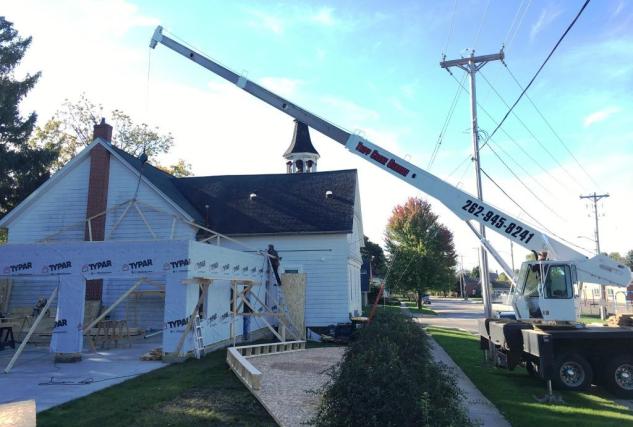
The first truss is placed.
The enormity of the roof trusses required the use of a crane to lift them from the ground, one by one, and set them on the walls. A full crew of men—five plus Tyler and the crane operator—had been summoned. You-Can-Call-Me-Al and Reroofer straddled ladders and makeshift footings to help place them and then secure them, while the other men dashed around on the ground. Because cranes and skilled crane operators are, shall we say, not inexpensive to rent, everyone was moving fast and efficiently so as not waste time, which was money.
For the most part, I couldn’t watch. I sat at my computer in my upstairs office, one wall of which bordered the garage. I heard the regular sounds of engines and hammering and men yelling, praying I wouldn’t hear anything more urgent or worrisome than that.
I didn’t. The crane left to do crane-type work elsewhere in less than four hours. No one was injured. The trusses were properly in place.
Tyler was happy.
After the last truss was set.
# # #
Today’s headline is the first line from a joke. Answer: Because he had a bad case of shingles.
Tomorrow: In the meantime… Read about what kept me busy here.










 Church Sweet Home