ABCs of church architecture turned private residence

It required fresh thinking to turn our church’s unique architectural features into functional elements of a private home.

Every church conversion is different. Here’s our translation, in alphabetical order:

Altar: a structure upon which offerings such as sacrifices and votive offerings are made for religious purposes. The altar in our church was removed when the congregation exited.

Altar piece: an altarpiece is a picture or relief representing a religious subject and suspended in a frame behind the altar. The altar piece on our church was a red velvet curtain, which we used as a furniture blanket and drop cloth before it met its end.

Altar rails: a set of railings, sometimes ornate and frequently of marble or wood, delimiting the chancel (the part of a church near the altar, reserved for the clergy and choir). I really wanted to repurpose this, but I lacked the creative thinking; we dumpstered our altar rail.

Bell tower: a tower which contains one or more bells. Our church’s bell, estimated to weigh 600 to 800 pounds, was returned to functional in the reno.

Bell turret: the ornamental feature above the bell chamber. This is the most distinctive exterior feature of our structure. We reroofed it and kept it intact.

Church kitchen: a place of welcome, where congregants join to share fellowship, celebrate joyful events, or sustain one another through moments of pain or suffering. The kitchen in the basement of the church was deconstructed. When we take up the basement remodel, we plan to install a new kitchen.

corbel
I played around with a few options for repurposing our corbels during construction, but they are sitting in the basement, awaiting a new life.


Corbel: a piece of stone jutting out of a wall to carry any superincumbent weight. We had wood corbels in the sanctuary of the church. We removed them, and they await inspiration for re-use.

Portal: a main entrance, on the church facade, sometimes highly ornamented. The original portal to our church, beneath the bell, was ornamented. When the entrance was moved in the 1940s, the dooryway was, shall we say, rather plain. We installed new doors and exterior lights, bringing back some of its glory.

Baptismal font: an article of church furniture or a fixture used for the baptism of children and adults. Like the altar, the baptism font was removed when the congregation exited.

Confessional: a cabinet-like unit in a church used for conducting confession. Catholic churches have confessionals. Methodist churches do not (thank goodness).

Pulpit: a small elevated platform from which a member of the clergy delivers a sermon. The pulpit was removed when the congregation exited.

Pews: a long bench with a back, placed in rows in the main part of some churches to seat the congregation. The pews were gone when we came along, but we brought one of our own, salvaged from a church in Belvidere, Illinois.

Vestments Closet
The vestments closet was eliminated in our remodel (for more of that story, tune in to ChurchSweetHome.com on Friday.

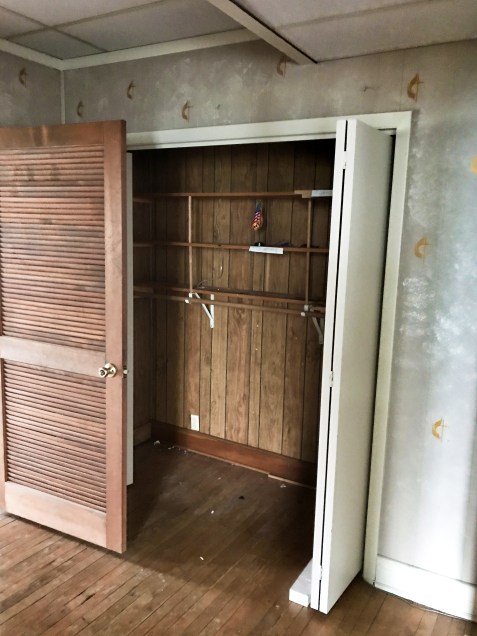
Sacristy: a room in a church where a priest prepares for a service, and where vestments and other things used in worship are kept. In our church, this was a closet, which was removed to install the back door.

Sanctuary: a sanctuary, in its original meaning, is a sacred place, such as a shrine. Also known as a haven, by extension the term has come to be used for any place of safety. The church’s sanctuary is now our great room, housing the kitchen, living room and dining room.

Spire: a spire is a tapering conical or pyramidal structure on the top of a building, often a skyscraper or a church tower. The original spire on our church was damaged or removed mid-century. But we found a new one at a flea market and installed it on top of the bell turret.

Stained glass: glass that has been colored by adding metallic salts during its manufacture; the colored glass is crafted into stained glass windows in which small pieces of glass are arranged to form patterns or pictures, held together (traditionally) by strips of lead and supported by a rigid frame. Our church had no stained-glass windows, only etched glass transoms, which we preserved.

red chair
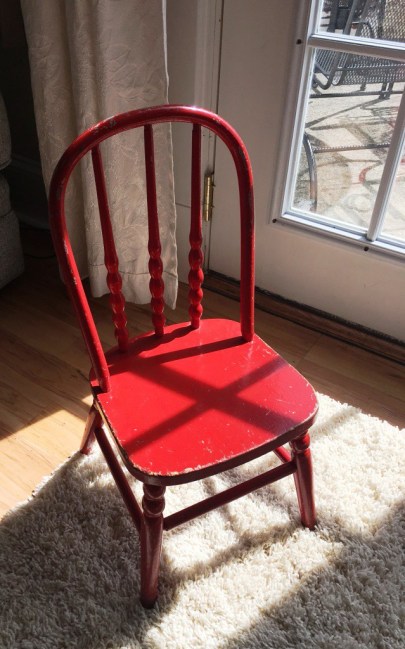
Historic Sunday School chair.

Sunday School room: a room or rooms in a church where teachers tell Bible stories and help children do craft projects. We found the cutest little tables and chairs for Sunday School on the second level, which we donated to Habitat for Humanity’s Restore. An older, historical children’s chair was gifted to us by one of the congregants; I repainted it and it finds a home in the second-story playroom under the eaves.

CSH Book Front Cover Only# # #

My memoir Church Sweet Home: A Renovation to Warm the Soul comes out May 5. Preorder the ebook at Amazon Kindle and Barnes & Noble Nook.

 

Quasimodo’s library

Our belfry has a little room on the second story beneath the bell.

The space is about 8 feet square. Not big enough for a bed but it would make a huge closet (in fact, the space beneath it on the first floor is a closet).

We chose to build a closet elsewhere on the second story so the belfry room could be something else. I toyed with making it my office, but the window (which was covered up when we purchased the church) is too high to see out of when seated. I decided it would make a great library. We haven’t finished the work, but the space has been much improved.

BEFORE

It was a scary place when we began demolition. Filled with miscellaneous boxes and Sunday school supplies, it was dark and dirty. The room is not ducted, so it’s cold in the winter and hot in summer. We found out later that piles of animal detritus filled the space above it (beneath the bell); I can only imagine the dust and junk that fell from that space every time the trap door on the ceiling to the bell was opened.

These both look like after photos (looking back into the second story from the little room), but trust me, the little room is much cleaner in the photo on the right.

IMG_1498
Here’s a shot showing the new window before it was trimmed out.

Much progress was made just by cleaning it out. Oh, the power of soap and water. We also uncovered the exterior window (it had a bullet hole in it) and replaced the boring hollow-core door to the room with a windowed door we found elsewhere in the church. Light makes the little room so much more pleasant.

Though I don’t have pictures of it, I painted the interior in the same silver gray we used elsewhere in the house. We decided to leave the original shiplap exposed, but we definitely need to build more shelves for all my books.

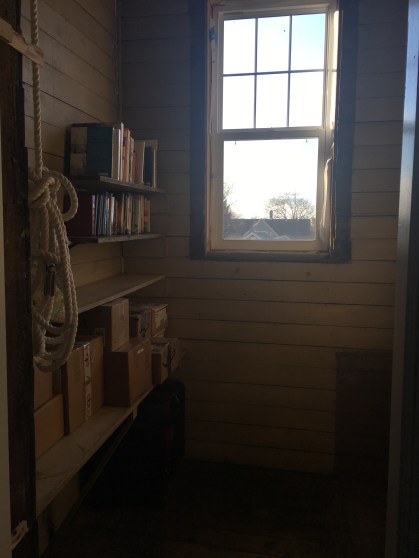
shelves empty
That new cording hanging there is what we pull to ring the bell.

We will also put a little bench on the side opposite the shelving for a reading nook, but the one I have in mind needs a new paint job (a project and a post for another day).

“Oh! No, please, I-I-I’m not finished; I-I-I still have to paint them.”

~ Quasimodo in the Disney version of The Hunchback of Notre Dame


Nailed it! Not

I’ve often written about how paint can make anything better, and I believe this strongly most of the time. I am proud of the way I transformed a beat-up dresser into a bathroom vanity.

upstairs vanity in place
The guest bath on the second floor.

Or a 100-year-old desk into a fresh-looking focal piece.

Desk closed after
Tyler’s desk now graces a corner of the great room.

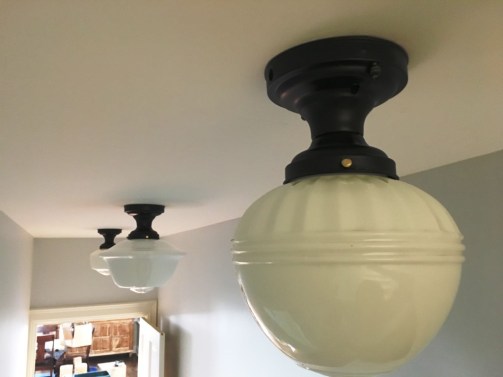
And especially light fixtures. I spray painted the chandeliers in the great room and our master bedroom, and also the collars for this historic lights in the Hall of History.

hall of history lights
The “collar” of a light fixture contains the wiring. These collars were all found in the church during the demo phase.

But alas, sometimes paint fails. Or maybe just I do as the painter. I share this failure here, lest you think every project we take on around Church Sweet Home is a home run. Sometimes, we strike out.

failed lamp

This lamp base has interesting marble accents, but I hated the gold leafy scroll work. It once sat in our living room in our former house. I spent a morning taping off the marble accents, and spray painted the gold parts matte black.

It was horrible (not even worth sharing the after photo). There was just no camouflaging that scrollwork.

However, Tyler used black spray paint to great effect recently on some furnishings and décor for our new winter condo. I share those transformations tomorrow on my Minnesota Transplant blog. Check in with me there if you’re looking for some lake home inspiration.

Outdoor party zone

Another project we wrapped up early enough last summer to enjoy it was the deck.

Some might call it a patio. Some might call it porch. We call it the deck.

From the beginning of Tyler’s Garage Mahal dreams, he envisioned a deck off the three-season “room” (also known as the fourth stall of the garage).

When the garage was built in late 2018, it got a roof but there was no time for siding. And certainly no deck. Even the windows on the east side were simply boarded up for the Wisconsin winter.

So the first element of finishing was to install enormous four-panel vinyl windows with screens. But the siding on that side of the garage awaited final placement after laying the deck.

deck in progress earlier
First windows, then stringers for the decking.

Excavation to ground level was first. Then Tyler and You-Can-Call-Me-Al laid the stringers (perfectly level, of course). A little corner was made to accommodate the biggest pine tree in the yard. Then they used 3,500 screws (no kidding) to secure the deck boards (the deck is roughly 34 feet long, 16 feet wide–we Go Big or Go Home around here, as regular readers are well aware).

deck in progress
First piece of furniture: the “contractors’ table.”

Now Tyler was ready to add some fun to the function. He drew inspiration from this picture of a slated ornamental wall:

deck inspiration
This “Pinteresting” image described the structure as a wind-breaker and privacy wall.

Tyler wanted a bit of a shield from gawkers passing by on the south side (a man likes to enjoy a beer in peace), and a wall of some sort seemed workable. I like how nice it looks. So You-Can-Call-Me-Al was set to work building a wall from this picture, not the first time our “blueprints” came from Pinterest.

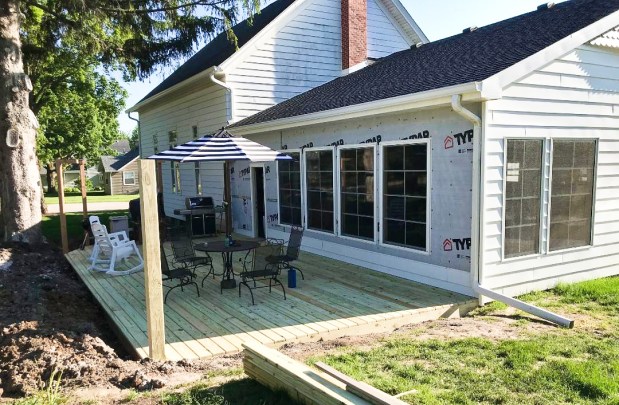
deck finished
Privacy wall in place.

Then Tyler stained everything in a couple of coats of Mountain Cedar.

deck from street
Here’s the “gawker’s” view from the street (picture taken last summer, when the grass was lush).

The deck still requires lighting (which awaits garage wiring). But we enjoyed it a few times and it was ready for the open house last fall. At some point soon, warm weather will return and we’ll enjoy again. And soon after that, I hope, we will be able to socialize there (even though we could probably entertain at least two or three couples and still have six feet between each of us!).


The pinnacle of success

I realized I dropped the ball, or maybe “dropped the spire” is a better metaphor for what happened here.

I wrote last summer how we found the perfect spire for our belfry when we went junking at “Wisconsin’s Finest” antique flea market in Elkhorn. The steel spire with Victorian era fleur-de-lis detailing had been salvaged from the turret of a decrepit late 1800s mansion in Vilas County, Wisconsin.

But I failed to show you how it turned out.

Spire, before and after painting

The junk spire required a bit of straightening. We had it sand-blasted before applying a few coats of rust-proof paint.

spire on articulating arm better

Tyler rented an articulating boom to provide safer access to the belfry forty feet off the ground. You-Can-Call-Me-Al enjoyed using the boom (it was easier on the legs than a ladder by far). He and Tyler accomplished some other repairs up there (Tyler remained on the ground), and early one clear Sunday morning, the spire was hauled up there.
I went to church that morning (a different, actual church with a worship service), and I specifically recall asking for protection for You-Can-Call-Me-Al. The good news is, he was fine and so is the spire.

Al waving on spire
You-Can-Call-Me-Al gives the thumbs up after he bolted the spired to the turret. That guy is fearless. My hands get sweaty just looking at this picture.

The belfry, described as “rooted” when we bought the church, required three phases of improvements, but it looks (and sounds) beautiful now.

belfry fall 2107
This is an early picture of the belfry, taken after Reroofer repaired the flat roof beneath the bell.
finished spire
And here’s the finished belfry. 

Now you know the rest of the story. The belfry is an exceedingly public result of the church’s renovation. Fixing it didn’t add a lot of value to the private residence, but I’m proud we pursued excellence and restored that historic bell tower to glory.

# # #

“Every person is endowed with God-given abilities, and we must cultivate every ounce of talent we have in order to maintain our pinnacle position in the world.”

~ Ben Carson,
retired neurosurgeon currently serving as the
U.S. Secretary of Housing and Urban Development

Church Sweet Home becomes a book

I started this blog because I’m writer. Having already written three books and thousands of blog posts, I sensed I had a great story, no matter how it turned out, and it needed to be documented.

Without knowing how it would end, I chose the unconventional approach of a real-time-memoir with the intention of turning my blog posts into a book. I’ve spent months polishing my prose and having it professionally edited, and finally, the launch day for the book Church Sweet Home: A Renovation to Warm the Soul is coming soon. Mark your calendar: May 5.

CSH Book Front Cover OnlyIf you’re here, reading this blog post, you’ve probably read most of the story and you sort of understand it all ends well. I have hundreds of loyal readers who cheered us on through months of dirty demolition and construction, and I am so grateful for the moral support you offered with nice comments and Facebook likes on so many nights we were exhausted and feeling sorry for ourselves. You helped pull us through.

You might be asking, why would I read this book if I followed the blog? Well, here are five reasons you might enjoy the book as much as you liked the blog:

  1. The book has an all-new prologue about abandoned churches.
  2. The story has a proper heart-warming ending.
  3. All the those annoying “our story so far” and “tomorrow” teasers are gone.
  4. You’ll find out how the real budget compares to the Tequila Budget.
  5. If you’re technically challenged or just too impatient to click through all the blog posts, you can page through the story easily and at your own pace.

I suppose you might know some people who would enjoy the story but aren’t blog readers. Voilà, a book is a nice gift for your friend.

So stay tuned for all the information you need to get yourself a paperback or ebook of Church Sweet Home in May.

In the meantime, I’ll continue to share updates about the renovation. I have a few in the archive, and we still have projects ahead of us.

Again, thanks for reading.


Open house, check

And we didn’t take a single picture.

This time last week, Tyler and I were recovering our breaths from our open house, which can only be described as a spectacular success.

After two years of planning, demolition and reconstruction, we were racing to the finish to get the church into show shape. My dad hung a thousand pictures on Saturday (he says a thousand, I think it was more like 22), and Tyler sent a lot of time making the lawn look presentable. Mom arranged a half dozen flower vases with fresh flowers gifted to us by a friend, so we had fragrant blooms in almost every room. As for me, I emptied all the trash cans as my last act before accepting guests; the message, of course, is that we have functional things like garbage cans, but we don’t actually use them (it’s a joke). 

Tyler estimates we had 250 people drop by in the two-plus hours we opened our doors to neighbors, contractors, former members of the church and interested onlookers. We had 105 sign our guest book. So I guess we had somewhere between 105 and 250 come to take a look at our church-house renovation. It felt like 250, for sure.

All four of us–me, Tyler, Mom and Dad– talked non-stop for two hours, and we ran the church bell a hundred times, at least. It was so nice to see people ooh and aah and to hear people say nice things about the church and our work. Among our visitors were three former pastors at the church, which was a fun and enlightening surprise.

We were so preoccupied, we didn’t take a single picture, though I know some people took a lot of them. If you’re willing to share, please let me know.

The best part was the booty we collected. We asked visitors to bring a non-perishable foot item for the Loaves & Fishes food pantry, which got its start in our basement when it was a functioning church, and our guests came through for the charity. More than 600 pounds of food was collected! Wow! Thank you!

If you attended our open house, thank you for being here, for contributing and for saying nice things (at least in earshot, ha, ha).

As for my regular readers who didn’t have the opportunity to be here, I will try to share some of the projects we finished this summer during the next couple weeks. The biggest project I finished that I’m excited to tell you about is the book I wrote about renovating the church. Much more to come on that subject, I assure you.

Fresh paint creates a clean slate (and a desk that practically invites one to work)

Paint is amazing stuff.

It covers a multitude of sins, and the right colors transform a surface from beat-up to practically new.

Other people look at beautiful wood and think it’s a shame to do anything other than apply stain. But I am a big fan of painted furniture and painted trim. It is inexplicably cathartic to cover up ugly colors and nicked-up surfaces with new paint. I like to listen to podcasts while I sand, tape and brush surfaces; the process is meditative. The first coat is satisfying, and the last one is pure bliss.

I painted or spray-painted a lot items for the old church in the past year and a half including the upstairs vanity, a headboard and footboard for a bed, a number of light fixtures and a few cupboard doors. But a recent project really shows off the beauty of paint.

Just after we moved into the church last fall, Tyler bought an antique roll-top desk he found on Craig’s List. He wanted a place in the great room to stash his office work away from sight when we entertained.


 Here’s the desk when we bought it, closed and open.

It had good bones and an ugly layer of brown paint. The seller claimed it had been around for more than a century, which made it as old as our 127-year-old church. After looking at it for several months as other priorities took my attention, I finally tackled the desk a couple of weeks ago with Fusion mineral paint (thanks, Sherra, for the great tip), and it turned out beautifully.

And here’s the desk now, painted.

The main color is Champlain, accented with Midnight Blue on the top and drawers. The desktop itself pulls out, and there was an inset area I filled with self-stick vinyl floor tile in Travertine, a creamy marble-like look.

Desk embellishment

I also used a little bit of Fusion’s Inglenook, sort of an aqua color, to accent some of the wood embellishments.

Desk lock

The knobs that came with the desk were workmanlike (read: ugly). It might surprise regular readers to learn I chose brass replacements; generally, I do not like brass, but it seemed an appropriate accent to the dark blue. Tyler found brass flowery knobs for most of the drawers, and we found plainer, smaller brass knobs at the flea market we shopped a few weeks back for the inside drawers. I painted the locks with a slick oil-based brass paint that practically sparkles.

The desk now resides elegantly in the corner of the great room (where the church organ once sat, which I find oddly satisfying). Until Tyler clutters it up, I’m leaving the roll-top open because it looks so nice.

If you liked this paint transformation, you might enjoy these past projects (shared on my personal blog):


Good times

Remember this?

TNT box

We found this sturdy wooden box when we were excavating under the extremely dusty eaves on the second floor of this 127-year-old Methodist church. Demolition yielded a lot of interesting artifacts we let go of (read: sold, donated or trashed), but Tyler took a liking to this old box that once held dynamite.

Back when our little church was coming together, the village was also home to the junction for two major rail lines. I imagine dynamite was used to dislodge bedrock in some locations to keep level the train tracks under construction. The bedrock where our village is located is probably made of shale or possibly dolomite, which in any case cannot be shoveled. It must be blasted.

Tyler cleaned up the box, sanded it and applied a couple coats of polyurethane. Then I added a few issues from my vast collection of magazines, and ta, da! A magazine rack for the great room in the church we now call home.

magazine rack

It looks dy-n-o-mite, don’t you think?

# # #

Alert readers may realize today’s headline is a not-so-veiled reference to the 1970s television sitcom “Good Times,” which starred Jimmie Walker whose character was known for the catchphrase “Dy-no-mite!” There’s a look into how my mind works, folks: History, geology, arcane TV references and home decor all come together in one place.

Combustion, ‘bustion, what’s your function?

In the 127 years the Church Sweet Home structure has existed, it’s been heated with wood, coal, fuel oil and now natural gas.

We unearthed evidence of these various heating methods during demolition including coal dust in the furnace room and repaired holes in the floor of the sanctuary that had once conveyed vents.

furnace room before
Here’s how the furnace room looked when we bought the church.

When we bought the church, two nearly new gas-forced-air furnaces nestled in the basement furnace room. It was impossible to walk around inside the room because enormous ducts hung from the ceiling. The ducts had to be big in order to heat a church sanctuary for services in the hour after someone turned on the furnaces; we kept the furnaces but we would eventually have all the ducts rearranged to accommodate our living needs. And oh, it was not clean. Surely the 12-by-15-foot room had been carefully swept when the building was being used as a church, but when we got to it, the building had been mostly empty for 16 months. The spiders had a heyday in there.

One warm December day, early in the demolition process, Tyler donned his Tyvek suit, a respirator and safety goggles, and he power-washed the entire basement, including that furnace room which once in its history had a coal chute.

That helped a lot. After the ductwork was replaced, Tyler moved a few shelving units in there and used the room for storage of various tools and out-of-service household items. This, and the furnaces—the highest function for a furnace room.

But my go-big-or-go-home husband wasn’t satisfied with that. Have I mentioned he’s a first-born Virgo, a bit of a perfectionist?

A couple of weeks ago, he moved everything out of the furnace room and power-washed it again (because just sweeping wasn’t enough). The furnace room was the last area of the basement that required a coat of Drylok masonry waterproofing paint. We think we’ve finally licked the basement water problem, and the paint was the last piece of the puzzle, insuring no seepage through the walls. Better to begin with clean walls, right? And once clean, how about smooth? Tyler applied hydraulic cement in all the cracks.

After he painted two coats of Drylok on the walls, he applied a coat of 1-part epoxy paint to the floor. This man knows how to cut in a paint line.

furnace room after
Here’s the furnace room now, soon to be refilled with miscellaneous items that require storage.

Wowsers! As with all things, it’s a wonder what a difference a little paint can make. The furnace room now looks like new construction, which it most definitely isn’t. I almost feel like decorating around the furnaces and turning it into a bedroom. Which I most definitely won’t. But it’s that nice.

Here’s to elbow grease and paint.

# # #

Today’s headline is a derivation of a Saturday morning Schoolhouse Rock video: Conjunction Junction. “Conjuction Junction, what’s your function? Hookin’ up words and phrases and clauses.”