Pink isn’t just a color

Our story so far: While the plumber, electrician and HVAC guys worked on the old Methodist church we were turning into our home, so did we.

# # #

A week or so later, Tyler loomed over the bed at 5:50 a.m. on a Saturday. “Home Depot opens in ten minutes. Time to get out of bed!”

Did I mention Tyler was an early riser?

I complied. Fortunately, Starbucks was on the way to Home Depot and Tyler deigned to stop. So at least I got some coffee.

We proceeded to Home Depot where I watched him walk the insulation aisle, checking packages.

“This is the one! Grab that cart.”

We took only one pink loaf of blow-in insulation back to the tool rental desk.

“How many packages come on a pallet?”

“Eighteen.”

“I’ll take two pallets.”

No kidding. That earned us the bulk discount, but we still invested four figures in insulation.

insulation pallet
Insulation pallet Number One.

Two pallets of insulation did not both fit into the back of the truck. So I drove one pallet back to the church and went right back to Home Depot for the second one.

Just about the time Tyler had cut all thirty-six loaves of insulation in half in our front yard, Reroofer arrived.

Reroofer, the trusty roof expert who worked on our belfry, didn’t know he was going to be helping with insulation, but he was game for anything (apparently he had had his coffee, too).
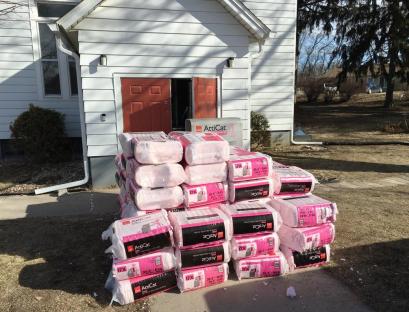
insulation yard
That’s a lot of insulation.

The assembly line began. Reroofer climbed into the space between the sanctuary ceiling and roof with one end of the hose, while I fed insulation a half loaf at a time into the blower outside the front door. Tyler supervised (more than once he reassured me that Reroofer was upright and ambulatory inside the attic rather than being buried by a mound of pink insulation—“He’s fine! Now get back out there and mind the blower!”).

pink panther
This was me, feeding insulation into the blower. Yes, I wore my pink work boots and a sly look on my face.

I found the job strangely satisfying. As the blower consumed half-loaf after half-loaf, the enormous pile of pink insulation slowly but consistently disappeared.

Four hours later, plus or minus a couple of breaks, we were done.

Or at least I was.

I went home to shower.

# # #

Tomorrow: Not everyone hit the showers. Reroofer wasn’t done yet as Chapter 21 concludes. Read it here.
Insulation against glamour

Our story so far: We worked on ceilings ad infinitum during the renovation of the 126-year-old Methodist church. 

# # #

Before sealing up ceilings and walls, I got to install insulation.

The pink stuff.

This job required no expertise, only perseverance. So I got tagged.

I suited up in Tyvek, safety goggles, gloves and a breathing mask, and set to work on the first area requiring insulation: The attic eaves.

It was like wrestling with Tyler if my king-sized husband were cotton candy—the insulation was bigger that I was, and there was no way I was gonna win this fight. I resisted, I poked and I punched when called for, and eventually I got the pink rolls stuffed between the studs.

The worst part was the height of the attic eaves—exactly short enough that I couldn’t stand and tall enough that I couldn’t reach the top when I was kneeling. I didn’t have quadriceps for this.

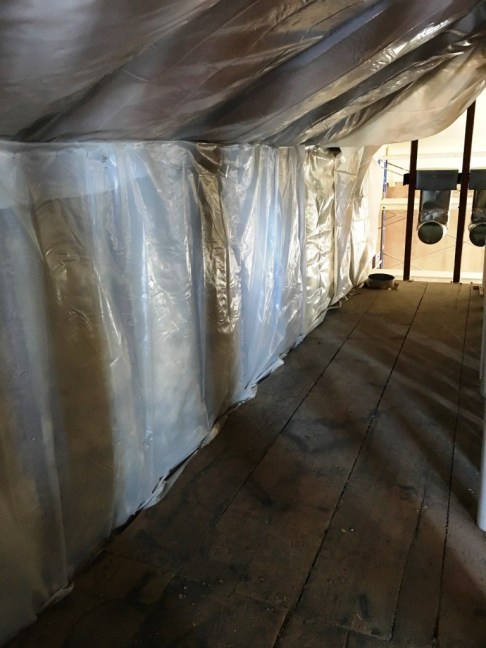
After wrestling with insulation for two days and thinking I was finished, I learned properly installed insulation requires a vapor barrier. So I spent an afternoon wrestling with plastic to cover the insulation and a staple gun (one of the few power tools I was comfortable operating).

When I finished, I was reminded of a mantra that circulated in the scrapbooking circles I once traveled. Scrapbookers rarely lack raw material because life and the photos one takes while living life keep happening. It can become overwhelming if one agonizes about every single detail on every single page so sometimes scrapbookers power through an imperfectly decorated scrapbook page just to be able to move on to the next one: Done is better than perfect.

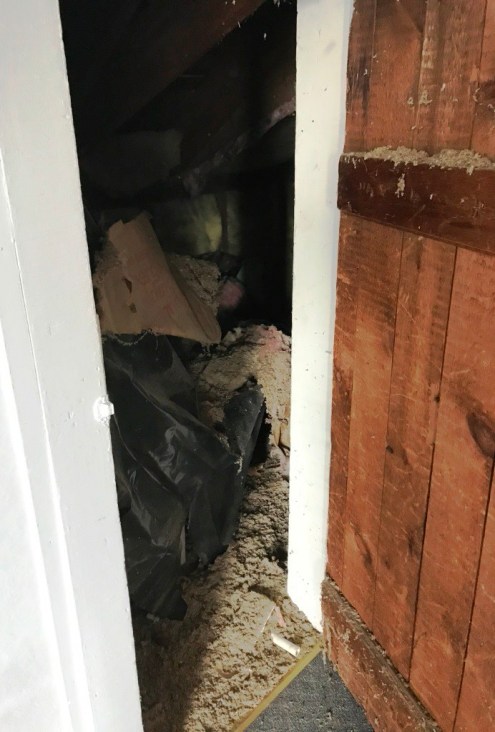
attic eave before
This is a shot of the attic when we bought the church. The door to the eaves had a sign that said “do not open.” We opened it anyway, and the eaves were filled with junk and dust.
insulated attic eave
After: Is this the finest insulated attic eave you’ve ever seen?

# # #

Tomorrow: Oh, we’re not done with insulation yet, missy! Nosirree! Da-dum, da-dum, da-dum da-dum da-dum, da-dum da-dummmmm. Can you hear that saxophone? Read about it here.


Find happiness where the sun shines

Our story so far: Deep in the midst of the framing and mechanicals phase of renovating the old Methodist church into our home, we focused on ceilings.

# # #

One of the features we dreamed of on the second floor was skylights. Our Number Three design rule was “Natural lighting brings the outdoors indoors.” While traipsing through a model home during an autumn Parade of Homes tour, we discovered a novel skylight that transmitted light from the roof to a main floor kitchen with a series of reflective surfaces inside a tube. It was a Solatube, the brand name for a tubular daylighting device. During a conversation with an installer at a home improvement show, we learned Solatubes can also include a bathroom vent and a solar-powered nightlight, which would be perfect for our upstairs bathroom.

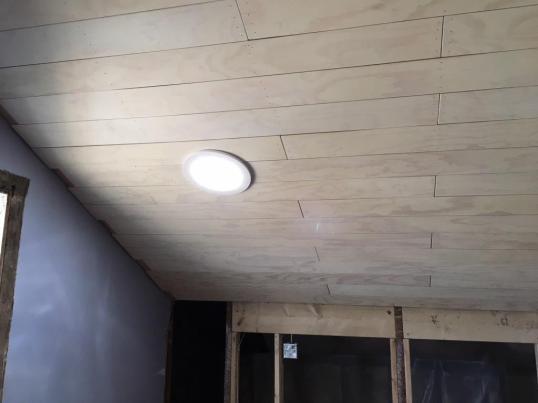
Tyler hurried to install the pickled plywood planks on the upstairs ceiling, and the Solatube installer arrived bright and early one Monday morning to install one tube in the bathroom and another one (without the vent and nightlight) in the adjacent area which would someday house my office.

solartube bathroom
You can see the bathroom Solatube glowing even in a picture!
solatube office
The Solatube in my future office.
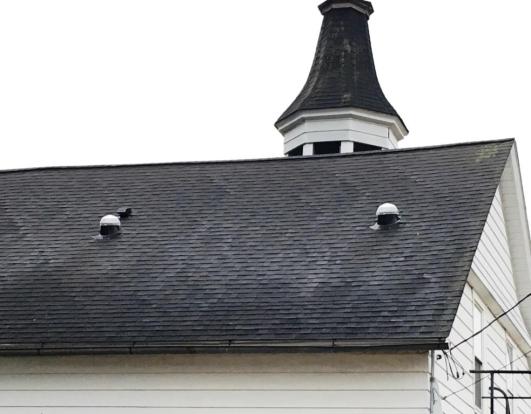
solatube outside
Here’s how the Solatubes looked on the roof of the church.

The Solatubes generated an amazing amount of natural light upstairs, just what we imagined. And, we learned we could get a tax rebate for utilizing energy-efficient lighting. Score!

# # #

Tomorrow: As long as we’re being energy conscious, we think pink. Read about it here.

Ceilings, ceilings everywhere

Our story so far: Things were looking up in the 126-year-old Methodist church we were renovating into our dream home.

# # #

Now Tyler paid attention to the other ceilings in the church.

ceiling bathroom
Bathroom ceiling, joisted in.

The master bath required a false ceiling.

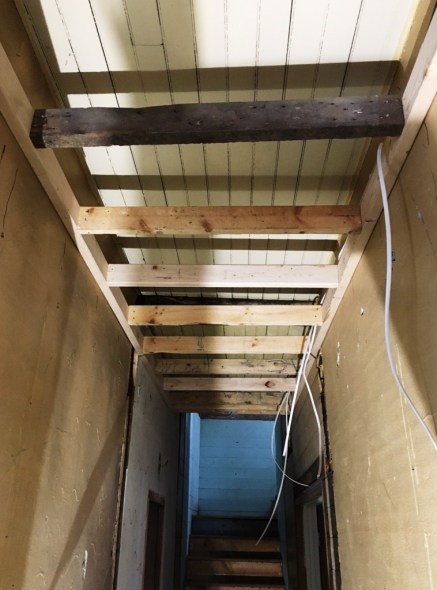
ceiling hallway
Hallway ceiling.

The hallway to the master bedroom required a false ceiling.

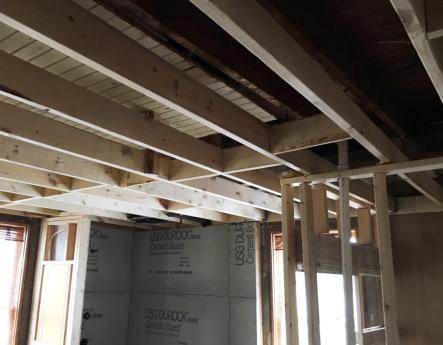
ceiling bedroom
Note: There’s room for window trim beneath the tray.

The master bedroom required a tray ceiling. The master bedroom’s ceiling was particularly vexing because of the unlevel floor and existing ceiling but Tyler persevered, as always, and made it work in a way Tim Gunn of “Project Runway” would have approved. In the remaining recessed area, we would install a ceiling fan.

The entryway required reconstruction to remove all the cross beams in what was formerly a false ceiling; here, we were going to drywall the actual ceiling with only two cross beams. Tyler also removed the last ancient wasp nest that had been decorating the church.

doorway bedroom
Ahh, an arch.

Among other details above our heads, Tyler created an archway for the open doorway from the master bedroom to the master bath, and he rebuilt the back stairway to the second floor that was hopelessly crooked thanks to a broken stringer.

Tyler in stairway
Pay no attention to the man beneath the stairway.

# # #

Tomorrow: We pursue a technologically forward approach to skylights. Read about it here.

Overwrought

Our story so far: My husband built a balcony off the choir loft in the 126-year-old Methodist church we were turning into our home.

# # #

More urgent that carpeting: A railing. Walking near the edge of the plywood was unnerving. When all we had was a doorway to nowhere, I urged Tyler to cordone off the scary maw. But with thirty-plus feet of balcony edge, there was no way to create temporary safety barriers.

We returned to the local manufacturer where we fantasized about a spiral staircase. The proprietor offered to let us mix-and-match her overstock railing spindles in the back room. We pawed through a half dozen dusty boxes (imagine how black the dust in an iron welding joint can be), and we were rewarded with enough forty-two-inch spindles to create a traditional wrought iron railing with a hint of upscale details.

The proprietor also paid us a visit at the church to measure and discuss the details of the stairway, which would take eight to twelve weeks to fabricate.

# # #

Tomorrow: More ceilings. See them here.

Swept away by, not under, the carpet

Our story so far: Things were looking up in the old Methodist church we were turning into our home when my husband Tyler finished constructing the floor of the balcony in the great room.

# # #

Now we could not just imagine but actually see all the square footage we had added with this balcony. It was magnificent even in its inchoate state. We had essentially added a second living room; one would be able to watch the big-screen TV on the main floor from the balcony. Tyler described the dream recliner he wanted to situate there in all its roomy, reclining leather glory.

square footage
A view of the in-progress balcony from the north end.

But the drawback of all that square footage was all that square footage. We had planned to save a lot of money on flooring by restoring the Douglas fir, oak and pine floors throughout the rest of the main floor and second story. But there was no restoring the plywood flooring on the balcony.

A trip to a flooring store yielded one word when the salesman announced the price per square foot of the carpeting we liked: “Ouch.”

OK, well we could put off that decision (and expense) for a while. Clearly, we would have to shop around. One of the Big Box retailers was summoned to measure and provide a quote, maybe install the ethereal loop-pile carpeting in a creamy white with light gray lattice pattern we saw displayed on an endcap. It was called “Snowflake.” I was reminded of humorist Erma Bombeck who once quipped, “All of us have moments in our lives that test our courage. Taking children into a house with white carpet is one of them.”

carpet samples
From left, Hammerhead, Snowflake and Moon Dust. Which would you choose?

“Do we dare install white carpeting?” I asked, polling family members with chunks of Snowflake, Moon Dust and Hammerhead.

“The Hammerhead is safer,” my son-in-law said.

But everyone else voted for creamy white.

I didn’t know if we had the courage required to install such light-colored carpeting in the place. But on the other hand, weren’t we—a couple in their 50s with no children in the house looking to cover a floor far from muddy outside entrances—the perfect candidates for white carpeting?

# # #

Tomorrow: Nailing a railing. Read about it here.

Baby, I’m amazed

Our story so far: During the demolition phase of renovating the 126-year-old Methodist church into our home, Tyler discovered the choir loft, and we decided to open it up to a balcony into the sanctuary, our future great room.

# # #

village people
The Village People

Once the header supporting the second floor was installed, Tyler built the archway upon which the floor joists of the balcony would rest. He enlisted the help of the HVAC guys to raise the arch (witnessing this, all I could think about was an old-fashioned barn raising—it takes a village to build a balcony). Then Tyler—with St. Johnny’s muscle—began nailing great big two-by-tens into place. Pretty soon he had a pergola built above what would someday soon be our kitchen.

pergola balcony
The floor joists of the balcony in place.

Putting a layer of plywood over the floor joists was easy—after the first piece. I was glad I wasn’t around to watch Tyler straddling floor joists nine feet off the floor to juggle that first piece of plywood and nail it on. He arrived home in one piece that day, so success had been secured.

To wrap up the balcony, Tyler constructed cross joists from the pergola to the north and south walls of the church. These were narrower than the center part of the balcony in order to clear the spiral stairway on the north side and the front window on the south. With the science part complete, a bit of art was necessary to draw the main part of the balcony together with the narrow part; Tyler planned a dramatic scallop and swoop to soften the edges of the balcony.

“Aren’t you impressed that I got that balcony built basically by myself?” Tyler asked me a few days later. He did not have to ask me this question because he knew very well I was impressed with his knowledge of construction and ability to carry out the plan. He asked this question out loud because after all he had built throughout his life, even he was impressed with this particular project.

# # #

Tomorrow: What do we do with all that square footage? Read about it here.

A blank canvas upon which to paint dreams

Our story so far: The 20-foot ceiling in the sanctuary—our future great room—was the whole reason we were interested in the old Methodist church so we wanted it to look not just good but grand. 

# # #

ceiling paint job
The drywallers at work, painting.

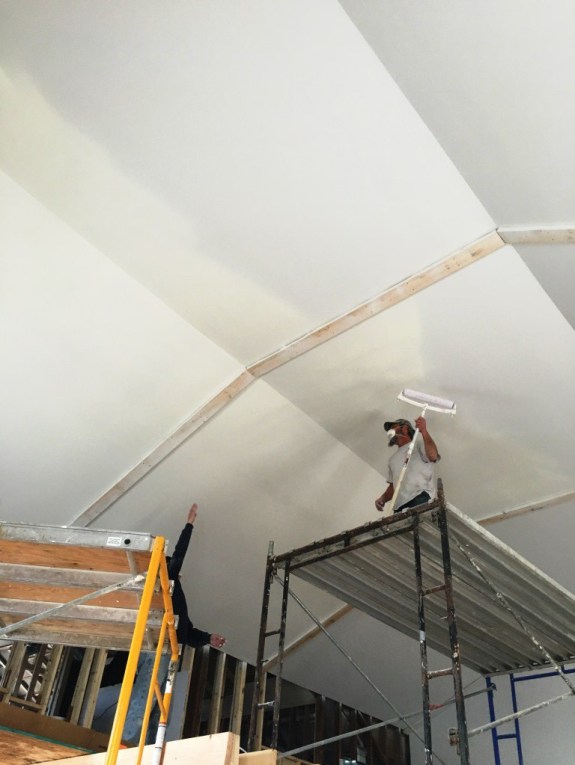
As long as the scaffolding was in place (and before we built the balcony), Tyler enlisted the drywallers to paint the sanctuary ceiling. As with the drywall, they were nothing if not efficient. They used a sprayer and an enormous roller to do the work. When I walked into the sanctuary to check their progress, it was like walking into fog; the process created an astonishing amount of airborne particulates. Hours later, a fine white dust covered everything in the room.

What color white? This was another detail that mattered. I didn’t want neon white—this was no hospital—so I chose Behr’s Sleek White in eggshell. It was that or Polar Bear, which had a grayish cast. I hoped I chose well.

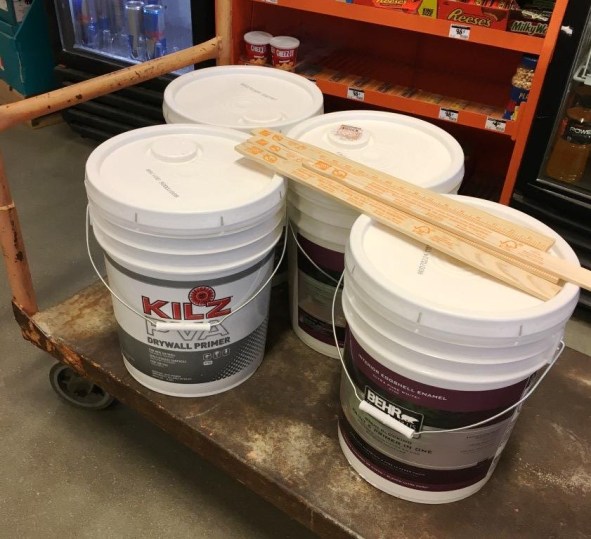
How much paint is required to paint a church ceiling? Now we knew. We purchased ten gallons of primer and ten gallons of white paint. I couldn’t even lift the buckets! Then, two days later, I picked up two more gallons of paint so the drywallers could finish the job. Twenty-two gallons. That’s a lot of paint.

20 gallons of paint
It’s a workout pushing 20 gallons of paint through a Big Box store.

# # #

Tomorrow: Building a balcony begins with two steps. Read about it here.

Let’s take it from the top

Our story so far: My husband Tyler and I purchased a 126-year-old Methodist church to turn into our home. Three months in, we had completed demolition and were deep into the framing and mechanicals phase of the project.

# # #

Chapter 21

Our Number One design rule was “details matter,” and this was most important starting at the top: The ceilings. The high ceiling in the sanctuary—our future great room—was the whole reason we were interested in a church so we wanted it to look not just good but grand. This is where the finishing work began.

As soon as they had completed demo on the sanctuary ceiling, the drywallers got to work installing the product from which they derived their name: Drywall.

Drywall, for the uninitiated, is a panel made of gypsum plaster pressed between thick sheets of paper. In modern homes, drywall is rarely seen but it literally surrounds us, concealed with paint or wallpaper or paneling inside our walls and ceilings. In the 1950s, it began replacing the traditional lath and plaster as a speedier alternative. We’d removed a good deal of plaster lath from the church to expose areas where we required ducts, pipes and wiring, but on the whole we left it intact where we could because it was strong and secure. But this wasn’t the Sistine Chapel, and we weren’t creating frescos in the plaster. Our sanctuary ceiling required new drywall to replace the fiberboard tiles that were there when we bought the church.

before drywall
The sanctuary ceiling, post demo. You can see the fiberboard tiles on two-thirds of it. We just covered them up with drywall.

Drywall comes in 4-by-8-foot sheets, and the drywallers chose to get it into the church with a boom truck through the upstairs windows. One might think an eighth-inch doesn’t make any difference in most matters, but not Tyler. He chose 5/8-inch drywall for the sanctuary ceiling because it was stiffer and laid flatter. It was also heavier. At one point, Tyler’s hired man St. Johnny and I moved a few pieces out of the way, and it was like, well, like hitting a brick wall.

But the unwieldiness of these large sheets of drywall didn’t deter the drywall team, even as they navigated scaffolding fifteen feet high and higher. Mudding the seams came next, and in a matter of a few days, they had performed their magic.

drywall
The great room ceiling, post drywall and mudding.

# # #

Tomorrow: How many gallons does it take to paint a church ceiling? Read about it here.

Like Chinese water torture

Our story so far: With four bathrooms planned for the old church we were converting into our home, we juggled a lot of details in the mechanicals phase of our project.

# # #

One afternoon when I arrived at the church after a day filled with exciting errands like picking up rough-in valves for Glimfeather the plumber and more paint for the drywallers who were making like Michelangelo and painting the cathedral ceiling, Tyler put me to work handing him tools for the construction of a form to contain the floor-leveling compound in which the upstairs shower stall would nestle.

Tyler built sides for the form; the bottom was simply the century-old pine flooring. Leveling compound is similar to concrete, only soupier. After adding water to the dusty compound, Tyler poured the goop into the form.

Immediately, we could hear the dripping.

“Is it leaking?” Tyler said, then more urgently when it was clear it was indeed leaking, “Where is it leaking?”

I ran down the steps and looked in horror at the rainfall of gray, pasty soup dripping through the floor, through the form, through the shower drain hole.

“Everywhere!”

One of the HVAC guys, who had been working in the basement, appeared out of nowhere to rescue a big roll of aluminum foil bubble wrap covered in pasty drips of leveling compound. “What is that?”

“Leveling compound,” I answered.

“Well, it’s leveling all the way to the basement.”

I shoved a tray and a bucket in place to catch drops.

“Get back up here!” Tyler bellowed.

He’d filled in a couple of the holes but we’d lost so much compound through the cracks, we needed more to fill the form. Tyler began mixing again. “Hand me bottles of water.”

Remember, we didn’t have running water in the church yet. The first batch of soup was made with a jug of water collected that morning at the rental house.

Tyler mixed up another batch of soup and dumped it in the form. “Is it still dripping?”

I ran downstairs again to look even though we both knew it was because we could hear it.

“Yup.”

But the waterfall had slowed to a trickle.

When Tyler came downstairs, I asked, “Did you know that was going to happen?”

“Well, they’re old floors. There’s bound to be a few holes.”

“It was pretty holey.”

“Well, that’s right. We live in a church. It’s a holy floor.”

# # #

Tomorrow: Things are looking up as Chapter 21 begins. Read it here.