Our story so far: Blood and sweat marked the walls we constructed for bathrooms on the main floor of the old Methodist church we were turning into a house.
# # #
At four o’clock in the afternoon, we’d finished with the powder room and water closet walls and decided to call it a day. (Working in the church after sunset was not our style—it got dark. And we got hungry.) Before putting all the tools away, Tyler turned the laser level to the opposite wall to guide construction of the wall dividing the master bedroom from the master bath.
He gasped.
I looked where he was looking, and I gasped, too. I looked back at him, standing on the ladder, his hand on the laser level.
“How did that happen?” I asked.
No response.
The red line of the laser level clearly defined the bottom of the false ceiling. And it cut through the top window trim of the bedroom windows. At least three inches short of where it should have been to allow for full window trim and crown molding in the master bedroom.
We spent all day building the walls perfectly level. But too short.
I’m not gonna lie. Expletives were spoken in ways they should not have been in a church.
# # #
Tomorrow: A new character enters the story. Who-hoo-hooo? Read about him here.
Our story so far: Day Two of wall construction in the 126-year-old church was one of blood, sweat and tears.
# # #
At one point, we had to reattach a top plate on a wall, which meant yanking out the nails to do it over again.
“Hold that there,” Tyler directed.
So I held the piece of wood at one end while he pounded out the board at the other end with a big hammer.
Bang!
The board came off, and his end—complete with two angry nails sticking out of it—came down.
On his head.
“Blasted, Monica! I told you to hold it!”
Only he didn’t say “blasted.” And he still had the hammer in his hand. His eyes told me he wanted to use it on something other than lumber.
He was holding his forehead, and blood was running down his cheek. The nails in the board had grazed his head.
“Oh my god, are you OK?”
I understood from his grumble that he was. But he was bleeding like a Halloween decoration; that’s how it is with a head wound.
We had no Band-Aids at the church, so I held a paper towel to his forehead. “Use direct pressure to stop bleeding,” echoed in my head. I held the paper towel better than the piece of wood because eventually, the scratch clotted, and we got back to work.
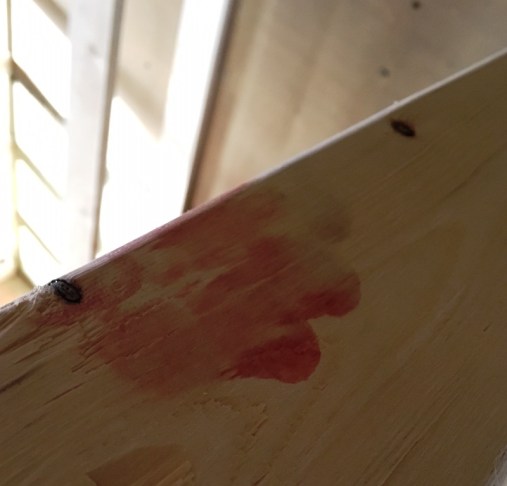
But not without a little blood on the top plate of the powder room wall.
Tyler’s bloody fingerprints, forever entombed on the top of the wall plate (he wasn’t very happy about me taking a moment to take a picture of this, but these are the sacrifices of a good documentarian).
You’re wondering about the tears, I’ll wager.
# # #
Today’s headline is a line from a Ralph Waldo Emerson’s poem not about marriage, but titled “Friendship.”
Our story so far: As we progressed through the mechanicals phase of our church conversion project, we learned it was tricky to build walls between 126-year-old floors and ceilings that may or may not be level.
# # #
The day began with a family crisis and progressed to a business crisis, but eventually we put out the fires and made our way to the church. Our goal was to construct the walls for the powder room, the water closet in the master bath and the wall behind the vanity in the master bath, all in the overflow area behind the kitchen so the plumber could begin roughing in plumbing.
Unlike the walls for the master bedroom closet which were supporting walls built to the ceiling, the walls on the day’s to-do list would have a false ceiling to accommodate the HVAC ducting and the plumbing from the second-floor bathroom. If your eyes are glazing over with the details, let me emphasize this important point: All the walls we were building were to be as tall as the false ceiling.
We began by haggling about room sizes and laying down two-by-fours on the floor to outline the walls. Just as Tyler was about to measure the studs and build vertically, he decided he needed a new tool: A laser level.
We couldn’t just measure down from the actual ceiling or up from the floor because each was crooked or uneven in their own unique ways. If we wanted a level false ceiling, we needed this crucial tool Tyler didn’t already possess.
OK, it was lunch time. Let’s go get lunch and drop by Home Depot. And spend more money. On another tool.
This was a battle I wasn’t going to win.
So we dined at a Chicago hot dog joint and dropped another couple hundred at Home Depot. Driving back to the church in the pickup truck, Tyler asked me to open the laser level box (with the Fort Knox unbreakable plastic clamshell, a feat in it itself) and read the instructions.
This was not poetry or a steamy novel. This was the instructions on how to set up and use a laser level.
All I remember is this one thing: “Looking into the laser light will cause blindness.”
Before returning to the work site, Tyler dropped me off at the rental house to check on the dog, throw the washed sheets in the dryer and run some quick paperwork. He returned to the church to set up the laser level.
When I arrived at the church twenty minutes later, the laser level was screwed to the wall, red laser lines marking the bottom of our false ceiling.
Looking into the laser light will cause blindness.
We got back to work exchanging nouns for tools and constructing studded walls.
Not infrequently that afternoon, my sweaty Romeo (thank you, Erin Napier for this “Home Town” description) would bend over to nail a stud into the bottom plate and sprinkle a few drops of perspiration on the floor.
That was the sweat in this story.
# # #
Tomorrow: Part II of building walls: Blood. Read about it here.
Our story so far: Building walls in the old Methodist church we were turning into a home required a three-dimensional perspective.
# # #
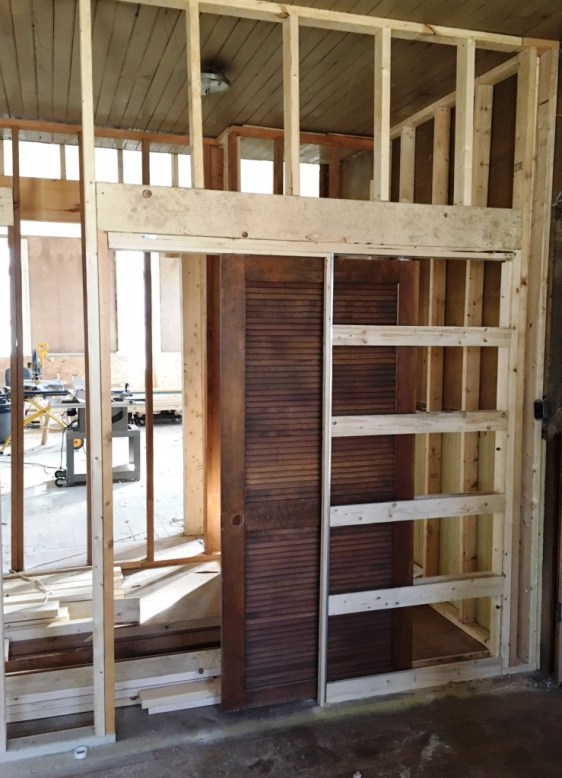
Tyler and his hired man St. Johnny also installed the first of five pocket doors in our house design.
I had been assigned to pick up the pocket door frame kits earlier in the week. Standing in line at the pro desk to pay for them, a builder behind me who looked like he had earned his experience remarked, “I hate installing pocket doors. They’re a pain.”
Maybe he installed pocket doors into already existing walls, because Tyler made it look easy to build one into a wide open space.
This pocket door leads to what will someday (soon) be the master bedroom closet. This solid-wood door originally was on an office in the church. It’ll get a paint job before it’s finished.
But Day Two of wall construction was one of blood, sweat and tears.
# # #
Tomorrow: Part I: Sweat. And a new tool. Oh joy. Read about it here.
Our story so far: Purchase of the 126-year-old Methodist church to turn into a home: Check. Interior demolition: Check. Building begins: Check.
# # #
Here’s what I didn’t understand about walls until I helped build some: They’re three dimensional.
This should be self-evident, but it wasn’t, at least to me. A wall should be perpendicular to the floor, perpendicular to other walls and level. If you don’t get things perfectly square, you’ll end up with a fun house maze.
I imagine this feat requires skill when one builds a house from scratch, but it’s a real trick when you’re building walls between 126-year-old floors and ceilings that may or may not be level.
Tyler took great pains to jack up the second floor to level, but “level” did not mean it was even. Every wall stud was a different length.
I helped build the closet walls on the main floor by performing a role as human tool holder. “Hand me the square.” “I need the level.” “Give me the power nailer.” (Let’s be honest, Tyler usually dispensed with pleasantries and placed orders with nouns only: “Nailer.” “Level.” “Hammer.”). Sometimes, I was promoted to two-by-four transport specialist or measurement expert (by expert, I don’t mean that I was responsible for measuring the length of the stud, but I did climb the ladder and hold the zero end of the tape measure securely to the ceiling).
In this manner, we (i.e., Tyler) built the walls to our walk-in closet which, conveniently also were supporting walls to the second floor.
# # #
Tomorrow: Pocket doors. Uffda. Read about it here.
Our story so far: The drywallers were making quick, satisfying progress on the ceiling of the sanctuary of the Methodist church we were turning into our home.
# # #
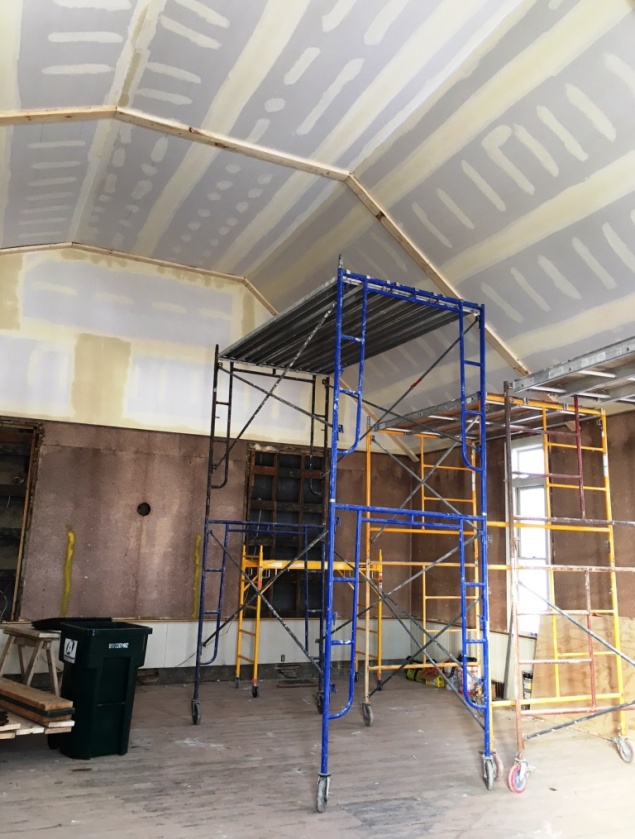
Along with the Sheetrock panels, the drywallers erected on the sanctuary ceiling the two-by-sixes to which our faux beams would be attached.
In this extreme close-up of our faux beam, you can see the wood grain and the foam interior.
Tyler had decided to have a look at rigid polyurethane foam beams—lighter and more durable than actual wood beams and more affordable, they were advertised as being “virtually indistinguishable from real wood.” But seeing was believing. Ordering a couple of one-foot samples of the faux beams, like choosing any finishing details in a house, was an odyssey. We ordered them online, of course (because that was Tyler’s mall of choice), where the array of options was dazzling.
L beam or U beam?
Rough sawn or hand hewn (or any of eight other textures)?
How wide? How high? How long? Do you need endcaps?
What color? We knew we wanted “brown” but we could choose from among eleven shades of brown. We finally settled on samples of pecan and antique cherry.
The antique cherry sample beam is on the left, pecan on the right.This close-up shows how the faux beam attaches to the two-by-six on the ceiling.
A couple of weeks later, our sample beams arrived, and Tyler stuck them on the two-by-sixes on the ceiling of the sanctuary (from the safety of the choir loft).
Remarkable. They were virtually indistinguishable from real wood beams. And they were as light as cappuccino foam, which would make them easier to install.
The beams would add just the distinction we wanted in the centerpiece of our great room: Our cathedral ceilings.
# # #
Tomorrow: Wall of fame. Or possibly shame. Read it here.
Our story so far: After what seemed like an eternity of demolition, we were beginning to build inside the old Methodist church we were turning into a home instead of tear down.
# # #
A few day after the drywallers tore down the ceiling tiles in the sanctuary of the church, as I was making the bed back at the rental house after doing laundry, Tyler called, frantic.
“What are you doing right now?”
“Um, making the bed?”
“We’re out of drywall screws. You need to go get some. Three-inch drywall screws.”
OK, this was a task I could pull off. I now had visited the nearby Home Depot so many times, I knew exactly which door to enter to find the “screws and nails” aisle.
“How many?” I asked.
“Um,” he said, apparently eyeing the ceiling where the drywallers were working. “Five pounds.”
Okey, dokey. Five pounds of drywall screws, coming right up.
When I got there, screws in hand, the church sounded like a real construction zone.
Men’s voices and hammers echoed in the sanctuary. St. Johnny made noise with the Air Locker pulling nails out of boards in the basement. The HVAC guys moved a truckload of shiny ventilation ducting into the basement of the church. A boom box was tuned to a rock station playing “Superstition” by Stevie Wonder, which includes the line “very superstitious, ladders bout to fall.”
Fortunately, the drywallers were using scaffolding, not ladders.
Superstition ain’t the way.
The drywallers were making quick, satisfying progress on the ceiling of the sanctuary. The place was beginning to take on the sheen of new construction, a nice change from insulation dust.
Nothing like the smell of new construction in the morning.
# # #
Tomorrow: Did you say foam? Or Faux? Read about it here.
Our story so far: Deliveries of nails and lumber were evidence that we were now building things inside the old Methodist church we were turning into a home instead of tearing things down.
# # #
Right around that time, the gutter guys showed up to upgrade the rain gutters on the front of the church. Thanks to a few warm days in January, Tyler determined the occasional water in the basement was seeping through a seam on the front wall of the basement. The way the old gutters were arranged allowed a significant portion of roof run-off to drop into one area in front of the church. Tyler suspected he would also have to do some excavation in front of the church at some point to improve underground drainage there, but that project could wait until spring.
In a few hours, we had new gutters. OK, we had to write a check for it, but it was immensely satisfying when someone else did the work, especially when it was twenty feet off the ground.
# # #
Today’s headline is a quote from Oscar Wilde, one of London’s most popular playwrights in the the 1890s, the decade our church was constructed.
Tomorrow: A delivery like Jimmy John’s: Freaky fast. Read about it here.
Our story so far: Activity began to accelerate, as evidenced by the volume of building materials accumulating inside the old Methodist church.
# # #
That’s a lot of lumber.
Two days after the nail delivery, a Mack truck with a hydraulic fork lift on the back arrived in front of the church and left behind two enormous piles of lumber on our sidewalk. In a biting 20 mph wind, Tyler’s hired man St. Johnny and I carried in 113 two-by-fours of various lengths, 30 two-by-sixes, 10 two-by-eights, 30 two-by-tens, 20 sheets of plywood and five LVLs (that would be laminated veneer lumber typically used for headers, for those of you who don’t handle industrial deliveries of lumber every day).
Oh joy.
Fortunately, it wasn’t snowing or raining.
All that lumber was evidence that we were now building things instead of tearing things down. This reality buoyed Tyler’s spirits considerably. He and his hired man St. Johnny had toiled for many weeks in relative isolation while they had demoed the interior of the church. Now Tyler could watch real progress as skilled workers made the church look better rather than looking worse.
# # #
Tomorrow: Get your head out of the rain gutter. Read it here.
Our story so far: My husband and I bought a 126-year-old Methodist church to turn into our dream home, and we–with a little help–spent nine weeks demolishing the interior.
# # #
Chapter 16
Activity at the church began to accelerate, as evidenced by the number of checks being written and the volume of building materials accumulating in the church.
This is what 2,000 nails looks like
One day, a relatively small box—Amazon’s smallest shipping box—was delivered to the front door. I tried to bring it inside, but I discovered abruptly I couldn’t lift it.
“What is that?” I asked Tyler later. “It’s as heavy as a thousand screws.”
“Two thousand, actually. Two thousand nails,” he replied nonchalantly.
So we were embarking on a construction phase requiring at least two thousand nails.