Our story so far: As summer solstice loomed, rain fell on the old Methodist church we were turning into our home. After a long day of sanding floors, Tyler discovered lakes of water in the basement. And that was only the beginning of a week of woes.
# # #
Rain continued to fall off and on all week. If it wasn’t raining, the skies were gray. The days that were supposed to provide the most hours of sunlight all year were only long days of gray.
Tuesday, Tyler pulled the upper kitchen cabinets out of the storage unit. Or at least the ones he could find. (Please don’t ask me why he was mounting cabinets before we’d finished flooring or painting—the foreman didn’t have the same sense of construction phases as I did.)
City of cabinets
Somehow, he’d lost the glass-fronted doors somewhere in the labyrinth of stored construction materials. The kitchen cabinets we snagged from the remodeling company had been disassembled for transport, and they looked like a lost civilization in the storage unit—the second storage unit we’d acquired to store all our finds. We had tucked away the glass-fronted doors somewhere on one of the units to keep them safe. Now we couldn’t find them at all.
# # #
Tomorrow: The sorrow of cabinets continues. Read about it here.
Our story so far: We were slogging through the Drywall, Painting & Flooring Phase of construction in our church conversion project.
# # #
Chapter 29
There comes a time in every mountain climb when exhaustion sets in and the craggy cliffs appear insurmountable. The ascent feels endless.
That time came for us in our renovation project when the days were literally the longest days of the year. They felt endless.
Our time of trial began innocently enough. With a few raindrops.
What’s a few raindrops? Into every life a little rain must fall. We’d already survived a spring hailstorm for the ages.
The summer rain accumulated into a flood.
Early on in demolition, we experienced water in the basement, a symptom of improper drainage and aging storm gutters. We replaced the gutters and thought we fixed the problem. Then a winter rainstorm came, and the furnace room got wet. Building a garage foundation should fix that, we thought.
But when the summer rain came, we hadn’t finished moving around all our fabulous dirt and instead of draining away from the foundation, the water drained right into the basement on the east side. And by the gas meter on the north side.
After a long day of sanding floors (a very long day), Tyler discovered lakes of water in the basement, one of them threatening my newly painted bathroom vanities. It was late, but still light(ish) outside. We slopped through the basement water, moving valuable items to dry ground.
The water in the vicinity of the vanities was blood-red.
Students of the Old Testament may recall that during Pharoah’s first plague, the water turned to blood.
This wasn’t a good sign.
Remember my painting parlor? Draped in red velvet?
The water in the basement was red because of my stupidity, not God’s wrath (at least, I don’t think so). I’d used the red velvet curtain that had once hung behind the altar of the church as a drop cloth, and as water puddled in the basement, the curtain soaked it up, dyeing it red. Why I was protecting the ancient basement floor that would be replaced anyway from paint drips, I still don’t know.
While Tyler squeegeed the water into the basement drains, I gathered up the curtain in a tub and lugged it outside. Sheets of rain continued to fall, and I nearly did, too, as I navigated the muddy yard to toss the tub away. I’m sorry the distinguished curtain that hung for so many years in the church and then served as splendid furniture blanket and drop cloth for us met such a lowly end, but it did.
That was Monday.
# # #
Today’s headline is a quote from 20th century New Zealand mountaineer Edmund Hillary.
Tomorrow: It’s gonna be that kind of week. Read about Tuesday here.
Our story so far: Our spiral stairway arrived, and a dozen people tried screwing it bottom first into the front door of our converted church. But it was a no-go. So our master carpenter removed the front doors and the doors into the sanctuary while we sweated it out on the front lawn.
# # #
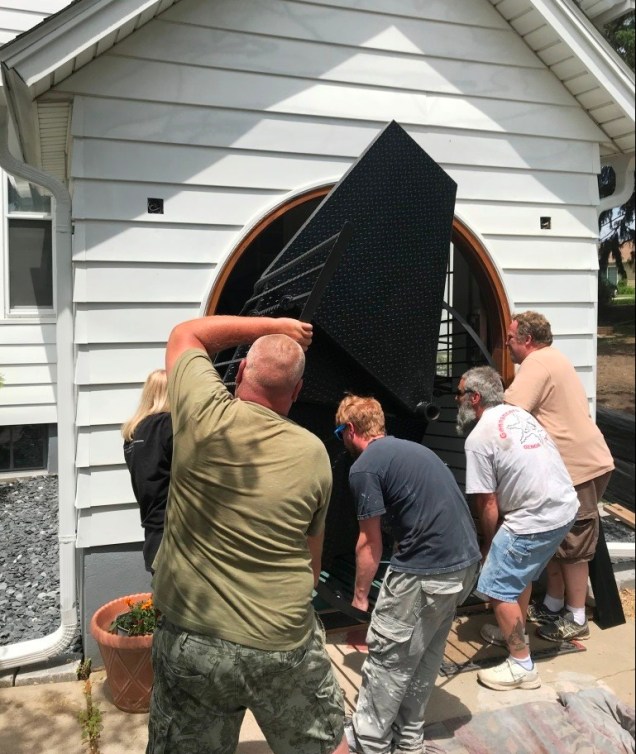
The spiral stairs proprietress’ head man suggested we turn the spiral stairway around in the front yard to spiral it in top first.
Our spiral stairway, halfway born.
Much grunting ensured, but before long, our spiral was completely screwed inside our entryway. One doorway down, one to go.
Looky there, she’s inside.
Experience made the second doorway easier, and gruntingly, the spiral was inside the sanctuary of the church.
Upsie daisy!
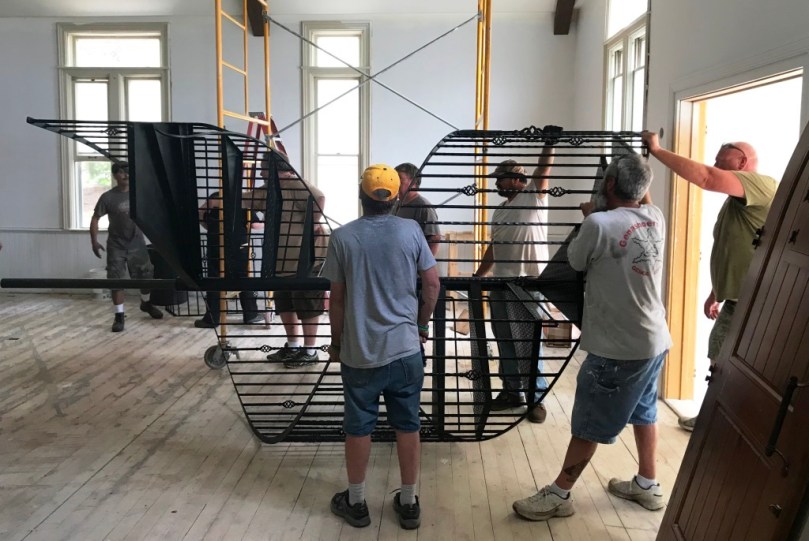
We (or more accurately, the men, because I was spent) lugged the spiral across the room and, after one last round of grunting, tipped the spiral upright.
She (our stylish spiral presented as a she) was bolted in place, and within minutes, Tyler and I climbed to the balcony on the steps of our spiral. Total installation time, including false start: Forty-four minutes. Not a record, but a competent average.
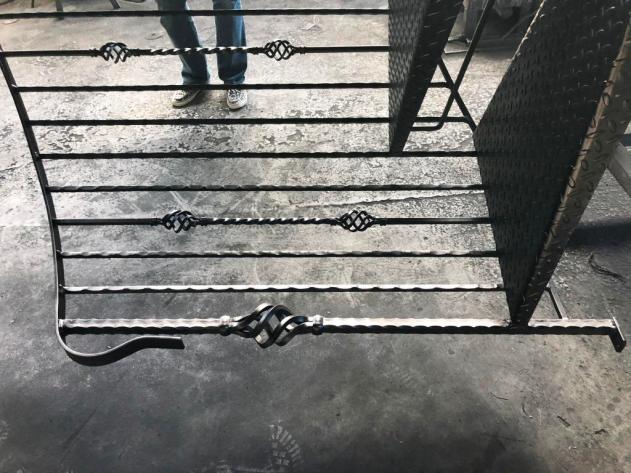
She was beautiful in all her black hammered spindles punctuated by her elegant basket balusters. She fit the corner of the great room perfectly, both in size and in style.
Tyler and I posed for a picture standing at the top of the steps in all our sweaty glory. We couldn’t stop smiling.
Ta-da!
# # #
Today’s headline is a line from Stevie Wonder’s hit “Isn’t She Lovely” written to celebrate the birth of his daughter. You can thank me later for this uplifting earworm.
Tomorrow: We are plagued, it seemed. Read about it here.
Our story so far: After working through every detail of construction for the spiral stairs we dreamed of for the old Methodist church we were turning into our home, delivery day arrived.
# # #
To be clear, delivery day was officially delivery only. The install was the homeowner’s responsibility. The spiral stairs proprietress suggested we needed one guy for every hundred pounds of stairway, meaning we needed Tyler plus seven guys. I could help, but I counted as only a half a guy (which was a pretty accurate assessment of my strength).
Accumulating seven guys willing to lift a spiral stairway in a village to which we hadn’t even officially moved sounded like a tough sell only to me. Tyler drafted his hired man St. Johnny, our tiler/master carpenter You-Can-Call-Me-Al, the carpenter helper, three drywallers plus a very large man invited by the chief drywaller. Plus me, a half-lifter. The proprietress and two of her men unofficially pitched in.
Ten guys and two women.
A little grunting.
This should be easy, I thought.
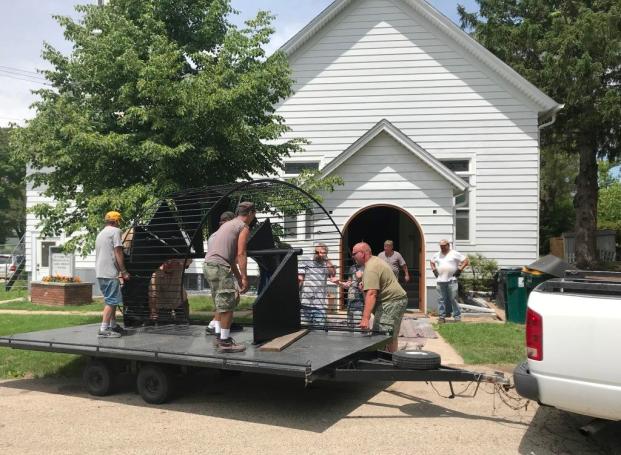
Our spiral arrived on a trailer.
We began by removing the stairs from the trailer, which we accomplished reasonably easily.
A spiral stairway with a diameter of six-foot-three would be considered larger than normal (ironically, my husband at six-foot-three was also considered larger than normal). This size spiral would need to be literally screwed into the church—twice because we had one exterior doorway and one doorway at the top of the entryway steps to the great room. Fortunately, both were double doorways. The proprietress and her head man had performed this feat hundreds of times, and they were confident it could be done.
With a little grunting.
Their record was seventeen minutes from trailer to securing the bolts to the floor.
We began spiraling our stairway in bottom first. The top of the spiral had a landing which would be secured to the balcony, making the top even bigger than the rest.
Excuse me, question: How is that landing going to clear the doorway? Answer: It’s not. Back her up, boys.
After several minutes of turning, and grunting, and shaving off some edges of the exterior wooden doorway, it was apparent we weren’t going to get the spiral in bottom first.
We backed it out. Most of us huffed and puffed in the middle-of-the-day sunshine while You-And-Call-Me-Al removed the doors from the hinges in both doorways.
At this point in the installation process, I was reminded of the Bible story in the Gospel of Mark about the father who brought his child to Jesus to have him cast out the spirit that afflicted the mute child with convulsions. “If you believe, all things are possible to him who believes,” Jesus told the father, to which the father replied, “Lord, I believe! Help my unbelief!” Jesus followed through and cast out the unclean spirit.
I expressed my skepticism to the proprietress.
“Oh, we can get it in there,” the ever-optimistic proprietress said.
“I believe!” I said. “Help my unbelief!”
She laughed.
# # #
Tomorrow: Oh, ye of little faith. Chapter 28 concludes. Read it here.
Our story so far: Among the treasures unearthed during demolition of the old Methodist church we planned to turn into our home was a choir loft on the second floor. We decided to open it up to the sanctuary and build a balcony. A distinctive balcony required a distinctive stairway.
# # #
Chapter 28
Among the benefits of living a mile away from the spiral stairs manufacturer was getting to see—in person—the (ahem, excuse the cliché) step-by-step construction of our stairway.
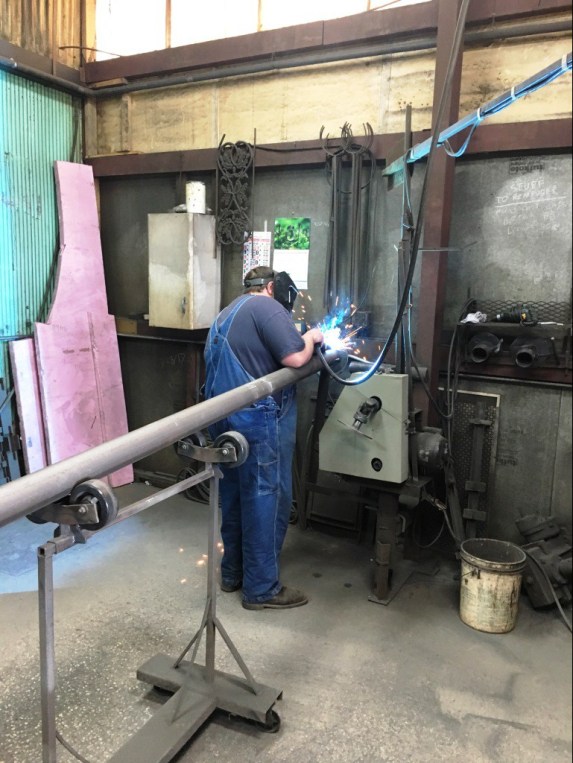
After we visited the manufacturer when Tyler first uncovered the balcony during demolition in January, the proprietress had befriended us, so she invited us over whenever one of the artisans had a question about some element of masterpiece that would someday grace our great room. The spiral was constructed in total at the manufacturer facility, to be delivered whole. Like the fireplace had many parts I couldn’t name before buying one, so is a stairway.
A welder works on the center pillar of our stair.
After determining the height and diameter of the spiral stairway with the benefit of careful measurements in March, we pawed through some of the proprietress’ leftover balusters in April to cut costs on our stairway. Balusters are the columns that support the rail. We selected a 4:1 mix of industrial hammered balusters and traditional basket balusters.
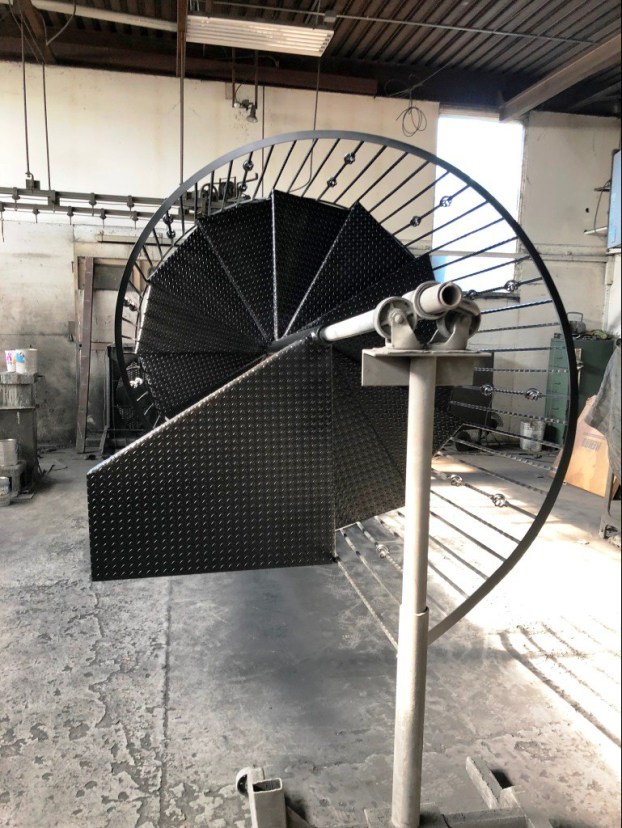
Here’s our newel post. Sideways for now.
Then we chose a newel—the post at the foot of the flight of stairs. We selected a giant-sized version of the basket baluster.
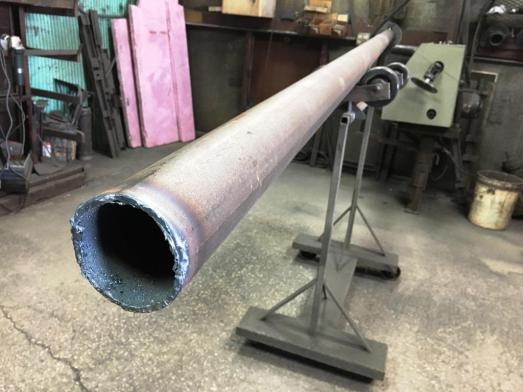
The pillar upon which everything spiral revolves.
(In the case of a spiral stairway, the pillar supporting the staircase may also be called a newel.)
Treads? We went with the industrial diamond plate.
Clockwise or counterclockwise spiral? Ours would be clockwise going up.
Our stairway is prepared for painting.
Color? Painted black. It was May.
Railing? We waffled on this decision, first selecting a smooth vinyl cover for the flat rail, but in a last-minute decision in early June we went with just the flat steel handrail.
Our engineering-minded spiral proprietress also helped Tyler determine proper basement floor support for the steel structure that would weigh about eight-hundred pounds.
Finally, we had worked through every detail, and delivery day the first week in June arrived.
# # #
Tomorrow: It takes a village. How’s that? Read about it here.
Our story so far: While the drywallers worked upstairs and the concrete finishers labored outside, I holed up in the basement with creative projects that would find life as soon as Phase Four: Cabinets began.
# # #
As I finished my last coats of polyurethane on the vanity, I pondered knobs. Initially, I had intended to reuse the original wooden knobs because they matched the veneer I had preserved for the top drawers, but with 90 percent of the wood painted, I considered painting the knobs, too.
So I took to Facebook to poll my friends.
“What do you think of these original knobs,” I asked friends on Facebook. “Should I paint them?”
One might say a lot of negative things about Facebook, but my friends are creative thinkers with good taste. One of them suggested vintage glass or crystal knobs, and a number of people seconded it. It was a great idea I hadn’t even considered.
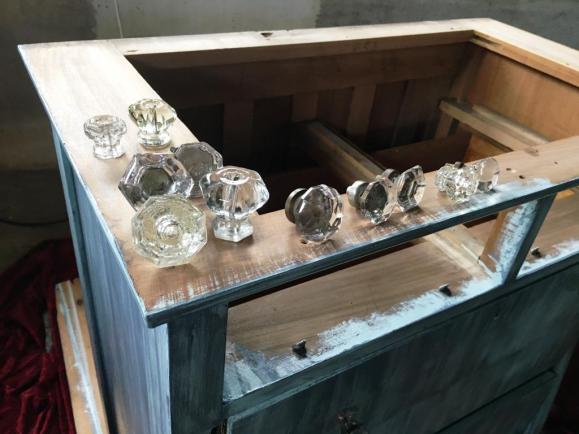
On my next visit to Home Depot, I found a suitable glass knob to try. Cost: $6. I needed 18 knobs, so this meant I would be spending more on knobs than I did for the whole second-hand dresser set! I liked the look of the single knob which inspired a visit to eBay, where I found a mismatched lot of vintage crystal knobs—enough for the dressers—for only $25. Sold.
The lot of crystal knobs came in all sizes, but they would work in an eclectic way.
Unfortunately, I discovered after applying the last coat of polyurethane that I had used too heavy a hand on the edges of drawers. Some of them no longer closed. So another round of aggressive sanding was required.
Still, I didn’t mind expending the effort. Including the quartz countertop, my eight-foot custom vanity cost only $1,020.86. And it looked like a million bucks.
The Facebook advice was just another example of the community rooting us on and helping us bring to fruition our vision.
Some people the ability to see for the beauty trapped in ugly things, and some people simply do not.
# # #
Tomorrow: Chapter 28 opens. One step at a time. Check it out here.
Our story so far: A swinging door spooked me as I worked alone in the basement of 126-year-old Methodist church we were turning into our home.
# # #
I do not have a good picture of the storm door that this one replaced, but I can assure you, this one is a lot whiter!
We also invested in a new back door for the basement to replace a functional but unlockable storm door. If ghosts intended to get in (or out), they’d better have a key.
# # #
Tomorrow: Chapter 27 about managing chaos wraps up. Read it here.
Our story so far: As I painted alone one evening on a dresser-cum-vanity in the basement of the 126-year-old Methodist church, a creepy creak and then a thud caught my attention.
# # #
The thud drew my scrutiny to the windows at the back of the church.
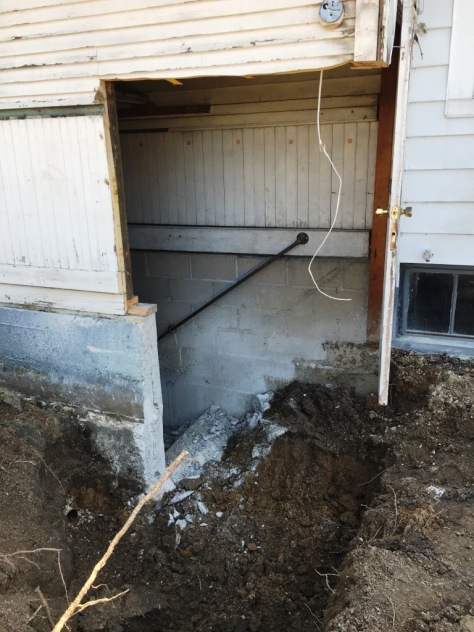
In the thickening darkness, I didn’t see a phantom. I saw the back door to the church, swaying in the breeze. And creaking. Because Tyler had recently jackhammered the back steps and cut out part of the wall, the door latched into thin air, and it was swinging to and fro and occasionally slamming shut.
See that door on the right? When Tyler cut a hole for the new steps, he also cut away the latch for the door.
This discovery made me laugh out loud.
It was not a ghost. It was the wind.
A look at the steel bridge permitting egress from the back door on the main floor.
A few weeks later, Tyler eliminated the creepy creak by building a proper back egress. The steel fabricator with beautiful but menacing dog we’d met a few weeks prior completed his work on the steel bridge. When my 20something adored stepson paid us a visit, Tyler took advantage of his upper body strength. They hauled the steel bridge into place, and Tyler built a floor and interim railings out of scrap wood. This finalized a proper, if temporary, back entry to the main floor of the church. And eliminated the both the latchless swinging door and the accompanying creak.
When the garage is built, this addition for the back entry will be removed.
# # #
Today’s headline is a quote from horror writer Stephen King.
Tomorrow: A new back door for the basement, too. See it here.
Our story so far: One evening, I sat in the basement of the 126-year-old Methodist church by myself trying to squeeze in a coat of paint on the bathroom vanity before I couldn’t see anymore in the gathering twilight.
# # #
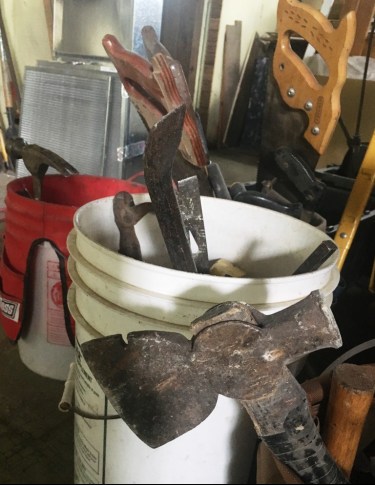
Tyler stored his tools in the church basement just feet away from my makeshift paint station. If the boogeyman had arrived empty-handed, he wouldn’t go wanting for an implement of terror for long.
Creeeeeeeeeeeeeak.
The sound was exactly like one heard in a horror movie before the boogeyman appeared with an axe or a chainsaw.
Buddhist monk Matthieu Ricard once said “When hearing a door creak, the optimist thinks it’s opening, and the pessimist thinks it’s closing.” I didn’t know which camp I was in.
“Who goes there?” I called out loud.
No answer.
Maybe my imagination was getting the better of me. It was rare, actually, that I spent time alone in the church. Usually I was there during the day when Tyler, at the very least, was working and often, several other men. I remembered how I’d scoffed early on about churches being haunted. Maybe my disbelief had ticked someone—or something— off.
Creeeeeeeeeeeeeak.
OK, this was real. It was not my imagination. I joined the camp of optimists and assumed this was a spirit with whom I could negotiate.
“I’m a good guy,” I said. “Let’s be friends. We can both live here peacefully. I want to fix things up, not tear things down.”
I began brushing paint faster.
Creeeeeeeeeeeeeak. Thud.
# # #
Today’s headline is a quote from American writer Audrey Niffenegger.
Tomorrow: The source of the phantom creak is revealed. Read about the culprit here.
Our story so far: While the drywallers worked upstairs and the concrete finishers labored outside, I holed up in the basement with creative projects that would find life as soon as Phase Four: Cabinets began.
# # #
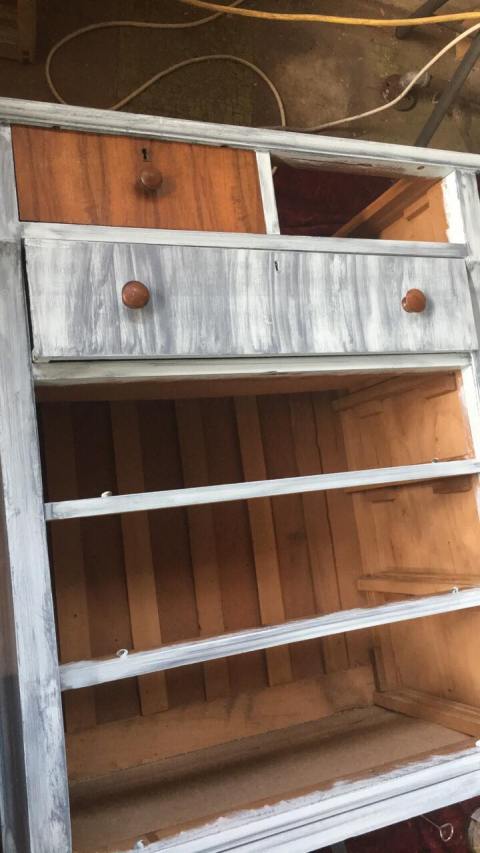
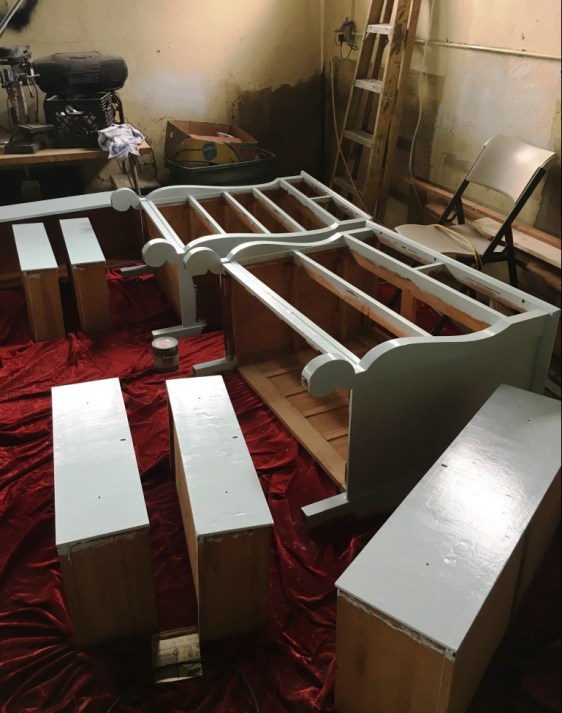
The dressers after a couple of coats of Sunken Pool.
In between everything else going on, I added coats of paint to the dresser that would ultimately become the upstairs bathroom vanity. Tyler set up a “paint parlor” in a corner of the basement for this type of work. A few weeks later on the recommendation of a friend, I would spend an evening learning about the wonders of mineral paint, which required only one or, at most, two coats for furniture projects like I was attempting. But at this point, I was using latex paint: Four coats of Sunken Pool, two coats of distressed Adirondack Blue (both from Behr available from Home Depot, of course) and then three coats of clear polyurethane. Plus sanding between every coat. Each coat required only about a half hour of time to apply, but I had to be patient and diligent in order to get drying time between coats.
One evening, early on in the garage foundation project, I sat in the basement by myself trying to squeeze in a coat of paint before I couldn’t see anymore in the gathering twilight. Usually, I caught a few minutes of MPR on my phone while meditating on my brush strokes, but that night, I just absorbed the silence of the church.
Until I heard a creepy creak. A door—somewhere—opened. Or closed.
Creeeeeeeeeeeeeak.
# # #
Tomorrow: Negotiations begin. Read about them here.







 Church Sweet Home