Old lights, new lights

Our story so far: We implemented meaningful ways to make the old Methodist church our home.

# # #

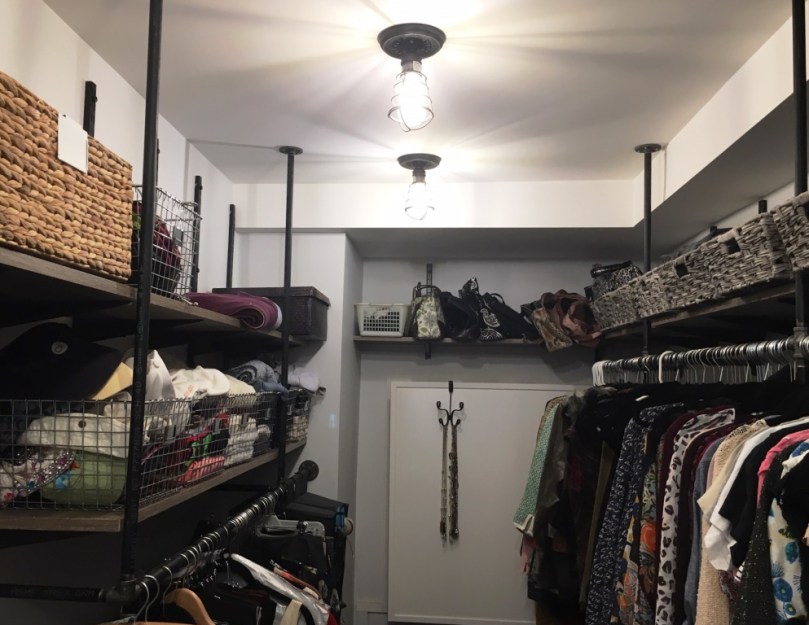
old light in back entry
One of the old lights formerly lit the side entryway to the church (the doorway through which this picture was taken was walled up to enclose our master bedroom).
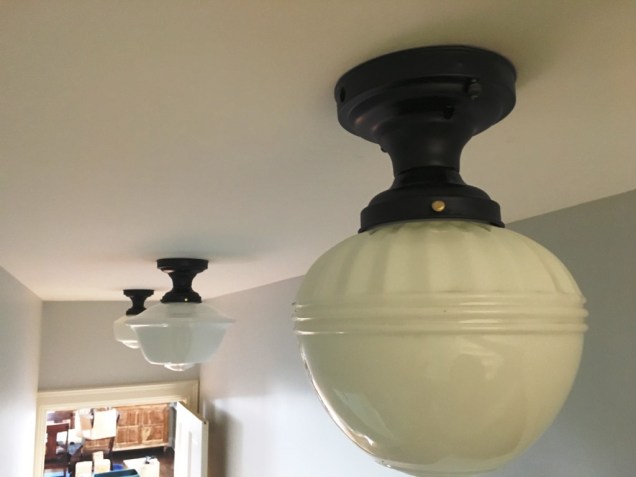
light globes
Shapely.

The Hall of History, when we purchased the church, was paneled and dark. Removing the paneling and installing drywall helped immensely, but it needed good lighting, too, to be inviting. What better fixtures than historical ones? Among my favorite recycling projects in the church was our reuse of these various light fixtures; one of them, for instance, originally lit the side entry. The globes shared color—white—but varied in shape.

rusty collars
Collars before spray paint.

We also unearthed a number of rusty collars of unknown age. I spray-painted the collars in matte black and had them rewired. The globes required only soap and water.

collars in spraypaint
Collars in the spray paint booth (that is, the basement).

Then they sat in storage for ages. I could hardly wait until it was their turn to get installed. They were among the last ones.

The best parts were the screws used to secure the globes in the collars. I, hater of all things brass, chose brass. They were just the right accent, and I loved them.

hall of history lights
Hall of history lights (with brass screws!).

When we moved in, I took great satisfaction in flipping the switch to turn on the lights in the Hall of History. They warmed my heart a little bit.

# # #

Tomorrow: More cozy touches in the kitchen. Read about it here.

A belfry is for a bell … and possibly books

Our story so far: Having moved into the old Methodist church which we had renovated into our home, I worked on making my home office homey.

# # #

books
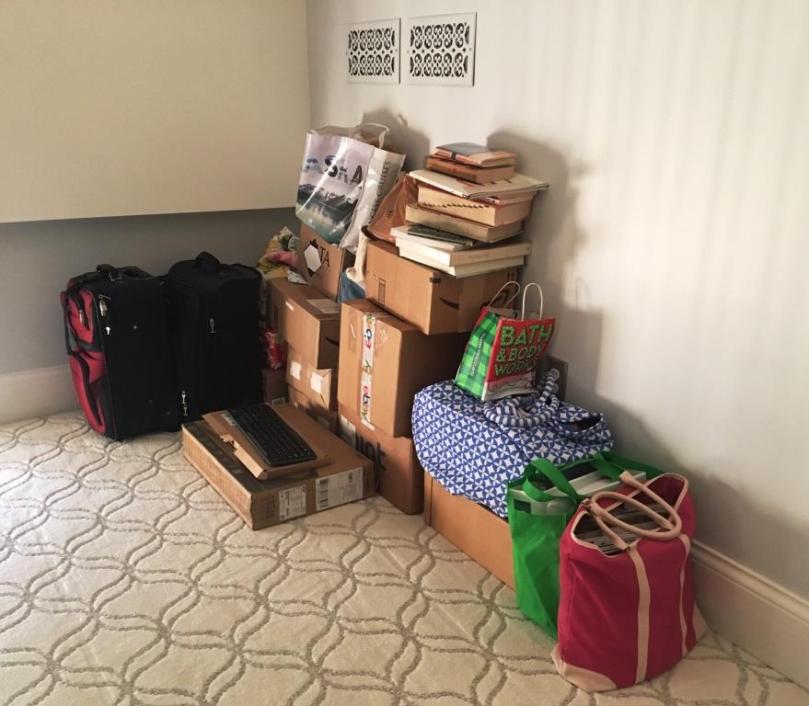
An assortment of boxes and bags filled with my treasured collection of books awaits unpacking in the corner of the balcony.

I still had a dozen boxes and bags of books to find a home for, but they were slated to occupy the belfry when construction there was finished. The belfry would make a lovely little reading nook someday.

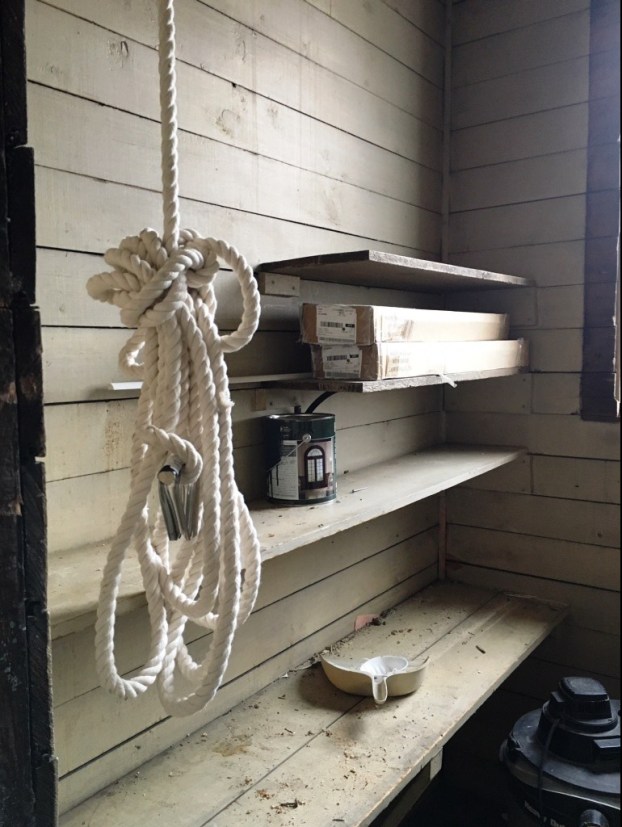
belfry shelves
I’m thinking these dusty shelves in the belfry (that’s the bell pull there, not a noose) deserve new life housing my collection of books at some point.

# # #

Tomorrow: Lights for the hall of history. Read about it here.

If a cluttered desk is a sign of a cluttered mind, of what then, is an empty desk a sign?

Our story so far: Having moved into the old Methodist church we had renovated into a residence, we now were working on making it a cozy home.

# # #

I began establishing cozy in my office. Guests wouldn’t be using this space, but I would—every day.

In our previous house, my office occupied the smallest bedroom. It was usually filled to the top with paper of all sorts—books, magazines, files, notebook paper, printing paper, loose papers, mail, greeting cards I treasured, greeting cards to send and stationery … I was a papyrophiliac. And it drove Tyler just a little bit crazy. He successfully encouraged me to upgrade from newsprint to digital editions of my favorite newspapers (yes, I subscribed to two), but I still adored paper anything and hesitated to let it go.

When we moved out of that house, I trashed and shredded a literal ton of paper. The experience was freeing. I felt so much lighter in a physical sense and a spiritual one, too, but I getting rid of a lot of paper didn’t mean I wanted to get rid of all paper.

I stored some of that treasured paper (books, primarily) and lugged around the rest of it in the RV we lived in for nearly a year. My desk in the RV was a corner desk—literally a triangle that had enough space for my computer and a pen caddy. It was difficult working that way, and when we finally moved into the church I got grumpy having to unpack and put together other rooms before doing my office. I longed to have my own paper-centric space back.

We chose the back corner of the second floor for my office because most of the time, no one but me would ever see it (paper piles everywhere—how fun!). My nook had a window overlooking the elementary school playground across the street. The sound of children’s voices made me happy and reminded me of how the window in my old office overlooked the basketball court in our former neighbor’s driveway where children frequently spent time throwing baskets.

When I finally had time to assemble my desk, the hardest part was finding all the parts. My desk was actually two desks made of sheets of glass and a whole lot of metal tubing. At first I feared I was missing some of the legs but a little digging revealed the missing parts in the closet—maybe the movers stashed them there, or maybe I did and I forgot. So many moving parts.

I spent the day with an Allen wrench and successfully reassembled both desks and they fit in a perfect L-shape in the corner. When my mom visited, we unpacked a dozen boxes labeled “office supplies” into the eaves behind my desk, and ta da, I had a real office again with a real desk and plenty of room to pile up paper. I was in heaven. Well, if not heaven, I was enjoying the rarefied air of the second story of an old church, and that was just fine.

office corner before
Here is how the space my office is now looked back when we first bought the church.
office
And here’s my office now.

# # #

Today’s headline is a quote credited to genius physicist Albert Einstein.

Tomorrow: Where will the books go? Read about it here.

Feel the radiance of your divine self

Our story so far: My husband and I purchased a 126-year-old Methodist church, renovated it into a home, moved in and built an attached garage—all in 11 months.

 # # #

Chapter 43

Chapter 43Some measure of coziness can be derived from candles and comfort food. So said Meik Wiking in her book about the Danish concept of hygge (pronounced hooga).
I had vowed to work comfort and coziness into the design of the old Methodist church conversion, and I knew I could get there with some soft throws and by serving hot coffee, cold drinks and good food to guests.

But what about the church itself? Especially that wide open sanctuary?

When friends visited the church in those early days of living there, they frequently said something along the lines of, “It’s more cozy than I thought it would be.” (More than one visitor stood in the great room, turning around to look at everything and refused to be hurried to the next stop on the “tour”; two people said they got goosebumps taking it all in—I loved comments like that.)

I credited Tyler’s brilliant concept of the balcony, which had the kitchen beneath. By pulling the kitchen into the great room, we took a bite out of the openness and had created a more cozy gathering place. The space was no longer imposing and formal, as it might have been when it was a worship space—it looked and felt like a home.

Oftentimes, guests would gather around the island (it seated five) to nosh on treats or appetizers while I puttered around the kitchen. It was fun to entertain. On the other hand, our only “living room” seating was the sectional. Six people could sit comfortably on the L-shaped couch, but it was a little awkward when that was the only place to sit, which I suppose is why some people gravitated to the island. We would remedy the seating arrangement in due time, but we worked on making the church more cozy and livable with many other small projects in those early days.

# # #

Today’s headline is a quote from spiritual teacher Yogi Bahjan who said, “What is a cozy home? Where you enter and you feel the radiance of your divine self.”

Tomorrow: I get cozy in my office. Read about it here.

Every time my husband kisses me, the garage door goes up

Our story so far: We moved into the old Methodist church we had turned into our home, and my husband turned his attention to construction of an extra-large attached garage.

# # #

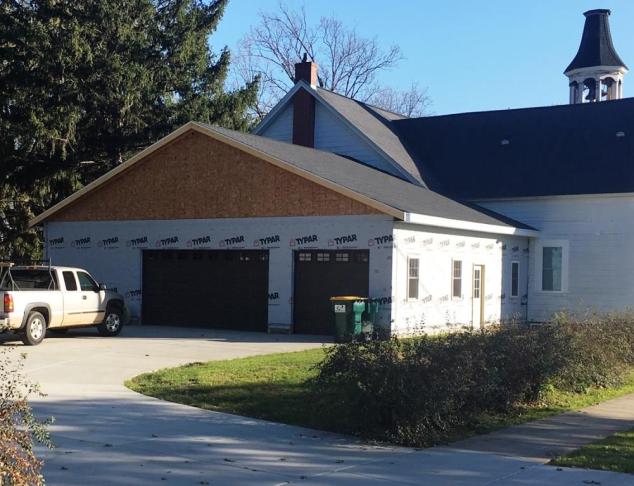
The final doors to be installed on the garage were the garage doors—the ones used to drive a vehicle inside. The garage door guy showed up and motored through installation, one section at a time from the ground up to the windowed top section. Tyler chose brown doors. He consulted me but we’d talked about so many options, I was a little surprised when I drove up upon returning from grocery shopping.

garage doors close
Ah, garage doors!

The garage door guy also installed garage door openers (that could be operated with our cell phones!), but we weren’t able to use them to actually drive our vehicles inside because we weren’t yet up to code. The drywallers still needed to drywall the exterior of the church that was inside the garage. Drywall is a fire barrier, and a fire barrier is required between the attached garage and the residence (and if our building inspector was a stickler about anything, he was a stickler about fire barriers). So despite having an enclosed garage with a shingled roof and operational garage doors, we parked our vehicles outside until the drywallers could perform their magic.

While they were here, the drywallers were going to fix the vanity wall in the second floor bathroom that had been torn apart to install proper wiring for the light fixtures. That’s what I was excited about: We were turning our attention back to the interior of the old Methodist church.

Here’s the “end” of that slide show we started with the beginning of Chapter 42 (yes, the Typar stays until we side over it, probably next spring):

This slideshow requires JavaScript.

# # #

Today’s headline is a quote from American country comedienne Minnie Pearl. The full joke: “The doctor must have put my pacemaker in wrong. Every time my husband kisses me, the garage door goes up.”

Tomorrow: Chapter 43 opens. Read about how the church was cozy here.

Bigly (or possibly big league, hard to tell)

Our story so far: Tyler scooped up a used refrigerator for his new mancave.

# # #

shingled garage
The fully shingled garage.

Our electrician stopped by, not for a beer, but to deliver a gift: A pair of lawn chairs he’d snagged for as good a deal as the refrigerator Tyler picked up. The electrician thought they would look right at home on our patio. We accepted his thoughtful gift. As he observed our mammoth garage structure, he remarked, “Your garage is bigger than my house.”

He wasn’t the only one to notice the Garage Mahal. A neighbor stopped by, echoing the electrician’s comments: “Your garage is bigger than most of the houses here.”

Point taken. The garage was about 50 percent bigger than the rental house we had lived in over the winter. Two blocks from the church, that rental house was part of the neighborhood which was dotted with a number of other rental units. To be fair, the neighborhood was also home to a couple of pretty impressive Victorian homes and a house that was once that town’s hotel.

Friends who saw pictures of our garage used words like “ginormous” and “massive.” It was big, no doubt, but I didn’t feel it was outsized. The three-car garage attached to our former home dwarfed the rest of the structure because, like most suburban houses built in areas without alleys, it stuck out front calling attention to itself (and Tyler still had two other structures in the yard to store all the tools and gardening supplies that didn’t fit in the garage). At least our chome garage was behind the house. I remembered how Tyler had filled the sanctuary of the church with tools when we first took possession. And he used a lot of those tools during demolition and reconstruction. They needed to be stored somewhere. Also, we had large vehicles (even so, we had to store the RV elsewhere because it was too tall and long for any standard garage). It might have been conspicuous now, but once the garage was sided to match the rest of the church, it would blend right in.

At least that’s what I told myself.

# # #

Tomorrow: Garage doors go on! See them here.

Eighty percent of success is just showing up

Our story so far: My husband worked on an attached garage for the old Methodist church we had turned into a residence.

# # #

nineteen dollar refrigerator
Is this the most stylist fridge you’ll ever see? Probably not. But it’s the best value.

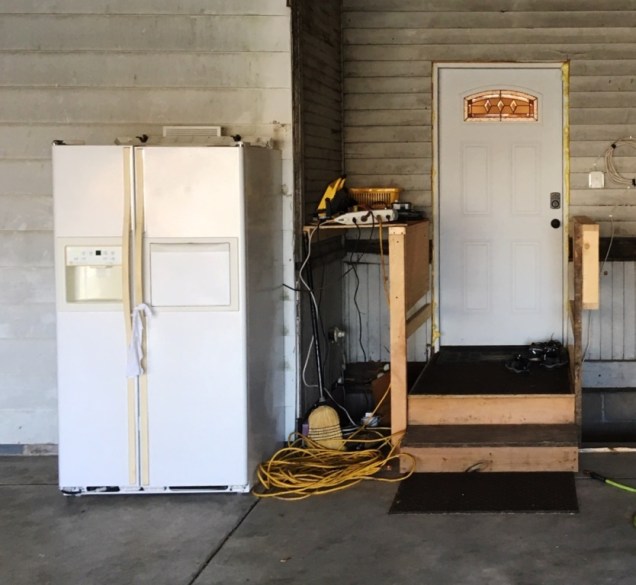
What’s a mancave without a refrigerator, right? During a trip to Menards to acquire nails or Typar or some other construction material (I lost track of what he was buying; so many trips to acquire more construction materials), Tyler ran across the deal of the century. Menards was peddling a used refrigerator. For months, he had been sending me to the Dollar Store to get another bag of ice for the cooler which housed the beer for the contractors happy hour he hosted when the heavy lifting was finished. “Another bag of ice?” I complained, not infrequently. When Tyler called me and asked if he should buy the refrigerator on sale for nineteen bucks, I never uttered a faster “yes!” We paid for the fridge by saving on three weeks of ice.

# # #

Tomorrow: Size matters. Read about it here.

Patio plans and preparation

Our story so far: Tyler constructed an attached garage for the old Methodist church we turned into our house.

 # # #

dirt before
These piles of dirt, delivered in May, sat in the yard for four months while Tyler focused on other priorities.

On a sunny autumn day a week or so later, Tyler rented an earth mover so he could finally redistribute all that glorious black dirt he acquired months before when the school across the street got a new parking lot. He also spread around a load of gravel in the lawn outside the future porch. This layer of gravel would settle over the winter and be ready for the installation of pavers for a patio off the garage porch. He planned a cozy fire pit, too. This patio would one day provide access the church lacked to the beautiful outdoor space. The garden planted by parishioners on the side of the church could be seen through the windows, but as a church, there was no porch, no patio, no deck— even the front door spilled out onto the public sidewalk. This three-season porch and outdoor patio was designed to remedy this lapse.

dirt after
That lighter area on the ground outside the garage is gravel where the patio will be built next year.

# # #

Tomorrow: Deal of the century. Read about it here.


Life is better on the porch

Our story so far: Tyler and his crew of assorted tradesmen built a modern attached garage for the 126-year-old Methodist church we had turned into our home.

# # #

garage windows and doors
The west side of the garage now has three windows facing the street. The doorway that used to exit out of the “lean-to” was moved north to provide an exit at the top of the rebuilt basement stairs.

The men installed some of the windows and exterior doors of the garage. The largest garage doors hadn’t yet been purchased, and the window openings of the planned three-season porch in the fourth stall of the garage were simply boarded up. Those windows would be installed later, probably springtime. Tyler had grand plans for this mancave porch, but he would be attending to it when the weather was getting warmer again instead of colder. In the meantime, he and his hired man St. Johnny built shelves to hold all the reclaimed wood in the basement.

garage inside
Here’s where you need to use your imagination: Windows will be installed where you now see shelves of wood and headers.

# # #

Tomorrow: A porch and a patio, too!

Only a barbarian sees the beauty in demolition

Our story so far: My husband and I bought an old Methodist church to turn into our home. After we got it renovated enough to move in, he started work on an attached garage before winter settled in.

# # #

At one point, it became necessary to finally demolish the structure that had protected the back stairway (I sometimes called it a lean-to, but it wasn’t strictly leaning against anything—it was the cover for the back stair). I was inside the church in the moments it was razed, and at first, I thought something terrible had happened. There was a mighty clatter. Then another. The men pried great hunks of roofing material and siding from the church, leaving behind the welded back-door walkway over the back stair. After clean-up and a bit of sweeping, all evidence of the lean-to was gone. The main floor back door and the basement door exited into the garage as if that’s the way they had always been. All that was missing was a railing around the steps going downstairs.

leanto before
Here is how the back entry looked when we purchased the church a year ago.
leanto with new steps
Here’s how the “lean-to” looked when we were pouring the garage foundation and building concrete steps into the basement.
leanto with back door
Here’s how the back entryway looked after Tyler installed a back door on the main floor and put in a wood-sheathed steel walkway over the back steps.
leanto gone
Here’s how the back entryway looked inside the garage after the “lean-to” was razed.

# # #

Today’s headline is a partial quote from Malaysian singer Kamahl. His full quote is, “Anyone can admire creation. Only a barbarian sees the beauty in demolition.”

Tomorrow: A garage has windows and doors, too.