Our story so far: Tyler constructed an attached garage for the old Methodist church we turned into our house.
# # #
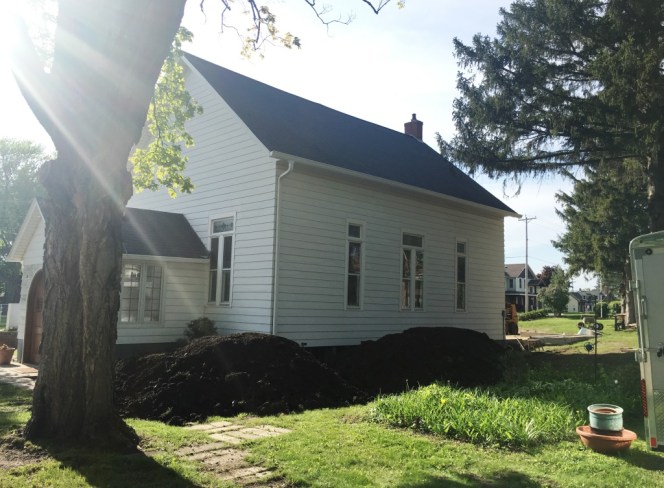
These piles of dirt, delivered in May, sat in the yard for four months while Tyler focused on other priorities.
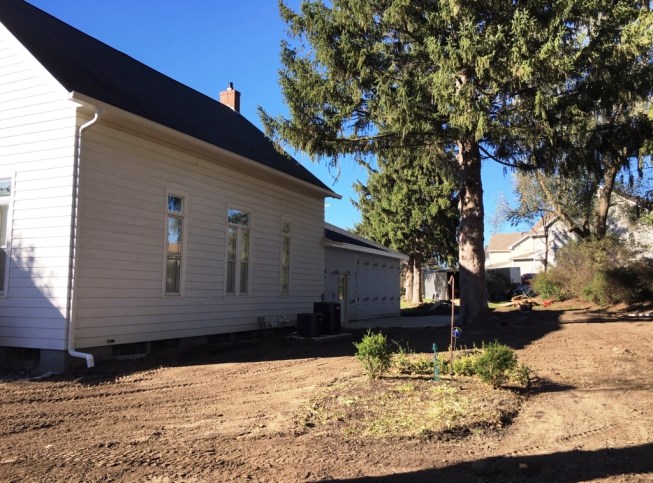
On a sunny autumn day a week or so later, Tyler rented an earth mover so he could finally redistribute all that glorious black dirt he acquired months before when the school across the street got a new parking lot. He also spread around a load of gravel in the lawn outside the future porch. This layer of gravel would settle over the winter and be ready for the installation of pavers for a patio off the garage porch. He planned a cozy fire pit, too. This patio would one day provide access the church lacked to the beautiful outdoor space. The garden planted by parishioners on the side of the church could be seen through the windows, but as a church, there was no porch, no patio, no deck— even the front door spilled out onto the public sidewalk. This three-season porch and outdoor patio was designed to remedy this lapse.
That lighter area on the ground outside the garage is gravel where the patio will be built next year.
# # #
Tomorrow: Deal of the century. Read about it here.
Our story so far: Tyler and his crew of assorted tradesmen built a modern attached garage for the 126-year-old Methodist church we had turned into our home.
# # #
The west side of the garage now has three windows facing the street. The doorway that used to exit out of the “lean-to” was moved north to provide an exit at the top of the rebuilt basement stairs.
The men installed some of the windows and exterior doors of the garage. The largest garage doors hadn’t yet been purchased, and the window openings of the planned three-season porch in the fourth stall of the garage were simply boarded up. Those windows would be installed later, probably springtime. Tyler had grand plans for this mancave porch, but he would be attending to it when the weather was getting warmer again instead of colder. In the meantime, he and his hired man St. Johnny built shelves to hold all the reclaimed wood in the basement.
Here’s where you need to use your imagination: Windows will be installed where you now see shelves of wood and headers.
Our story so far: My husband and I bought an old Methodist church to turn into our home. After we got it renovated enough to move in, he started work on an attached garage before winter settled in.
# # #
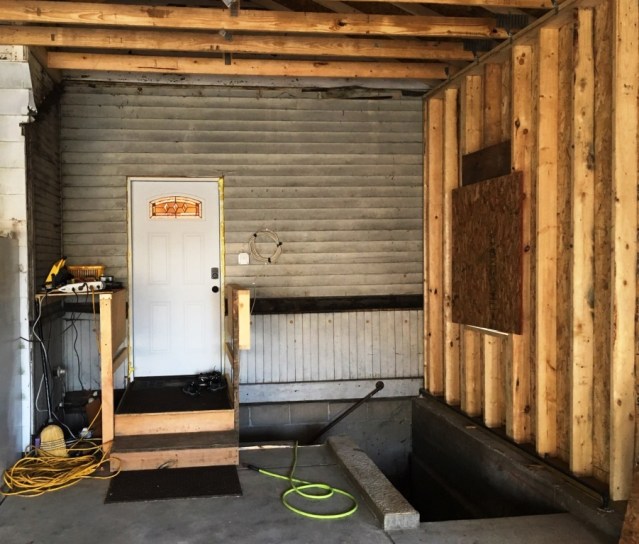
At one point, it became necessary to finally demolish the structure that had protected the back stairway (I sometimes called it a lean-to, but it wasn’t strictly leaning against anything—it was the cover for the back stair). I was inside the church in the moments it was razed, and at first, I thought something terrible had happened. There was a mighty clatter. Then another. The men pried great hunks of roofing material and siding from the church, leaving behind the welded back-door walkway over the back stair. After clean-up and a bit of sweeping, all evidence of the lean-to was gone. The main floor back door and the basement door exited into the garage as if that’s the way they had always been. All that was missing was a railing around the steps going downstairs.
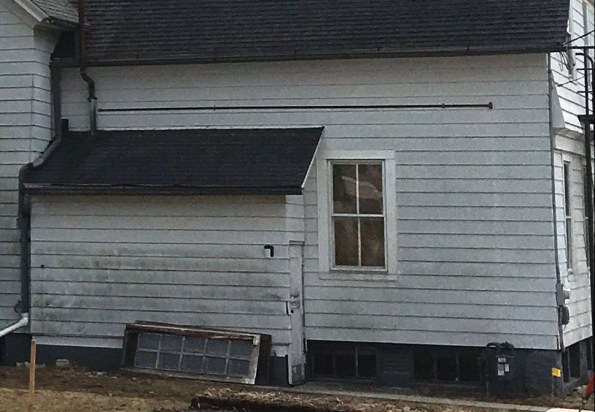
Here is how the back entry looked when we purchased the church a year ago.Here’s how the “lean-to” looked when we were pouring the garage foundation and building concrete steps into the basement.Here’s how the back entryway looked after Tyler installed a back door on the main floor and put in a wood-sheathed steel walkway over the back steps.Here’s how the back entryway looked inside the garage after the “lean-to” was razed.
# # #
Today’s headline is a partial quote from Malaysian singer Kamahl. His full quote is, “Anyone can admire creation. Only a barbarian sees the beauty in demolition.”
Our story so far: A rain delay gave Tyler the chance to test out the sound system inside the old Methodist church we had turned into our home.
# # #
Tyler and his posse wrangled with passing showers over the course of the following days, but they made steady progress nailing plywood to the roof, then roof felt and ice-and-water barrier and finally black shingles to match those of the church.
The men working on the attached garage finished the shingles on the east side first.
# # #
Tomorrow: The lean-to’s last act. Read about it here.
Our story so far: We moved into the old Methodist church we had renovated into our home, slowly unpacked our belongings, and Tyler was building an attached garage.
# # #
The day after the garage trusses were set, it rained. And the day after that. And the day after that.
Rather than frustrating Tyler, it pleased him. For a change, he was happy to take a break from sawing wood. So he could saw some wood. On the sectional in front of his enormous TV. Zzzz. He also spent some of his time indoors setting up the great room sound system and threading speaker wires through the basement.
He tested out his sound system when a couple of his musically inclined friends from way back and their wives paid us a visit. While we were lingering around the dining room table (we might have been basking in the glow provided by some excellent tequila), Tyler turned up The Rolling Stones to top volume.
“If you start me up, I’ll never stop.”
The music sounded pretty impressive. This was a former church sanctuary, after all, designed for big sound.
“You make a grown man cry.”
Tyler laughed. Our friends laughed. I laughed, too. A get-together like this was exactly why we’d purchased the church.
“Kick on the starter, give it all you got.”
We couldn’t hear our laughter over the music. This was impressive inside. But I was curious about how it sounded outside. What would the neighbors think?
I left the table, making a path to the powder room. Only I ducked out the back door instead and walked around the church to the front to hear how the music sounded outside.
Sounded just fine. I could hear Mick Jagger. He could never stop by now. But even a passersby on the sidewalk wouldn’t be likely to complain. Unless they complained they weren’t invited.
Our story so far: During a visit to see the transformation, my father installed more than fifty knobs on various cabinets in the old Methodist church we had rehabbed into our home.
# # #
Mom proved her prowess, too. She helped me unpack a dozen boxes of office supplies (yes, you might say we had an obsession with them), and she made an apple bundt cake for a pair of friends, one of whom spent her birthday paying a visit to see me and the church. I was grateful for the bundt pan I had unpacked, for my evenly heating gas stove and for the decorative cake plate on which to serve it—things I didn’t have in the camper for nearly two years.
Almost too pretty to wipe my hands on.
My friends gave me a housewarming gift of a candle and a hand towel that said, “Meals & Memories are made here,” an appropriate sentiment for my new kitchen.
The evening before they returned home, Mom and Dad helped us remove the super sticky plastic wrap from our balcony carpeting. Removal was as farcical as the application, but we persevered. Mom helped me assemble the legs for the balcony chairs, which I had gallantly retrieved from the store weeks before but hadn’t had a chance to put together. The engineering student working part-time at the furniture store put his know-how to use to get both balcony chairs and six dining room chairs (all in boxes) into the back of my pickup so I had to make only one trip.
Nice view.
Mom and I recovered our breath while trying out the new chairs and taking in the balcony view.
“Now I have to find a lamp for up here,” I said.
“Where are you going to plug it in?” Mom asked.
“We have an outlet in the floor,” I said, looking down to locate it. “At least, I think we do.”
We looked between the chairs. We looked under the chairs. No outlet.
“Oh my goodness, they carpeted over it,” I said, feeling the floor to see if I could locate the outlet through the carpeting.
We couldn’t find it that way either.
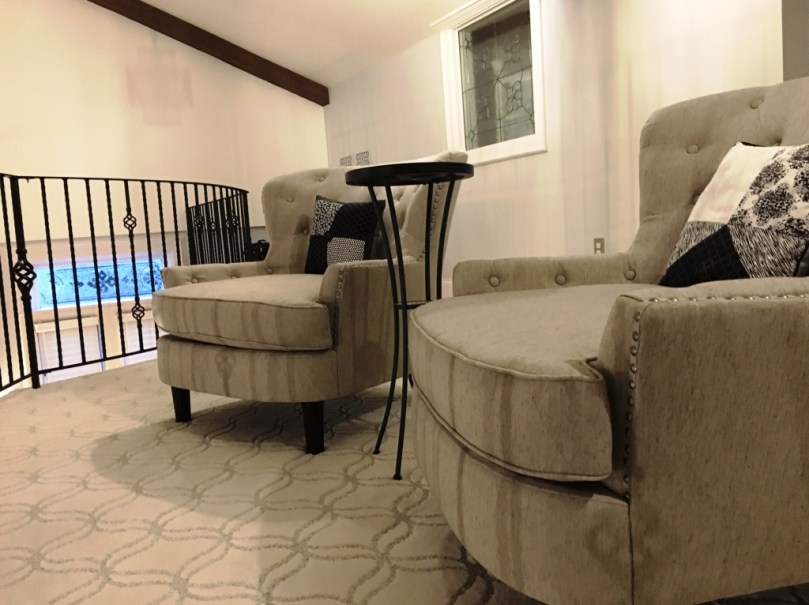
The chairs from the front side. Just makes you want to grab a cup of tea and a book, doesn’t it?
I mentioned the omission to Tyler later. “Oh, the electrician forgot that outlet,” he said. “The carpeting installers wouldn’t have known to leave a hole for it. We’ll have to do it later.”
Ah, later. Another “later” project.
First, Tyler was determined to finish his garage. But Mother Nature had other plans.
# # #
Tomorrow: Rain provides a musical break. Read about it here.
Our story so far: Shortly after we moved into the church we turned into our home, my parents paid us visit.
# # #
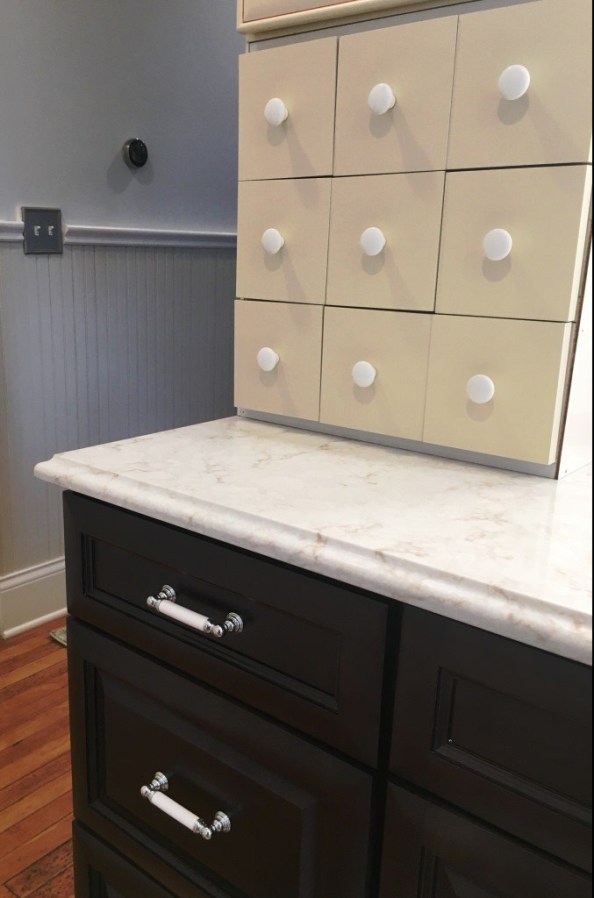
I ended up going with white porcelain knobs in the bathroom. The drawer pulls are accented with polished chrome, like the sink faucets.
A more enduring gift than the abundant harvest was my dad’s expertise with a cabinet hardware jig, a device that makes it easier to install cabinet knobs. He spent his “free” time during my parents’ visit installing more than fifty cabinet knobs throughout the church. When we moved into the church and I asked Tyler about when he would put on all our knobs, he said, “Rome wasn’t built in a day.” Rome wasn’t finished when Dad left, but at least I could open all my cabinets properly.
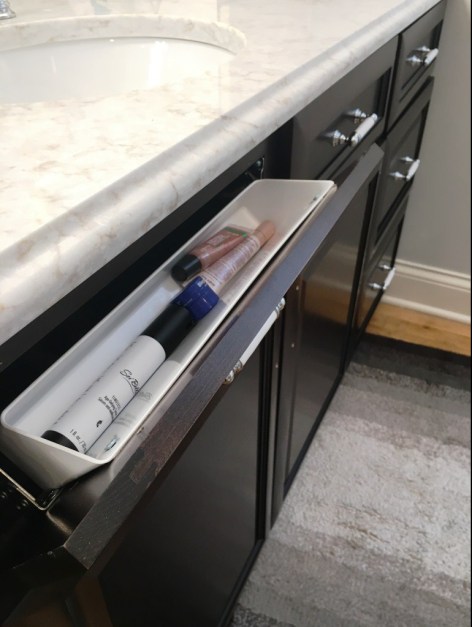
When I pulled bags of knobs out of the bathroom cabinets for Dad to install, I ran across a couple of boxes of tip-out sink-front trays that turn false drawer fronts into usable storage.
“Oh, maybe you can install these while you’re at it,” I said off-handedly, not fully grasping the enormity of the task I was asking Dad to perform.
How handy!
In his typical fashion, he did not complain (much). He figured out how to remove the false drawer fronts and install the trays (and the knobs!). Two cautionary tips: Dad told Tyler it would have been much easier to do before the quartz counter top had been glued on (impossible in our situation since we couldn’t find them then, but a useful note for you future DIYers). And, if you have a Dad as clever as mine who installs such handy drawers, you better put them to use. Because he will check when he visits at a later date and grouse about it to your sister when he discovers he put in all that effort and they’re not even used. I filled mine immediately with tooth floss and lip gloss.
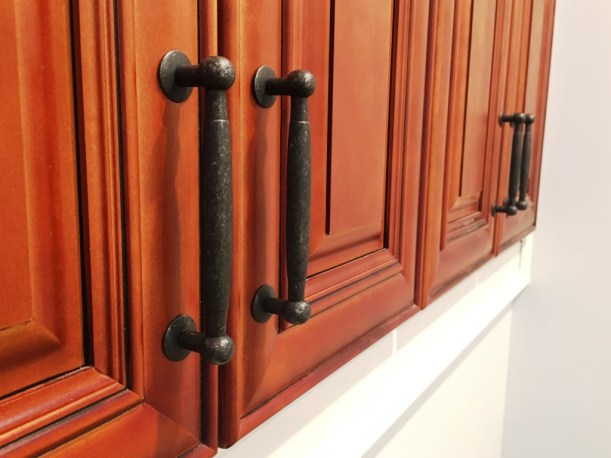
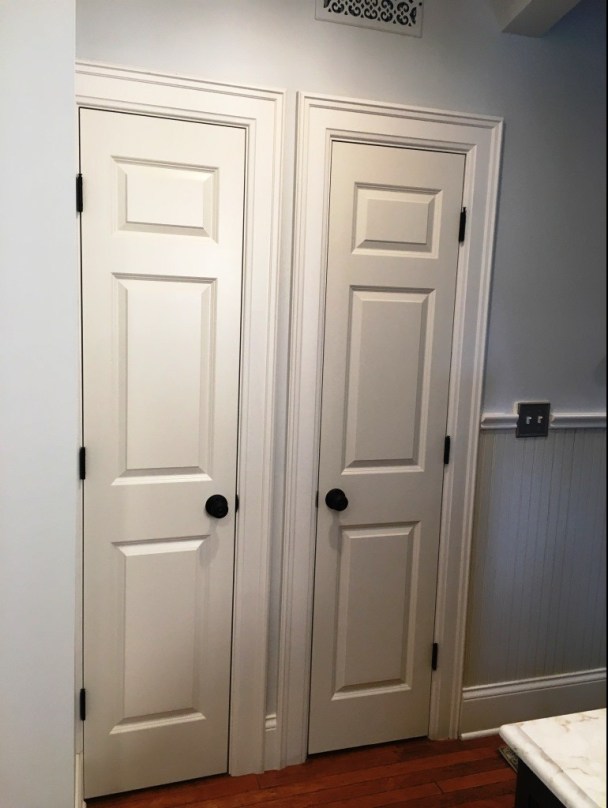
The knobs for the beverage bar cabinets came from the drawers originally in the display kitchen but which ended up in the master bath.The knobs for the mudroom cabinets were a perfectly rustic.After my linen closet doors hung ajar for a couple of weeks, Dad solved the problem by installing the door knobs. Bingo!The knobs on the laundry room cabinets were my favorite. They matched the plumbing pipe we used for the closet rods.
# # #
Tomorrow: The balcony, unveiled. Check it out here.
Our story so far: While my husband was working on the big and noisy work of constructing an adjoining garage on the church we converted into a home, I was working on smaller and quieter projects.
# # #
I also unpacked box after box of cookware and serving ware. Cast iron, stainless steel, non-stick, porcelain. Crystal, ceramic, glass, bamboo. Oval, round, rectangular, decorative. All the large, fancy and heavy pieces we didn’t bring with us in the RV but couldn’t bear to part with were now unpacked and homes found. When we entertained, I pulled out a butter knife with quiet satisfaction. Such an inconsequential but lovely flourish I could offer guests once again. For the butter. Which was served in a ceramic butter dish instead of a Tupperware one. This small thing made me happy.
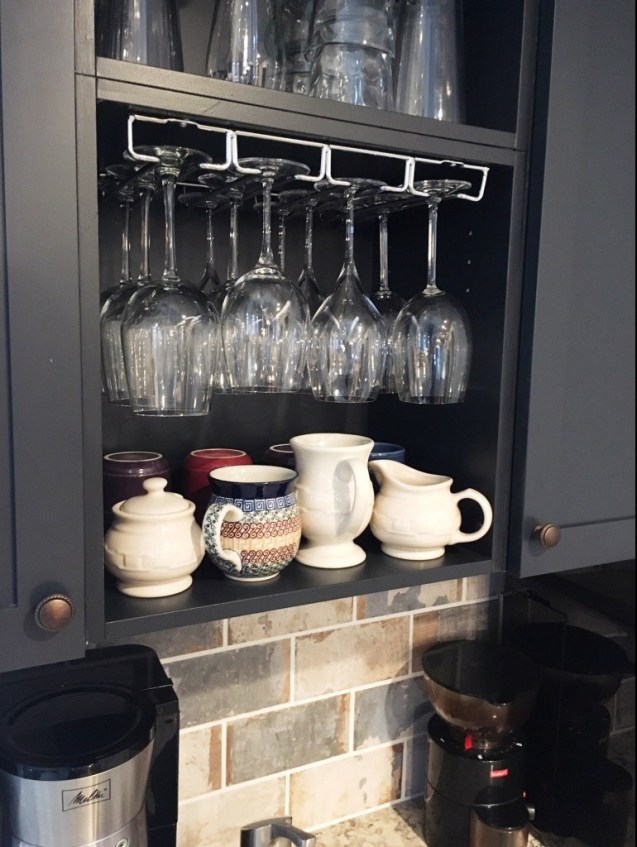
And glass wine glasses! Oh, the simple joy of a real wine glass. For many months while we had traveled in the RV, I drank wine from plastic glasses unless I dined out (and, believe me, I appreciated using glass when I had the opportunity). Glass glasses were so much more civilized, sophisticated and aesthetically pleasing than plasticware. I unpacked all but one of our glass wine glasses intact and stowed them in the cabinets of our new beverage bar. A few days into the garage construction project, my parents paid us a visit, and my clever father installed a plethora of cabinet organizers, including the stemware holding rack that turned my wine glasses from functional pieces into art.
My new stemware rack in use.
I was still surrounded by boxes when Mom and Dad arrived, but with their help over the course of seventy-two hours, we made much progress. They arrived bearing news: “When we drove by Home Depot,” Dad said, “they had a sign that said, ‘Tyler and Monica, We Miss You!’”
Oh, ha, ha. Yes, our visits to the store had reduced in frequency but had in no way come to an end (shortly after Mom and Dad left, I ended up making two trips to Home Depot in a single morning).
When I offered Mom a drink and recited the options, she said, “Oh, your aunt will be pleased. She thought your beverage bar only offered coffee, beer and wine, and she doesn’t drink any of those, but I didn’t know you had water, too.” Indeed, the DrinkPod had been installed and dispensed filtered water in three temperatures: cold, room temperature and hot. Mother learned its ease of operation and helped fulfill drink requests for the remainder of her visit.
My parents also came bearing delicious gifts of harvest: Fresh buttercup squash from their Minnesota garden, two kinds of apples from Dad’s orchard, honey from their property they rented out on the plains of North Dakota, jars of homemade applesauce, homemade chokecherry jelly, and real maple syrup collected and cooked by the pastor who had once confirmed me in church.
# # #
Today’s headline is a quote from Galileo Galilei, the 17th century Italian scientist who discovered Jupiter had moons revolving around it, among many other physical and astronomic observations. He was twice accused of heresy by the church. And apparently he was a fan of wine, which he, alas, most likely drank out of a vessel made of something other than glass.
Our story so far: We moved into the mostly finished converted church, and Tyler worked on adding a garage.
# # #
While Tyler and his crew worked on a big and noisy project, I worked on projects small and quiet.
Switch plates and outlet covers, for example. Rather than paying the electrician to install dozens of switch plates, which required no particular talent, Tyler put me on the job. On the main floor, we chose a sleek metal-look alternative to standard white. I spent ninety minutes screwing on plates before I ran out of the right shapes and energy. I was half done.
A distinctive switch plate.
# # #
Tomorrow: The simple joy of a real wine glass. Read about it here.
Our story so far: The foundation was poured and walls were built for the garage addition to the old Methodist church we had turned into a home.
# # #
During the course of a week, the skeleton walls were built just in time for the delivery of the roof trusses. These, too, had plans of a sort. Tyler specified the size, and the factory constructed the triangle-shaped roof supports in an engineeringly correct manner (“engineeringly” is not a word, but you get the point—they wouldn’t fall to fiddlesticks). Because the garage was not small, these trusses were not small either. They were forty-four feet long, and when they were delivered, the pile filled nearly the entire driveway. The weatherman also delivered: The day dawned sunny and clear, if a little more breezy than one might like.
The morning we set the trusses, Tyler—who had dreamed of this huge garage for the better part of a lifetime and after months of renovating the church was getting sick and tired of constructing anything and wanted to see progress—said, “If we get through today without anyone getting hurt, I’ll be happy.”
I knew then this work was tricky, trickier than most of what we had performed in our little, some might say big, project. If Tyler was measuring success by lack of injury rather than by dumpsters filled or two-by-fours used or square footage sanded, then this must be serious business indeed.
The first truss is placed.
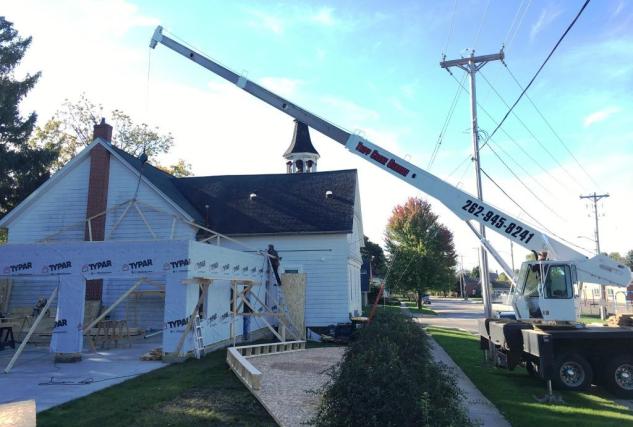
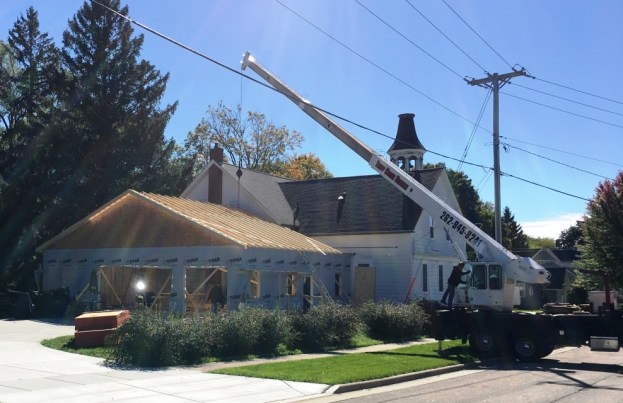
The enormity of the roof trusses required the use of a crane to lift them from the ground, one by one, and set them on the walls. A full crew of men—five plus Tyler and the crane operator—had been summoned. You-Can-Call-Me-Al and Reroofer straddled ladders and makeshift footings to help place them and then secure them, while the other men dashed around on the ground. Because cranes and skilled crane operators are, shall we say, not inexpensive to rent, everyone was moving fast and efficiently so as not waste time, which was money.
For the most part, I couldn’t watch. I sat at my computer in my upstairs office, one wall of which bordered the garage. I heard the regular sounds of engines and hammering and men yelling, praying I wouldn’t hear anything more urgent or worrisome than that.
I didn’t. The crane left to do crane-type work elsewhere in less than four hours. No one was injured. The trusses were properly in place.
Tyler was happy.
After the last truss was set.
# # #
Today’s headline is the first line from a joke. Answer: Because he had a bad case of shingles.
Tomorrow: In the meantime… Read about what kept me busy here.