Monica Lee is the author of four memoirs/autobiographical fiction books: her latest is Church Sweet Home: A Renovation to Warm the Soul. Also available: Truth, Dare, Double Dare, Promise or Repeat: On Finding the Meaning of "Like" in 1982, How to Look Hot & Feel Amazing in Your 40s: The 21-Day Age-Defying Diet, Exercise & Everything Makeover Plan and The Percussionist's Wife.
Like a bat out of hell, I’ll be gone when the morning comes.
~ Meat Loaf
So, tell the truth now, do you have bats in your belfry?
The answer is definitively no. We do not have bats in our belfry.
However, we have had a bat swooping around the fans in our 20-foot great room ceiling. And if I’m being honest, it happened more than once.
Ardent fans of the blog will remember the first time we found a bat in the church, and I recounted that slapstick incident in the book.
It (or its relative) visited twice more, after we moved in. The first time, the little imp disappeared. Suddenly, he was winging around the room while we were watching TV, we chased him around for a bit, and then *poof* he was gone. Very disconcerting, it was.
The second time, my hero of a husband batted him down (get it? He batted down a bat?) with a fish net and then removed him from the great room in a bucket. Since it’s illegal to kill bats, let’s just say he flew off to greener pastures. Or a better belfry. Whatever.
Tyler suspected the bats were getting into the false roof of the church through the chimney (not the belfry), so that’s been sealed up, and we haven’t seen a bat in a long time. We could never figure out how they were getting from the false roof into the house. That part’s a mystery.
Metaphorically, do we have bats in our belfry? Also a definitive no as evidenced by the end result we live in. We weren’t crazy. We were crazy like foxes: seemingly foolish but in fact extremely cunning.
# # #
My memoir Church Sweet Home: A Renovation to Warm the Soul comes out May 5. The paperback will be available on Amazon and Barnes & Noble. Preorder the ebook at Amazon Kindle,Barnes & Noble Nook and Kobo.
Among the treasured objects displayed at the church are works of art created by my father.
He probably wouldn’t call them “art,” but the more he refines his craft, the better he gets.
You may remember me sharing this end table fashioned by Dad and now a part of the balcony seating area at the chome.
Dad is a woodworker, and you can bet it’s been his refuge during the pandemic. He’s been very productive. When he was younger, he made bigger pieces of furniture, including shelving for two of my previous houses, an entire master bedroom set for himself, a bathroom vanity for my sister, a warehouse full of kid-sized kitchen tables and chairs, “regular size” tables, end tables, coffee tables and more. Recently, his focus has shifted to smaller, more sophisticated pieces, and some of these lovelies have made it into the church.
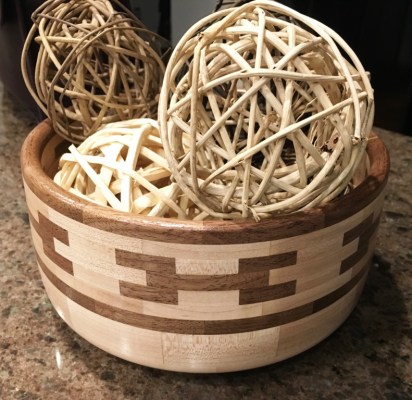
Bowls, made with hundreds of pieces of wood and turned until smooth and functional, are some of his works. You might remember this bowl, the first one he gave me.
I received another bowl for my birthday, sort of opposite in color. I don’t have a picture of that one, but here’s a similar one he gifted to my sister.
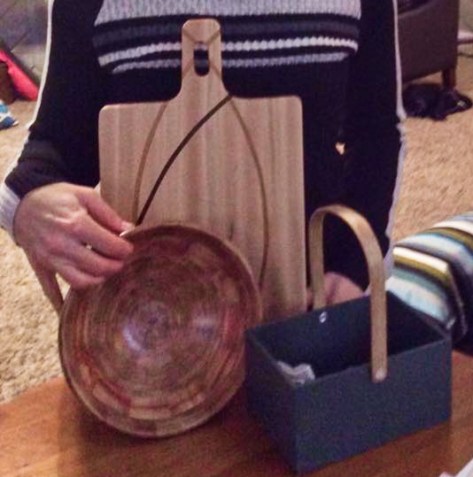
Dad also made the wooden basket on the left, and the beautiful cutting board, one for each my sister and me, which he directed both of us to put into use, which I did, by using it as a styling item on my counter. But to make him happy, here it is, in “use” as a cheese board.
That cutting board is quite a feat of wood manipulation. Those darker pieces of curved wood are not veneers, they go through the whole piece.
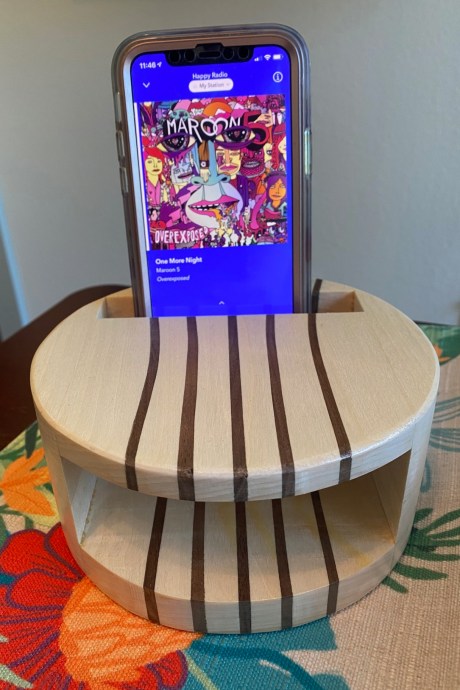
Recently, Dad also gifted me with a functional piece I use many days at my desk.
It’s a microphone of sorts, amplifying music or radio sound from my smart phone which fits neatly in the slot. It’s quite clever. Those stripes are not paint; they’re a different type of wood integrated into the piece.
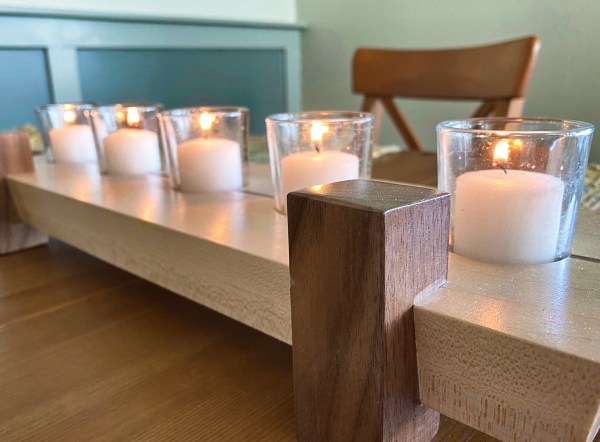
And one final piece to share: Dad made this candle holder as a house warming gift for our new down-south condo.
The flickering candles are like little beacons of hope. Dad’s works of art spread joy everywhere they go.
Before and after photos are satisfying. In the same minute, you see the agony of the mess along side its potential: the thrill of victory. Plus, there’s a little spot-the-difference mystery. Is that really the same person/pantry/porch/plastic surgery patient?
But I think the subject of the before and after photos finds them even more satisfying than just any old viewer. Because they know the work that came between the before and the after. As I prepare to launch Church Sweet Home, the memoir based on this blog that has depended heavily on the power of transformation, Tyler and I have been reflecting on our favorite before-and-afters of our church conversion project.
Tyler’s favorite before and after transformation is so obscure, I haven’t shared photos of it until now (and it wasn’t easy finding these shots among the 10,000 photos I took of the renovation). His favorite transformation is the back egress.
Here’s the before:
BEFORE: This little lean-to covered the stairway to the basement of the church.
Originally, the only back door in the church was below ground level. This would never do for Tyler’s vision, which included an attached garage. We needed to get from the garage into the house without having to go through the basement. This transformation required many things: relocating the wires that anchored the power pole, jack-hammering the concrete steps to reroute them inside the garage, building a garage, removing the lean-to, cutting a doorway, and building a walkway over the stairway.
This walkway is what Tyler is most proud of—that he thought of it at all and figured out a way to make it happen. The walkway could have been built of wood, but its depth would have intruded on the headroom over the stairway. Instead, he had a steel fabricator make a bridge that was inches shallower but still strong enough to convey a person over the stairway.
AFTER: The basement stairway, formerly enclosed in the lean-to, now turns into the garage. The steel bridge is hidden behind in the wooden steps leading to the back door.
Here’s a look at the before-and-after from inside the church:
BEFORE
AFTER
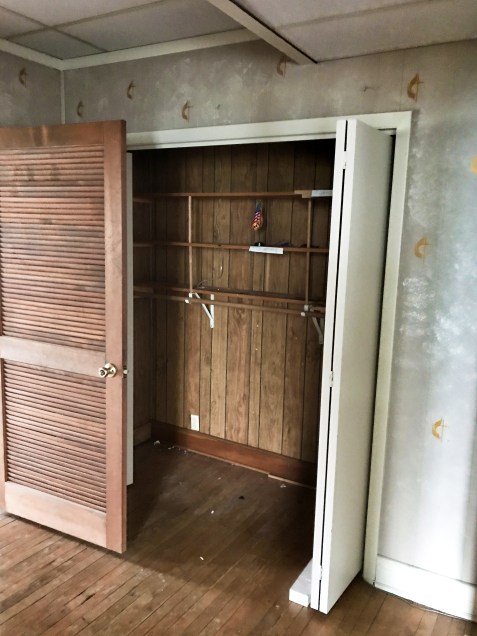
A closet originally filled the space where the back door was cut.
Now my favorite transformation: the headboard in the master bedroom.
BEFORE: The space that would be the master bedroom had a wall cutting through the middle. That wall (just two-by-four stumps in this picture) was built in the late 20th century, we think.
Tyler built a new wall on the right side of the window seen above. Then he and my stepson built a half-wall, an idea for a headboard that I saw on an episode of Fixer Upper. Tyler then created a feature by nailing on wood we salvaged from the basement. It came in a rainbow of distressed colors; all it needed was a couple of coats of clear polyurethane.
The headwall was dressed up with some church-window wall art on the shelf. The space is lit with chandeliers we found in storage when we demoed the church. I cleaned them up, spray-painted them and lit them with new lightbulbs. Tyler tracked down a couple of old bank safes on Craigslist, and they became our nightstands.
A moodier look.
The room also has a tray ceiling. Rope lighting is tucked inside, and Tyler can change the color of the lighting with his smart phone. Very romantic! This before and after is my favorite because it’s just so pretty.
If you’re a fan of before and after transformations, check out the Before & After tab on the blog for lots of satisfying projects we accomplished around the church.
# # #
My memoir Church Sweet Home: A Renovation to Warm the Soul comes out May 5. Preorder the ebook at Amazon Kindle and Barnes & Noble Nook.
It required fresh thinking to turn our church’s unique architectural features into functional elements of a private home.
Every church conversion is different. Here’s our translation, in alphabetical order:
Altar: a structure upon which offerings such as sacrifices and votive offerings are made for religious purposes. The altar in our church was removed when the congregation exited.
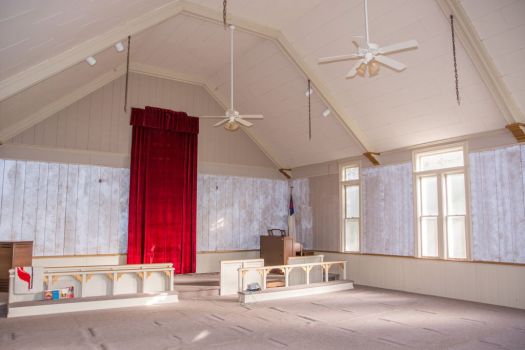
Altar piece: an altarpiece is a picture or relief representing a religious subject and suspended in a frame behind the altar. The altar piece on our church was a red velvet curtain, which we used as a furniture blanket and drop cloth before it met its end.
Altar rails: a set of railings, sometimes ornate and frequently of marble or wood, delimiting the chancel (the part of a church near the altar, reserved for the clergy and choir). I really wanted to repurpose this, but I lacked the creative thinking; we dumpstered our altar rail.
Bell tower: a tower which contains one or more bells. Our church’s bell, estimated to weigh 600 to 800 pounds, was returned to functional in the reno.
Bell turret: the ornamental feature above the bell chamber. This is the most distinctive exterior feature of our structure. We reroofed it and kept it intact.
Church kitchen: a place of welcome, where congregants join to share fellowship, celebrate joyful events, or sustain one another through moments of pain or suffering. The kitchen in the basement of the church was deconstructed. When we take up the basement remodel, we plan to install a new kitchen.
I played around with a few options for repurposing our corbels during construction, but they are sitting in the basement, awaiting a new life.
Corbel: a piece of stone jutting out of a wall to carry any superincumbent weight. We had wood corbels in the sanctuary of the church. We removed them, and they await inspiration for re-use.
Portal: a main entrance, on the church facade, sometimes highly ornamented. The original portal to our church, beneath the bell, was ornamented. When the entrance was moved in the 1940s, the dooryway was, shall we say, rather plain. We installed new doors and exterior lights, bringing back some of its glory.
Baptismal font: an article of church furniture or a fixture used for the baptism of children and adults. Like the altar, the baptism font was removed when the congregation exited.
Confessional: a cabinet-like unit in a church used for conducting confession. Catholic churches have confessionals. Methodist churches do not (thank goodness).
Pulpit: a small elevated platform from which a member of the clergy delivers a sermon. The pulpit was removed when the congregation exited.
Pews: a long bench with a back, placed in rows in the main part of some churches to seat the congregation. The pews were gone when we came along, but we brought one of our own, salvaged from a church in Belvidere, Illinois.
The vestments closet was eliminated in our remodel (for more of that story, tune in to ChurchSweetHome.com on Friday.
Sacristy: a room in a church where a priest prepares for a service, and where vestments and other things used in worship are kept. In our church, this was a closet, which was removed to install the back door.
Sanctuary: a sanctuary, in its original meaning, is a sacred place, such as a shrine. Also known as a haven, by extension the term has come to be used for any place of safety. The church’s sanctuary is now our great room, housing the kitchen, living room and dining room.
Spire: a spire is a tapering conical or pyramidal structure on the top of a building, often a skyscraper or a church tower. The original spire on our church was damaged or removed mid-century. But we found a new one at a flea market and installed it on top of the bell turret.
Stained glass: glass that has been colored by adding metallic salts during its manufacture; the colored glass is crafted into stained glass windows in which small pieces of glass are arranged to form patterns or pictures, held together (traditionally) by strips of lead and supported by a rigid frame. Our church had no stained-glass windows, only etched glass transoms, which we preserved.
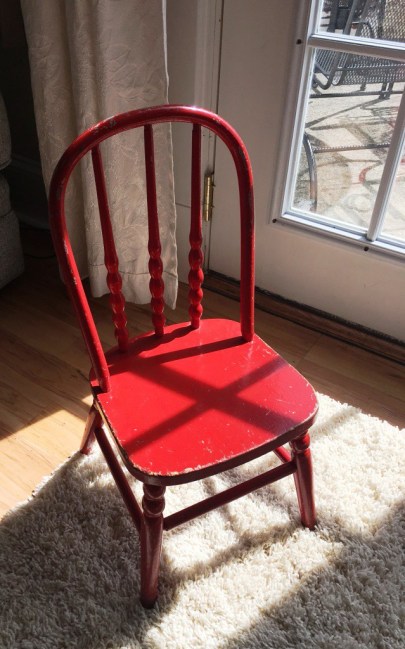
Historic Sunday School chair.
Sunday School room: a room or rooms in a church where teachers tell Bible stories and help children do craft projects. We found the cutest little tables and chairs for Sunday School on the second level, which we donated to Habitat for Humanity’s Restore. An older, historical children’s chair was gifted to us by one of the congregants; I repainted it and it finds a home in the second-story playroom under the eaves.
# # #
My memoir Church Sweet Home: A Renovation to Warm the Soul comes out May 5. Preorder the ebook at Amazon Kindle and Barnes & Noble Nook.
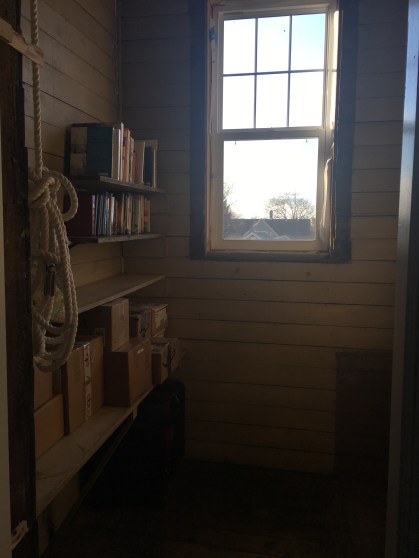
Our belfry has a little room on the second story beneath the bell.
The space is about 8 feet square. Not big enough for a bed but it would make a huge closet (in fact, the space beneath it on the first floor is a closet).
We chose to build a closet elsewhere on the second story so the belfry room could be something else. I toyed with making it my office, but the window (which was covered up when we purchased the church) is too high to see out of when seated. I decided it would make a great library. We haven’t finished the work, but the space has been much improved.
BEFORE
It was a scary place when we began demolition. Filled with miscellaneous boxes and Sunday school supplies, it was dark and dirty. The room is not ducted, so it’s cold in the winter and hot in summer. We found out later that piles of animal detritus filled the space above it (beneath the bell); I can only imagine the dust and junk that fell from that space every time the trap door on the ceiling to the bell was opened.
BEFORE
AFTER
These both look like after photos (looking back into the second story from the little room), but trust me, the little room is much cleaner in the photo on the right.
Here’s a shot showing the new window before it was trimmed out.
Much progress was made just by cleaning it out. Oh, the power of soap and water. We also uncovered the exterior window (it had a bullet hole in it) and replaced the boring hollow-core door to the room with a windowed door we found elsewhere in the church. Light makes the little room so much more pleasant.
Though I don’t have pictures of it, I painted the interior in the same silver gray we used elsewhere in the house. We decided to leave the original shiplap exposed, but we definitely need to build more shelves for all my books.
That new cording hanging there is what we pull to ring the bell.
We will also put a little bench on the side opposite the shelving for a reading nook, but the one I have in mind needs a new paint job (a project and a post for another day).
“Oh! No, please, I-I-I’m not finished; I-I-I still have to paint them.”
~ Quasimodo in the Disney version of The Hunchback of Notre Dame
Hanging artwork can be the hardest part of a renovation.
When I last blogged about the north wall of the great room (the former altar area), it looked like this:
The north wall, semi completed.
The cabinetry, shelving and stereo speakers were installed, but a big blank space was left to the right of the fireplace. I planned a massive family photo display.
First I had to choose the right photos (as anyone who takes a lot of family photos knows, this is no easy task, not to mention finding them). Along with wedding photos and graduation mugshots, I mixed in a lot of meaningful travel photos so the resulting combination looked more like art and less like studio shots. Then I figured out how to size them so the whole display of 18 images looks like a single unit. After determining I wanted them all to be canvas-wrapped, I sourced a vendor. Then I had to pay for them (it was a lot). And then they had to be hung (Dad was roped into that project, handing each image exactly two inches away from the others, and believe me, it was tricky, but he prevailed). Each step took time and focus, and the stakes were high–these were treasured family photos to be hung in a highly visible area.
I succeeded, just in time for the open house last fall.
The biggest image is a photo my stepdaughter took when we were on a family trip to the Croatian coast; it’s a stunner.
I also set framed photos on the countertop at the bottom (not shown here). (That cross on the upper right shelf, by the way, is original to the church, another tip of the hat to the former while featuring what’s new.)
Speaking of, here are before and after photos of the Hall of History, the hallway between the great room and our master suite. The hall is another photo gallery where we hung photos of the church throughout history and our ancestors.
Before
After
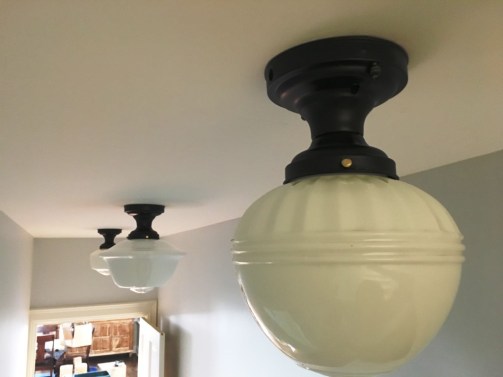
This space turned out spectacularly. The light fixtures all hung elsewhere in the church when we acquired it and were moved here, the wood flooring (underneath old dirty carpeting) is original to the building and now protected with an old-fashioned braided rug, and there is lots of room to hang more photos as I get my act together. All the photographs in the hallway are framed in black to tie them together, but they are hung more randomly than the canvas-wrap display in the great room. The hallway just makes one want to linger–in a hallway!
Maybe my approach to themed family photo display inspires you to do something with all those family photos you have on your phone, that you own, in a box, with a fox … but I digress. Surround yourself with pictures of your loved ones if you can’t surround yourself with your actual loved ones. Stay well, my dear readers.
I’ve often written about how paint can make anything better, and I believe this strongly most of the time. I am proud of the way I transformed a beat-up dresser into a bathroom vanity.
The guest bath on the second floor.
Or a 100-year-old desk into a fresh-looking focal piece.
Tyler’s desk now graces a corner of the great room.
And especially light fixtures. I spray painted the chandeliers in the great room and our master bedroom, and also the collars for this historic lights in the Hall of History.
The “collar” of a light fixture contains the wiring. These collars were all found in the church during the demo phase.
But alas, sometimes paint fails. Or maybe just I do as the painter. I share this failure here, lest you think every project we take on around Church Sweet Home is a home run. Sometimes, we strike out.
This lamp base has interesting marble accents, but I hated the gold leafy scroll work. It once sat in our living room in our former house. I spent a morning taping off the marble accents, and spray painted the gold parts matte black.
It was horrible (not even worth sharing the after photo). There was just no camouflaging that scrollwork.
However, Tyler used black spray paint to great effect recently on some furnishings and décor for our new winter condo. I share those transformations tomorrow on my Minnesota Transplant blog. Check in with me there if you’re looking for some lake home inspiration.
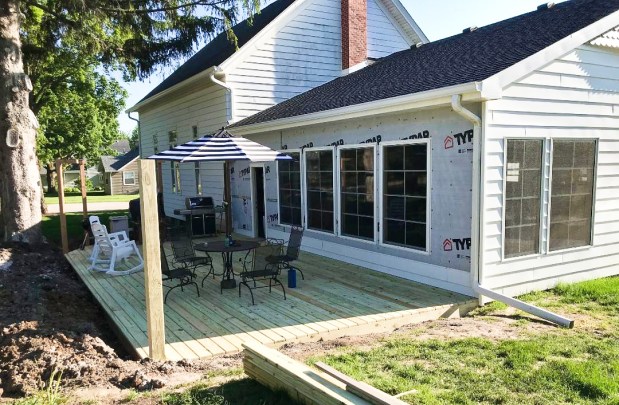
Another project we wrapped up early enough last summer to enjoy it was the deck.
Some might call it a patio. Some might call it porch. We call it the deck.
From the beginning of Tyler’s Garage Mahal dreams, he envisioned a deck off the three-season “room” (also known as the fourth stall of the garage).
When the garage was built in late 2018, it got a roof but there was no time for siding. And certainly no deck. Even the windows on the east side were simply boarded up for the Wisconsin winter.
So the first element of finishing was to install enormous four-panel vinyl windows with screens. But the siding on that side of the garage awaited final placement after laying the deck.
First windows, then stringers for the decking.
Excavation to ground level was first. Then Tyler and You-Can-Call-Me-Al laid the stringers (perfectly level, of course). A little corner was made to accommodate the biggest pine tree in the yard. Then they used 3,500 screws (no kidding) to secure the deck boards (the deck is roughly 34 feet long, 16 feet wide–we Go Big or Go Home around here, as regular readers are well aware).
First piece of furniture: the “contractors’ table.”
Now Tyler was ready to add some fun to the function. He drew inspiration from this picture of a slated ornamental wall:
This “Pinteresting” image described the structure as a wind-breaker and privacy wall.
Tyler wanted a bit of a shield from gawkers passing by on the south side (a man likes to enjoy a beer in peace), and a wall of some sort seemed workable. I like how nice it looks. So You-Can-Call-Me-Al was set to work building a wall from this picture, not the first time our “blueprints” came from Pinterest.
Privacy wall in place.
Then Tyler stained everything in a couple of coats of Mountain Cedar.
Here’s the “gawker’s” view from the street (picture taken last summer, when the grass was lush).
The deck still requires lighting (which awaits garage wiring). But we enjoyed it a few times and it was ready for the open house last fall. At some point soon, warm weather will return and we’ll enjoy again. And soon after that, I hope, we will be able to socialize there (even though we could probably entertain at least two or three couples and still have six feet between each of us!).
We made good use of the bonus space under the eaves on the second story of Church Sweet Home.
On one side, I store office supplies and Christmas decorations.
The entry door to the playhouse.
On the other side of the roof, Tyler created a little playhouse for our grandchildren. It’s about four feet wide, seven feet long and five feet tall and accessible from the guest bedroom.
This is the window to the playhouse with the doors closed.
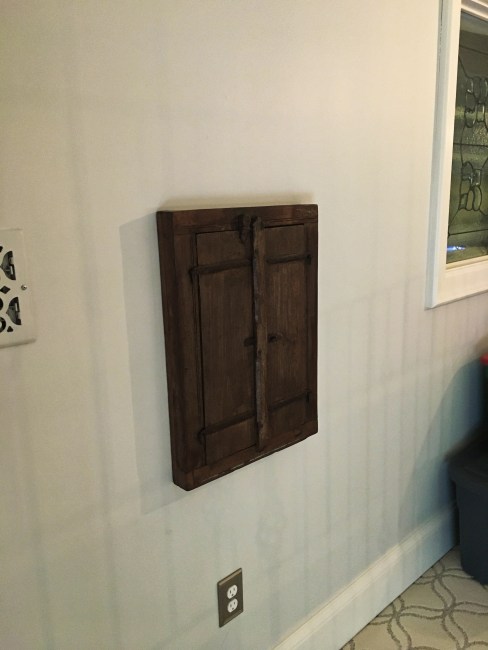
A window on the balcony side was the finishing touch on the playhouse. For the window frame, Tyler found a doored mirror at Ginger Blossom, one of our favorite local furniture stores. He removed the mirror, and in its place, the frame looks like a little wooden treasure box.
This is the window with the doors open.
Look how thick that wall is! That’s one of the original exterior walls of the old Methodist Church. It’s dark inside there because the little room still requires proper lighting and some nice comfy carpeting. But what’s inside there right now has a story, too.
The current residents: Raggedy Andy and Raggedy Ann, though even at 40 years old, they hardly look ragged.
This couple was given to me by a dear woman, a new friend I knew not long enough. A talented sewing congregant at our church made Raggedy Anns & Andys for the annual bazaar, back when our church still had a women’s group and bazaars. (They were made from what must have been a widely circulated pattern because my own mother made me a vary similar pair– twice! Oh, how many times Raggedy Ann listened to my troubles!) My friend bought this particular pair for her son, when he son was still a little boy who might appreciate such things.
A couple weeks before our open house last fall, this friend called me up and invited me over because she “had something to give me.” I was honored to be granted an audience, let alone a gift, because my friend had long been battling a terminal illness and she was nearing the end. (When I first met her when I moved to town, I didn’t even realize she was ill, she carried herself with such optimism and grace.)
I paid her a visit, and she gave me these handmade treasures because she thought “they came from your church, so they belong there now.” I accepted them with gratitude and made a home for Raggedy Ann and Andy in the playhouse, to display during our open house. (By the way, Andy there is seated on another gift from another generous benefactor. That little chair, repainted to match my design scheme, was once a Sunday School chair at our church.)
Very sad for me (and anyone else who knew her), my friend died the day of our open house.
These dolls make me think of my friend Deanna, and whenever I think of her, I think of her fondly. She was wise and generous and very kind to think of me and support our home improvement project so enthusiastically.
“Life is a song. Sing it.
“Life is a game. Play it.
“Life is a challenge. Meet it.
“Life is a dream. Realize it.
“Life is a sacrifice. Offer it.
“Life is love. Enjoy it.”
You can see the etched glass transom windows in the sanctuary on the right. The transom above the former front door, which may or may not have been stained glass, has been lost to history.
That the little Methodist church didn’t have stained glass windows was a plus for us in renovating it into our house.
Incorporating such obviously religious architecture into a private home is tricky.
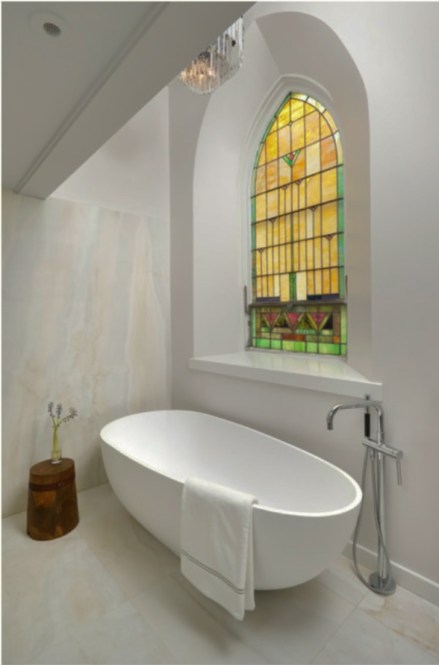
Here’s a church conversion that did it well.
You can see how the ceiling was adjusted in the bathroom design to accommodate the window, but it’s lovely.
I found this on Houzz under the banner “the best church conversions.” Located in Chicago’s Little Italy neighborhood, this former Methodist church, built in 1901, is described as a “dream project for a young couple who wanted an open, light-soaked home in which to raise their three children.”
Stained glass has been around for a thousand years, and it is typically featured in the windows of churches and other significant religious buildings. It has the benefit of allowing light without tempting parishioners with outside distractions during services. The most elaborate stained glass windows in churches tell stories, such as the stations of the cross or of saints.
This image captures how the church, and its windows, looked when we purchased it.
The windows in our church were not stained glass, but they were clouded glass to keep worshippers’ attention within. We swapped that out for clear glass. The original transom windows were etched glass. A kind of decorative glass, etched glass is the result of a series of small cuts made to the glass, by acidic, caustic or abrasive substances, after the glass has been manufactured. The cuts normally appear white against the glass and can be made into patterns or images.
The etchings in our windows feature flowers and geometric designs.
One of our transom windows has a small crack, but we resolved that by installing storm windows.
At some point in the reconstruction process, Tyler hit upon a way to incorporate stained glass into our design—as interior windows on the balcony. All the stained glass windows we found in antique stores were too gold or red for our color scheme until we found these leaded glass windows. They were the perfect “stained” glass without stain.
One of these windows overlooks the tub. It’s not as dramatic as the Chicago church conversion, but it suits our aesthetic.
 # # #
# # #




 # # #
# # #
 # # #
# # #












 Church Sweet Home