Crowdsourcing, the ultimate disruptor

Our story so far: While the drywallers worked upstairs and the concrete finishers labored outside, I holed up in the basement with creative projects that would find life as soon as Phase Four: Cabinets began.

# # #

As I finished my last coats of polyurethane on the vanity, I pondered knobs. Initially, I had intended to reuse the original wooden knobs because they matched the veneer I had preserved for the top drawers, but with 90 percent of the wood painted, I considered painting the knobs, too.

So I took to Facebook to poll my friends.
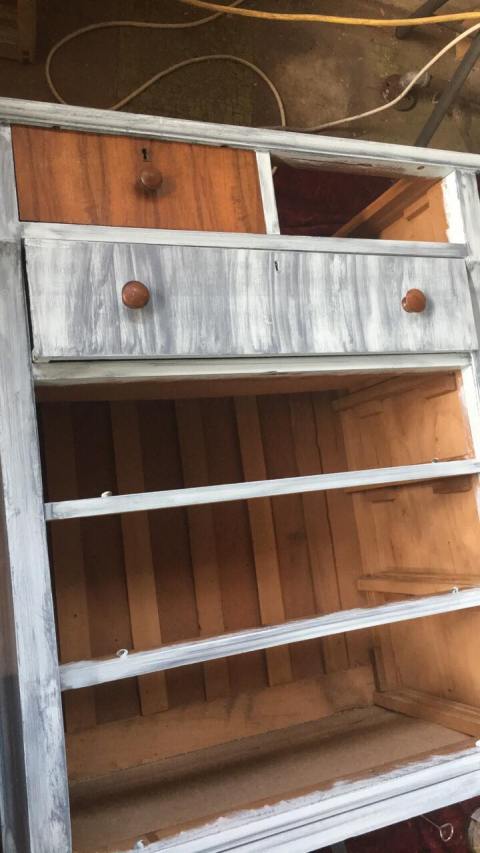
wood knobs
“What do you think of these original knobs,” I asked friends on Facebook. “Should I paint them?”

One might say a lot of negative things about Facebook, but my friends are creative thinkers with good taste. One of them suggested vintage glass or crystal knobs, and a number of people seconded it. It was a great idea I hadn’t even considered.

On my next visit to Home Depot, I found a suitable glass knob to try. Cost: $6. I needed 18 knobs, so this meant I would be spending more on knobs than I did for the whole second-hand dresser set! I liked the look of the single knob which inspired a visit to eBay, where I found a mismatched lot of vintage crystal knobs—enough for the dressers—for only $25. Sold.
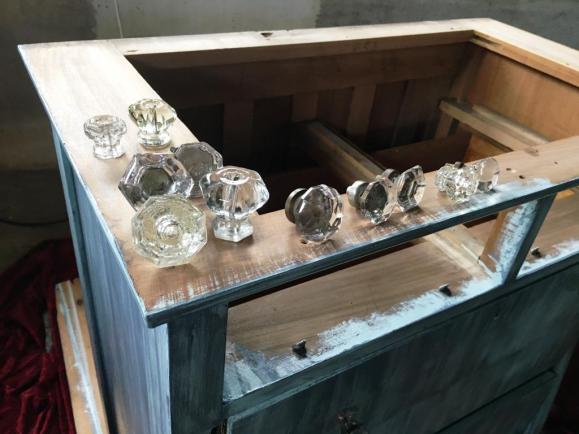
crystal knobs
The lot of crystal knobs came in all sizes, but they would work in an eclectic way.

Unfortunately, I discovered after applying the last coat of polyurethane that I had used too heavy a hand on the edges of drawers. Some of them no longer closed. So another round of aggressive sanding was required.

Still, I didn’t mind expending the effort. Including the quartz countertop, my eight-foot custom vanity cost only $1,020.86. And it looked like a million bucks.

The Facebook advice was just another example of the community rooting us on and helping us bring to fruition our vision.

Some people the ability to see for the beauty trapped in ugly things, and some people simply do not.

# # #

Tomorrow: Chapter 28 opens. One step at a time. Check it out here.

Old ways won’t open new doors

Our story so far: A swinging door spooked me as I worked alone in the basement of 126-year-old Methodist church we were turning into our home.

# # #

back basement door
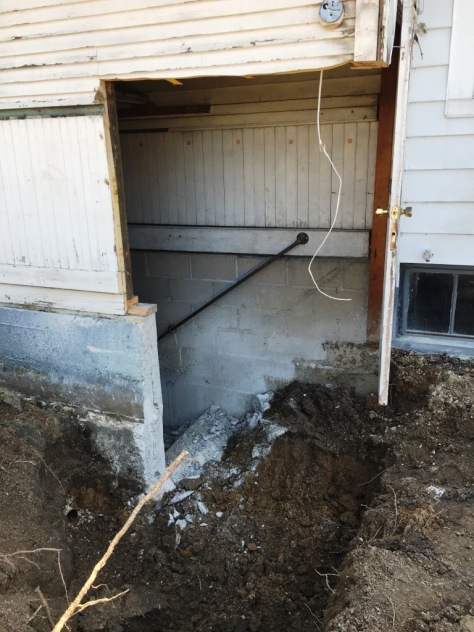
I do not have a good picture of the storm door that this one replaced, but I can assure you, this one is a lot whiter!

We also invested in a new back door for the basement to replace a functional but unlockable storm door. If ghosts intended to get in (or out), they’d better have a key.

# # #

Tomorrow: Chapter 27 about managing chaos wraps up. Read it here.

We need ghost stories because we, in fact, are the ghosts

Our story so far: As I painted alone one evening on a dresser-cum-vanity in the basement of the 126-year-old Methodist church, a creepy creak and then a thud caught my attention.

# # #

The thud drew my scrutiny to the windows at the back of the church.

In the thickening darkness, I didn’t see a phantom. I saw the back door to the church, swaying in the breeze. And creaking. Because Tyler had recently jackhammered the back steps and cut out part of the wall, the door latched into thin air, and it was swinging to and fro and occasionally slamming shut.

jackhammered steps
See that door on the right? When Tyler cut a hole for the new steps, he also cut away the latch for the door.

This discovery made me laugh out loud.

It was not a ghost. It was the wind.

steel bridge
A look at the steel bridge permitting egress from the back door on the main floor.

A few weeks later, Tyler eliminated the creepy creak by building a proper back egress. The steel fabricator with beautiful but menacing dog we’d met a few weeks prior completed his work on the steel bridge. When my 20something adored stepson paid us a visit, Tyler took advantage of his upper body strength. They hauled the steel bridge into place, and Tyler built a floor and interim railings out of scrap wood. This finalized a proper, if temporary, back entry to the main floor of the church. And eliminated the both the latchless swinging door and the accompanying creak.

back entry with steps
When the garage is built, this addition for the back entry will be removed.

# # #

Today’s headline is a quote from horror writer Stephen King.

Tomorrow: A new back door for the basement, too. See it here.

Ghost stories are speculations, little experiments in death

Our story so far: One evening, I sat in the basement of the 126-year-old Methodist church by myself trying to squeeze in a coat of paint on the bathroom vanity before I couldn’t see anymore in the gathering twilight.

# # #

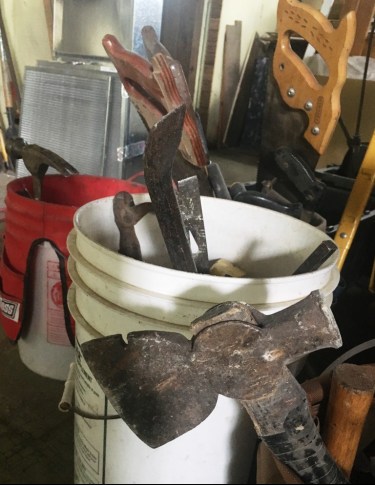
implements of terror
Tyler stored his tools in the church basement just feet away from my makeshift paint station. If the boogeyman had arrived empty-handed, he wouldn’t go wanting for an implement of terror for long.

Creeeeeeeeeeeeeak.

The sound was exactly like one heard in a horror movie before the boogeyman appeared with an axe or a chainsaw.

Buddhist monk Matthieu Ricard once said “When hearing a door creak, the optimist thinks it’s opening, and the pessimist thinks it’s closing.” I didn’t know which camp I was in.

“Who goes there?” I called out loud.

No answer.

Maybe my imagination was getting the better of me. It was rare, actually, that I spent time alone in the church. Usually I was there during the day when Tyler, at the very least, was working and often, several other men. I remembered how I’d scoffed early on about churches being haunted. Maybe my disbelief had ticked someone—or something— off.

Creeeeeeeeeeeeeak.

OK, this was real. It was not my imagination. I joined the camp of optimists and assumed this was a spirit with whom I could negotiate.

“I’m a good guy,” I said. “Let’s be friends. We can both live here peacefully. I want to fix things up, not tear things down.”

I began brushing paint faster.

Creeeeeeeeeeeeeak. Thud.

# # #

Today’s headline is a quote from American writer Audrey Niffenegger. 

Tomorrow: The source of the phantom creak is revealed. Read about the culprit here.

That’s kind of creepy

Our story so far: While the drywallers worked upstairs and the concrete finishers labored outside, I holed up in the basement with creative projects that would find life as soon as Phase Four: Cabinets began.

# # #

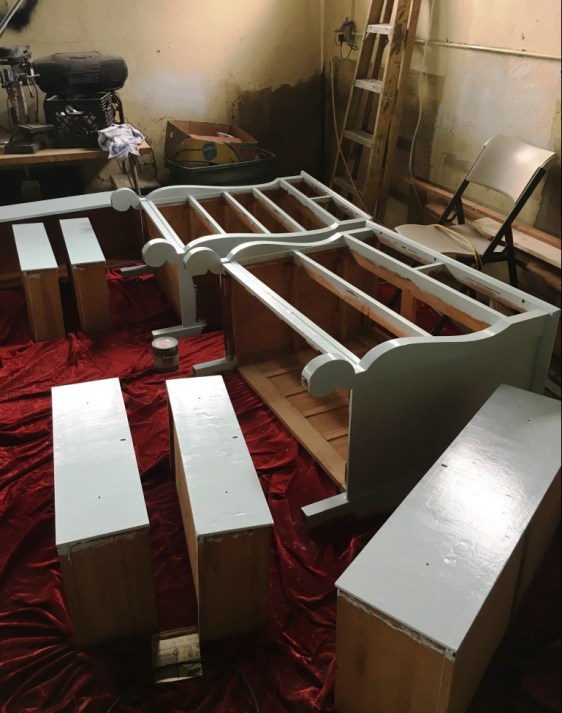
pieces of vanity
The dressers after a couple of coats of Sunken Pool.

In between everything else going on, I added coats of paint to the dresser that would ultimately become the upstairs bathroom vanity. Tyler set up a “paint parlor” in a corner of the basement for this type of work. A few weeks later on the recommendation of a friend, I would spend an evening learning about the wonders of mineral paint, which required only one or, at most, two coats for furniture projects like I was attempting. But at this point, I was using latex paint: Four coats of Sunken Pool, two coats of distressed Adirondack Blue (both from Behr available from Home Depot, of course) and then three coats of clear polyurethane. Plus sanding between every coat. Each coat required only about a half hour of time to apply, but I had to be patient and diligent in order to get drying time between coats.

One evening, early on in the garage foundation project, I sat in the basement by myself trying to squeeze in a coat of paint before I couldn’t see anymore in the gathering twilight. Usually, I caught a few minutes of MPR on my phone while meditating on my brush strokes, but that night, I just absorbed the silence of the church.

Until I heard a creepy creak. A door—somewhere—opened. Or closed.

Creeeeeeeeeeeeeak.

# # #

Tomorrow: Negotiations begin. Read about them here.

Energy that turns every situation into something unexpected

Our story so far: Many months into the renovation of the old Methodist church into our home, it seemed as though nothing was getting accomplished, but it was a big project with a lot of moving parts. In fact, we were ticking off a number of items on our to-do list.

# # #

While the drywallers worked upstairs and the concrete finishers labored outside, I holed up in the basement with creative projects that would find life as soon as Phase Four: Cabinets began.

The kitchen backsplash, for instance, presented a bit of a problem. I wanted something rustic, so glittery glass tile was out. Subway tile, I found too boring. I also wanted something that would coordinate with both the creamy colored kitchen cabinets and the navy beverage bar cabinets.

Nothing was quite right until I found Paramount Flooring’s porcelain tile in Havana, inspired by the cement tiles that lined patios, walkways, walls and floors in 1950s Cuba. To puzzle out the backsplash, I order four boxes of tile in Sugar Cane (white), Havana Sky (blue), Old Havana Blend (mixed colors) and Deco Mix (square decorative tiles).

Havana tile
Turns out, the Havana tile looked like a rustic subway tile.

One quiet Sunday afternoon, Tyler’s cousin and her husband paid us visit. Her husband helped Tyler pull the old sidewalk pieces out of our driveway; the concrete finishers would pour new sidewalk when they finished the driveway. Tyler’s cousin had similar taste in décor, and while the men worked outside, she helped me lay tile on the basement floor to see how the pieces might look as a backsplash. The Sugar Cane tiles carried the day. I figured I’d use a few random Havana Sky pieces to add interest and tie in the blue. The decorative square tiles would be the ideal accent above the stove in a style similar to one I saw on DIY Network.

backsplash stove
A real fan of home improvement TV isn’t afraid to take pictures. I want to give proper credit here, but I can’t remember if this backsplash was on “Stone House Revival,” “Barnwood Builders” or “Barn Sweet Home.”

One more decision, made.

# # #

Today’s headline is a partial quote from former professional baseball player Fernando Perez: “In Cuba and specifically in Havana, there’s a sort of energy that turns every situation into something unexpected.”

Tomorrow: Things get creaky. And creepy. Check it out here.

Shut the front door

Our story so far: We were attending to myriad small tasks in our church conversion project.

# # #

Like so many other elements of house construction, doors do not come complete.

Take the fireplace, for instance. We bought a fireplace, really just the firebox. We also needed to purchase stone for the chase. And a hearth. And a mantelpiece.

Or a shower. Once you find a shower head, you also need the handle. And the trim parts.

Find cabinets you love, and you still must invest in hardware.

So it is with doors. Our front doors were a steal on Craig’s List, but they came without door knobs. Or locks.

The options available at the Big Box home improvement store were too mass-market for our distinctive castle doors. So Tyler did what he does best and took to eBay, where he found wrought iron hasps and handles.

When my dad, an accomplished carpenter who wasn’t afraid to work with expensive pieces of wood, paid us a visit and noticed we hadn’t yet installed knobs on our doors, he remarked, “Better measure six times and cut once on that project.” Our impressive doors were heavy solid wood; Tyler had only one chance to get the handles right.

But we couldn’t continue to open the doors with the tiny handles for the speak-easy portals as we took to doing early on, so Tyler did what he had to with his chance and installed the distinctive handles and locks. Cutting once.

Open sesame.

# # #

Tomorrow: How to choose a backsplash. Read about it here.

Nuts for bolts

Our story so far: As the drywallers and the concrete finishers worked, we crossed things off our to-do list in our church conversion project.

# # #

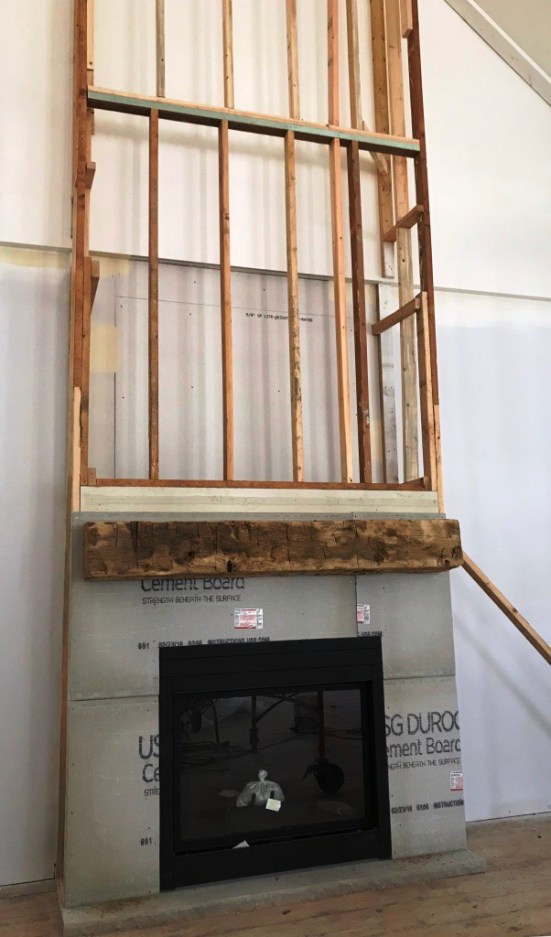
With the drywall up and the driveway complete, Tyler returned his attention to the church interior. It was time to get another beam out of the way: The two-hundred-pound barn-beam mantelpiece he’d found on Craig’s List. Unlike the polyurethane beams on the ceiling, this project required a heavy-duty approach to fastening it.

Tyler determined the optimal height of the mantel by researching the firebox manufacturer’s recommendations. The beam was real wood after all, and wood is combustible. Then he enlisted You-Can-Call-Me-Al’s carpentry skills; this was no one-man job.

First they reinforced the mounting area behind what would be the stone by installing two four-by-sixes stacked on top of each other as a mounting plate. Then they drilled holes in the backer plate for eight ten-inch lag bolts.

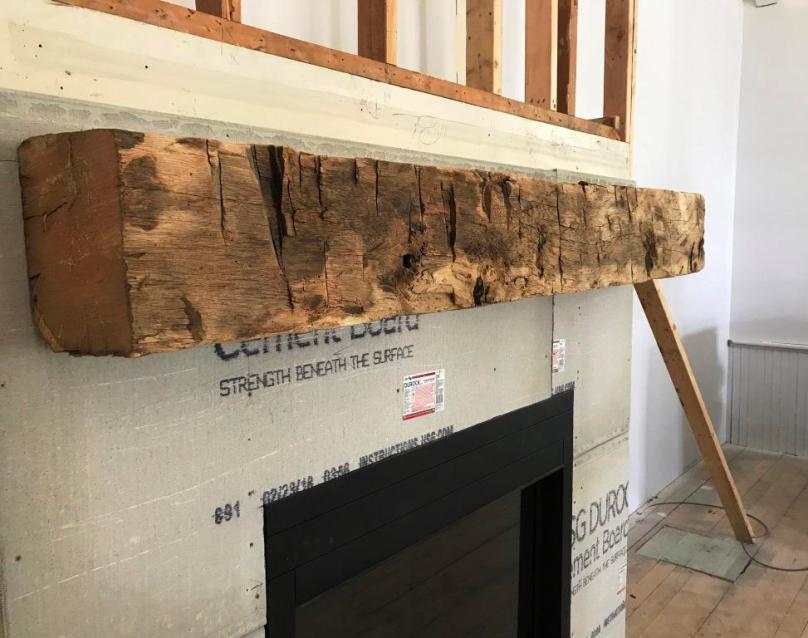
mantel closeup
That’s rough hewn, baby.

As he handled the beam, Tyler admired it. The Iowa barn from which the beam was removed was 122 years old, according to the Craig’s List seller, but the beam itself could have predated our 126-year-old church. Either the steam-powered saw mill hadn’t been invented yet or it wasn’t available, so the beam had been hand hewn from a red oak log with a broad axe.

Because the beam was so thick (eleven inches square), Tyler cut it to length with a chain saw. Inside the church. In any other circumstance, a chain saw wielded inside a building was the stuff of horror movies, but in this case it was simply convenient.

You-Can-Call-Me-Al and Tyler created temporary wooden brackets to prop up the beam in which they partially predrilled holes for the lag bolts. Once they secured the mantelpiece in place, You-Can-Call-Me-Al tested their work by standing on it. You-Can-Call-Me-Al might be described as wiry, but still, this was a good test.

Built solidly, indeed.

mantel faroff
This shot gives you an idea of where we’re going with this.

# # #

Tomorrow: Hardware for the front door. See it here.

Bona fide is Latin for in good faith, and isn’t planting an act of faith?

Our story so far: Renovating the old Methodist church into a home was a big project with a lot of moving parts. And moving mud.

# # #

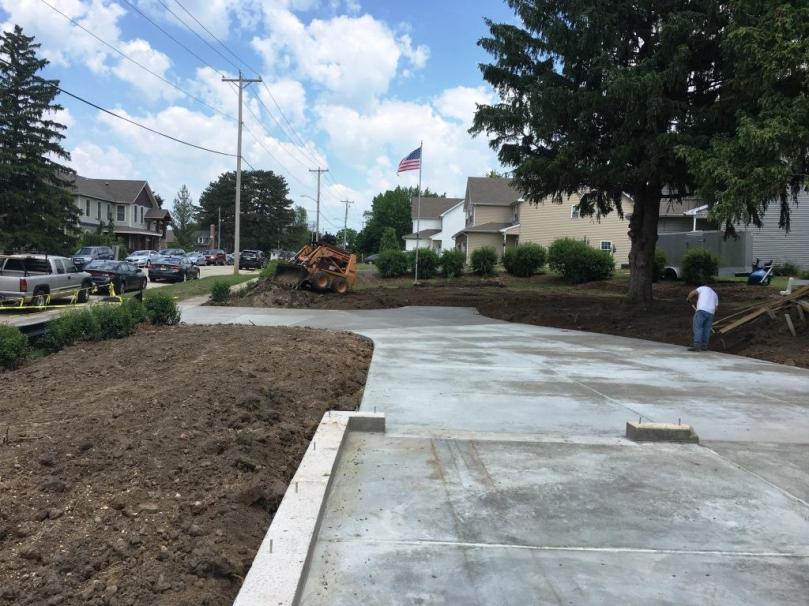
The last day of school at the elementary across the street created an uncharacteristic parking jam; the streets all around our church were lined with cars owned by parents who were marking the day by picnicking with their children on the school grounds. Interestingly, people recognized our new driveway as “real,”  even though it was closed to entry by yellow caution tape. Relieved to find a spot, I slipped into the opening with the beat-up pickup after an errand.

moving mud
Tyler moving mud with a skid loader; his hired man St. Johnny moving it with a shovel.

Tyler, meanwhile, was self-conscious of his construction mess. With the driveway poured and hardening in the summer sun, Tyler took advantage of the skid loader he’d borrowed to landscape the piles of dirt created by the driveway project. He fashioned a low berm that lined the driveway and protected the roots of the ancient pines in the back yard; we’d designed the project to spare all of our trees.

Though it would take a few weeks to grow, he spread grass seed over the dirt. Soon we would have a bona fide lawn again.

# # #

Tomorrow: A different beam gets installed. Check it out here.

Wherever you go, whatever you do, I’ll always be there supporting you

Our story so far: As my husband walked the new foundation of his garage, describing in grand detail how it would someday look, I got a tingle in my chest just to see him so happy.

# # #

I would feel that embodiment of excitement again a few days later when the drywall team and You-Can-Call-Me-Al joined forces to install the faux beams in the sanctuary of the church (a.k.a. great room) (read here about the purchase of the faux beams). I couldn’t bear to hang around during the day, listening to debates about angles and watching the men teeter on scaffolding, but when Tyler and I surveyed their work at the end of the day, I could barely speak.

beams on ceiling
The mood lighting of early evening without the benefit of electric lights doesn’t do this shot justice, but it gives you an idea of how our ceiling now looks.

Finally, our home was beginning to look like I imagined it would when we first toured the church eight months before. Even without light fixtures and fans, our fake beams looked finished and majestic. The beams were everything I’d hoped they’d be.

beam closeup
This artsy angle on the beams was taken from the balcony.

# # #

Tomorrow: More mud? Read about it here.