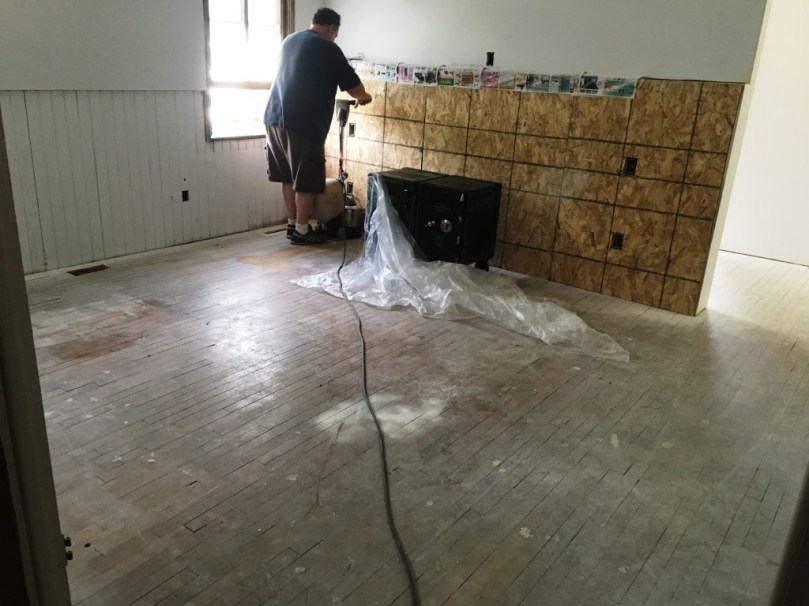
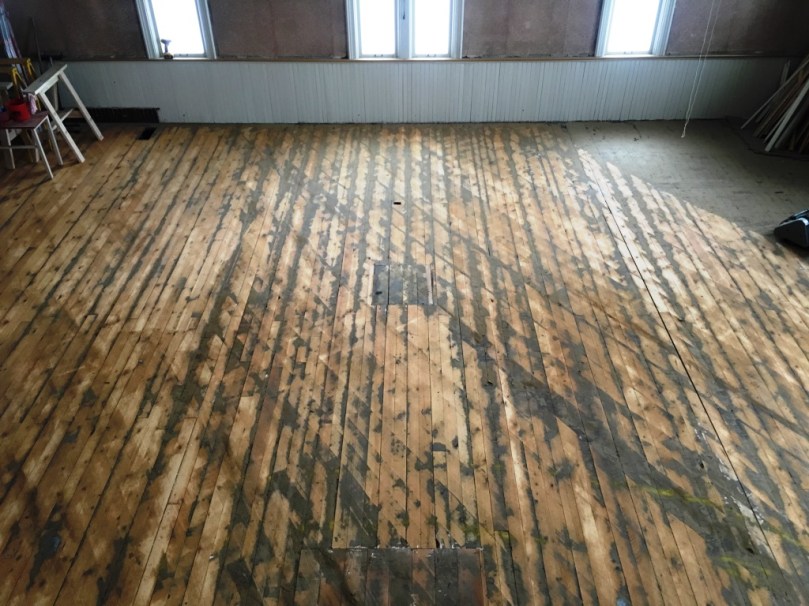
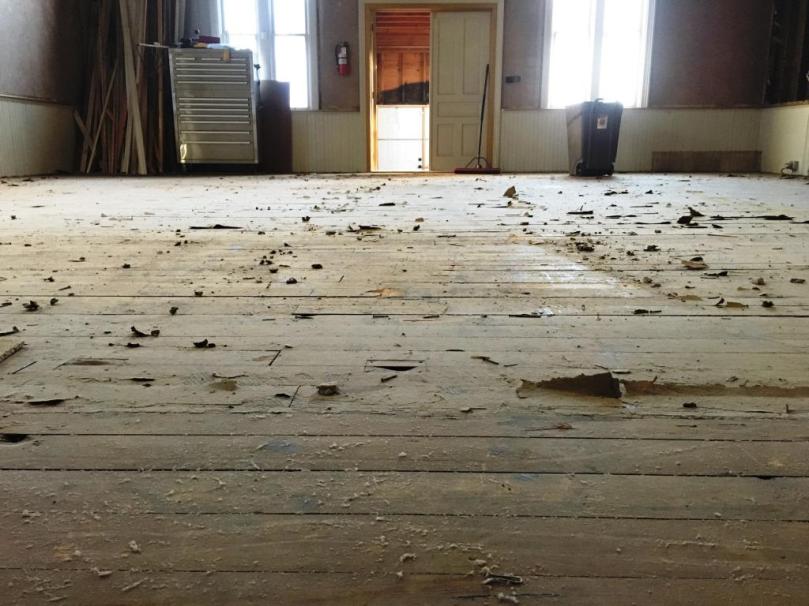
Our story so far: After sanding floors for months at the old Methodist church, we spent a little time filling the seams.
# # #
Our next hurdle was stain. Fortunately, choosing a stain color proved to be much easier than choosing paint colors for the trim and walls. We decided to go without stain on the maple in the master suite and on the pine on the second floor. A couple of coats of clear polyurethane was all we needed to show off the hardwood.
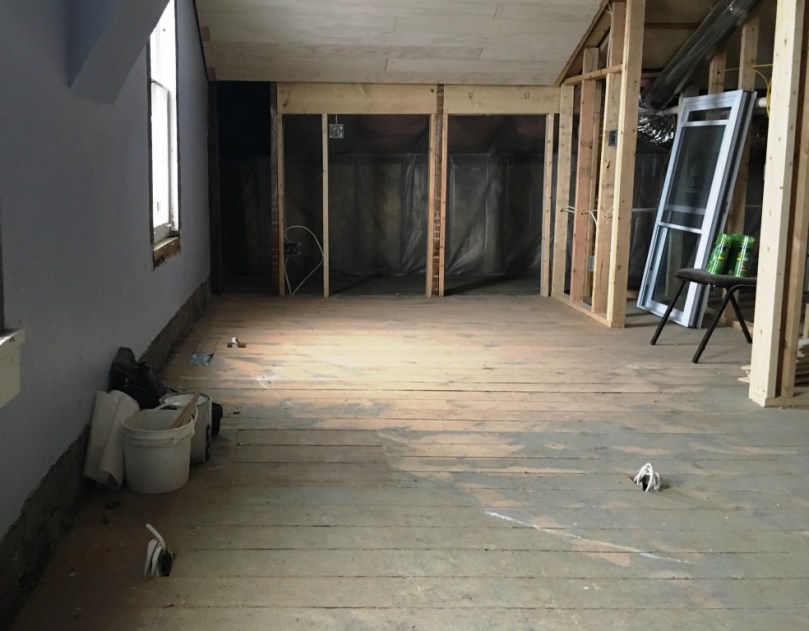
Here’s how the master bedroom floor look at the beginning of the sanding process.Here’s how the master bedroom floor looked after Tyler filled the seams and applied one coat of polyeurethane.Here’s a picture of the second floor after half of it had been sanded the first time. This was even before drywall was up.This is the second floor after one coat of polyurethane.
# # #
Tomorrow: Luck equals preparation plus opportunity. Read about it here.
Our story so far: My husband and I were sanded 2,200 square feet of hardwood in the old Methodist church we were turning into our home.
# # #
Sanding floors was too physically difficult to perform two days in a row (at least for 50somethings). So on “rest” days, Tyler, St. Johnny and I accomplished other duties: Cleaning up the basement and sorting wood, buying windows and ceiling fans, building feature walls, pickling wood planks for the second floor ceiling, buying more sandpaper and a thousand and one other tasks.
Eventually though, the end—or clean raw wood—was in sight. Curious and relieved to be nearing the end of sanding, I added up how much we’d spent on sandpaper, and I was surprised to figure out we’d spent hundreds of dollars on sandpaper—nearly a hundred dollars more on sandpaper than on renting the sanders.
Which firmly establishes sanders as the printers of the home improvement world (how much more is spent on print cartridges than the printers!).
# # #
Tomorrow: Emptying and filling seams. Read about it here.
Our story so far: We spent one hot, sawdusty Saturday morning sanding the second floor of the old church we were turning into our home.
# # #
The second floor, post sanding, in the afternoon sun.
After our showers, we were so exhausted we fell back into bed (we got up early, remember) and napped. It was one of those glorious naps during which you sleep so hard that when you wake, you are still paralyzed with slumber. I just lay there for a few minutes savoring my job-well-done accomplishment. Tyler roused, and we determined a late lunch at the nearby Mexican joint would solve our hunger problem most quickly. It was as I attempted to get out of bed that I realized my lower back ached. Not a little I-know-I-worked-hard-today ache, but a big I-think-I’ve-hurt-myself ache.
“Oh, my back hurts,” I said.
“Oh, my back always hurts,” my compassionate husband said.
I was able to get out of bed, get dressed with some trouble and make it to the Mexican joint for lunch, but I couldn’t bend over or babysit for a week because I didn’t trust myself to be able to pick up my granddaughter. My husband quickly realized I was not suffering from any run-of-the-mill back pain and handled sanding duties solo for a long while after that. It took three weeks for my back to return to normal operation. I determined it wasn’t actually the work of sanding that hurt my back but the effort of lifting the super-heavy industrial sander up the steps. This underscored the safety reminder every manual laborer since the age of Doan’s Pills learns: Lift with the legs, not the back.
# # #
Tomorrow: The price of sandpaper. Read about it here.
Our story so far: My husband and I got up early one Saturday in June to “eat our vegetables first.” We figured we could sand floors on the second floor of the old church for four hours, then enjoy the rest of the day. But we were stymied by a long breakfast and quickly rising temperatures.
# # #
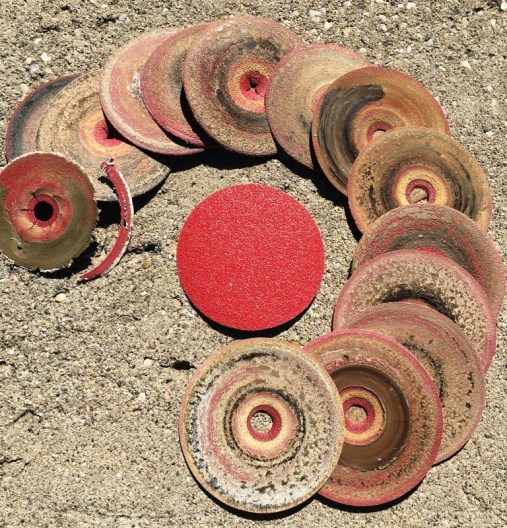
A new sanding disc surrounded by mastic-encrusted used ones.
The center of the floor was in pretty good shape after the previous sandings, but the edges were thick with mastic. No sooner would I install a new sanding disk on my edger than it would be gummed up with glue, unable to remove any more layers. Up to retrieve another disk, then down on my knees to install it and proceed a few more inches along the edge of the floor.
No sound can be heard above the buzz of one sander let alone two. So there was no music, no conversation, only attention to detail.
I took as few breaks as possible, besides the disk replacement, with the intention of finishing the edges upstairs and then tackling the Hall of History and the mud room on the main floor before having to return the sanders. But I ran out of sanding disks before I got downstairs. And Tyler ran out of energy.
Still, we had to drag the sanders down the stairs, blow clean the devices, hoist them into the truck and haul them back to the rental desk by 11:30. All in the searing high-noon heat and humidity. The pancakes and eggs we had during our extra-long breakfast break provided just enough fuel to meet our deadline. As we climbed back into the truck, Tyler said, “where to for lunch?”
Tyler had no shame, apparently, but we looked a fright. Sweaty, covered in sawdust, my hair all askew from wearing a ventilator and ear muffs all morning.
“I’m not going anywhere for lunch,” I said. “I’m going home to take a shower!”
Tyler obliged my vanity, and I indulged in the best shower of my entire life.
# # #
Tomorrow: Mexican with a side of aspirin. Read about it here.
Our story so far: We had 2,200 square feet of hardwood to refinish in the 126-year-old Methodist church we were turning into our dream home.
# # #
We’d pretty much agreed, Tyler and I, that we’d do something other than work on the church on weekends—shopping, chores, socializing, resting—but the pressure of finishing the floors began to eat away at our best intentions. We couldn’t install cabinets until we finished the floors, and we couldn’t install countertops until we had cabinets, and we couldn’t have sinks until we had countertops, and we couldn’t have running water until we had sinks.
So one Saturday morning in June, I agreed to sand floors for four hours. If we returned the sander within four hours, we paid less than using it all day. It seemed a good way to get an unappealing chore out of the way first and then enjoy the rest of the day. Plus, we figured to be done before the hottest temperatures of the day, predicted to be in the nineties.
So we got out of bed at 5:30 a.m. and rewarded ourselves with breakfast out. Only the diner we settled on was a cook short and experiencing problems with its electronic ordering system. A thirty-minute treat turned into seventy-five minutes of Chinese water torture. So we didn’t get the sanders rented and into service until eight o’clock.
This is an edge sander. The black parts are handles. Imagine finding a place between your legs for the inflated sawdust-catching bag.
We donned ventilators, safety glasses and ear protection. Tyler used the orbital sander on the second floor, and I used the edger. The sander had so much power and I so little core strength, I could only control it by leaving one knee on the ground and using the other leg and both arms to propel it in the direction I wanted it to go. I probably looked like some sort of middle-aged spider trying to control a panicked fly.
# # #
Tomorrow: Which has higher priority? Hunger or vanity? Read about the dilemma here.
Our story so far: The first step in sanding hardwood floors in the church we were turning into our home required a drum sander and 24-grit sandpaper.
# # #
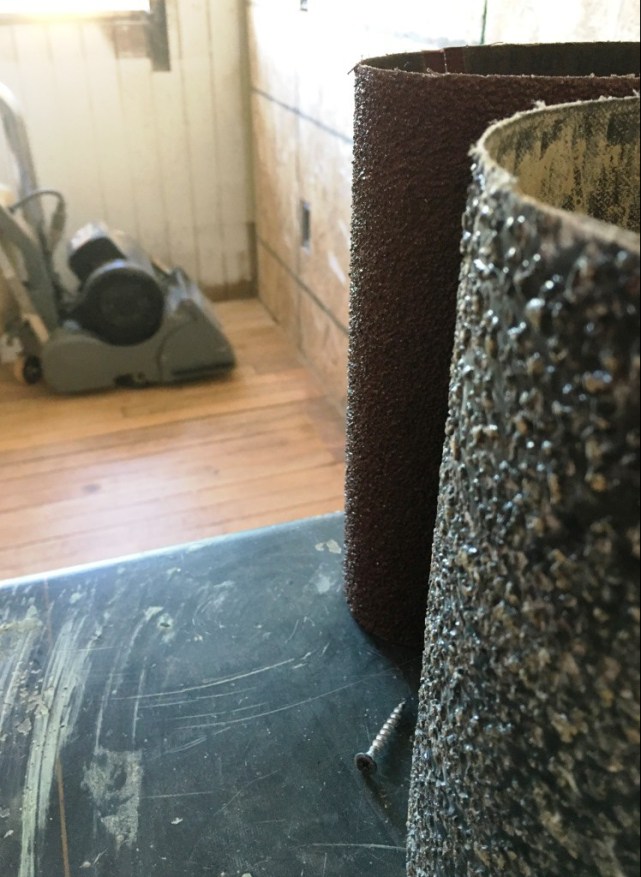
That’s a drum sander in the background; 24-grit sandpaper nearest, and 36-grit right behind.
Have you ever seen 24-grit sandpaper? I hadn’t. I’d only used the relatively even sheets of sandpaper to smooth edges and surfaces on furniture I painted. How cute. Twenty-four-grit sandpaper is the wicked sumo wrestler of finishing materials—it looked like it had gravel on it and if you got in its way, you’d be flattened.
At this point, I used a floor edger to sand right up to the walls in the sanctuary; this step required the operator to kneel, and since I still had my natural joints, I was elected. Then someone (usually Tyler, but sometimes St. Johnny) used the orbital sander with 60-grit sandpaper going with the grain.
On ordinary wood floors, one might be finished sanding. But we didn’t have ordinary wood floors; we had 126-year-old wood floors. Over the course of a century, the floor had settled everywhere except where the beams in the basement supported the structure. This left narrow grooves in the sanctuary floor that remained untouched by the stand-up sanders. Seated on a rolling flat cart low to the floor, Tyler used a belt sander and a hand-held oscillating sander to smooth out those grooves.
Final pass was with an orbital sander and 80-grit sandpaper.
Of course, vacuuming was required after each sanding step.
And that was just the sanctuary floor. We had to do the whole thing all over again in the master suite (with maple flooring, which is much harder than pine), in the Hall of History and on the second floor. In total, we had about 2,200 square feet of hardwood to finish.
# # #
Tomorrow: Sanding the second floor. Read about it here.
Our story so far: When we started sanding the wood floors in the old Methodist church, it was still wintertime.
# # #
Sanding is a little like driving across North Dakota. At first, you’re impressed with the everlasting undulating landscape, but it’s not long before you realize the points of interest are too few and far between.
I didn’t realize it then, but the sanding of the floors had only just begun. There was this first step with a drum sander and 24-grit paper on a diagonal to remove the mastic and level the wood. Then two passes with a drum sander, one with 24-grit sandpaper and one with 36-grit paper with the grain.
Here’s a shot of the sanctuary floor from the choir loft (before the balcony was built) right after Tyler’s first pass at sanding. The yellow parts are raw Douglas fir which showed great potential; the gray parts are covered with stubborn mastic.
# # #
Today’s headline is a quote from William Rounseville Alger, a Unitarian minister, author and poet.
Tomorrow: Steps 3 through 99 with a pit stop at 24. Read about it here.
Our story so far: The layers of flooring and gunk covering the original wood floors at the old Methodist church were beginning to feel as if they would never end. During the official demo phase we peeled back the old carpeting and padding. We then removed carpet staples and nails covering every square foot of the sanctuary.
# # #
Then there were pieces of tin.
Tyler found dozens of dinky pieces of tin nailed all over the sanctuary floor. Someone had meticulously cut the tin to size, nailed each corner and added nails every two inches when the piece was bigger. He took to removing them, and discovered they covered little divots and other dings in the hardwood. But like the nails and staples, they had to go.
Tyler discovered a hidden treasure.
In the back corner of the room, he found a much larger hunk of tin. When he peeled it up, he discovered a time capsule of sorts: Several copies of what appeared to be religious newspapers for young people—Dew Drops and Young People’s Weekly—filled with serialized stories and articles of advice. He was amazed to see they dated to the 1920s.
He developed the back story to this strange find: A teen-age boy—maybe the minister’s son—was tasked with covering the dings in the floor before it was covered with something (tile? carpet?). When he got to the place where there was once perhaps the wood stove smokestack, he stashed a pile of Sunday school newspapers for posterity with the unspoken message, “I was here.”
At this point, we were finally down to the mastic-covered wood, and sanding commenced.
# # #
Tomorrow: It snowed the first day we sanded the floors. That’s how long we’ve been at it. Read about it here.
Our story so far: Sanding hardwood floors in the old Methodist church we were turning into our home was dirty work.
# # #
Sanding hardwood is hard work. To the elbow grease, add a flurry of sawdust and you’ve got good reason to hire out the work.
But we didn’t. We hired out the duct work, we hired out the electrical, we hired out the plumbing, we hired out the drywall and we hired out the painting. Unlike those other tasks, sanding didn’t require any particular expertise, only numerous trips to the Big Box rental desk, attention to detail and a willingness to endure dust (a lot of dust). It’s the job you often see novices attempt on DIY Network’s “First Time Flippers”; viewers see about ninety seconds of effort, even though the rehabbers probably spent weeks doing the work. Though the investment in time is big, the investment in cash is small, and the return is potentially huge. Everyone likes the sound of “original wood floors.”
And so, we found ourselves sanding floors in the old church during cold days in February and hot days in June.
Fundamentally, sanding is granular demolition and despite labeling it the “flooring phase,” the truth of the matter was we were still demoing the flooring seven months after we purchased the old Methodist church to turn into our home. The layers of flooring and gunk covering the original wood floors were beginning to feel as if they would never end. During the official demo phase we peeled back the old carpeting and padding that was two decades old if it was a day. Then there were the thousands of carpet staples and hundreds of nails covering every square foot of the sanctuary.
We knew there was beautiful wood somewhere under all that ugly mastic.
# # #
Tomorrow: Oh, you can’t sand yet. Look out for the tin! Check it out here.
Our story so far: We juggled enough projects at the old Methodist church as summer inched on that something different occurred in a steady rhythm every day.
# # #
We’d found plenty for You-Can-Call-Me-Al to do, too, as he was equally skilled using a tile saw and any number of wood saws.
One day, I stood on the balcony pickling the last of the planks for the upstairs ceiling. I wore headphones, listening to National Public Radio, while quietly rolling diluted white paint on wood.
Tyler worked in the master bedroom with a table saw and a nail gun, assembling the bead board on the closet wall.
You-Can-Call-Me-Al played the radio at a volume that didn’t quite overwhelm the sound of his tile saw when he modified one of the stones for the fireplace. He was finally making progress on our twenty-foot fireplace after a couple of false starts with unacceptable mortar. The stone guy suggested a type he’d used for an outdoor fire pit, but when we tried it, the stone would still come off twenty-four hours later. This might have been okay for a three-foot-high fire pit, but we eventually learned (from a Home Depot guy, to his credit) that we needed mortar for a vertical application. Because when laying stone twenty-feet off the ground, you do not want it to fall off, lest you kill someone. Still, You-Can-Call-Me-Al built only about three or four vertical feet of fireplace a day so it would dry level.
This was the sort of meditative work I enjoyed. Roll, roll, roll of the paint. Pithy NPR observation about the history of Chinese food. Whirr, whirr of a saw. Pop, pop, pop of a nail gun. The swoosh of mortar on the back of a hunk of stone. Whomp, whomp, as You-Can-Call-Me-Al occasionally used a rubber mallet to coax a piece into place. Then more of the same. The only way of determining the passage of time was the eventual grumble of my stomach, calling me to lunch.
You-Can-Call-Me-Al got to within a foot of the ceiling before we ran out of stone for the fireplace (of course, we reordered more, but it would take a few days to be delivered). If you look closely on the upper left, you can see the ends of the boards I painted for the upstairs ceiling.
# # #
Tomorrow: Chapter 32 opens with thoughts about travel. Read about them here.