We interrupt our storytelling to wish you, our faithful readers, a merry Christmas.
Tomorrow: While you’re waiting in line to return your Christmas gifts, you can read the next bit of Chapter 8 recounting a Black Friday score. Read it here.
We interrupt our storytelling to wish you, our faithful readers, a merry Christmas.
Tomorrow: While you’re waiting in line to return your Christmas gifts, you can read the next bit of Chapter 8 recounting a Black Friday score. Read it here.
Our story so far: The closing date on the old Methodist church we intend to convert into our home is delayed again.
# # #
Chapter 8
Every Thanksgiving, I make Tyler verbalize all the things he’s thankful for in the past year. I hate to think of the holiday as only an opportunity stuff oneself, watch football and read the ads for Black Friday. Usually, on our way to a feast of turkey and pecan pie, we count down the Top 10 people and experiences for which we’re grateful.
This year, Thanksgiving fell smack in the middle of our two-week hiatus from getting our hands on the keys to our new old church. So we had to be thankful for finding the church, if not grateful for getting started on the project. We had no choice but to travel to enjoy a feast. Our little rental house was so small, it didn’t have room for a table, and I don’t think anyone would have enjoyed standing around the kitchen island to dine. So we drove to Tyler’s mother’s house and counted our blessings along the way: Very happy to have sold our house in the suburbs. Grateful for becoming grandparents. Thankful we had the opportunity to travel around a bit before settling down again. Excited to begin work on our little 126-year-old church.
# # #
Tomorrow: Chapter 8 continues with a description of a Black Friday score. Read it here.
Our story so far: My husband Tyler picked up a lot of experience when he undertook a mammoth project back in the early 1990s to renovate an old tobacco farmhouse without any modern amenities into his house.
# # #
One of the things I like to say about my enterprising husband is that he is one to go big or go home. He likes big steaks, big trucks and, fortunately for me, big women (or at least tall ones; I’m 5-foot-10). Our RV is among the biggest on the road, and of course, he’s fond of big houses, too.

This first renovation project was no different. Once Tyler had the old tobacco farmhouse livable, he decided he needed more space. So he built a 24-by-36-foot two-story addition; the main floor was the family room and above it was the master bedroom. (He deconstructed the Swedish wood stove and moved it to heat the addition.) And then he built a three-car garage on the other side of the farmhouse.
When I say “he built it,” I’m being literal. He would frame one wall and invite a buddy or a relative over to help him stand it up. People who know Tyler won’t be surprised he paid his buddies in beer. A lot of beer.
The entire project took just less than two years to construct. Five years after he and his wife bought it, they moved to Minnesota. They sold the old tobacco farm for ten times what they’d paid to purchase it.
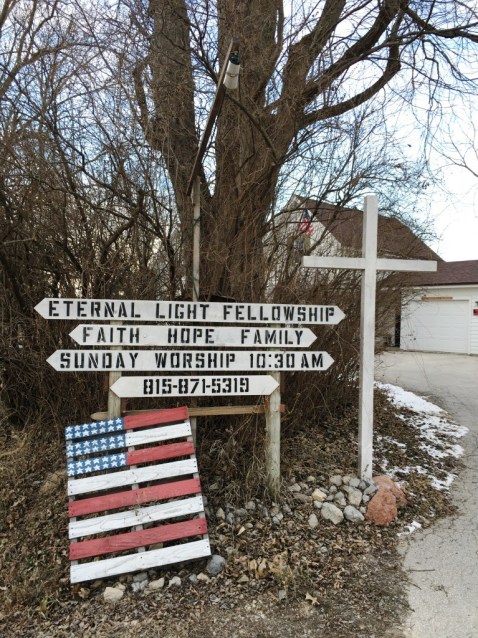
Ironically, Tyler’s old tobacco farmhouse transformation was big enough to house a whole congregation—let’s call it cathedral big. We drove by it not long ago, and there’s cross, a flag and a rustic sign out front that reads “Eternal Light Fellowship/Faith Hope Family/ Sunday Worship 10:30 a.m.”
# # #
Tomorrow: Chapter 8 opens with a moment of gratitude. Read it here.
Our story so far: Are you willing to take on a fixer upper? My husband and I thought we were, and we made a plan to renovate a 126-year-old Methodist church into our dream home.
# # #
Chapter 7
My beloved husband Tyler knew well what it meant to renovate a house and why anyone about to tackle such an undertaking should proceed with caution.
Nearly thirty years ago, Tyler’s first whole-house renovation project began with Boone County’s oldest operational tobacco farm.
He and his wife at the time purchased the property in Northern Illinois for just the price of a new car in the 1980s from the two bachelor brothers who had grown tobacco there for decades. Now in their 80s, one of the brothers was in ill health and living in a nursing home; the other planned a move to join him.
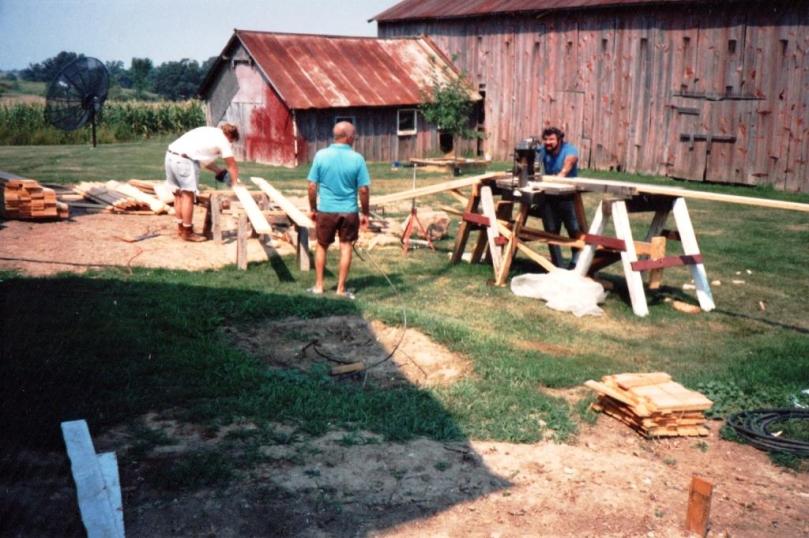
One of the buildings on the farm was a distinctive tobacco barn with hinged foot-wide openings. They all locked from the inside with a wooden peg. The slates were opened to dry the tobacco hanging inside.
The brothers smoked their product. Every out building had Zig Zag cigarette rolling paper packages stuffed in every crevice.
The farmhouse had no heat except a warm-morning stove connected to a fuel oil tank. There was one light switch in every room connected to a single bulb hanging from the ceiling. Old horsehair plaster was on all the walls and ceilings. The flooring and trim was basic Douglas fir that could be refinished; the baseboards were distinctive. The main floor consisted of three rooms, and a steep stairway led to the second half-story. The basement was a five-foot-deep hole with a dirt floor.
There was no plumbing. The “running water” was a well pump outside. The brothers pumped water and brought it inside for drinking and bathing. When Tyler had the well tested, it was like death syrup, the levels of live bacteria and chloroform so high as to be practically toxic (chloroform was used an anesthetic in the Civil War). The “bathroom” was a two-hole outhouse on skids so the brothers could move it when the pit beneath it filled.
# # #
Tomorrow: Hard physical effort transforms the old tobacco farm. Read it here.
Our story so far: We moved into a rental house two blocks from the church, ready to get to work renovating it into our dream home.
# # #
It was two weeks after we originally planned to close on the church (two weeks!), and no closing had been scheduled. The church still didn’t have the paperwork it required to designate authorized signatures.
Tyler had had it. He was anything but understanding at this point.
Sure, we were protected from the elements now, but really! We wanted to close on the church two months ago! Should we walk away from the deal?
Though we entertained a few conspiracy theories that the congregation really didn’t want to sell the church, we knew in our hearts they just weren’t as motivated to wrap things up as we were. So we decided to give them some incentive. We offered to extend our offer for two more weeks (admitting to ourselves it would be a regular miracle if we closed in two weeks), but we also lowered our offering price. Now our good deal was even better!
We sweated it out for twenty-four hours while we awaited a response, but the church accepted. So now we had a few thousand more in our budget and two more weeks to plan how to use it.
As we relaxed in front of the TV one evening in our little rental house, I asked Tyler how he was feeling about things.
“Excited,” he said right away. “And scared.”
# # #
Tomorrow: Tyler is knows very well what he’s in for. Read it here.
Our story so far: We begin moving into a rental house two blocks from the church so we have a warm place to clean up and crash while we renovate.
# # #
On Days Two and Three of our move, we transferred our meager belongings from the camper and the urgent items from the cargo trailer into our tiny rental house. Our most critical need: A bed. We would need restful slumber if we ever hoped to survive renovating the church.
We’d packed our big, beautiful king-sized Sleep Number bed into the cargo trailer the day before we moved out of our cardboard box in the suburbs. The camper had room for only a queen-sized bed, so we bid farewell to the best bed upon which either of us had ever slept when we moved out.
Unlike a standard mattress and box spring, a Sleep Number bed is a unique combination of foam, air pillows, zippered compartments and an inflation device. We’d carefully packed it all away in the cargo trailer. The last thing to go in was the first thing to come out.
Amid sleeting flurries in southern Wisconsin, we cajoled the pieces of the bed out of storage and hauled them into the little house. We slammed shut the cargo trailer doors and parked it on the now-muddy gravel driveway inside the garage foundation. A garage had once stood on this lot, but now, only the cement-block foundation remained. After much cold-handed grunting and groaning, we affixed a boot on the tire and paddle-locks on the trailer doors.
Tyler had built a platform for the bed in our new bedroom out of two-by-fours and plywood (the original platform remained in the trailer). We set to work assembling our bed.
After sorting out all the pieces, we realized we were missing one: The inflation device.
An air bed isn’t much of a bed without air.
Ugh.
Back to the cargo trailer to pinpoint the apparatus.
“What does it look like?” I implored, while climbing over boxes and craning to see the labels on bins.
Clearly, I wasn’t paying attention eleven months before when we disassembled the bed.
“It’s the size of a bread box,” Tyler instructed.
Believe me, a bread box is a needle when the 30-foot cargo trailer is the haystack.
Especially when the air is filled with ice-cold wet sleet.
Eventually, we found the contraption, repacked and re-secured the trailer, and retreated to the warmth of our little rental house. Once we had all the pieces, the parts went together pretty easily. As we lay on our beloved king-sized bed looking at the spiderweb-free ceiling of our warm little house, we were content. I was amazed at how quickly I felt comfortable in our little rental. It felt like a mansion compared to the RV, and I swiftly reacclimated to house living.
In three days, we would close on the church, and we could start our project at long last.
Or so we thought.
# # #
Tomorrow: Chapter 6 concludes with a twist any fan of “The Money Pit” could have predicted. Read it here.
Our story so far: After a delay in closing, we decided to rent a house near the church to live in while we renovate it into our house.
# # #
Chapter 5
As we waited impatiently for the church to gather the necessary closing documents, we got a look at the freshly minted survey for our lot.

To our surprise, we were about to become owners of three lots. Together, our triangle-shaped property comprised about a third of an acre. The church building was situated on the corner where two streets intersected (there had never been a parking lot, at least not in recent history; apparently parishioners used street parking or the elementary school’s lot kitty corner to the church). This positioning would allow us to build a garage in the back yard with a curb cut on the west side of the lot, avoiding the ugly maw of a double garage door overwhelming our front door as so many suburban homes without alleys have. (Before we purchased our former residence, I’d vowed never to buy such a monstrosity, but alas, that’s how modern houses are plated and constructed nowadays.)
There would be no welcoming porch though. Our front door was 3.78 feet over the property line. Technically, our light sconces on either side of the front door were street lights. Instead, we planned a screen porch off the to-be-built garage overlooking our side yard.
# # #
Tomorrow: I’m of two minds about the amount of square footage in which we’re about to invest. Read it here.
# # #
Did you used to worship at this church? If you have memories you’d like to share, I’d like to include some of them in our story about renovating the church into our house so others can appreciate its history. Simply click on “Contact” above and send me your story.
Our story so far: A cursory inspection reveals the roof of the belfry in the church we planned to buy was in terrible, possibly dangerous condition.
# # #

Initially, in the privacy of our bed in the early morning hours as we dreamed of our church, Tyler cooked up the idea that he could use the emergency stairs that were attached to a different side of the house to repair the belfry himself. He described in alarming detail how he could move the stairway around the building, climb up twenty-five feet, deconstruct the belfry piece by piece around the bell and rebuild the roof.
In November.
I forced him to recount his brilliant plan in excruciating detail to both of our children in the hopes that they would dissuade him of such lunacy (again with the crazy!).
The light of day and after the encounter with Stan the mummified squirrel when Tyler had gotten a good look at the damage, he realized we needed to get professionals involved.
# # #
Tomorrow: A mummified squirrel is nothing compared to the terror of a quote on belfry repair. Read it here.
Our story so far: The seller of the church we wanted to buy and convert into our house disclosed the belfry was “rooted.”
# # #
On our third showing of the church, which occurred while we were still waiting for the title to clear and we talked our real estate agent into letting us in again despite the prospect of the tiny commission, my enterprising husband packed a hazardous materials suit, goggles, a face mask and a big flashlight. Oh, and a hammer.
He donned his apparel—what a dashing figure, not too unlike the Stay Puft Marshmallow Man—and climbed a step-ladder in the closet on the second floor that led to the belfry. A couple of whacks at the trap door, and he was inside.
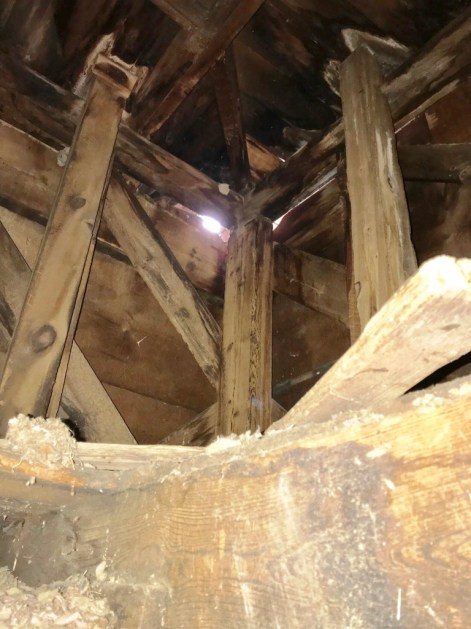
Unfortunately, he could see the sky. Coffee-can sized holes dotted the perimeter of the roof around the bell. On days with worse weather, rain was probably pouring into those holes. And who knows what else!
Well, we found out what else.

Stan the squirrel.
The mummified and dust-covered rodent’s wide-open mouth betrayed the terror he must have felt in his last moments.
The real estate agent and I were standing along the far wall while Tyler poked around. We had no interest in coming face to face with a bat.
Tyler found Stan. But he didn’t find any bats.
Oh, joy! We didn’t have bats in our belfry after all! (I told that joke ad nauseam for days afterward. And I’m not promising I won’t use it again.)
# # #
Tomorrow: Tyler cooks up a plan to repair the belfry. Read it here.
Our story so far: Everyone thought we were crazy to renovate such an old structure, let alone a church, into our home.
# # #
I spent a little time talking Tyler into rehabbing a church.
“This is the only way to get what we really want. Otherwise, we’re just buying someone else’s foolhardy decorating decisions.”
“Imagine how awesome our great room will be. We can buy an 18-foot tall Christmas tree. Our children will love it!”
“It’ll be a great workout. Why buy a membership to a gym when we can work out in our own house?”
“We’ll never find a property so cheap. Heck, even the land itself is worth what we’re paying.”
“We can get this done without a mortgage. It’ll be all ours in two years!”
Honestly, that’s all it took to convince Tyler. He liked challenges. In the business world, I called him the dragon slayer because the bigger the account, the more hair on it, the more he liked it. Big risks reaped big rewards.
Plus he wanted to please me. He’s a great husband like that.
# # #
Tomorrow: Buying a church spooks some naysayers. Click here to read.
 Church Sweet Home