To jerry-rig: Organize or construct in an improvised manner

Our story so far: Tyler located a display model kitchen on Craig’s List that matched the style we were looking for inside the church we were turning into our home.

# # #

The Craig’s List kitchen wasn’t perfect, but it was darn close. And the price? We were buying the whole kit and caboodle for about 25 percent of the retail cost of the cabinets alone. Coincidentally, the remodeling firm had just sold a different display kitchen to another woman who was renovating a church into a home. It was a trend.

But what would we have to jerry-rig?

A few things.
little drawers
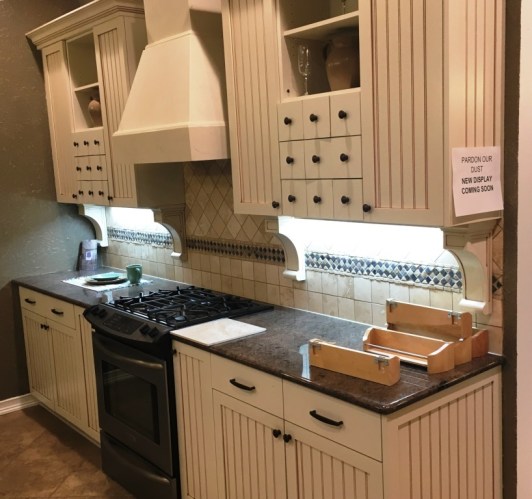
We needed another six inches in width, which we could get with a bigger stove and vent. And those drawers were nonfunctional.

We’d need to find a 36-inch wide stove in order to fill the back wall of our kitchen space which was six inches wider than the display. But we already had an extra wide stove vent we could switch out with the display vent.
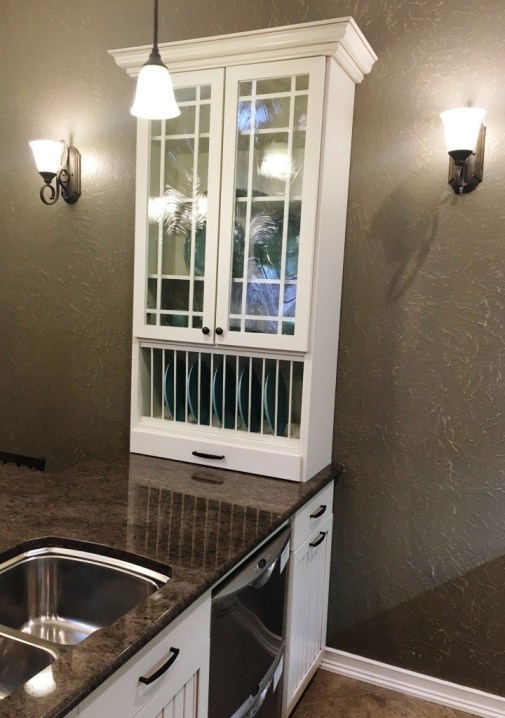
glass fronted doors
These glass-fronted doors could flank the stove vent, in place of the little drawers and bookshelves.

And the little drawers in the upper cabinets—supremely bad design. Even I, a 5-foot-10 woman, could not see inside the top drawers. Those would have to be replaced, but I had an idea we could reuse the little drawers in the master bath vanity. To fill the spaces next to the stove, we could use the glass-fronted doors on the hutch at the end of the island.
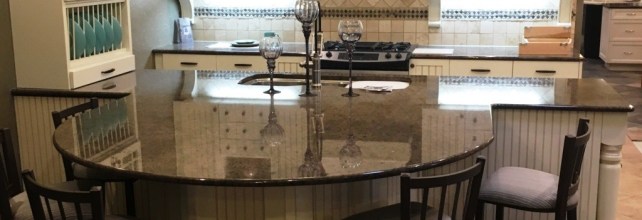
tongue
The tongue of our island stuck out about thirteen inches too far.

The tongue of the island was a bit too long for our space. We would need to have that shortened so it wouldn’t stick out from beneath our balcony. We decided to invest in having the countertop professionally disassembled, moved and reassembled. The countertop experts could shorten the tongue and smooth the other rough edges as part of the move.
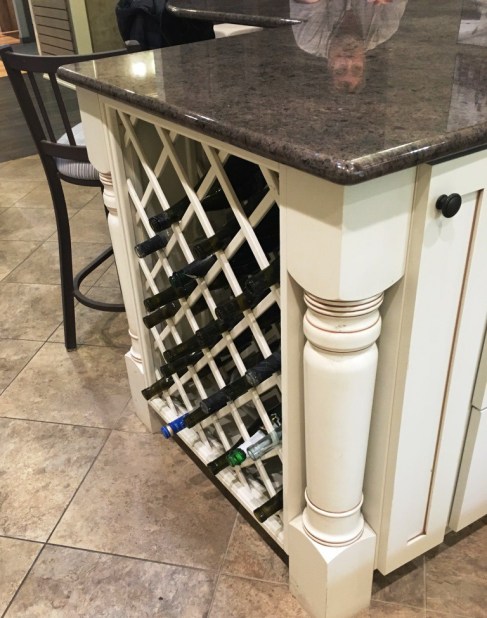
wine rack
The wine rack would have to go on the other end of the counter. (Man, that granite has a polish to it, dontcha think?)

And we’d have to flip the lower cabinets on either side of the sink so the wine rack would be on the side nearest the beverage bar.

We’d also have to invest in a new matching cabinet above the refrigerator and a few doors for the island so we could use it for storage. While we were adding, we could get coordinating cabinets for the beverage bar.

Even with the changes, we were scoring a budget-saving deal on a high quality kitchen.

# # #

Tomorrow: Kitchen appliance Number One, check. Read about it here.

Kitchen recipe calls for pinch of patience, spoonful of luck

Our story so far: While building inside the 126-year-old Methodist church we were renovating into a home, we were also buying—as often as possible, from Craig’s List and other discount outlets.

# # #

Tyler, the Craig’s List stalker, found a set of kitchen cabinets on sale. They appeared to be custom-painted cabinets in the perfect color of cream we had tried and failed at least once to locate.

He placed a call to the seller and found out someone had already expressed an interest. We were second in line, but if you’ve ever interacted with Craig’s List sellers, you know that could mean you’re second in line behind a serious buyer, so you’ll never hear from the seller, or it could mean you’re second in line but the seller has already told four people that, or it could mean the seller is too meek to tell you it’s already sold, or it could mean the seller is just plain cruel and they’re not really selling anything.

In any case, we wrote it off. “Another one will come up,” Tyler said. He was nothing if not confident.

Lo and behold, the seller called about a week later. “Still interested?”

“You bet. We’ll be there tomorrow.”

Tyler and I spent the next couple hours studying the ad and measuring the space where we intended to put the kitchen, down to the half inch.

We drove the next morning to the seller’s location, the showroom of a remodeling company only an hour away from the church. The kitchen had only ever been on display, never in actual use. It came complete with the kitchen sink and thousands of dollars worth of granite countertop. The ad offered the countertop for free as long as we moved it at our own risk and expense.

kitchen on display
Our dream kitchen in the showroom.
sink
Here you can see the triple sink in the granite countertop.

The granite countertop looked brownish black in the pictures. I had my heart set on a light-colored Quartz countertop, but if we could get a dark granite countertop for free? Well, call me fickle then. I would be in love with dark granite.

When we saw it in person and ran our hands across the grayish-black countertop (even better), fantasized about washing dishes in the triple sink (or whatever one does with a triple sink), and opened and soft-closed the dovetail-jointed drawers, our hearts melted.

# # #

Tomorrow: What’s it gonna take to make this kitchen work inside the church? Read about it here.

Hand in hand with building: Buying

Our story so far: We had entered the construction phase of our church conversion project.

# # #

Chapter 18

Selling something on Craig’s List can be a pain in the neck. There’s the picture taking and ad writing that take some time, but the real irritation are the looky-loos. Potential buyers who ask a bunch of arcane questions about the dimensions or color or history and after you’ve answered, they disappear into the ether. Or the ones who send text messages riddled with spelling errors at 11 p.m. or 5 a.m. Or the jerks who show up and dicker over ten bucks.

But Craig’s List is an amazing marketplace full of great deals and unique goods for buyers.

pace-arrow-001
Ye olde Pace Arrow, how I miss thee

We were buyers, and Tyler was an authority. Not too many years before, Tyler turned a $500 gift into an RV we used for several years to travel the country. He bought and repaired increasingly valuable vehicles until he scored a 1983 Pace Arrow from a retiree in what was now our home state of Wisconsin. After we put thousands of miles on the 454-cubic-inch, 375-horsepower engine, he sold the old turd for a profit.

Now, when we needed nearly everything to renovate the old church, Tyler fired up his CSmart app to shop all Craig’s List listings for Milwaukee, Madison, Rockford and Chicago at the same time.

His first find was the magnificent castle doors described in Chapter 9.

His next conquest: A full kitchen.

# # #

Tomorrow: A look at our new(ish) kitchen. See it here.

A day in the life of an inexpert rehabber

Our story so far: We built walls and hired a plumber as we made progress renovating a 126-year-old Methodist church into our home.

# # #

Chapter 17

How does a member of the construction crew who doesn’t know anything about construction contribute during a renovation project of this magnitude?

Three ways: Odd jobs, errands and laundry.

Laundry probably doesn’t need much explanation. The clothes we wore were often dusty and sweaty by the end of a day, and someone had to wash them. That someone was me.

As for an odd job, I was uniquely suited to measure for the faux beam order Tyler wanted to place. Uniquely suited because I still had my own, natural-born knees and was light enough to climb the scaffolding in the great room.

scaffolding high
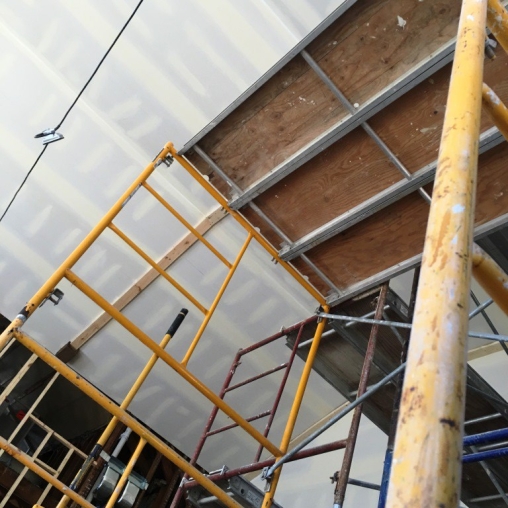
The scaffolding looked a lot more appealing from the bottom, I’m not gonna lie.

Fifteen feet off the ground I realized I’d forgotten the tape measure. I was seated on the platform, sweating and nauseated, and now I had to put my hands in the air to catch a moving tape measure.

I did not catch it. Tyler had good enough aim to land it on the platform. But I still had to measure for the beams. Above. My. Head.

Let’ just say we got the measurements down to the foot, not the inch. And I got back on the ground in one piece.

Odd jobs also included communications. Print this quote. Find this business card. Track down this phone number. Respond to the salesman working up a quote about his proposed shower base color.

Also, opening mail. Nearly every day, some guy from FedEx, UPS or USPS stopped by with a package, which would have to be opened to determine the contents and then, if required urgently, delivered to the church. And someone had to crush cardboard boxes (or they’d never all fit in the recycling bin).

One day, the guy from Brown left an enormous box on our front step. By the time I got the door open, Brown was already in his truck.

“Hey, the box is open!”

“You can accept or reject. What do you want to do?”

“Um, I’m pretty sure these are one-of-a-kind leaded glass windows. They’re fragile.”

“Accept or reject? The box opened when I picked it up.”

“Did you drop it?”

“Accept or reject, that’s all I can do.”

“I guess I’ll have to see when I open them.”

Brown drove off.

Disgusted, I carefully dragged the enormous package into the rental house, and called Tyler to inform him.

“Well, open them to find out if they’re broken.”

damaged leaded glass
The box was labeled fragile but it should have been labeled “one-of-a-kind leaded glass windows inside–do not drop, ram, tip or stack haphazardly.” We paid $118 for shipping what was essentially decorative trash when we received it.

Twenty minutes and five layers of cardboard, plastic, foam, bubble wrap and tape later, I still couldn’t get a good enough look at the windows Tyler had found on Craig’s List to determine if they were broken. (Two days later, Tyler dove deeper and determined they were. One of a kind and broken.)

And errands. I got very good at errands. If I could work Starbucks into the route, I did it. Drop off another load of scrap metal? Yes. Find a glass retailer who could do replacement glass for the light fixtures? Sure, I’ll bring him the light fixtures to see if he could do it. Need some tile samples for the shower? Home Depot, here I come.

Meanwhile, Tyler was calling the HVAC guys to get an ETA (again), building walls for the refrigerator and the pot filler behind the stove, directing St. Johnny to pick up the yard, burning brush and checking over the plumber’s work.

We made a good team.

# # #

Chapter 18: We weren’t only building. We were buying, too. Read it here.

Sawing wood is what she was intended for

Our story so far: We were deep into the construction phase of converting a 126-year-old church into our dream home.

# # #

By now, Tyler had finished constructing the walls on the main floor and upstairs. We were ready to think about the second floor ceiling.

Unlike the main floor’s drywalled ceiling decorated with beams, we chose something with a bit more farmhouse flavor for the upstairs, which would house a bathroom, bedroom and my office: Pickled, planked plywood.

We’d seen Tyler’s cousin’s husband turn plain old plywood into beautiful planked flooring when we were camped in their yard (was that only last year?), and we thought we could copy the idea on our ceiling.

Pickling and installing the ceiling was a multi-step process that began with a good day’s work ripping boards on the table saw. Tyler chose to do this with me on an otherwise quiet Saturday.

The table saw is not my favorite piece of equipment since it carried with it the threat of cutting off one’s digits. But the boards were too big for Tyler to cut straight without help, so the foreman tagged me as his crew.

sawdust.jpg
Check out that mountain of sawdust.

I caught on quickly when to push, when to pull and when to catch newly sawn pieces of lumber, but let me tell you, 20 pieces of plywood is a lot of 5.75-inch planks. And a half a bagel for breakfast wasn’t enough to fuel the manual labor. We took a couple of water breaks, but by the end, my self-talk sounded like this (if you could have heard it over the whine of the saw):

“Think about sawing, not about lunch. Don’t let Tyler’s fingers get cut. Seventeen planks to go. Who left the front door open? Concentrate on the saw. Tyler, be careful. Don’t slip in the sawdust. Don’t pull too fast. Watch Tyler’s fingers. Sixteen planks to go. Do I want tacos or a bratwurst for lunch? Don’t think about lunch. Step over the pile of sawdust. Watch Tyler’s fingers. Is that fifteen or fourteen? Keep the plank straight. Don’t push too hard. Watch Tyler’s fingers.”

Finally, the stacks of plywood were piles of planks.

ceiling planks
Stacks of planks. With the table saw looming in the shadows.

We still had days of sanding and painting and nailing ahead of us before we’d have a finished ceiling, but Step One was complete and so were Tyler’s hands.

Time for lunch.

# # #

Today’s headline comes from Mark Twain: “Write without pay until someone offers pay. If nobody offers within three years, the candidate may look upon this as a sign that sawing wood is what he was intended for.”

Tomorrow: Chapter 17 opens with a day in the life of an inexpert renovator. Read about it here.

Shall we dance?

Our story so far: We stood knee-deep in mechanicals at the old Methodist church we were turning into a home. I nicknamed our plumber Glimfeather because he was a night owl who was impressively productive after dark. But he made frequent appearances during the day, too.

# # #

One day when I happened by the church on the way to the post office, I witnessed the strange dance plumbers and HVAC guys must do often on custom projects.

Because the structure in which he was working was a 126-year-old church, Glimfeather was having to figure out how to vent the kitchen sink drain; it had something to do with drain clogs (or preventing them, I didn’t understand the details). The sink was situated in the middle of our kitchen island in the middle of our sanctuary (Tyler took issue with my choice of the word “middle” as the sink was closer to one side than the other of the sanctuary, but suffice it to say, it was not on the edge of it). This meant it was draining and venting into the middle of our basement, and Glimfeather needed to figure where to run the pipes while avoiding the beams which supported, well, pretty much the entire structure.

Meanwhile, the HVAC guy was replacing the ductwork, much of which ran along the ceiling of the basement. His work, which included more modern, streamlined ducts than had been in the church originally (or, at least since it was heated with gas forced air), required all new routing to accommodate the new rooms we constructed.

But the kitchen sink drain threatened to muck it all up.

where plumber and hvac danced
Where the plumber and the HVAC guy danced: You can see how the drain pipe intersects with the path of the duct.

So Tyler, Glimfeather and the HVAC guy problem-solved out loud, tossing out several alternatives that each created their own problems. Tyler was adamant about maintaining the sanctity of his beams while Glimfeather was ruffled about the angle of his pipes. The HVAC guy mostly nodded and shrugged.

I literally bit my tongue because A) I knew nothing about sink vents or drains, B) I knew nothing about cold-air returns and C) no one was looking at me for direction; they were looking at Tyler. All I could think about was how stupid I had been to dream about a sink in the middle of the kitchen island and how badly I didn’t want to lose this brilliant concept. And also? I didn’t want such low ceilings in the basement that I felt claustrophobic.

Finally, the HVAC guy suggested maybe his fabricator could create a custom piece of ductwork to accommodate the drain.

Key word: Custom.

Custom, if you didn’t already know, means expensive in the renovation world. As you may recall, the new standard ductwork throughout the church was not in the Tequila Budget let alone custom ductwork.

But anything is possible if you’re willing to pay for it.

In retrospect, I was surprised the dance didn’t culminate in this sooner.

Of course, Tyler who sensed my agitation by the way I was pacing the basement silent but brooding, OK’ed the custom ductwork.

My kitchen design and basement airiness were saved.

For about the hundredth time, I was glad Tyler knew what he was doing and was able to linger at the church so he could referee these negotiations.

# # #

Tomorrow: Is a table saw scarier when you’re hungry? Read about it here.

The best ideas come in the dead of night

Our story so far: My husband Tyler and I bought a 126-year-old Methodist church to turn into our dream home.

# # #

We had endured weeks of dirt, dust and debris during the demolition phase of the project, and when we began building walls, I realized we had weeks of sawdust ahead of us, but I believed we were done with the dirtiest of dust.

Until the plumber started work.

Following months of cat herding, Tyler collected bids from no fewer than six plumbers. When Plumber Number Six presented his hand-written bid with the flourish of enthusiasm for our project, it seemed our search was over. “I like him,” Tyler said to me as the potential plumber left the room to check on some detail or another. “You?”

I smiled and nodded. This prospect spoke with reassuring authority, asked questions that indicated he had a lot of experience, and his hand-written quote signaled we weren’t going to be paying for a lot of marketing. We wanted a well-plumbed house, not unsubstantiated flash.

Tyler closed the deal.

“You’re hired.”

As if to underscore the serendipity of our choice, Tyler’s hired man St. Johnny pointed out the plumber wore a burly cross necklace. Seemed like he would fit right in.

Plumber Number Six got to work almost immediately, and we learned quickly he was the night owl to Tyler’s morning lark. Tyler never met a 5:30 a.m. he didn’t like, but Glimfeather earned his nickname by proving he was most productive under bright construction spotlights at 10 p.m. (or, frequently, even later).

Glimfeather was the talking owl who helped the protagonists find a kidnapped prince in The Silver Chair, one of C.S. Lewis’s books in the Chronicles of Narnia. Like our plumber, Glimfeather was wise, spirited and most alert after dark. Exploring the progress the plumber made in the church the morning after his late-night work was often a little like Christmas morning.

Glimfeather’s first project was to jackhammer the basement floor and reroute the sewer pipe in the basement to accommodate our new bathrooms.

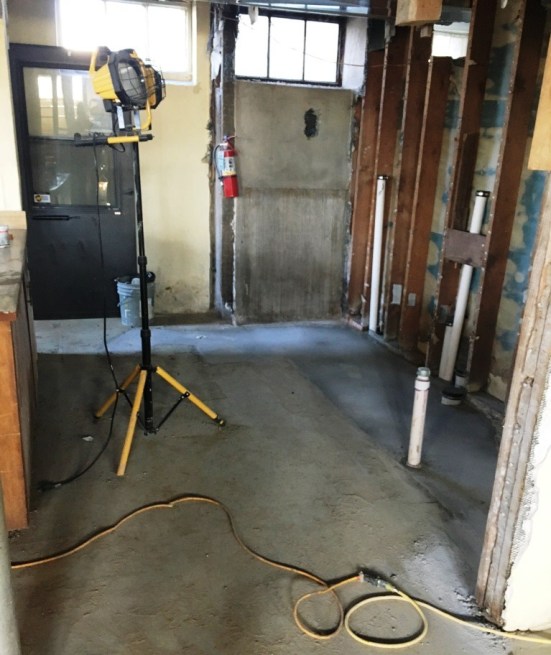
[On the left, the back entry to the basement when we purchased the church. On the right, the back entry after demo and the plumber’s excavation.]

Not only did the project create piles of concrete debris, the excavation of dirt was a little off-putting. I didn’t like thinking about the proximity of dirt beneath our foundation, but with holes in the floor, there was no denying it. And that sewer pipe that was supposedly in such good shape? We had a “Houston, we’ve got a problem” moment when Glimfeather pointed out the top of the pipe was so rusty it was disintegrating. So even the portion of pipe that wasn’t being moved had to be replaced.

At the same time, February forgot it was still winter for a few days, and a foot of snow melted under rainy skies. This time, instead of water coming in the front of the basement (where we had the gutters replaced), it seeped into the back in the furnace room. Muddy water everywhere. St. Johnny spent an entire day filling and emptying the shop vac over and over. And we moved the precious castle doors, which had found a temporary home on the floor of the basement, to higher ground.

Eventually the rain stopped, and a few nights later Glimfeather sealed the dirt and new sewer beneath new concrete, and he began constructing the maze of pipes that produce the modern luxury of running water.

no dirt in basement
The back entry of the church after the new concrete was poured.

# # #

Today’s headline is a partial quote from Josh Fox, American film director, playwright, environmental activist and night owl. The full quote from a 2013 interview in the Daily Intelligencer: “I’m a night owl, and luckily my profession supports that. The best ideas come to me in the dead of night. My friends know I’m up, so they can call at three in the morning. Just don’t call me at, like, eight.” After doing it once, Tyler avoided calling Glimfeather at eight, too.

Tomorrow: How a plumber dances with an HVAC guy. Read about it here.

Two walls forward, one wall back

Our story so far: Blood and sweat marked the walls we constructed for bathrooms on the main floor of the old Methodist church we were turning into a house.

# # #

At four o’clock in the afternoon, we’d finished with the powder room and water closet walls and decided to call it a day. (Working in the church after sunset was not our style—it got dark. And we got hungry.) Before putting all the tools away, Tyler turned the laser level to the opposite wall to guide construction of the wall dividing the master bedroom from the master bath.

He gasped.

I looked where he was looking, and I gasped, too. I looked back at him, standing on the ladder, his hand on the laser level.

“How did that happen?” I asked.

No response.

The red line of the laser level clearly defined the bottom of the false ceiling. And it cut through the top window trim of the bedroom windows. At least three inches short of where it should have been to allow for full window trim and crown molding in the master bedroom.

We spent all day building the walls perfectly level. But too short.

I’m not gonna lie. Expletives were spoken in ways they should not have been in a church.

# # #

Tomorrow: A new character enters the story. Who-hoo-hooo?  Read about him here.

A ruddy drop of manly blood

Our story so far: Day Two of wall construction in the 126-year-old church was one of blood, sweat and tears.

# # #

At one point, we had to reattach a top plate on a wall, which meant yanking out the nails to do it over again.

“Hold that there,” Tyler directed.

So I held the piece of wood at one end while he pounded out the board at the other end with a big hammer.

Bang!

The board came off, and his end—complete with two angry nails sticking out of it—came down.

On his head.

“Blasted, Monica! I told you to hold it!”

Only he didn’t say “blasted.” And he still had the hammer in his hand. His eyes told me he wanted to use it on something other than lumber.

He was holding his forehead, and blood was running down his cheek. The nails in the board had grazed his head.

“Oh my god, are you OK?”

I understood from his grumble that he was. But he was bleeding like a Halloween decoration; that’s how it is with a head wound.

We had no Band-Aids at the church, so I held a paper towel to his forehead. “Use direct pressure to stop bleeding,” echoed in my head. I held the paper towel better than the piece of wood because eventually, the scratch clotted, and we got back to work.

But not without a little blood on the top plate of the powder room wall.

blood
Tyler’s bloody fingerprints, forever entombed on the top of the wall plate (he wasn’t very happy about me taking a moment to take a picture of this, but these are the sacrifices of a good documentarian).

You’re wondering about the tears, I’ll wager.

# # #

Today’s headline is a line from a Ralph Waldo Emerson’s poem not about marriage, but titled “Friendship.”

Tomorrow: Why we cried. Read about it here.

Sunshine in my pockets

Our story so far: Building walls in the old Methodist church we were turning into a home required a three-dimensional perspective.

# # #

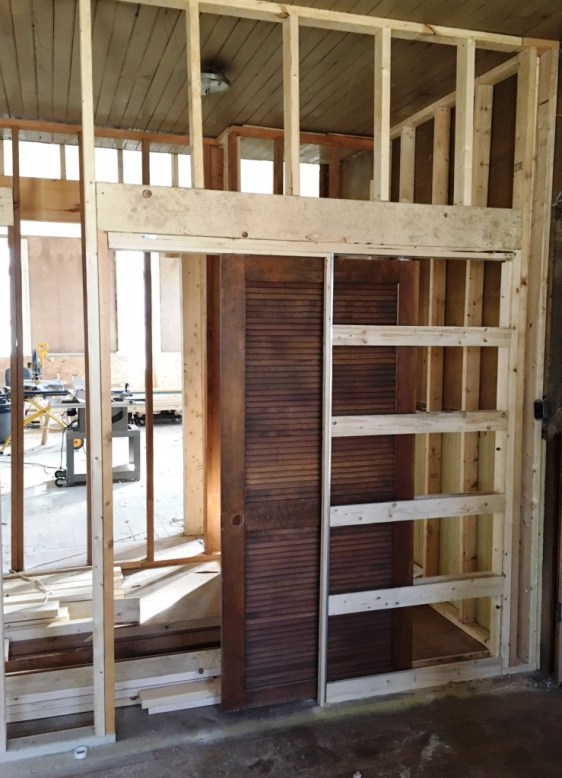
Tyler and his hired man St. Johnny also installed the first of five pocket doors in our house design.

I had been assigned to pick up the pocket door frame kits earlier in the week. Standing in line at the pro desk to pay for them, a builder behind me who looked like he had earned his experience remarked, “I hate installing pocket doors. They’re a pain.”

Maybe he installed pocket doors into already existing walls, because Tyler made it look easy to build one into a wide open space.

pocket door
This pocket door leads to what will someday (soon) be the master bedroom closet. This solid-wood door originally was on an office in the church. It’ll get a paint job before it’s finished.

But Day Two of wall construction was one of blood, sweat and tears.

# # #

Tomorrow: Part I: Sweat. And a new tool. Oh joy. Read about it here.