Our story so far: We rocked on as we chose stone for the fireplace and various elements of the 126-year-old Methodist Church we were turning into our house .
# # #
When it came to shopping for countertops, we had one thing in mind: Remnants.
Sure, I dreamed of quartz countertops early on when anything I could dream was valid and we knew laminate was out of the question. No one on HGTV installed laminate countertops.
Quartz, of course, doesn’t come cheap. But we lucked out when we bought the display kitchen that offered the granite countertop for “free,” noting we would be extricating it at our own risk. Free’s good, especially for granite, so we paid a pro to remove it and store for a tiny fraction of what it would have cost to buy new. Granite is not quartz but. Free.
That left us with a long list of other countertops to procure: The beverage bar off the kitchen, the master bathroom vanity and the upstairs bathroom vanity. We also decided to use quartz for the curbs on the master shower. And I had an idea for a mirror in the front entryway that would require a tiny shelf.
Do you see dollar signs yet?
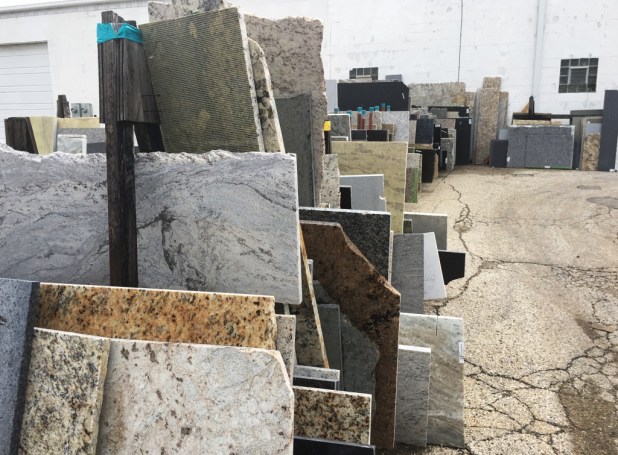
We could have chosen a single sheet of granite or quartz and used it throughout the house, but in another bit of locational luck, a custom countertop dealer had a retail shop only four blocks from the church. Driving by the establishment revealed they had what looked like a lot leftovers in their back lot. Hundreds of really lovely leftovers.
These are just a few of the remnants tempting drivers-by at the local countertop shop. I learned later that some of them were already called for, but still, a lot of options.
I was determined to find remnants for all our stone needs which would save us a little money and, I believed, add some interest to our home. We weren’t doing a California flip house, after all, and we didn’t want a slick, matchy-matchy look.
# # #
Today’s headline is a Japanese proverb.
Tomorrow: Some of the deals I scored. Check them out here.
Our story so far: We chose to clad the fireplace chase in the great room of the converted Methodist church with a manufactured stone, and we found an old barn-wood beam we could use for the mantel.
# # #
Besides sweat equity, one last piece was required to complete the fireplace.
Before we started shopping, the fireplace was all one thing in my mind: The fireplace. I didn’t understand that a fireplace consisted of a firebox, the chase, the mantel and the hearth, and other parts, too, that I couldn’t describe, let alone name. All priced separately, of course. Building a fireplace was like choosing the upgrades of an SUV; long ago when I purchased a Dodge Durango, the salesman asked me if I wanted a back seat. A back seat? Of course I wanted a back seat! Durangos come without back seats?!
Of course, we wanted a hearth for our fireplace. Historically, hearths are associated with home and family because the hearth was the main source of heat in a home and where meals were cooked. We wouldn’t have embers popping out of the fire, but without a hearth, a modern fireplace looks unfinished.
I had no idea where one purchased hearths. Oh! The fireplace store. Of course. But Tyler led us to a landscaping store located on the fringe of our little village. Modern Pinterest-worthy backyard patios feature fireplaces, so our landscaping supply firm did indeed sell hearths. And they would deliver. Not just to the front door but inside to the back of the great room. Which was important because we chose a seven-foot long solid slab of Indiana limestone. Like every other construction material, it was heavy as, well, heck.
Limestone, for those interested in recalling ninth grade geology, is formed of calcium carbonate, deposited over millions of years as marine fossils decomposed at the bottom of a shallow Midwestern sea. Because of Chicago’s proximity to Indiana, limestone was used extensively in rebuilding the Windy City after the Great Chicago Fire, which occurred two decades before our little Methodist church was constructed. The Pentagon, the Empire State Building, the new Yankee Stadium in the Bronx and churches, university structures and courthouses across the country feature Indiana limestone in their exteriors.
And now we had a piece of it in our living room.
We only purchased enough limestone for the visual part of the hearth. The landscaping supply firm delivered it right to where it will be in perpetuity.
# # #
Today’s headline is a quote from Blessed Teresa Maria of the Cross, Carmelite nun and founder of many Italian schools in the early 20th century.
Tomorrow: Stone for the countertops. Read about it here.
Our story so far: We found some good-looking, affordable manufactured stone veneer for the fireplace in the great room of the old Methodist church we were converting into a home.
# # #
You know how when you’re looking for something, you tend to find it everywhere? In that way serendipity works, we happened by a fireplace store on the way home from the manufactured stone showroom. The young salesman was well-informed about all things fire (including some envy-worthy outdoor grills we’d like to own at some point when we had free time to drink red wine and grill juicy steaks), and he was happy to show us some heavy-duty manufactured wood fireplace mantels. Unfortunately, the longest one he offered measured six feet; we needed seven. And his price was appalling.
Tyler began asking around for barn beams he could repurpose into a mantel, but he met with little success. We weren’t the only people who aspired to a rustic look, making barn wood beams all the rage and therefore, pricy.
So Tyler once again turned to Craig’s List, and before long, a real barn beam turned up. The seller was asking only about a quarter of what we would have paid for the too-short manufactured beam.
But he lived in downtown Chicago. Ninety minutes of high-volume traffic away.
My kind of town, Chicago is, if you’re content to ride the “L,” the city rail system. Or flag down a rude taxi driver. Or take your chances with Uber. If you’re driving a car, it’s a video game of narrow one-way streets filled with parked cars and obnoxious jay walkers who pop out of nowhere in the middle of the block.
And driving a nineteen-foot extended cab pick-up through Chicago’s residential streets only amps up the stress.
Well, the seller lived on a street like that.
But we managed to connect with him in front of his brownstone where we double-parked briefly, and he showed us to the alley behind his house. As he flipped open his garage door, the barn wood beam inside seemed to glow. I swear could hear the sort of cinematic music set to Bo Derek’s beach scene in the movie “10” (am I dating myself?).
This hand-hewn barn-wood beam was perfect.
Eight feet long and ten inches square, this beam could have been a model for an authentic looking manufactured wood mantel. Because it was as authentic as it gets. It even sported a rusty nail.
The seller told us he personally removed the beam from the peak of a 122-year-old barn near Dyersville, Iowa, and transported it to Chicago to use part of it in his house. If Dyersville sounds familiar, it’s because “Field of Dreams” was filmed there in the midst of America’s most iconic corn fields.
“What do you think?” Tyler asked me in a tone of voice he used when he didn’t want to show the seller how much he really wanted it.
“Sure, if that’s the look you’re going for,” I equivocated.
“Will you take $200?” Tyler asked the seller. He only asked this so he could say he tried.
“$275. Firm. You won’t find another beam like that for less than three times the price.”
The seller knew his product.
“Pay the man,” Tyler told me.
Now we had to get the beam home. It weighed two hundred pounds if it weighed an ounce.
Fortunately, the seller was willing to help. He and Tyler wrangled it into the back of the truck (tailgate down), and we secured it with a tie-down. But let’s be honest. If the beam was going to fall out of the truck when we were driving down the interstate at seventy-five miles an hour, no puny ratchet strap was going to stop it. We would have just kept going.
As we were driving away through the narrow alley, our perfect fireplace mantel in tow, Tyler marveled at his exquisite find.
“Kinda crazy though,” Tyler mused. “I thought I’d find one way out in the country, and I ended up finding one in downtown Chicago.”
We successfully transported the barn beam home, where Tyler pressure-washed 122 years of dust off it. Here, it’s drying in the sun outside the church.
# # #
Tomorrow: What a home without a hearth? Read about it here.
Our story so far: One can’t build one’s home solidly, as we aspired to do in the converted Methodist church, without stone. As we executed the interior design of Church Sweet Home, stone in some form or another played an important role. First decisions to make were about the fireplace.
# # #
Once again, Tyler did not purchase the 40-inch-wide fireplace when a 48-inch-wide one was available. This was the centerpiece of the biggest room on the house after all. After shopping the options, he ordered his enormous gas fireplace online to be delivered directly to the church. Oh, just wait. We planned to put a TV above the mantel. We wouldn’t be stingy with the size of that either.
The fireplace will be where the altar once was.
Close-up view.
In full, the chase of the fireplace would be seven feet wide. As we pondered the design, we considered putting it in the corner of the great room or along the east wall but ultimately sided with symmetry; the fireplace would be located where the altar once was, appropriate perhaps, given that the Pagans used altars to burn sacrifices. Though we toyed with shorter options, our “go big or go home” philosophy drove us to build the chase to the ceiling even though it was actually vented to the exterior chimney. Which meant we would be investing in two-hundred square feet of stone.
An extreme close-up of the polyurethane stone veneer revealed bubbling and a plastic-like look.
While shopping for rigid polyurethane foam beams, Tyler found faux stone in the same material. We ordered a sample, hoping to be as impressed as we were with the polyeurethane beams. It would be fun to heft actual stone to the top of the chase. But the faux stone was horrible. The edges weren’t as crisp as real stone would be, and one could see bubbles in the material. And unlike the beams, people would be able to walk right up to it and inspect its faux-ness. Back to the drawing board.
Faux stone. No way.
Natural stone, though, was substantially more expensive and would require the skills of a bricklayer.
Hmm.
Maybe we could afford manufactured stone, which is made of pigmented cement baked in molds. Though certainly not as light as high-density polymer, veneer stone weighs about half of its natural stone counterpart. Tyler had experience installing this type of product so while he would need help, he wouldn’t need an artisan mortar man.
Our lead drywaller suggested a stone vendor a half-hour away. One day when we needed a break from the dust and noise of the church, we paid this vendor a visit. Thank goodness for Google maps, which led us through multiple intersections into the back of an industrial park filled with nondescript buildings. The store barely had a sign, but inside we found a small showroom and an upright display of the brand of manufactured stone we had in mind. I began pulling samples off the display (samples of stone, even manufactured stone, you probably aren’t surprised to learn, are heavy), and we were impressed with how it mimicked the look of natural stone.
We selected a sedate gray ledge stone and held our breaths while the salesman did the math on our square footage.
His number sealed the deal. We found our fireplace veneer.
Here’s a side-by-side comparison of the high-density polymer stone veneer (left) vs. the manufactured stone veneer we ultimately chose. From a distance, the polymer looks fine, but up close it was too slick for our tastes.
# # #
Tomorrow: The mantel comes with a story. Read it here.
Our story so far: Five months into the renovation of a 126-year-old Methodist church into our home, spring arrived.
# # #
Chapter 24
Our church renovation project was beginning to look like the list of traditional gifts one should give one’s spouse for wedding anniversaries. We’d put the paper year behind us when we dumped a ton of it during the demolition phase. We’d observed the precious metals years by replumbing and rewiring the church. And wood? Tyler and crew handled innumerable two-by-fours in building walls and ceilings. We’d skipped over the crystal and china years to land squarely in the stone years.
Pouring liquid stone.
Sheetrock, for example. It was the brand name for our drywall. Sheetrock. And what’s concrete anyway? Concrete, of which we’d poured yards for the foundation walls of our garage and would pour many yards more, was a substance created from gravel and cement that dries rock hard. Speaking of gravel, Tyler spent two days using his cousin’s dump truck to haul load after load of gravel from a nearby gravel pit for the base of the garage foundation.
One can’t build one’s home solidly, as we aspired to do, without stone. What’s more solid than stone? It was bricks, after all, that stymied the huffing, puffing Big Bad Wolf. Our church structure was built on a sixteen-inch-thick foundation of field stones.
Now, as we executed the interior design of Church Sweet Home, stone in some form or another played an important role. First decisions to make were about the fireplace.
Somehow, we managed to neglect the fireplace in our Tequila Budget. Might have been the tequila we were drinking at the time, but we were probably more drunk with excitement in those first heady days of dreaming about buying a church.
Of course, we were going to have a fireplace. It wasn’t one of those bad-news budget-breakers like redoing all the heating and cooling ductwork. And it wasn’t one of those great ideas we added to the project midstream like the balcony. Nope, we just forgot about the centerpiece of our great room when we were planning our great room. Duh.
Unfortunately for the budget, a fireplace isn’t like register covers (another one of those things we neglected to think of when we were figuring our figures). A fireplace costs big bucks, and we weren’t likely to find the gigantic one we wanted on Craig’s List.
So the Tequila Budget took another hit when we shopped for a fireplace.
Maybe we’d burn it at some point.
In the fireplace.
# # #
Tomorrow: It’s only the genuine article for us. Maybe not natural, but genuine. Read about it here.
Our story so far: Spring arrived at the old Methodist church we were turning into our home, and with it, the drywallers began work inside while Tyler broke ground for his garage outside.
# # #
Some of the greenery in our yard didn’t require planting, only discovering.
Raspberry plant?
On the edge of our property bordering the dumpster area for the nearby rental properties, Tyler spied a raspberry plant. He claimed this as ours. This he would baby until he could coax it into producing berries. Near the front of the property, the congregation had left behind a garden plot, and a vast array of perennial greenery grew up in it, including a beautiful yellow tulip and a daffodil.
Daffodils are an optimistic flower. And foolproof.Tiptoe … through the tulips … with me.
Tulips were my favorite spring flower. Picking them only spoiled their beauty so they were best enjoyed in situ, which served to inspire many a spring walks. In a few days, the tulips were gone.
Nothing is so fair as lilacs in spring.
Not quite as ephemeral, but still fleeting and worth appreciating in their time, were lilacs. The lilac bush on the corner of the property that I prayed would bloom when Tyler trimmed all the bushes in the fall did indeed offer up woolly purple blossoms, intoxicatingly fragrant.
The yard may have been a muddy mess, but she wore a mighty pretty corsage.
“The smell of moist earth and lilacs hung in the air like wisps of the past and hints of the future.” ~ Margaret Millar
# # #
Today’s headline comes from Matthew 6:29.
Tomorrow: Chapter 24 opens with the fireplace budget. Or lack thereof. Read about it here.
Our story so far: In the midst of constructing a garage for the old Methodist church we were turning into our home, rain had turned our yard into a staging area for a mud pie maker.
# # #
Our garden plot. See that house in the background, across the street? It’s also a restored historic building, once a hotel.
Tyler exercised his green thumb and invested in four yards of 100 percent organic, sterilized composted cow manure, which he dumped in a burial-mound-like fashion next to the flagpole.
Ah, more mud.
Then he planted two cherry tomatoes, four beefsteak tomatoes, four pepper plants, four cucumbers plus basil and mint.
He also picked up a number of marigolds and Salvia, which he planted in the church sign planter.
He was so happy he could do this small thing in terms of gardening. The previous year, we had been living in a camper and traveling from place to place which prevented him from having a garden. He missed growing things and picking vegetables and, most of all, eating fresh produce he grew himself.
Another shot of the vegetable garden, this time overlooking the site of our future garage.
# # #
Tomorrow: What we didn’t plant that blessed us. Check it out here.
Our story so far: Concrete work began on the garage for the old Methodist church we were turning into our dream home.
# # #
I’ll take an order of spring with a side of mud, please.
By now the yard was a muddy mess, and continued rain would intermittently interrupt our progress. Between the heavy machinery and the intermittent spring showers, our lawn looked like a pig pen with apparently random concrete walls sticking out it. Not that we had a lush yard of grass to begin with unless you count the crabgrass.
Among the spring showers dripping on our construction zone was a hail storm for the ages. A squall rolled through about 9 o’clock one evening. It sounded like a guy with a baseball bat was pounding on the flat roof of our rental house. Tyler went outside to determine the damage and brought back a jagged lemon-sized piece of ice, one of many.
The next morning, there were holes as big as my fist in the west-side window screens of the rental and twigs and branches covered the yard.
Tiny dents were in evidence on our vehicles. An assessment of the church property revealed hail damage to the west side of the cargo trailer and, alas, the church.
The west side of the church pockmarked with little hail dents.
During the next few weeks, no fewer than a dozen roofing and siding contractors visited us, offering to repair the hail damage and work with our insurance. This didn’t make sense for us given our deductibles, but scores of neighbors enlisted their help. Soon we wouldn’t be the only property in town with hammer-wielding contractors making improvements.
# # #
Tomorrow: The best use of mud. Read about it here.
Our story so far: While the drywallers were working inside the old Methodist church we were transforming into our home, we went to work on the garage.
# # #
The next day, the building inspector dropped by so we could prove we really dug four-feet-deep footings (apparently some people prevaricate regarding this detail, which is why the inspector makes an appearance before the cement mixer does).
A cement mixer rumbled into our yard to pour eighteen yards of concrete into the trenches. Astute readers are probably aware that though people use the terms cement and concrete interchangeably, cement is actually an ingredient of concrete. Now we employed an experienced concrete finisher and his crew to fill in the basement windows with concrete block and build wooden forms for the concrete walls of the cement pad. A few days later, the cement mixer dropped by again and left behind eight-and-a-half yards of cement.
There goes the natural light! Here’s a shot of the basement windows covered with concrete block.Wooden forms for the concrete walls.The finished concrete walls took on the wood grain from the forms.
# # #
Tomorrow: It wouldn’t be spring if there were no mud. Read about it here.
Our story so far: To make way for a garage, my husband Tyler jackhammered away part of the back stairway on the 126-year-old Methodist church we were turning into our home.
# # #
After the surgery on the stairway, it was time to dig footings for the garage. I soon learned my husband had a skill of which I wasn’t aware.
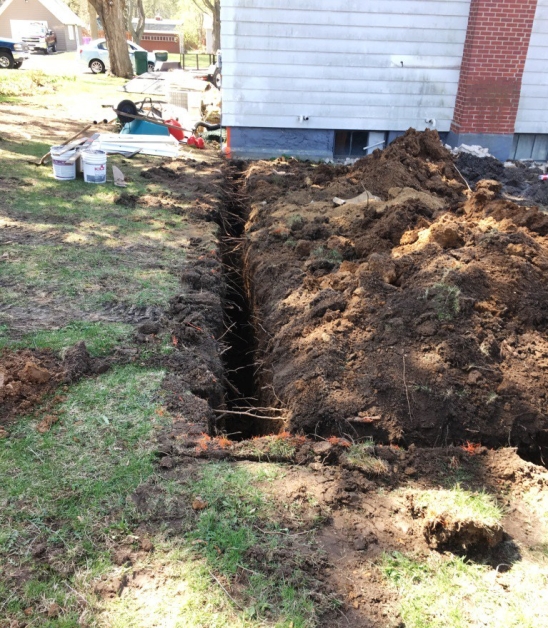
In the case of our garage, footings meant a hundred feet of frost walls four feet deep. A concrete pad wasn’t enough since our garage would be attached to a structure with an existing basement. To dig these deep trenches, Tyler rented a mini excavator and hired a guy (a friend of a friend) who could manipulate the excavator with precision. The trenches—three sides of the garage—were completed in a day.
Now that’s a trench.
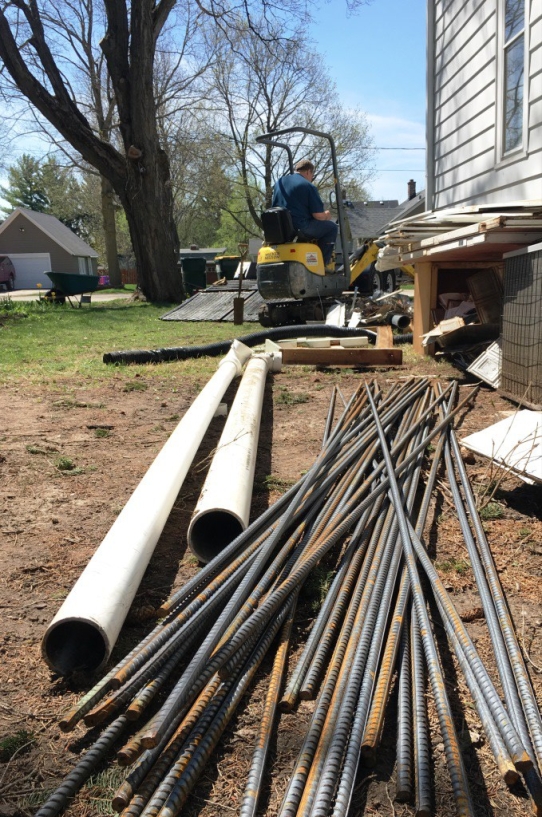
My role that day was errand girl. I went to Subway to get lunch for the workers. But I worked harder the next day when I used pruning snips, an implement similar to a manual hedge trimmer, to clip a hundred years of pine roots obstructing the trenches. The excavator had cut through a lot of roots, but it wouldn’t do to have any obstructions when we were ready to pour concrete. So I squatted in the mud to cut roots two feet below the surface of the yard, and then I moved rebar out of the borrowed flatbed trailer to the yard. As I’ve mentioned, rebar is heavy, at least for old ladies, so I opted to move carry two pieces at a time and walk more rather than try to try to lift ten pieces at a time.
That was my contribution to the garage.
Tyler, excavating. (That’s my neat pile of rebar there in the foreground.)
Meanwhile, as long as we had possession of it, Tyler was using the excavator to dig up bushes. Running an excavator is like playing a video game; the controls affect both the excavator itself and the operation of the scoop, depending on how you turn them. He maybe couldn’t have dug a precise trench but with a bit of practice to activate his muscle memory, he was digging up arborvitae roots like a pro in no time. Tyler first learned to operate a back hoe when he was trying to save money by digging his own septic system for his old tobacco farm decades ago. Necessity is the mother of invention (or something like that).
Tyler and I had been married nearly ten years, but I was learning new things about him all the time during this church renovation. I didn’t know he knew how to run an excavator until I saw him, sweaty and concentrating, behind the controls. Such a skill just doesn’t come up in everyday conversation. Fortunately for our budget, my Renaissance Man was saving us money in every phase of this undertaking.
Tomorrow: More heavy stuff—concrete. Read about it here.









 Church Sweet Home