Homegrown chicken makes for a memorable feast

Our story so far: My husband Tyler intends to draw on his previous experience in the early 1990s transforming an old house on a tobacco farm as he faces the renovation of a 126-year-old Methodist church into our dream home.

# # #

When Tyler acquired the property, the first step was emptying the place of the decades of cigarette rolling papers and other assorted junk accumulated by two old bachelors. The unfinished half-story had two old iron beds with four-inch thick mattresses. Tables on each side of the bed were piled high with identical clothing for the brothers: Bib overalls, stained V-neck T-shirts and union suits in varying degrees of being worn out. Behind the tobacco barn, near a plow and disc (put into use in their time by mules) stood a stack of aluminum pie tins as tall and as wide Tyler.

“There must have been more than a thousand,” Tyler mused when he told me about his project. Here his story deviated a bit from renovation concerns to memories of this property.

“Back there was a stump, too, the brothers used for butchering chickens,” he recalled. “I did, too. There was a broad-head axe hanging in the tobacco barn that I still have, and I used it to cut the heads off the chickens I grew in the yard. My grandma Blair helped me. I chopped the heads off, dipped them in a caldron of boiling water, and Grandma did the feathers. I can still see her there in a lawn chair plucking feathers.”

“Did they taste good, those chickens?” I asked, thinking of a book I’d read recently about how free-range chickens in decades past have so much more flavor than mass-market chicken breasts of today.

“They were the best chickens I’ve ever eaten,” he remembered.

Tylers first reno
Tyler at work on his first reno, circa 1992.

Tyler returned to remembering his renovation experience and the difficult physical labor required to pull off such an undertaking. After cleaning up the property, he knocked all the horsehair plaster and lathe off the walls of the farmhouse, installed 100-amp electrical service and wired the whole house. Tyler had taken vocational classes on electrical and picked up real-world experience by wiring rental housing and cabins with his grandfather. He installed a high-tech (at the time) Swedish wood stove outside and ran HVAC channels to heat the entire house.

Then he ran PVC pipe throughout the structure in order to bring running water (from a new well) inside to the kitchen, two bathrooms and a second-floor laundry. As the days turned into weeks, he put in his own septic system. The neighbor dug the trenches with a backhoe, Tyler laid the pipe and rock, and a guy came out to set the tank.

The septic system passed inspection. The plumbing passed inspection. The electrical passed inspection. Now it was habitable.

The basement was another phase. Years before, his parents figured out a masterful method for keeping the teen-aged Tyler busy: He dug out their entire basement by hand. So he put that experience to good use by digging out the tobacco farmhouse basement the same way, moving out the dirt with a little elevator into the back of a pickup truck. Once it was deep enough to stand up in, he poured a cement floor.

# # #

Tomorrow: Tyler’s first whole-house renovation comes to a surprising and possibly ironic conclusion. Read it here.

One splinter of experience is worth a whole fixer upper of warning

Our story so far: Are you willing to take on a fixer upper? My husband and I thought we were, and we made a plan to renovate a 126-year-old Methodist church into our dream home.

# # #

Chapter 7

My beloved husband Tyler knew well what it meant to renovate a house and why anyone about to tackle such an undertaking should proceed with caution.

Nearly thirty years ago, Tyler’s first whole-house renovation project began with Boone County’s oldest operational tobacco farm.

He and his wife at the time purchased the property in Northern Illinois for just the price of a new car in the 1980s from the two bachelor brothers who had grown tobacco there for decades. Now in their 80s, one of the brothers was in ill health and living in a nursing home; the other planned a move to join him.

tobacco farm
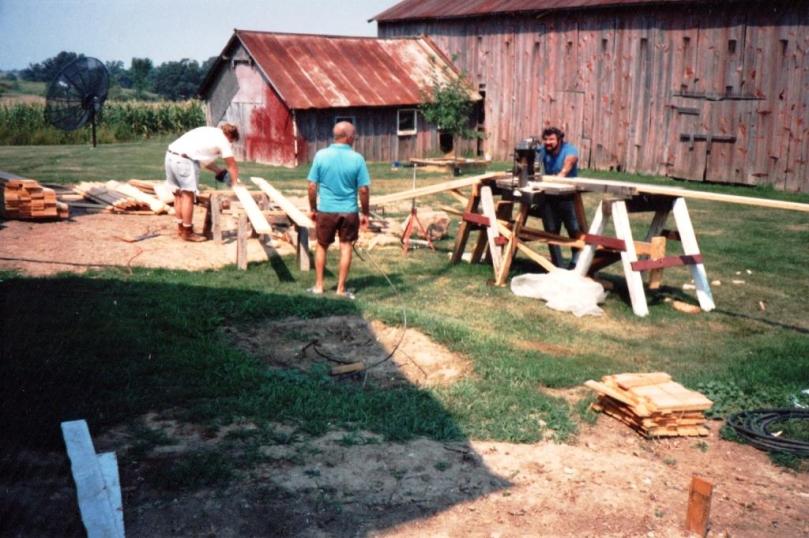
That’s Tyler there on the left, sawing. His grandfather, in the middle, and a buddy lend a hand to the construction project. The old tobacco barn is in the background.

One of the buildings on the farm was a distinctive tobacco barn with hinged foot-wide openings. They all locked from the inside with a wooden peg. The slates were opened to dry the tobacco hanging inside.

The brothers smoked their product. Every out building had Zig Zag cigarette rolling paper packages stuffed in every crevice.

The farmhouse had no heat except a warm-morning stove connected to a fuel oil tank. There was one light switch in every room connected to a single bulb hanging from the ceiling. Old horsehair plaster was on all the walls and ceilings. The flooring and trim was basic Douglas fir that could be refinished; the baseboards were distinctive. The main floor consisted of three rooms, and a steep stairway led to the second half-story. The basement was a five-foot-deep hole with a dirt floor.

There was no plumbing. The “running water” was a well pump outside. The brothers pumped water and brought it inside for drinking and bathing. When Tyler had the well tested, it was like death syrup, the levels of live bacteria and chloroform so high as to be practically toxic (chloroform was used an anesthetic in the Civil War). The “bathroom” was a two-hole outhouse on skids so the brothers could move it when the pit beneath it filled.

# # #

Tomorrow: Hard physical effort transforms the old tobacco farm. Read it here.

The timeline for closing on a church is not ordained

Our story so far: We moved into a rental house two blocks from the church, ready to get to work renovating it into our dream home.

# # #

It was two weeks after we originally planned to close on the church (two weeks!), and no closing had been scheduled. The church still didn’t have the paperwork it required to designate authorized signatures.

Tyler had had it. He was anything but understanding at this point.

Sure, we were protected from the elements now, but really! We wanted to close on the church two months ago! Should we walk away from the deal?

Though we entertained a few conspiracy theories that the congregation really didn’t want to sell the church, we knew in our hearts they just weren’t as motivated to wrap things up as we were. So we decided to give them some incentive. We offered to extend our offer for two more weeks (admitting to ourselves it would be a regular miracle if we closed in two weeks), but we also lowered our offering price. Now our good deal was even better!

We sweated it out for twenty-four hours while we awaited a response, but the church accepted. So now we had a few thousand more in our budget and two more weeks to plan how to use it.

As we relaxed in front of the TV one evening in our little rental house, I asked Tyler how he was feeling about things.

“Excited,” he said right away. “And scared.”

# # #

Tomorrow: Tyler is knows very well what he’s in for. Read it here.

What is an air bed without air? A sack

Our story so far: We begin moving into a rental house two blocks from the church so we have a warm place to clean up and crash while we renovate.

# # #

On Days Two and Three of our move, we transferred our meager belongings from the camper and the urgent items from the cargo trailer into our tiny rental house. Our most critical need: A bed. We would need restful slumber if we ever hoped to survive renovating the church.

We’d packed our big, beautiful king-sized Sleep Number bed into the cargo trailer the day before we moved out of our cardboard box in the suburbs. The camper had room for only a queen-sized bed, so we bid farewell to the best bed upon which either of us had ever slept when we moved out.

Unlike a standard mattress and box spring, a Sleep Number bed is a unique combination of foam, air pillows, zippered compartments and an inflation device. We’d carefully packed it all away in the cargo trailer. The last thing to go in was the first thing to come out.

Amid sleeting flurries in southern Wisconsin, we cajoled the pieces of the bed out of storage and hauled them into the little house. We slammed shut the cargo trailer doors and parked it on the now-muddy gravel driveway inside the garage foundation. A garage had once stood on this lot, but now, only the cement-block foundation remained. After much cold-handed grunting and groaning, we affixed a boot on the tire and paddle-locks on the trailer doors.

Tyler had built a platform for the bed in our new bedroom out of two-by-fours and plywood (the original platform remained in the trailer). We set to work assembling our bed.

After sorting out all the pieces, we realized we were missing one: The inflation device.

An air bed isn’t much of a bed without air.

Ugh.

Back to the cargo trailer to pinpoint the apparatus.

“What does it look like?” I implored, while climbing over boxes and craning to see the labels on bins.

Clearly, I wasn’t paying attention eleven months before when we disassembled the bed.

“It’s the size of a bread box,” Tyler instructed.

Believe me, a bread box is a needle when the 30-foot cargo trailer is the haystack.

Especially when the air is filled with ice-cold wet sleet.

Eventually, we found the contraption, repacked and re-secured the trailer, and retreated to the warmth of our little rental house. Once we had all the pieces, the parts went together pretty easily. As we lay on our beloved king-sized bed looking at the spiderweb-free ceiling of our warm little house, we were content. I was amazed at how quickly I felt comfortable in our little rental. It felt like a mansion compared to the RV, and I swiftly reacclimated to house living.

In three days, we would close on the church, and we could start our project at long last.

Or so we thought.

# # #

Tomorrow: Chapter 6 concludes with a twist any fan of “The Money Pit” could have predicted. Read it here.

Moving day

Our story so far: Rather than move directly into the church we intended to convert into our house, the rapidly cooling autumn weather prompts us to rent a house nearby.

# # #

Chapter 6

When it came time to move into little house two blocks from the church ten days after we’d signed the rental papers, we decided to do it over the course of three days. We spent the first day cleaning.

Oh, the house looked clean enough upon first inspection. No garbage. The floors appeared swept. The cupboards probably had been wiped out. Probably.

But my husband, born a Virgo, wasn’t one to trust when it came to cleaning. One of a Virgo’s principle traits is perfectionism. If a Virgo sets out to do something, he typically doesn’t rest until it’s done very (very!) well which I guess is a good thing when it comes to cleanliness (and church reconstruction).

He brought along five gallons of concentrated Simply Green. Five gallons.

We scrubbed literally every surface, and what we didn’t scrub, we swept or vacuumed. Gone were the whispery spider webs in the ceiling corners. Gone was the scrounge on the bathroom floor. Gone was the greasy dust on the ceiling fans that had clearly never been touched, let alone dusted, by the previous resident.

This was a good warm-up for the church, which had sat empty for sixteen months and had 119 years before that to accumulate gunk. Ceiling fan dust would be the least of it.

# # #

Tomorrow: A bed, a bed, our kingdom for a bed! Read it here.

Too big, too small and juuuuust right

Our story so far: As we waited impatiently for the church to gather the necessary closing documents, we got a look at the freshly minted survey for our lot.

# # #

Some math revealed we were about to be owners of 5,033 square feet of livable space, including the basement, in the church we intended to convert into a house; this was roughly fourteen times the size of the camper in which we’d resided for nine-going-on-ten months.

Part of me felt guilty for giving up the minimalist lifestyle. When people asked why we’d moved in the first place, we often told them our house had gotten too big; we rarely walked into entire rooms.

But the truth was, we just hated that house. It didn’t start that way—it was a home to raise a teenager in a decent school district. But we’d paid more for it than it was ever worth, and then the 2008 Recession hit and stole even more equity from us. Spending any money on it at all to make it more our own and less mass market felt wasteful and pointless. The teenager grew up. The longer we stayed there, the less it felt like home, which is opposite the way it should have been. Getting out was a relief.

The part of me that didn’t feel guilty about taking on so much house felt positively giddy about it. Living in a camper for a season had proven to be problematic when it came to entertaining. There was too little room to prepare meals much less serve them. Overnight guests slept in our living room and were forced to awaken at the first grind of the coffee. I was excited to create inviting guest spaces in our new home, and with a grandchild on the way, I wanted plenty of space to spread out the crib, toys and other paraphernalia accumulated by modern parents.

I also longed for our king-sized bed. The camper only had room for a queen, and Tyler and I together more than filled it. Cozy had started to become cramped.

Tyler also began to resent the landmines I’d created everywhere by stuffing our belongings into every conceivable space; I longed to have cupboards to organize dishware, toiletries and shoes without having to pull every last thing apart to get to the bottom of a pile.

There were a lot of coordinates and numbers, but what the survey didn’t capture was how that square footage was going to create a sanctuary for a family.

# # #

Tomorrow: We begin the move into our temporary rental. Read it by clicking here.

Of all we survey

Our story so far: After a delay in closing, we decided to rent a house near the church to live in while we renovate it into our house.

# # #

Chapter 5

As we waited impatiently for the church to gather the necessary closing documents, we got a look at the freshly minted survey for our lot.

front door
Our front door in the right of way.

To our surprise, we were about to become owners of three lots. Together, our triangle-shaped property comprised about a third of an acre. The church building was situated on the corner where two streets intersected (there had never been a parking lot, at least not in recent history; apparently parishioners used street parking or the elementary school’s lot kitty corner to the church). This positioning would allow us to build a garage in the back yard with a curb cut on the west side of the lot, avoiding the ugly maw of a double garage door overwhelming our front door as so many suburban homes without alleys have. (Before we purchased our former residence, I’d vowed never to buy such a monstrosity, but alas, that’s how modern houses are plated and constructed nowadays.)


There would be no welcoming porch though. Our front door was 3.78 feet over the property line. Technically, our light sconces on either side of the front door were street lights. Instead, we planned a screen porch off the to-be-built garage overlooking our side yard.

# # #

Tomorrow: I’m of two minds about the amount of square footage in which we’re about to invest. Read it here.

# # #

Did you used to worship at this church? If you have memories you’d like to share, I’d like to include some of them in our story about renovating the church into our house so others can appreciate its history. Simply click on “Contact” above and send me your story.

Sometimes Plan B offers A+ luxuries

Our story so far: We decide to convert a 126-year-old Methodist church into a house. The first closing date—October 31—came and went as the seller struggles to track down the detailed closing documents.

# # #

After six weeks of scheming and waiting, on November first, the day after we agreed to an extension of our closing date, Tyler began shopping for an apartment. He’d toyed with, then rejected the idea a couple of times based on the trouble of the moving and demands for long-term leases and long commuting distances to the work site of the church, but now, after purchasing propane in three-figure volumes, he was serious.

After he lowered his standards enough to entertain all options however unsavory, he found something we thought could work: A one-bedroom house that allowed pets (to accommodate our aging miniature schnauzer), and it was situated only two blocks from our church. We completed the application and scheduled a time to look at the place in person. And not a moment too soon. The morning of our walk-through, the garden hose supplying water to our camper (which was necessary not only for drinking and showering but for flushing the toilet, too) froze. Campers don’t plan trips to northern Illinois in November for a very good reason.

The rental house was tiny but functional. There was room enough for our king-sized bed, lots of natural light and, unbelievably, a wine refrigerator and jetted tub. In this case, “cozy” was a mansion compared to the meager 358 square feet in our RV. Judging by the dirt in the corners, it was clearly a rental property, but who needed pretty? We were going to build pretty into the church. And as with all things related to real estate, it had the three things we most wanted: Location, location, location. We agreed to the terms on the spot and scheduled a day to move in: November eleventh, four days before we planned—hoped?—to close on the church.

While we were town, we accomplished our first maintenance task, an act the church granted us permission to do even though we weren’t officially owners: Tyler extended the downspouts on the church to coax water away from the foundation and the basement.

# # #

Tomorrow: Chapter 5 opens with a look at the lot survey.

# # #

Did you used to worship at this church? If you have memories you’d like to share, I’d like to include some of them in our story about renovating the church into our house so others can appreciate its history. Simply click on “Contact” above and send me your story. Read it here.

Nothing like a blank slate to inspire interest in reusing, recycling, repurposing

Our story so far: We’re waiting impatiently for the seller of the church we want to buy and turn into our home to conjure up the paperwork necessary to provide a clear title.

# # #

In retrospect, I believe God was giving us a break. An opportunity to catch our breaths and think. A few weeks of rest. But at the time, the delay was maddening. Here we’d finally gotten our heads around the idea that we weren’t going to live in the camper and travel the country indefinitely, and we’d decided to jump back into the real estate market. We’d found a property we were pretty confident we couldn’t lose money on no matter what Wall Street did to Main Street. We’d created a renovation plan. We’d determined we could agree on the style of our kitchen backsplash, the fireplace mantel and the color of the paired sectionals with which we planned to furnish the great room. But we couldn’t actually do anything other than shop.

This was problematic since we no longer owned a garage in which to store the amazing deals Tyler scored on Amazon Prime and Craig’s List. On a brief business trip, we visited an expansive architectural salvage store with historic doors and unique bathroom fixtures, but we couldn’t buy any of it. Nowhere to put our treasures. Tyler found an amazing store of used construction materials in greater Chicago selling 23 pieces of solid wood kitchen cabinets in the perfect shade of cream. Upon inspection, they were the perfect shade of yellow so we didn’t invest in them, but we were awed by bathroom vanities in every shade of the rainbow and the doors in widths from 27 inches to 32 inches. Too bad we didn’t know exactly how wide we’d need our doors. Or how many for that matter.

The visits to seconds shops cemented our decision to pursue this renovation with as many pieces of recycled materials as we could find. We’d sold most of our furniture when we vacated our home a year before, and we were horrified by how little other people valued our belongings. We’d vowed never to buy new unupholstered furniture again (upholstered furniture of unknown origin, not so much).

Our lack of storage space didn’t prevent Tyler from stopping at an estate sale and finding an ornate Mirror, Mirror on the Wall for the front entryway. He also scored a bathroom faucet, sink and vanity from Craig’s List. He purchased two-by-fours and built eight saw horses. All of these finds, he stashed in the garages of his cousin and his mother (sometimes over their objections).

# # #

Tomorrow: Chapter 4 concludes with the creation of a new plan. Read it here.

How to inhabit a church in just three easy steps

Our story so far: We’re filling our time waiting to close on the church we plan to convert into our home by creating budgets and making plans.

# # #

As the prospect of freezing temperatures became ever more real in our camper, we debated how long it would take for us to acquire a habitation permit from the village.

The building inspector told Tyler he required an operational bathroom, kitchen and bedroom before he would allow us to occupy the church. So simple! Just three rooms!

bathroom.jpg
Check out that sweet bathroom. Just kidding. It’s hard to see but that’s not one, not two, but three room deodorizers on the window ledge.
Well, we had a toilet in the basement.

Kitchen Before
The church kitchen in the basement in all its “before” glory.
At this point, we didn’t even have running water. The congregation had turned it off sixteen months before when they vacated the church building to merge with another congregation in a nearby city. They took all the pews, the pulpit, the altar and both the bathroom and kitchen sinks. The basement kitchen countertops existed but were unmoored from the walls.

On the third showing at the church when we found Stan the squirrel, we discovered puddles of water in the basement. The caretaker, who noticed us at the church as he drove by, came inside to tell us the basement always got water when it rained. Shouldn’t a caretaker do something about that? I wondered silently.

A basement prone to flooding was probably not a great place for a bed.

Tyler spent a month scheming about plumbing in order to construct a bathroom shower and install new (or newish) sinks. He consulted with an electrician. He called an HVAC guy to schedule a furnace check. And he pondered how we might keep our sleeping area free of construction dust. We could take our time once we were living inside the church, but speed was of the essence in getting it livable.

Every day the church failed to conjure up the necessary documents for closing the deal put us more on edge. Tyler would lay awake at 2 a.m. thinking about 100-year-old lead pipes and drain vents. For me, the sleeplessness came at the beginning of the night. I would watch HGTV for hours before retiring for the evening, and then I’d lay awake re-arranging the location of the main floor laundry and dining room table. Or I’d scroll through pages on Pinterest looking at rustic accent walls, vaulted bedroom ceilings and DIY entryways only to dream about them later.

# # #

Tomorrow: Chapter 4 continues with a description of the wonders of architectural salvage. Read it here.