Stuff you won’t salvage from most houses on the market

Our story so far: After closing on the sale of an old Methodist church, we got to work cleaning it up and demoing the interior.

# # #

Chapter 9

Amusing things one finds in a 126-year-old Methodist church:

Map of Palestine
“Modern” day Palestine, for Sunday school discussion.

—A 1969 map of Palestine with the footnote: “Boundaries do not necessarily carry the approval of the countries involved.” Some things never change.

—A treasure trove of pots and pans abandoned by the olderish church ladies who had no interest in kneeling on the floor and reaching all the way to back of the bottom cupboard in the basement kitchen. We scored some great stuff, including a template for cutting a pie into exactly six equal pieces and a pristine piece of brand-name Tupperware for storing flour or sugar and labeled with a marker “UMC” (United Methodist Church, of course); I pressed this into service as a Chex mix storage device during the holidays. Plus, a top-quality insulated casserole carrier I can only imagine some proud church lady mourned losing for years.

play telephone
Friends urged me to keep it for my granddaughter, but it was just too filthy. And archaic.

—A play telephone with a dial-—who dials a phone anymore?—and a telephone book.

—A stereo and vinyl records to go with it. In the words of Ronco infomercial huckster Ron Popeil, but wait, there’s more! Cassette tapes and CDs.

—Lights, which are not at all surprising. But the switches were befuddling. Hidden behind doors and inside closets. The wiring was strange.

—An ancient looking wooden box labeled TNT. I imagined how it might have found its way to the church: A railroad worker’s wife (our village was once the junction of two major railroad lines) made four delicious apple pies for a church supper and opted to transport them in the handiest sturdy container.

TNT box
This will most certainly be repurposed. But not for carrying pies.

What we didn’t find, or at least didn’t recognize as we threw them into the garbage, was the remote controls for the ceiling fans in the church. Hanging at least ten feet off the ground, it was impossible to simply pull a chain to start them. Consulting the caretaker, we learned the remotes existed, but somehow, we lost them in the flurry of activity of cleaning and organizing the first few days. Tyler had me dig through a couple of garbage bags, but if they were in there, they were hidden by rotten wood and sawdust.

# # #

Coming Tuesday: My favorite discovery. Read it here.

Hairy landscaping requires a trim

Our story so far: Tyler recruits a hired man to help us renovate the 126-year-old Methodist church we intend to turn into our home.

# # #

As if to illustrate His countenance upon us, the first few days we owned the church, the sun shined brightly. The weather was unseasonably warm for the end of November in Wisconsin, so we made hay while the sun shined. Well, brush. We made brush.

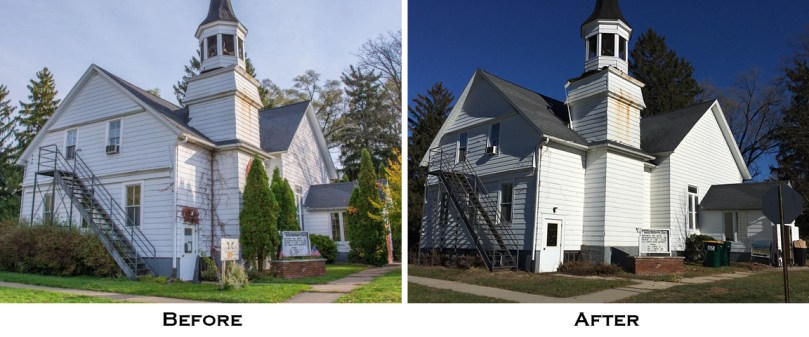
We’d had the opportunity to drive by the church a hundred times (or so) while we waited to close on it. Without the keys to get inside, we focused our attention on the exterior, and we came to detest the arborvitae (over)growing near the entryway. They needed more than a trim; an extraction was called for. A chainsaw (one of Tyler’s many saws) was put into service, and down came the overgrown bushes. Tyler’s new hired man Johnny and I scurried around like little ants, hauling the pieces of trunk and greenery to the backyard burn pile.

arborvitae before and after

Tyler then turned his attention to the row of bushes lining the sidewalk (and growing through our exterior staircase to the second floor). Even Tyler (yes, he also has a green thumb) couldn’t determine their species, but we knew we wanted to keep them for aesthetics and privacy, but, oh, they needed a trim.

bushes before and after

At the end of the row, Tyler revealed something he could identify: A lilac bush. Oh, I loved lilac bushes! So fragrant! I distinctly remember the lilac bushes in the alley of the home in which I grew up in Central Minnesota. One May afternoon when I was about 14, I grudgingly performed the chore of taking out the garbage and, to my delight, discovered the aromatic flowers crowding out the scent of potato peels in the garbage can. Being the trash man that day was a gift.

That bush was spared of trimming. Please let it bloom in the spring, I prayed.

When we were done, the brush pile was twenty feet wide and six feet high.

A few days later, Tyler called the fire department and alerted them to an imminent bonfire. The firemen gave him the equivalent of a shrug, and Tyler burned up two years worth growth in a few hours. Our first before-and-after project: Immensely satisfying.

# # #

Tomorrow: Chapter 9 begins with a few revelations. Read it here.

Shared work is half the work

Our story so far: We began the demolition phase at the 126-year-old Methodist church we acquired to turn into our house.

# # #

Churches have saints, and our saint was St. John.

Even Jesus couldn’t do everything by himself. He gathered twelve apostles, among the first was John, one of the sons of Zebedee. Our St. John was a follower, too, an excellent follower of Tyler’s orders.

The third time we visited the church, after making an offer on it but two months before we actually closed the deal, Tyler and I visited the local grocery store. It was really just a glorified convenience store that had made a name for itself selling bacon-wrapped beef tenderloins, but hey, we could get sugar or a can of soup or, heck, a beer in a pinch. Tyler quizzed the cashier as we departed.

“Do you know anyone looking for work?”

She gave him a bewildered look. Maybe she thought he was asking something nefarious.

“I’m renovating a building, and I need some help.”

“Help? Like what kind of help?”

“You know carrying things, moving things around, demolition. That kind of thing.”

“Hmm, I don’t know.” She made a show of looking like she was thinking about various fellows who would be willing to carry things.

“Well, if you think of anyone, would you give them my number?”

“Sure,” she said, taking Tyler’s name and number on a slip of paper. “Maybe I know someone.”

I chided Tyler as we left the store. “Why do you think the cashier is the only person in town who knows people who do manual labor?” I asked.

“She’s the only person in town I talked to!”

“No one is ever going to call you. She threw that piece of paper away as soon as we left the store.”

“Well, maybe so, but it can’t hurt to ask.”

Lo and behold, a guy called Tyler a few days later. Introduced himself as Johnny and said he heard Tyler needed some help on a building project.

“See!” Tyler told me later.

At the time, we were hoping to close on the church in a matter of days. We didn’t know it would take weeks. So he told Johnny to give him a call in three or four days. Every single time, Johnny followed through. He called three or four days later, and Tyler filled him in on the latest delay.

We couldn’t be so lucky, I thought, to find a guy in the very town we were buying a property who would be willing to be Tyler’s hired man.

But sure enough, Johnny showed up in his work clothes on Day Two, and boy, could he work. And best of all, he was the most cheerful order taker I’d ever seen.

“Move that.” “Take that over there.” “Help me pick this up.” “Take that apart.”

Whatever Tyler asked, Johnny carried out.

While carrying loads of garbage, I lowered my voice and told Johnny I hoped it was OK, taking Tyler’s orders (I’m not implying I was irked to be taking orders, please don’t misunderstand).

“No, we get along great,” Johnny chirped. “We’re on the same wavelength.”

If Johnny wasn’t a saint, he was an angel.

# # #

Tomorrow: Check out our first before-and-after pictures. Read it here.

Oodles of tools

Our story so far: Finally (finally!) we closed on the 126-year-old Methodist church we intended to renovate into the home of our dreams.

# # #

The list of “first things to do” at our old church was long.

First, there was demolition.

First, we had to pick up and clean.

First, we had to do some yard work.

First, we needed to address the deteriorating belfry.

But what happened first—really first—was moving in all of Tyler’s tools.

For the regular handy man, this might take a few hours. With Tyler, it took at least three or four days.

First we fished all of his tool boxes from our cargo trailer where they had been stored since January when we moved out of our previous house. Then we transported all the tools that had arrived at our little rental house via the productive guys at UPS and the Postal Service in the time we’d been there; thanks to Amazon Prime, Tyler was on a first-name basis with the UPS guy on Day Two. We retrieved saw horses Tyler had built and stored at his cousin’s house and his mother’s. And then he made a couple of trips to Home Depot for various sheets of plywood, doodads and, of course, locking mechanisms to secure everything.

When he was done (or as done as any man with a penchant for tools who still had money in his pocket), the sanctuary of the church (a 26-by-36-foot space) was filled with tool boxes, plywood work tables, saw horses, saws and duplicates of just about every tool known to man. Or at least known to woman.

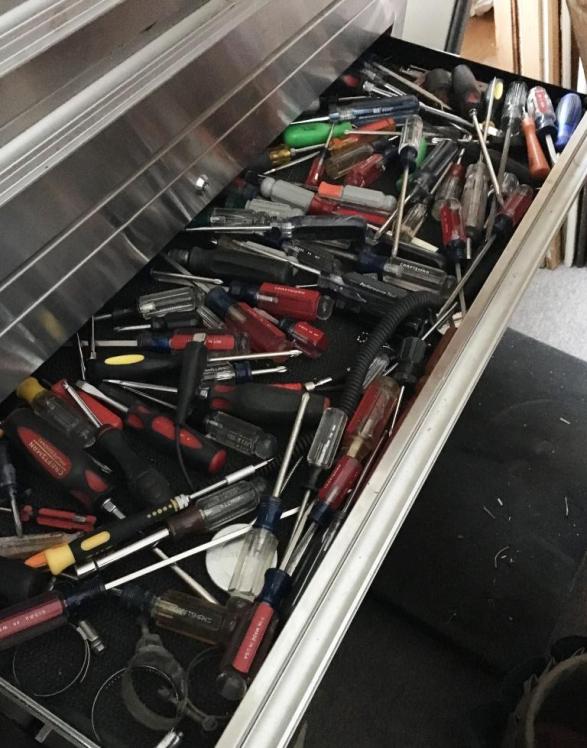
screwdriver drawer
This is Tyler’s screwdriver drawer.

Just the array of screwdrivers boggled this woman’s mind.

At one point in the demolition process, Tyler needed a very heavyweight hook. A little bit of digging revealed exactly the hook he needed, a medieval-looking device suitable for hanging a dead knight from the rafters.

“What is that?!”

“It’s a come-along.” (I didn’t ask what a come-along was. I looked that up later: It’s a hand-operated winch.)

“Why do you have that?”

“We needed it for the race car.”

Of course. For the race car.

Yes, the Renaissance Man who was my husband was a bit of a grease monkey, too. A few years before, he and his brother raced stock cars on the dirt racetrack in northern Illinois near our home at the time. Every weekend all summer long, they’d spend their evenings driving a $500 piece of junk around a quarter-mile race track wearing out tires. Invariably, by the end of the night, the vehicle would be inoperable for one reason or another (an encounter with another beat-up race car operated by a competitive wild man will do that), and the hunk of metal would have to be loaded onto a trailer so it could be returned home for repairs. This is why my husband had an enormous, scary-looking come-along.

Please do not ask why he still had an enormous, scary-looking come-along, four years after he quit racing. But the answer to that explains why it took us three or four days to unpack his tools.

# # #

Tomorrow: An angel joins our team. Read it here.

If plastic cups could clink: ‘Here’s to the church’

Our story so far: We made an offer on a 126-year-old Methodist church with the intention of converting it to our home, but we became impatient when the closing was delayed twice and drawn out two and half months.

# # #

For all the buildup to closing day, the closing meeting itself was uneventful. We arrived at the designated location for the hand-off of the keys, and within 45 minutes, we’d paid our cash, signed the papers, shook hands with our long-suffering real estate agent and the poor pastor who just wanted to write sermons not track down 100-year-old paperwork, and we were done.

We drove straight back to our rental house, where Tyler dropped me off so I could change into something more … suitable for demo.

“Grab a couple of cups,” he instructed as her put the truck into gear. “I’ll meet you at the church.”

IMG_8859
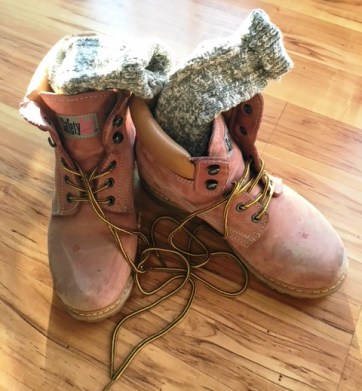
Pink boots from Safety Girl: Fashion first.

I changed into my new pink work boots (yes, because if I’m going to get dirty, I might as well do it in style) and grabbed two red Dixie cups. I put poopy puppy, our 10-year-old miniature schnauzer, on a leash, and we walked the two blocks to the church.

Meanwhile, Tyler stopped at the liquor store (conveniently, only two blocks from the church in the other direction) and invested in the finest bottle of champagne, er, sparkling wine, the village had to offer.

Tyler was fingering the key to the front door when I arrived.

“Oh, you waited for me.” I smiled.

And then we were sitting on an abandoned office chair and a 25-year-old padded banquet chair in the middle of our sanctuary, sipping champagne from red Dixie cups.

“Here’s to the church,” Tyler said.

“The church,” I said, looking around the quickly dimming room. We’d turned on the electricity (and, glory be, it worked) but we couldn’t find switches to the sanctuary lights, so as the winter sun began to set, the room took on a romantic atmosphere.

“Are you ready for this?” he asked.

Methodists don’t have confessionals, so I had to own up in the dimming light of the sanctuary.

Now I’m scared.”

# # #

Tomorrow: First things first. Read it here.

A place for every thingy-whatsit and every thingy-whatsit in its place

Our story so far: We’re waiting (and waiting) to close on the 126-year-old Methodist church we intend to renovate into our home.

# # #

On Black Friday, Tyler got up before the sun did to wait in line at the nearby Home Depot. He arrived back at the rental house before I’d had my first coffee with orders:

“Help me get this thing unloaded.”

The thing was a tool chest. Or, more precisely, another tool chest. If I had a thing for books (and I did), Tyler had a thing for tools. Every time he used one of his tools to fix something or save us the cost of hiring someone to do the work, he reminded me: “I couldn’t have done that without the thingy-whatsit, you know. Aren’t you glad I have so many thingy-whatsits?” Only he didn’t say thingy-whatsit. All his tools had specific names and uses that somehow eluded me. I understood hammers and screwdrivers; I could even differentiate between a flat-head screwdriver and a Phillips screwdriver. But I could never remember the difference between a wrench and a pliers. And God help me if he started lauding the values of various kinds of saws.

All of these various implements required storage (of course—what’s jewelry without a jewelry box?). We might need a screwdriver or a wrench or a pliers (or a measuring tape or a sledgehammer) to transform our church into a house so thank goodness he found a tool box at Home Depot, right?

“It was too good a deal to pass up.”

Sort of like the church, I suppose.

# # #

Tomorrow: Are you as tired of waiting for us to close on the church as we were? Then don’t miss tomorrow’s segment. Read it here.

A peaceful moment before the chaos to count blessings

Our story so far: The closing date on the old Methodist church we intend to convert into our home is delayed again.

# # #

Chapter 8

Every Thanksgiving, I make Tyler verbalize all the things he’s thankful for in the past year. I hate to think of the holiday as only an opportunity stuff oneself, watch football and read the ads for Black Friday. Usually, on our way to a feast of turkey and pecan pie, we count down the Top 10 people and experiences for which we’re grateful.

This year, Thanksgiving fell smack in the middle of our two-week hiatus from getting our hands on the keys to our new old church. So we had to be thankful for finding the church, if not grateful for getting started on the project. We had no choice but to travel to enjoy a feast. Our little rental house was so small, it didn’t have room for a table, and I don’t think anyone would have enjoyed standing around the kitchen island to dine. So we drove to Tyler’s mother’s house and counted our blessings along the way: Very happy to have sold our house in the suburbs. Grateful for becoming grandparents. Thankful we had the opportunity to travel around a bit before settling down again. Excited to begin work on our little 126-year-old church.

# # #

Tomorrow: Chapter 8 continues with a description of a Black Friday score. Read it here.

Go big or go home

Our story so far: My husband Tyler picked up a lot of experience when he undertook a mammoth project back in the early 1990s to renovate an old tobacco farmhouse without any modern amenities into his house.

# # #

One of the things I like to say about my enterprising husband is that he is one to go big or go home. He likes big steaks, big trucks and, fortunately for me, big women (or at least tall ones; I’m 5-foot-10). Our RV is among the biggest on the road, and of course, he’s fond of big houses, too.

finished house
Tyler’s addition to his reno house nearly doubled the original square footage.

This first renovation project was no different. Once Tyler had the old tobacco farmhouse livable, he decided he needed more space. So he built a 24-by-36-foot two-story addition; the main floor was the family room and above it was the master bedroom. (He deconstructed the Swedish wood stove and moved it to heat the addition.) And then he built a three-car garage on the other side of the farmhouse.

When I say “he built it,” I’m being literal. He would frame one wall and invite a buddy or a relative over to help him stand it up. People who know Tyler won’t be surprised he paid his buddies in beer. A lot of beer.

The entire project took just less than two years to construct. Five years after he and his wife bought it, they moved to Minnesota. They sold the old tobacco farm for ten times what they’d paid to purchase it.

Ironically, Tyler’s old tobacco farmhouse transformation was big enough to house a whole congregation—let’s call it cathedral big. We drove by it not long ago, and there’s cross, a flag and a rustic sign out front that reads “Eternal Light Fellowship/Faith Hope Family/ Sunday Worship 10:30 a.m.”

fellowship church
That’s Tyler first renovated house, er, church, in the background.

# # #

Tomorrow: Chapter 8 opens with a moment of gratitude. Read it here.