Not everyone likes church bells, ding dong

Our story so far: We hired a nimble reroofer to repair the rotting belfry in the 126-year-old church we intend to renovate into our dream home.

# # #

At one point on Day Two of repairs, Reroofer rang our bell. Oh, what a beautiful sound! Full and melodious. I dreamed of ringing the bell on special familial occasions like birthdays and anniversaries and, of course, New Year’s Eve. Some grandmothers bake cookies or plant gardens with the grandkids; I wanted to be that special grandmother no one else had who offered bell-ringing responsibilities to her grandchildren.

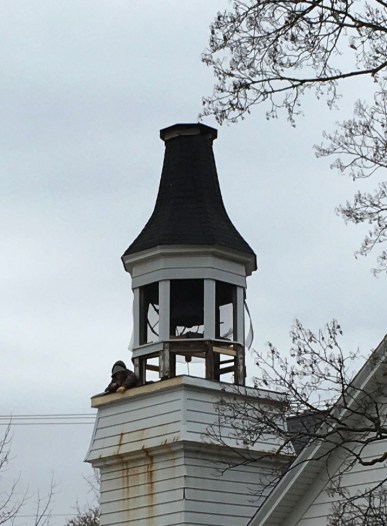
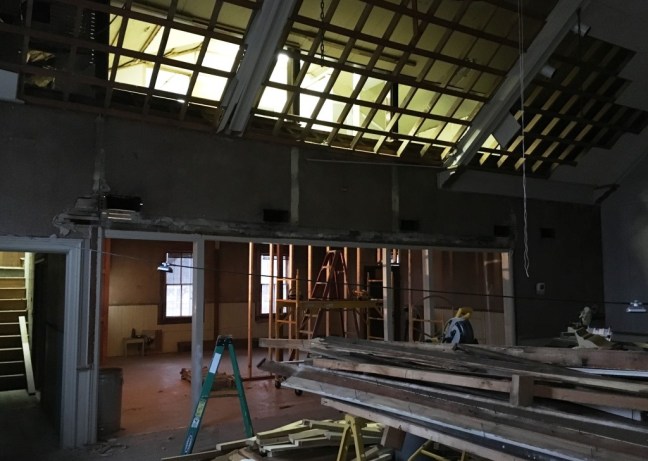
belfry mid construction
Our belfry, mid construction.

In sharing these fanciful notions with interested listeners, I heard more than one story about kampanaphobia: The fear of bells. The phobia is triggered by a negative experience with bells.

“What will your neighbors think of you ringing your bell?”

I’d never considered the possibility that anyone wouldn’t like our bell.

When I looked up the village noise ordinance, I discovered, to my dismay, it applied to residential properties, which of course is what we hoped to be rezoned as: “All noise shall be muffled or otherwise controlled as not to become objectionable due to intermittence, duration, beat frequency or shrillness.” A church bell that belonged to a residence was required to abide by different rules than a church bell that belonged to a church. I prodded Tyler to discuss this with the building inspector who asked, “Well, are you planning to ring it at midnight every night?”

No, no, of course not.

It seemed the noise ordinance was enforced much like whatever rules applied to bonfires in our little village: Be responsible, don’t get carried away and be conscious of your neighbors.

# # #

Tomorrow: Reroofer presents the bill for his services. Click here to read it.

‘It’s worse than I thought’

Our story so far: After two and half months of waiting to close on a 126-year-old church we intend to turn into our home, we finally get inside and start demolition revealing its odd and interesting wonders.

# # #

Chapter 10

Five days after we closed on the church, the roofer showed up. Securing the bell tower was high on the to-do list after the seller had disclosed the roof was “rooted” and our pre-closing inspection revealed it was indeed rotted. With winter was closing in fast, so was our window of opportunity.

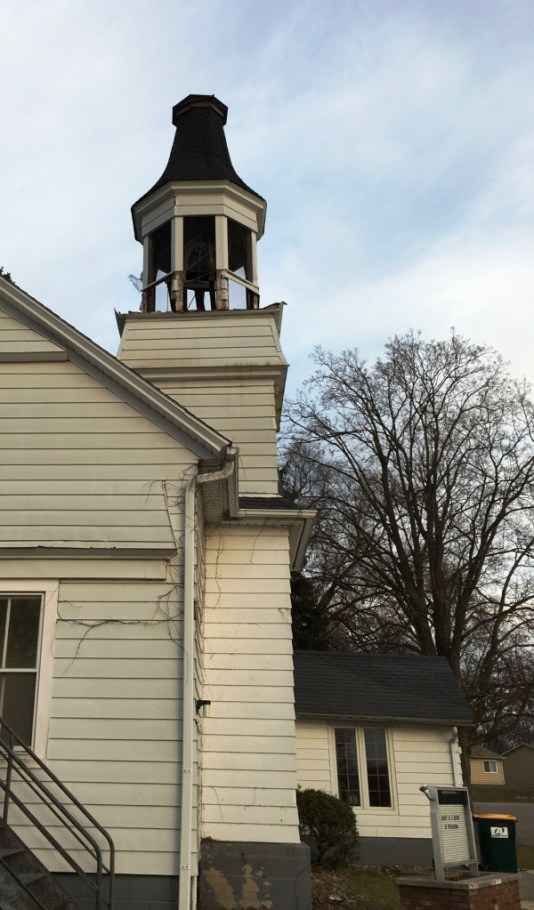
belfry definedAfter a couple of different bids from roofers of various talent, we went with not a steeplejack, but a friend of a friend with a good reputation for flat roofs. For the purposes of clarity, a few definitions might be in order. The bell turret on our church—the ornamental feature above the bell chamber—appeared to be in decent condition and shingled with materials at least as new (or old) as the rest of the church roof. It was the flat roof floor of the bell chamber (beneath the bell) that was falling apart.
The roofer was a young man with a deceivingly slight build and a long reddish beard. He had a name, but in my imagination, I called him Reroofer, sort of the fairytale contractor version of Repunzel: “Reroofer, Reroofer, let down your beard!” Unlike Repunzel, though, he would not have been trapped in any castle towers; Reroofer had the agility of a monkey climbing around the belfry thirty feet off the ground.

Initially, Reroofer thought he could fix the holes in the roof in two days. After he was there a couple of hours, tearing off disintegrating shingles and ancient pieces of wood, Tyler called up to him from the ground and asked him how it was going.

“It’s worse than I thought.”

Uh-oh.

The bell, it turns out, was three-inch thick cast iron, weighing a thousand pounds, we guessed without the benefit of a scale. Some carpenter in the past had cobbled together a solution to the aging bell supports, and now the old fix was worse for wear.

Working mostly from the inside (which made it more bearable to watch), Reroofer needed to transfer the weight of the bell while replacing the supporting structure, so he did so with an ingenious system of straps and come-alongs (and an equally gymnastic helper on Day Two of repairs). The supports were replaced with new, treated four-by-fours. When he finished, the bell hung a foot higher than before his work.

# # #

Tomorrow: Another definition: kampanaphobia. Click here to read it.

Some assembly required; moat not included

Our story so far: My husband Tyler, an excellent online shopper, found a set of front doors for our church on Craig’s List in exactly the style we had admired at a nearby big-box store.

# # #

So we drove 90 minutes south one Sunday after church to check ’em out.

They were indeed only slightly used and exactly what we were looking for. Tyler the Negotiator wrangled the owner to the ground in a metaphorical wrestling match (“We have cash. And we’ll take them off your hands today”) and claimed a pin; the seller accepted an offer of less than half of what we would have paid for new.

The only challenge was the “we’ll take them off your hands today” part. Remember, these were eight-foot double doors. And they came with the frame. Doing the math, you’ll realize they were larger than any pickup truck bed.

Fortunately, Tyler planned ahead for that.

He’d brought along two-by-fours, a saw (a cordless Skilsaw circular saw, if you must know—another one of Tyler’s many cutting devices), an electric drill and a box of screws. In a matter of minutes, he’d built a frame to carry the doorframe on top of the pickup truck. Then we wrapped the doors in the biggest, most royal furniture blanket you’ll ever see: The 12-foot red velvet curtain that until very recently had been hanging in the front of the church.

A few bungee cords later, and we were off.

We returned safely and in one piece to the church and, with a little help, carried our new entryway inside, to be installed much later when the weather was warmer and the moat had been filled (just kidding about the moat).

castle doors safely home
Our nearly new castle doors, in storage until they can be installed.

# # #

Tomorrow: Chapter 10 opens. Belfry redux. Read it by clicking here.

Seek and ye shall find

Our story so far: We were in the midst of demolishing the interior of our 126-year-old Methodist church with grand plans to turn it into our home.

# # #

Even though we could have waited, one major purchase we sprung for during demolition was a set of new doors for the entryway to the church. Tyler found a deal on Craig’s List we just couldn’t pass up.

Earlier, while we waited to close on the church, we admired an exterior door on display at Home Depot. As soon as I saw it, I knew Tyler would love it, and when I led him away from the plumbing fixtures to the front door display, I knew I was right.

We exchanged one of those looks like a couple does when they happen upon the perfect name for their first-born and they both know it.

This was it.

It was a rustic knotty pine with an operable speakeasy door behind a grille. It looked like it belonged on a castle, which was perfect, since a man’s home is his castle. And it could be special ordered as a 96-inch-tall pair. The existing entry to the church included two 80-inch-tall doors, and we knew we wanted a footprint at least as large.

Naturally, a special-order set of front doors from a big-box store exacts a king’s ransom. We’d allotted something for the front entryway in the Tequila Budget, but not that much.

But Tyler being Tyler took that as a cue to snoop around architectural salvage joints and online, and wouldn’t you know it, in a couple of weeks, someone in a nearby kingdom placed a listing on Craig’s List for just such a set of doors with the title: “Remodel reject.” Asking price: $1,000 less than new.

“Whaddya think?” Tyler asked.

“They’re perfect,” I said. The Craig’s List doors even had the speakeasy portal, and they were arched. “We should at least go and look.”

# # #

Tomorrow: Chapter 9’s revelations conclude with a description of how we got our doors home again, home again, jiggity jog. Click here to read it.

Picture this in a different era

Our story so far: Demolishing the interior of our 126-year-old Methodist church so we can remodel it into our home brings to light a number of revelations.

# # #

Sometimes during demolition, we encountered remarkable reminders of the building’s age (besides the unremarkable dust). We spotted a couple of 1969 pennies apparently lost by a carpenter when constructing the altar area. Tyler found more than one square nail as he was taking things apart, and he discovered full two-by-fours (today’s uniform two-by-fours are actually 1.5-by-3.5-inches in size) and a piece of one-by-eight that was fifteen feet long without a single knot, not even pin knots. Even so, it was hard to remember our church had been built before Orville and Wilbur Wright flew their first airplane.

One Sunday morning about ten days after we closed on the church, we worshiped at the Methodist church in the nearby town into which our little congregation had merged some months before, leaving behind the empty building.

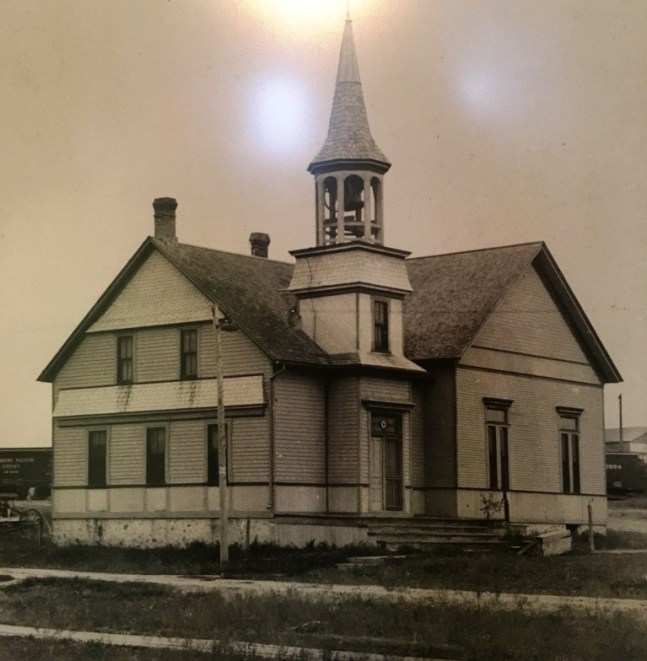
church in early 20th century
Here’s how our church looked at some point in the early 20th century.

Just inside the entryway in a place of honor, an old picture of what was now our church was hanging on the wall. It was fascinating. It was our church, all right, but in a different world. One could see a covered wagon and hitching posts outside the church. There were no trees, and a railroad ran behind where now was only a row of bushes. The picture revealed the original entryway of our church was just beneath the belfry. Scallop shakes decorated fluted details. This photo only encouraged Tyler’s desire to strip the current steel siding from the building.

Difficult to differentiate in the black-and-white photo, what looked like a stained glass window transom was perched over the entryway.

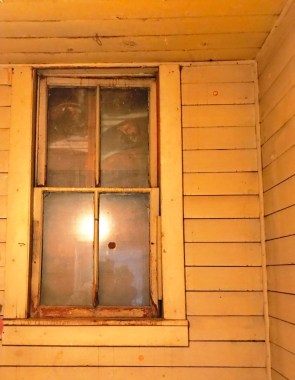
window inside belfry
This window inside the belfry on the second story of the church. The exterior is covered up now, but it can be seen in the image of the church above.

The window we could see from the inside of the belfry was showing on the outside in this picture. We hoped to return this window and more to the structure at some point in the belfry reconstruction process.

The church had an active historical society, and I asked if I could be invited to the next meeting. An answer came in the affirmative, and I hoped to determine the exact age of our beloved little church.

# # #

Tomorrow: We find something else, only this discovery is on Craig’s List. Click here to read it.

Dreaming of a stairway to heaven

Our story so far: During demolition, Tyler revealed the choir loft on the second floor of the 126-year-old Methodist church we were converting our home, and he suggested we extend the balcony into the main sanctuary, our future great room.

# # #

But the grand expansion of the second floor wasn’t in the Tequila Budget. We’d be adding square footage that needed to be built, carpeted and railed. We also toyed with the idea of adding a second, more decorative stairway to the second floor. (Technically, we already two stairways to the second floor—an interior enclosed wooden stairway and an exterior metal fire escape. The fire escape, an eyesore not required if the church were residential, would be removed and sold at a future date.)

And naturally, our taste ran toward the expensive.

The next day, Tyler made an early morning stop at a nearby spiral stairway manufacturer. They’d been making custom stairs and rails for nearly seventy years, right in our village, only blocks from the church.

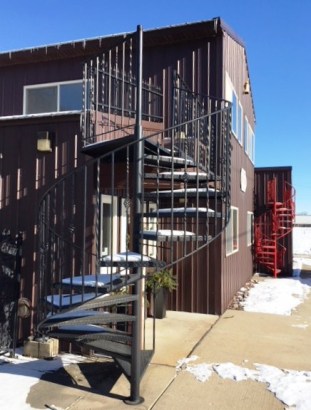
spiral staircase
Spiral stairways on display outside at a nearby manufacturer.

On display, both inside and out, were a number of functioning spiral stairways to show off different spiral widths, spindles, treads and handrails. As you might imagine, a spiral stairway is a custom project that is designed to an exact height. One does not pick a stairway off of a big-box shelf and install with an Allen wrench. Besides the height, one can choose the materials, all the decorative elements and which way the stairs will run, clockwise or counterclockwise. Immediately, our creative juices were flowing. And as long as we’re building a spiral staircase, why not also order a wrought iron balcony railing, right?

Being custom, neither of these design features would come cheap.

Since we were still in the middle of demolition and the spiral staircase manufacturer had been making stairways for the better part of a century, it was safe to take the wait-and-see approach to the staircase and railing. They weren’t going anywhere, and neither were we.

But it was fun to dream.

# # #

Tomorrow: We’re reminded our church was built before the Wright Brothers learned to fly. Read about it here.

Lofty ideas

Our story so far: Under layers of carpeting, paneling and ceiling tiles, we discovered the original finishes of the 126-year-old Methodist church we are demoing in order to turn it into our home.

# # #

But the best thing we discovered during demolition was the choir loft.

The old saying, “Man plans, God laughs” was evident in this church renovation. We had planned to close a week or two after we made an offer on the church, and we all know how that worked out. Now, our plans for the second floor were changing with every swing of the sledge-hammer.

One of the members told us the second floor used to be the choir loft, and as we (“we” being Tyler and his hired man St. Johnny) began pulling down the shelves and closets and walls upstairs, the balcony opened up like sunshine through the clouds. Tyler poked and prodded, and then smashed and crushed, to reveal the original, higher ceiling in the sanctuary and the huge opening into the second floor.

choir loft
Readers will have to use their imagination here. The lighted area above is the choir loft, overlooking the scrap wood pile in the sanctuary of the church.

Tyler was inspired.

He called me (I was fiddling with some sort of paperwork back at the rental property) and said, “I have a great idea, hear me out.” He described extending the balcony floor into the great room and constructing the kitchen underneath it which would create more space for our master bedroom in the overflow area behind it.

It was indeed an inspired concept.

For a number of days, we had been walking around the overflow area looking for ways to incorporate the kitchen, an entry from the to-be-built garage, a guest bath, the master bedroom, the master bathroom, a walk-in closet and a main-floor laundry. It was a lot to ask of 600 square feet.

No matter how I turned it around in my dreaming mind at night or on paper during daylight hours, I couldn’t figure out how to pull it off without sacrificing a shower or a laundry room or a walk-in closet (or all three).

Tyler’s concept would make room for all our creatures comforts, keep the kitchen we wanted and fill up some of the excess space in the great room.

# # #

Tomorrow: Tyler’s inspired idea requires a custom feature. Of course. Click here to read it.

The floor beneath our feet (and layers of carpeting)

Our story so far: The first phase of our church conversion is demolition, and we found a number of interesting items as we cleaned up and tore down.

# # #

Demolition is 5 percent revelation and 95 percent dirty work. In those first few heady days of demolition, we were still in the revelation phase, and it was fun.

pine floors
Tyler scrapes away the carpet glue so we can see what the original sanctuary floor looked like.

As we peeled away layers of carpeting, carpet padding, paneling and ceiling tiles, we discovered the beautiful original finishes of the old Methodist church. That moment in a DIY television show when a flipper discovers hardwood floors and swoons? That’s real. We did a little dance when Tyler pulled back the carpeting in the main sanctuary and found wide pine hardwood; Tyler suspected it might be Douglas fir. If we weren’t so old, we would have done a breakdance when we revealed the oak floors in overflow area, the room we intended to turn into our master suite.

beadboard
In this image, you can see the original pine floor (front and right) and the oak flooring (left) as well as the beadboard we exposed in the future master bedroom (left) and beadboard that rings the main sanctuary (it’s painted above where the altar area flooring used to be).

Under the 1970s wood paneling, beadboard—the kind that was installed a single board at a time instead of with today’s monolithic sheets—lined the master suite area up to the chair rail (or, at least, where the chair rail used to be). The ceiling in the master bedroom was also narrow-slated wood of some sort. We imagined a fantastic tray ceiling with the wood revealed in the center.

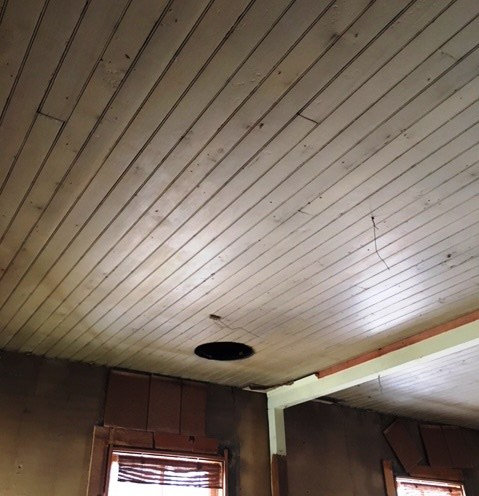
ceiling
This ceiling in the future master bedroom was hidden behind a suspended ceiling and a layer of fiberboard ceiling tiles.

# # #

Tomorrow: We find an interesting architectural feature we think we can incorporate into our floor plan. Click here to read it.

‘Never argue with someone who buys ink by the barrel’

Our story so far: We unearthed a number of interesting things, valuable and amusing, as we cleaned up the 126-year-old Methodist church we planned to turn into our house.

# # #

“Advent is a season of preparation.”

Perhaps a church sign is dangerous in the hands of a writer. Instead of just listing the service times, a clever sign keeper can post phrases like “If you’re looking for a sign from God, this is it” and “God answers knee-mail.”

church-sign-advent.jpg
Only the first of a string of messages with double meaning understood, perhaps, only by me.

Well, the old Methodist church came with a sign.

Originally, I thought we’d eventually demo the sign, but more and more friends urged us to keep it and post messages like “We welcome the Hendricksons for dinner” and “Guess who turns 51!”

And on Day Two of cleaning up the church and tearing down the crusty stuff, I found the box of metal letters for the sign board.

Actually, Tyler found them, and he directed me to remove the message about the food shelf moving across town and replace it with “Merry Christmas.”

The only problem was, it wasn’t Christmas yet. It wasn’t even December.

It was the last glorious day in November, unseasonably warm enough to remove one’s jacket if one is working hard trimming hedges, carrying brush and raking leaves. As a fairly regular church goer, I knew the first Sunday in the liturgical year when Christians all over the world celebrate the beginning of Advent was coming in a few days. Advent is the run-up to Christmas, a liminal season of expectation. But to describe it only as a time of waiting sells Advent short, just as the days between Thanksgiving and December 25 are more than simply an out-of-breath sprint to be endured.

Bible readings this time of year are about waiting and preparation and expectation. I enjoyed Advent, reminding myself it is not an empty time. It is a season of fullness. Because preparing can be just as meaningful as the celebration itself.

And so I posted a message on our church sign with a handy double meaning: “Advent is a season of preparation.”

I could have been slogging through days of demolition and cleaning and organizing, simply wishing we could be done with them. But with months of work ahead of us, I’d be wishing away a significant portion of my life. I’d better be enjoying the dirty, noisy or drafty moments for what they were; anticipation should be as joy-filled as the hullabaloo for which we’re waiting.

I was inordinately pleased with my church sign message. I smiled to myself every time I drove by. One day, the former pastor of our old Methodist church stopped by when Tyler was burning brush in the back yard. She thanked him for preserving the old building, and she also made a point of telling him she liked the message in the sign.

“She got it!” I shrieked happily when Tyler told me about the encounter.

A writer never tires of the act of publication, even if it’s only as public as a church sign.

# # #

Tomorrow: More revelations during the demo phase. Read it here.