Our story so far: In the midst of constructing a garage for the old Methodist church we were turning into our home, rain had turned our yard into a staging area for a mud pie maker.
# # #
Our garden plot. See that house in the background, across the street? It’s also a restored historic building, once a hotel.
Tyler exercised his green thumb and invested in four yards of 100 percent organic, sterilized composted cow manure, which he dumped in a burial-mound-like fashion next to the flagpole.
Ah, more mud.
Then he planted two cherry tomatoes, four beefsteak tomatoes, four pepper plants, four cucumbers plus basil and mint.
He also picked up a number of marigolds and Salvia, which he planted in the church sign planter.
He was so happy he could do this small thing in terms of gardening. The previous year, we had been living in a camper and traveling from place to place which prevented him from having a garden. He missed growing things and picking vegetables and, most of all, eating fresh produce he grew himself.
Another shot of the vegetable garden, this time overlooking the site of our future garage.
# # #
Tomorrow: What we didn’t plant that blessed us. Check it out here.
Our story so far: Concrete work began on the garage for the old Methodist church we were turning into our dream home.
# # #
I’ll take an order of spring with a side of mud, please.
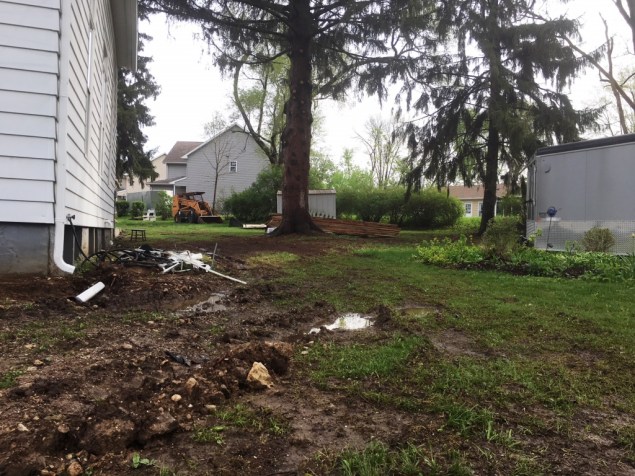
By now the yard was a muddy mess, and continued rain would intermittently interrupt our progress. Between the heavy machinery and the intermittent spring showers, our lawn looked like a pig pen with apparently random concrete walls sticking out it. Not that we had a lush yard of grass to begin with unless you count the crabgrass.
Among the spring showers dripping on our construction zone was a hail storm for the ages. A squall rolled through about 9 o’clock one evening. It sounded like a guy with a baseball bat was pounding on the flat roof of our rental house. Tyler went outside to determine the damage and brought back a jagged lemon-sized piece of ice, one of many.
The next morning, there were holes as big as my fist in the west-side window screens of the rental and twigs and branches covered the yard.
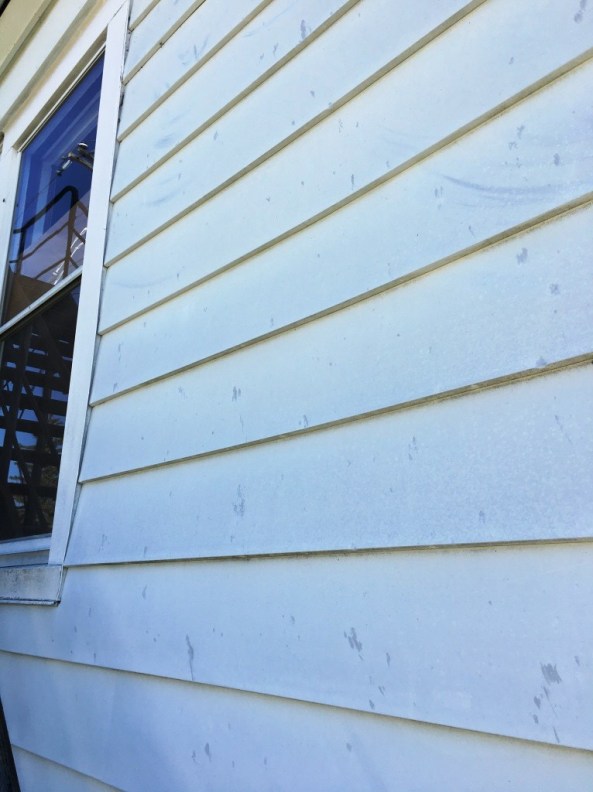
Tiny dents were in evidence on our vehicles. An assessment of the church property revealed hail damage to the west side of the cargo trailer and, alas, the church.
The west side of the church pockmarked with little hail dents.
During the next few weeks, no fewer than a dozen roofing and siding contractors visited us, offering to repair the hail damage and work with our insurance. This didn’t make sense for us given our deductibles, but scores of neighbors enlisted their help. Soon we wouldn’t be the only property in town with hammer-wielding contractors making improvements.
# # #
Tomorrow: The best use of mud. Read about it here.
Our story so far: While the drywallers were working inside the old Methodist church we were transforming into our home, we went to work on the garage.
# # #
The next day, the building inspector dropped by so we could prove we really dug four-feet-deep footings (apparently some people prevaricate regarding this detail, which is why the inspector makes an appearance before the cement mixer does).
A cement mixer rumbled into our yard to pour eighteen yards of concrete into the trenches. Astute readers are probably aware that though people use the terms cement and concrete interchangeably, cement is actually an ingredient of concrete. Now we employed an experienced concrete finisher and his crew to fill in the basement windows with concrete block and build wooden forms for the concrete walls of the cement pad. A few days later, the cement mixer dropped by again and left behind eight-and-a-half yards of cement.
There goes the natural light! Here’s a shot of the basement windows covered with concrete block.Wooden forms for the concrete walls.The finished concrete walls took on the wood grain from the forms.
# # #
Tomorrow: It wouldn’t be spring if there were no mud. Read about it here.
Our story so far: To make way for a garage, my husband Tyler jackhammered away part of the back stairway on the 126-year-old Methodist church we were turning into our home.
# # #
After the surgery on the stairway, it was time to dig footings for the garage. I soon learned my husband had a skill of which I wasn’t aware.
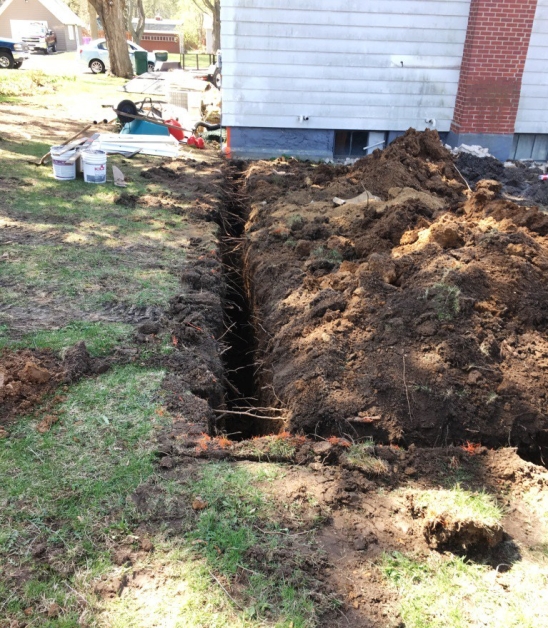
In the case of our garage, footings meant a hundred feet of frost walls four feet deep. A concrete pad wasn’t enough since our garage would be attached to a structure with an existing basement. To dig these deep trenches, Tyler rented a mini excavator and hired a guy (a friend of a friend) who could manipulate the excavator with precision. The trenches—three sides of the garage—were completed in a day.
Now that’s a trench.
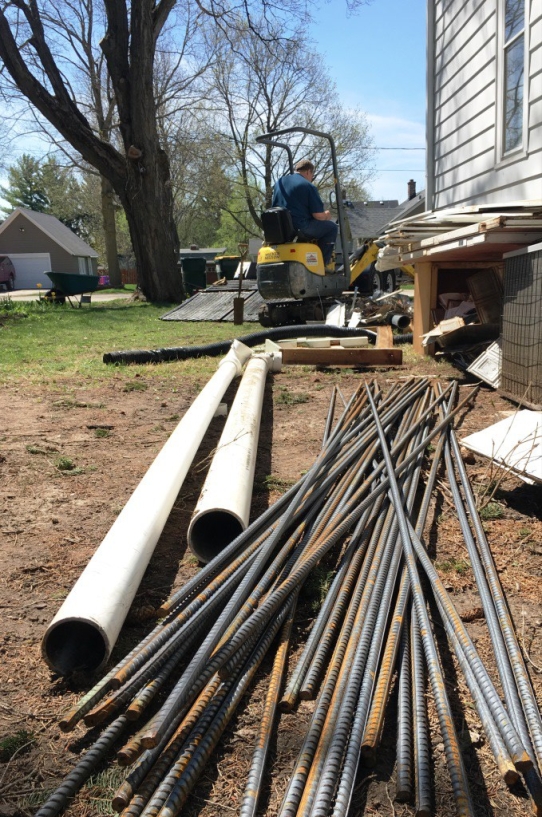
My role that day was errand girl. I went to Subway to get lunch for the workers. But I worked harder the next day when I used pruning snips, an implement similar to a manual hedge trimmer, to clip a hundred years of pine roots obstructing the trenches. The excavator had cut through a lot of roots, but it wouldn’t do to have any obstructions when we were ready to pour concrete. So I squatted in the mud to cut roots two feet below the surface of the yard, and then I moved rebar out of the borrowed flatbed trailer to the yard. As I’ve mentioned, rebar is heavy, at least for old ladies, so I opted to move carry two pieces at a time and walk more rather than try to try to lift ten pieces at a time.
That was my contribution to the garage.
Tyler, excavating. (That’s my neat pile of rebar there in the foreground.)
Meanwhile, as long as we had possession of it, Tyler was using the excavator to dig up bushes. Running an excavator is like playing a video game; the controls affect both the excavator itself and the operation of the scoop, depending on how you turn them. He maybe couldn’t have dug a precise trench but with a bit of practice to activate his muscle memory, he was digging up arborvitae roots like a pro in no time. Tyler first learned to operate a back hoe when he was trying to save money by digging his own septic system for his old tobacco farm decades ago. Necessity is the mother of invention (or something like that).
Tyler and I had been married nearly ten years, but I was learning new things about him all the time during this church renovation. I didn’t know he knew how to run an excavator until I saw him, sweaty and concentrating, behind the controls. Such a skill just doesn’t come up in everyday conversation. Fortunately for our budget, my Renaissance Man was saving us money in every phase of this undertaking.
Tomorrow: More heavy stuff—concrete. Read about it here.
Our story so far: After months of effort, we’d arrived at the drywall phase of renovation in the 126-year-old Methodist church we were turning into our home.
# # #
While the drywallers were doing their thing inside the church, Tyler got busy outside. Finally, the weather made the Great Outdoors inviting again, and Tyler began work on his Garage of Dreams.
In the way that other phases overlapped one another, Phase Six: The Garage was overlapping Phase Three: Drywall, Paint & Flooring. This was necessary for two reasons. First, the weather was finally nice again. Second, it was becoming increasingly apparent we weren’t going to be able to move into the church when we elected to wrap up our lease on the nearby rental house. It looked like we were going to have to move back into the camper, which we preferred to park on the cement slab of our future driveway and garage rather than a muddy yard.
This wasn’t an entirely unwelcome development given the nice weather. Recall that we were forced to move out of the camper in mid-November only because of snow and the imminent threat of freezing sewage pipes. On the other hand, it would have been convenient to move directly from the rental house into the church. But without the luxuries of finished flooring, countertops and closet racks in the church, we elected to take up residence in the camper again.
When deciding to purchase this particular church, the size of the lot was as appealing as the location. No churches came with attached garages, and some small churches offered no place to build a garage. When we contemplated the church in Pecatonica, Illinois, the garage we planned would have taken up all the open lot that came with the church. Though there was no parking lot or off-street parking with our 126-year-old Methodist church, the structure itself was situated on the front of a long triangular lot, which left lots of land for a garage with space left for a garden and other green space.
For several weeks, Tyler had been pacing and tracing the outline of his garage and driveway, collecting bids, consulting with the building inspector on setbacks and footings, and pricing creature comforts (like urinals and method of garage heating). Bids on outsourcing all the work ran high, so with his eye on the Tequila Budget, Tyler took on some parts of the project himself. He was ready to break ground.
Or at least break concrete.
The first step in his grand garage plan was to break up part of the concrete stairway from the basement. The straight stairway required a turn in order to be situated completely inside the future garage. The top four steps had to go.
Back steps, post demolition.
So Tyler rented a jack-hammer. And jack-hammered through several feet of concrete. His hired man St. Johnny earned his pay that day, hauling away the heavy chunks and digging a four-foot-deep hole to accommodate a new mid-stairway landing.
Tyler came home of the church that day in a state of exhaustion. After months of demolition and wall construction, he admitted that was only a warm-up. “I haven’t worked that hard in years,” he said at the end of jack-hammer day as he flopped on the couch, soon to be sleeping.
# # #
Tomorrow: Some old dogs do have new tricks. Read about it here.
Our story so far: The drywallers began work on the 126-year-old Methodist church we were turning into our dream home.
# # #
Just as walls were taking shape, my parents who lived in Minnesota came for a visit.
I almost always brought home A’s from school, but better than any report card was showing my parents around the church. Finally, they could see in three-dimensions all we had been describing, lo, these many months.
The day after walking through our future home the first time, I asked my parents what they thought.
“Well,” my mother said, “we think you’ve come a long way in five months. But you have a long way to go.”
My 70something father is an avid woodworker, and he had contributed beautiful built-in bookshelves to both of my last two houses (alas, the bookcases are still there, even if I’m not) so naturally, he lent a hand to the church reconstruction project while he was here.
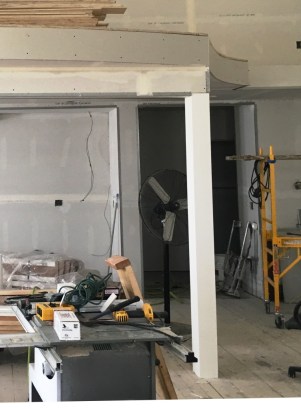
This is one of the balcony columns that required special attention. Doesn’t Dad do nice work?
Tyler wanted something tougher than drywall wrapping the two pillars holding up the balcony. Those posts will be in a high-traffic area near bar stools that may get backed into the posts on exuberant occasion. Dad agreed to wrap the pillars with vinyl board (think of the material in PVC pipes, only flat). He and I traipsed around Home Depot together to find the right stuff and delivered it to the church, where Dad spent one morning measuring twice and cutting once to make our pillars look as clean and nearly finished as our walls.
The three of us, Mom and Dad and I, also paid a visit to the impressive showroom where I found the Lighting Savant (and lot of distinctive light fixtures). Mom and Dad needed some advice and some pendant fixtures for their kitchen. They found both—the Lighting Savant was just as helpful to them as he had been to me.
A successful visit all the way around.
# # #
Tomorrow: Tyler gets busy outside. Read about it here.
Our story so far: The subcontractors for our drywall job at the 126-year-old Methodist church found it distasteful, so the A Team, the men who had so skillfully finished our sanctuary ceiling, got handed the ball.
# # #
The A Team began (on Day Three) in the master bath so our tiler, You-Can-Call-Me-Al, could put down his saw and pick up his spatula again and get back to tiling.
Drywall, mid job.
The drywall concealed all our sins: Crooked pipes, ugly studs, awkwardly stapled insulation plus dirt and sawdust. White sheets occasionally interrupted with “5/8” CP LITE-WEIGHT FIRE-RATED” print covered everything. Even before mudding the seams, the new drywall made actual rooms out our wooden studs. People warned us our rooms would feel smaller, but I didn’t feel that way at all. Our rooms finally felt like rooms.
In completing the bathroom, the new Sheetrock sealed up our short-cut. The linen closet—an awkward eighteen-inch-square chunk of space between the mudroom, the walk-in-closet and the bathrooms—lost its status as a doorway and became what it was designed for: A closet.
After five days of hanging drywall in all the rooms on the main floor and second story, the A Team began taping the seams and mudding them, which finished all the edges nicely.
Our wall work was nothing on the scale of God’s and it was taking a lot longer than six days, but in the words of Genesis, we saw everything that we had made, and behold, it was very good.
# # #
Today’s headline comes from “Upright Come,” a song by Patti Smith.
Our story so far: Five tons of drywall was delivered to the 126-year-old Methodist church we were turning into our dream home.
# # #
Day Two of drywall was less efficient than simple delivery. Our drywaller had subcontracted our job to another team. When they arrived and discovered the job was at a 126-year-old, not-perfectly straight church, and it required five-eighth-inch-and-therefore-heavier drywall, the B Team promptly left.
They left. The dour-faced workers got into their pickup truck and left the scene with nary a word.
I saw them driving away as I walked up to the church. Only I didn’t know they were our workers.
“Where are drywallers?” I asked Tyler, who was busying himself with one of the other thousand details requiring attention.
“They left.”
“Are they coming back?”
“I don’t know,” he said.
Well, they didn’t come back.
After regrouping with Tyler and explaining what the B Team didn’t verbalize before departing, our drywaller agreed to use his A Team, the same men who’d had so skillfully finished our sanctuary ceiling, but it would take longer. Despite hearing echoes of “Two weeks! Two weeks!” in my ears, we readily agreed.
# # #
Today’s headline is a quote often attributed to Leonardo Da Vinci and sometimes to Pablo Picasso. And the message in the church sign is a paraphrase from a sermon by Pope Francis.
Tomorrow: The walls made by drywall. Check it out here.
Our story so far: Spring arrives, and with it, a new phase in the more than five-month-long renovation of the 126-year-old Methodist church into our home: Drywall.
# # #
Upon mentioning the advent of drywall, friends in Great Britain who coincidentally were renovating their kitchen remarked on the differences in English terminology. In Wisconsin, drywall came in panels made of gypsum plaster pressed between thick sheets of paper. In Great Britain, a dry wall was a wall of stones without mud in between them. Brits, my friend informed me, use either wet plaster brick or block external walls; plasterboard—the equivalent of drywall panels—is used on internal stud walls. I was reminded of the old days when I visited London frequently for work, stuffing my luggage in the boot (that is, the trunk) and dining on lunches of prawn sandwiches garnished with rocket (shrimp sandwiches with a side of arugula).
The church gulps in sheet after sheet of drywall.
Day One of drywall was delivery day. Tyler removed windows on the first and second floors, and two fully equipped guys pulled five tons of drywall from a flatbed truck into the church in a couple of hours.
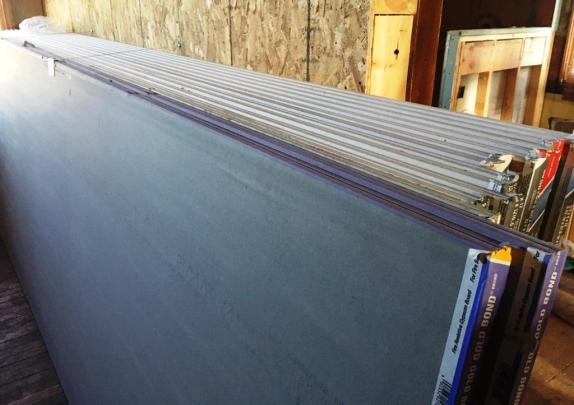
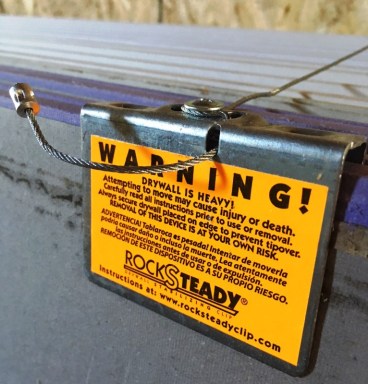
This stack represents only about one ton of drywall.Kudos to the guy (or gal) who developed this brand name: RockSteady. For a drywall stabilizing company. Clever.
We got rid of two thirty-yard dumpsters full of extra weight, and now we were replacing all it and then some. Drywall was so heavy, as a matter of fact, it was dangerous. The delivery guys wired stacks of four-by-twelve-foot sheets against the walls of the church with little warning clips: “Warning! DRYWALL IS HEAVY! Attempting to move may cause injury or death.”
Not that I needed another reminder of the weight of construction materials. There is a reason you don’t see old ladies with no upper body strength working in the construction industry. I struggled to lift pretty much everything. (Except insulation. That was easy to lift. Hard to manipulate.) Lumber was heavy. Five-gallon buckets of paint were heavy. Tile was really heavy. Sledgehammers? Solid-wood doors? Drywall? Rebar? Brick? Well-constructed cabinets? All of it reminded me how little strength I had ever, let alone now in my fifties. Before our construction project, I puffed up my chest when I was able to open a bottle of spaghetti sauce by myself. I wasn’t built for this.
# # #
Tomorrow: Day Two of drywall doesn’t go so well. Read about that fiasco here.
Our story so far: After months of demolition, framing and mechanicals, spring arrived at the church we were turning into our home, and we looked forward to the next phase: Drywall, Paint & Flooring.
# # #
The final task Tyler completed before the drywall was hung was to install the front doors. Remember? The doors for the man’s home that is his castle? We’d purchased them off Craig’s List months ago now, and they were stored in the basement, awaiting their final home. Initially, we thought we’d wait until everything else was finished, but Tyler thought it better to let the drywallers work around the castle doors, rather than pull apart their careful work later only to do it again.
The enormous arched door frame was so large, we couldn’t fit through the basement door, so it had been moved around the sanctuary fifteen times while various contractors worked around it. Now Tyler pulled off the exterior siding on the front entryway, and You-Can-Call-Me-Al helped him slide the door frame into place. Tyler’s hired man St. Johnny helped hang the heavy doors in the frame, and You-Can-Call-Me-Al performed the required cosmetic surgery so they swung smoothly.
All winter and early spring, the only evidence of any activity inside the church was the string of pickup trucks parked outside of it. Now, the whole world could see a hint of the transformation in store for the rest of the structure.
Our rustic castle doors with operational speakeasy portals were absolutely the perfect doors for the church. Even before we put back the siding and installed the exterior lights or even door handles, we earned compliments from friends and passing strangers on this exceeding public design choice.
They made me so happy.
# # #
Tomorrow: Drywall delivery day. Read about it here.






 They left. The dour-faced workers got into their pickup truck and left the scene with nary a word.

 Church Sweet Home