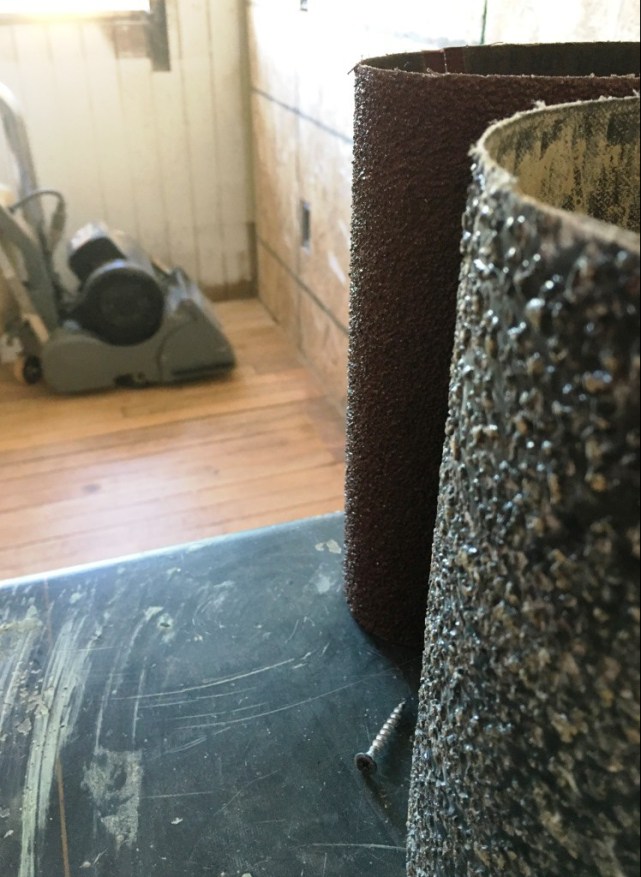
Our story so far: The first step in sanding hardwood floors in the church we were turning into our home required a drum sander and 24-grit sandpaper.
# # #
That’s a drum sander in the background; 24-grit sandpaper nearest, and 36-grit right behind.
Have you ever seen 24-grit sandpaper? I hadn’t. I’d only used the relatively even sheets of sandpaper to smooth edges and surfaces on furniture I painted. How cute. Twenty-four-grit sandpaper is the wicked sumo wrestler of finishing materials—it looked like it had gravel on it and if you got in its way, you’d be flattened.
At this point, I used a floor edger to sand right up to the walls in the sanctuary; this step required the operator to kneel, and since I still had my natural joints, I was elected. Then someone (usually Tyler, but sometimes St. Johnny) used the orbital sander with 60-grit sandpaper going with the grain.
On ordinary wood floors, one might be finished sanding. But we didn’t have ordinary wood floors; we had 126-year-old wood floors. Over the course of a century, the floor had settled everywhere except where the beams in the basement supported the structure. This left narrow grooves in the sanctuary floor that remained untouched by the stand-up sanders. Seated on a rolling flat cart low to the floor, Tyler used a belt sander and a hand-held oscillating sander to smooth out those grooves.
Final pass was with an orbital sander and 80-grit sandpaper.
Of course, vacuuming was required after each sanding step.
And that was just the sanctuary floor. We had to do the whole thing all over again in the master suite (with maple flooring, which is much harder than pine), in the Hall of History and on the second floor. In total, we had about 2,200 square feet of hardwood to finish.
# # #
Tomorrow: Sanding the second floor. Read about it here.
Our story so far: When we started sanding the wood floors in the old Methodist church, it was still wintertime.
# # #
Sanding is a little like driving across North Dakota. At first, you’re impressed with the everlasting undulating landscape, but it’s not long before you realize the points of interest are too few and far between.
I didn’t realize it then, but the sanding of the floors had only just begun. There was this first step with a drum sander and 24-grit paper on a diagonal to remove the mastic and level the wood. Then two passes with a drum sander, one with 24-grit sandpaper and one with 36-grit paper with the grain.
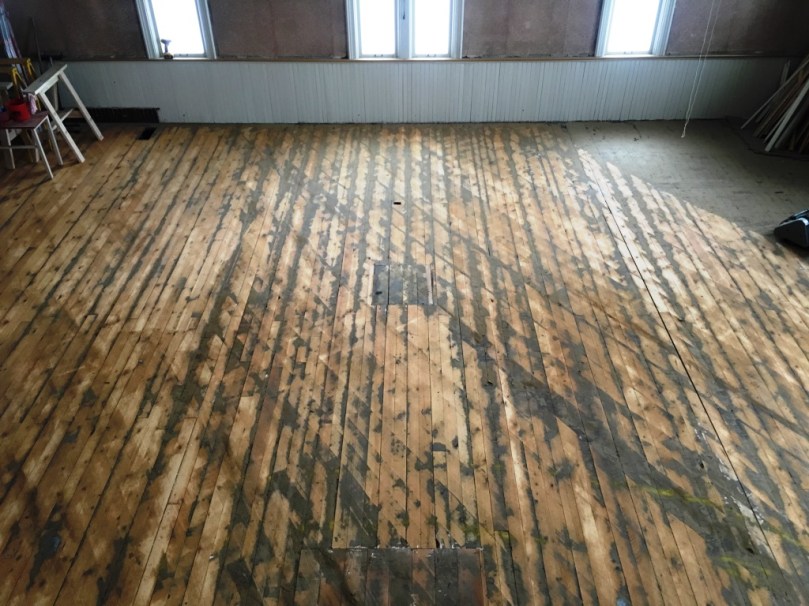
Here’s a shot of the sanctuary floor from the choir loft (before the balcony was built) right after Tyler’s first pass at sanding. The yellow parts are raw Douglas fir which showed great potential; the gray parts are covered with stubborn mastic.
# # #
Today’s headline is a quote from William Rounseville Alger, a Unitarian minister, author and poet.
Tomorrow: Steps 3 through 99 with a pit stop at 24. Read about it here.
Our story so far: Having accomplished basic prep on the hardwood floors of the sanctuary of the old Methodist church, it was time to try sanding it.
# # #
Looks like cotton, feels like it weighs a ton.
It was still winter that first day Tyler tried sanding the floors. The morning dawned with five inches of heart attack snow on the ground and an early morning wake-up call.
The day before, Tyler called Home Depot to inquire about renting a floor sander. He was told they were rented on a first-come, first-served basis; he couldn’t reserve one. But he asked the guy at the rental desk if he might give him a call that night to confirm a floor sander was available when the store closed, which would indicate if one might be available in the morning. The guy agreed to give Tyler a call, but Tyler didn’t actually expect him to do it, given our experience at that point with flaky contractors and our inexperience with the folks employed at the local Home Depot. But indeed, at 8:15 p.m., the guy called and confirmed not one but two floor sanders would be available the next morning.
So Tyler woke up, made coffee, drove to Home Depot to pick up the floor sander, grabbed breakfast at Starbucks and was back at our rental house by seven o’clock, where I was groggily brushing my teeth and making coffee.
“Mission accomplished?” I asked.
“Yup! Today’s the day we take the top layer of grunge off the floor.”
He was excited. I was just waking up.
But I got dressed while he snowblowed the sidewalk in front of our rental house. We’d sold our enormous high-powered snowblower a year before when we embarked for a life on the road, never dreaming we’d be living in the snowy Midwest again so soon.
But lucky us: Among the strange and varied items the congregation left behind at the church was a little snowblower. It didn’t work, but Tool-Time Tyler was never deterred but such details. He fiddled with some element or another of the small engine, filled it with gas, and voila, we were the proud owners of a snowblower again.
The winter so far had called more often for a shovel than a blower, but that morning’s snow was deep and heavy. So when we were ready to head to the church, we loaded the little snowblower alongside the big floor sander in the back of the truck, and the first task was clearing the sidewalks over there.
Remember the church so many months ago? Notice the former doors on the front and the dumpster outside.There’s a sidewalk under all that snow!
Blowing snow, as it happens, is a lot like sanding floors. Move slowly, walk in a straight line, generate a lot of snowdrifts (or sawdust drifts). I didn’t appreciate the act of shoveling all that much, but I liked looking back over a well-shoveled sidewalk and feeling satisfied.
With a lot of foot traffic from a parade of contractors ahead of us, we weren’t interested in finishing the hardwood floors just yet, but Tyler took the opportunity presented by the wide-open spaces to sand off the top layer of glue and mastic with a drum-type floor sander and 24-grit sandpaper.
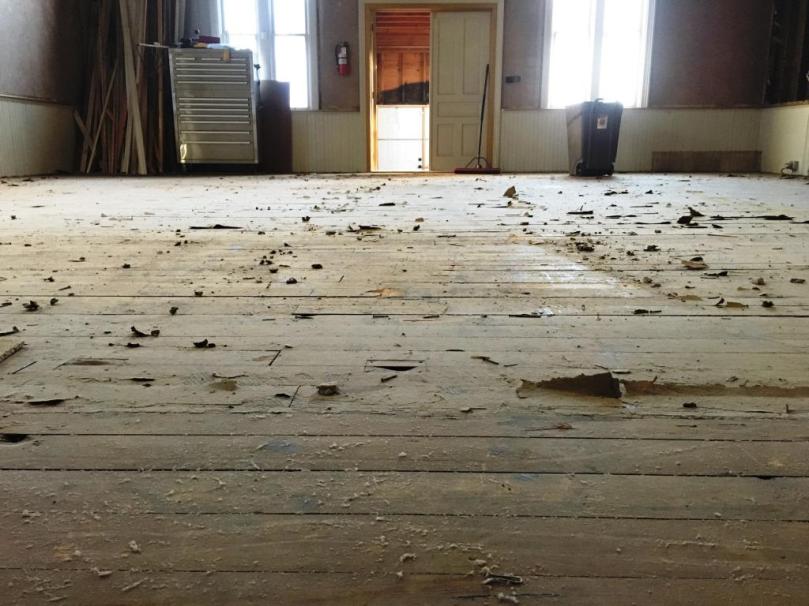
Wow, talk about a feeling of satisfaction! Our 126-year old Douglas fir flooring in the main sanctuary was beautiful under all that gunk. Some people might object to the knots and seams, but with a rustic transitional design scheme, it was perfect for us.
Here’s how the Douglas fir of the sanctuary floor looked after the first sanding.
# # #
Today’s headline was appropriated from English novelist J.B. Priestly who once wrote, “The first fall of snow is not only an event, it is a magical event. You go to bed in one kind of a world and wake up in another quite different, and if this is not enchantment then where is it to be found?”
Tomorrow: Oh, the sanding has just begun. You thought a stairway had a lot of steps. Read about them here.
Our story so far: The layers of flooring and gunk covering the original wood floors at the old Methodist church were beginning to feel as if they would never end. During the official demo phase we peeled back the old carpeting and padding. We then removed carpet staples and nails covering every square foot of the sanctuary.
# # #
Then there were pieces of tin.
Tyler found dozens of dinky pieces of tin nailed all over the sanctuary floor. Someone had meticulously cut the tin to size, nailed each corner and added nails every two inches when the piece was bigger. He took to removing them, and discovered they covered little divots and other dings in the hardwood. But like the nails and staples, they had to go.
Tyler discovered a hidden treasure.
In the back corner of the room, he found a much larger hunk of tin. When he peeled it up, he discovered a time capsule of sorts: Several copies of what appeared to be religious newspapers for young people—Dew Drops and Young People’s Weekly—filled with serialized stories and articles of advice. He was amazed to see they dated to the 1920s.
He developed the back story to this strange find: A teen-age boy—maybe the minister’s son—was tasked with covering the dings in the floor before it was covered with something (tile? carpet?). When he got to the place where there was once perhaps the wood stove smokestack, he stashed a pile of Sunday school newspapers for posterity with the unspoken message, “I was here.”
At this point, we were finally down to the mastic-covered wood, and sanding commenced.
# # #
Tomorrow: It snowed the first day we sanded the floors. That’s how long we’ve been at it. Read about it here.
Our story so far: Sanding hardwood floors in the old Methodist church we were turning into our home was dirty work.
# # #
Sanding hardwood is hard work. To the elbow grease, add a flurry of sawdust and you’ve got good reason to hire out the work.
But we didn’t. We hired out the duct work, we hired out the electrical, we hired out the plumbing, we hired out the drywall and we hired out the painting. Unlike those other tasks, sanding didn’t require any particular expertise, only numerous trips to the Big Box rental desk, attention to detail and a willingness to endure dust (a lot of dust). It’s the job you often see novices attempt on DIY Network’s “First Time Flippers”; viewers see about ninety seconds of effort, even though the rehabbers probably spent weeks doing the work. Though the investment in time is big, the investment in cash is small, and the return is potentially huge. Everyone likes the sound of “original wood floors.”
And so, we found ourselves sanding floors in the old church during cold days in February and hot days in June.
Fundamentally, sanding is granular demolition and despite labeling it the “flooring phase,” the truth of the matter was we were still demoing the flooring seven months after we purchased the old Methodist church to turn into our home. The layers of flooring and gunk covering the original wood floors were beginning to feel as if they would never end. During the official demo phase we peeled back the old carpeting and padding that was two decades old if it was a day. Then there were the thousands of carpet staples and hundreds of nails covering every square foot of the sanctuary.
We knew there was beautiful wood somewhere under all that ugly mastic.
# # #
Tomorrow: Oh, you can’t sand yet. Look out for the tin! Check it out here.
Our story so far: We were in the midst of Phase Three of construction: Drywall, Paint & Flooring at the old Methodist church we were renovating into our dream home.
# # #
Chapter 32
I used to believe no shower felt better than the one you took after a thirty-hour trans-Pacific plane flight.
At one point in my marketing career, I took such flights regularly. I began the trip, usually before dawn, wrangling a huge suitcase and heavy computer bag. I’d drive or take a shuttle to the airport. Stand in lines, handle dirty money (all cash is dirty, even someone who’s not a Virgo knows), touch doorknobs and hand rails already touched by the thousands of other members of unwashed humanity, dine off of filthy seatback trays, drool on myself as I tried to sleep on the plane, change planes at least twice, usually four times (because there were no direct flights from St. Cloud, Minnesota, United States of America to Mount Ku-ring-gai, New South Wales, Australia), wait in the sunshine for another shuttle or cab to my hotel, stand in line to check in at the hotel and finally arrive at my destination a day and half after I began. If I could summon the energy, the first thing I did was take a shower. Oh that shower was sweet, washing off hours of exhausting traveling and disgusting germs, and I exited the shower a new woman.
I used to believe that shower was the best shower ever.
Until I sanded hardwood floors.
No shower feels as good as the one a rehabber takes after sanding 126-year-old wood floors for a few hours on the second story of an old church in 90-degree temps.
Our story so far: We juggled enough projects at the old Methodist church as summer inched on that something different occurred in a steady rhythm every day.
# # #
We’d found plenty for You-Can-Call-Me-Al to do, too, as he was equally skilled using a tile saw and any number of wood saws.
One day, I stood on the balcony pickling the last of the planks for the upstairs ceiling. I wore headphones, listening to National Public Radio, while quietly rolling diluted white paint on wood.
Tyler worked in the master bedroom with a table saw and a nail gun, assembling the bead board on the closet wall.
You-Can-Call-Me-Al played the radio at a volume that didn’t quite overwhelm the sound of his tile saw when he modified one of the stones for the fireplace. He was finally making progress on our twenty-foot fireplace after a couple of false starts with unacceptable mortar. The stone guy suggested a type he’d used for an outdoor fire pit, but when we tried it, the stone would still come off twenty-four hours later. This might have been okay for a three-foot-high fire pit, but we eventually learned (from a Home Depot guy, to his credit) that we needed mortar for a vertical application. Because when laying stone twenty-feet off the ground, you do not want it to fall off, lest you kill someone. Still, You-Can-Call-Me-Al built only about three or four vertical feet of fireplace a day so it would dry level.
This was the sort of meditative work I enjoyed. Roll, roll, roll of the paint. Pithy NPR observation about the history of Chinese food. Whirr, whirr of a saw. Pop, pop, pop of a nail gun. The swoosh of mortar on the back of a hunk of stone. Whomp, whomp, as You-Can-Call-Me-Al occasionally used a rubber mallet to coax a piece into place. Then more of the same. The only way of determining the passage of time was the eventual grumble of my stomach, calling me to lunch.
You-Can-Call-Me-Al got to within a foot of the ceiling before we ran out of stone for the fireplace (of course, we reordered more, but it would take a few days to be delivered). If you look closely on the upper left, you can see the ends of the boards I painted for the upstairs ceiling.
# # #
Tomorrow: Chapter 32 opens with thoughts about travel. Read about them here.
Our story so far: We attacked various indoor projects at the old Methodist church we were turning into our home.
# # #
St. Johnny had a different task every day. Frequently, it involved moving construction materials or sanding or using the shop vac, but during a couple days in early July, he earned his keep by digging ditches in the back yard. Tyler had devised a way to coax water away from the foundation, but he needed to lay puffy drainage piping in ditches. This was not easy work in hot weather (or any weather, let’s be honest), but we feared the next fifty-year rainfall event. If we ever hoped to finish the basement, it had to remain dry.
A few days later, Tyler asked St. Johnny to edge the sidewalks, which appeared as if it hadn’t been done for years. This task wasn’t as necessary as the drainage project, but it was satisfying to see the before, during and after all in one day.
Ah, I can see the whole sidewalk again.
# # #
Today’s headline should be familiar to kids who grew up in the ’70s. It’s the title of a best-selling book of children’s poetry by Shel Silverstein.
Tomorrow: The sounds of construction. Read about them here.
Our story so far: I laid out the tiles in dry format for my tile rug to be set in the hardwood between my stove and the sink in my future kitchen at the old Methodist church.
# # #
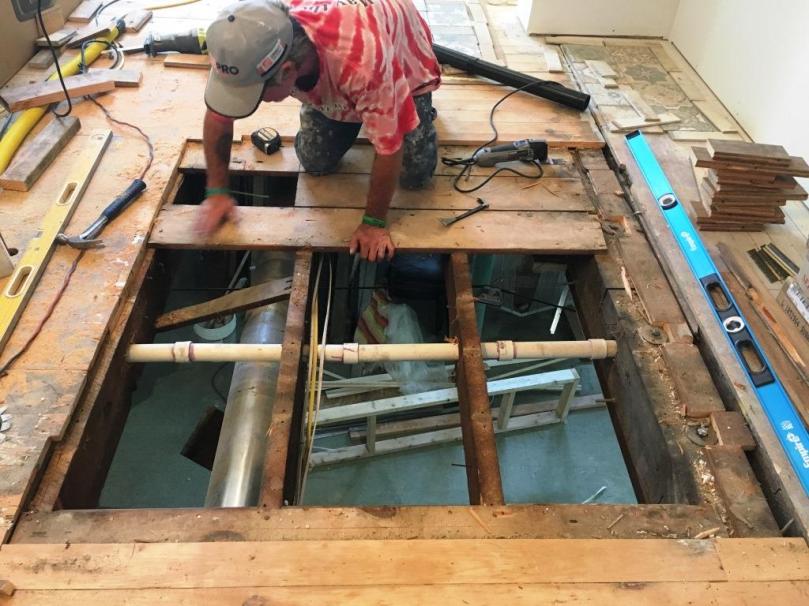
That’s the basement you can see through the sanctuary floor there! (And You-Can-Call-Me-Al, hard at work.)
My tile rug prompted You-Can-Call-Me-Al to poke around the subfloor where it would eventually be tiled between the stove and sink. He determined that the 126-year-old subfloor wasn’t up to the task of supporting the tiles which could mean they would flex when someone walked on them and then crack. This meant I had to make another trip to Home Depot, No. 4 just for that week.
I was now what you’d call a regular at the local Home Depot, the nearest Big Box home improvement store. Before this project, I would have told you Big Box clerks were flunkies who weren’t well informed, but that’s not true: The clerks at this particular Home Depot were awesome. The cashiers always tracked down someone to help me load whatever I bought (which I’ve repeatedly mentioned was invariably heavy). One of the flooring guys once saved me after seeing only my behind sticking out of a pallet of tile on the floor. The paint mixer and I were on a first name basis. But it was the guys in the lumber department who I really appreciated. Tyler would give me a list of wood and/or screws to buy, and they would help me find it and usually load it onto a cart.
On this trip, Tyler told me to buy three-quarter-inch plywood with a cement board underlayment. The helpful clerks in the lumber department (I had two this day!) told me it didn’t exist. I had long since given up on trying to translate, so I called Tyler and handed my phone to one of the clerks. Turns out, I needed two things: Half-inch plywood and quarter-inch cement board.
# # #
Tomorrow: The work gets harder. Read about it here.
Our story so far: As summer inched on, we juggled a variety of projects at the old Methodist church we were turning into our home.
# # #
One day when Tyler wasn’t feeling well, I was promoted to foreman. Make that temporary foreman.
Unlike Tyler who could operate power tools, I tended to more pedestrian tasks. That day included two trips to Home Depot, one to pick up the sander for St. Johnny to use on the upstairs floor, and a second to drop it off. You-Can-Call-Me-Al tended to miscellaneous carpentry tasks (like trimming out the upstairs belfry door and repairing holes in the hardwood near the back door).
Final size will be about three-and-a-half feet by five.Tile configuration above the stove.
In between errands, I laid out the tile rug to be set into the hardwood in my kitchen using two boxes of mixed tiles. You-Can-Cal-Me-Al didn’t want to be the one choosing the design, so I laid it out dry and took a picture. While I was at it, I laid out the tile feature for above the stove. And then I touched up the spiral stairway, which got a little scratched as it was screwed into the church.
My short stint as boss resulted in forward progress and no maiming, so I think it was a success.
# # #
Tomorrow: My tile rug project inspires another trip to Home Depot. Read about it here.


 At one point in my marketing career, I took such flights regularly. I began the trip, usually before dawn, wrangling a huge suitcase and heavy computer bag. I’d drive or take a shuttle to the airport. Stand in lines, handle dirty money (all cash is dirty, even someone who’s not a Virgo knows), touch doorknobs and hand rails already touched by the thousands of other members of unwashed humanity, dine off of filthy seatback trays, drool on myself as I tried to sleep on the plane, change planes at least twice, usually four times (because there were no direct flights from St. Cloud, Minnesota, United States of America to Mount Ku-ring-gai, New South Wales, Australia), wait in the sunshine for another shuttle or cab to my hotel, stand in line to check in at the hotel and finally arrive at my destination a day and half after I began. If I could summon the energy, the first thing I did was take a shower. Oh that shower was sweet, washing off hours of exhausting traveling and disgusting germs, and I exited the shower a new woman.