My kingdom for a drywall screw

Our story so far: After what seemed like an eternity of demolition, we were beginning to build inside the old Methodist church we were turning into a home instead of tear down.

# # #

A few day after the drywallers tore down the ceiling tiles in the sanctuary of the church, as I was making the bed back at the rental house after doing laundry, Tyler called, frantic.

“What are you doing right now?”

“Um, making the bed?”

“We’re out of drywall screws. You need to go get some. Three-inch drywall screws.”

OK, this was a task I could pull off. I now had visited the nearby Home Depot so many times, I knew exactly which door to enter to find the “screws and nails” aisle.

“How many?” I asked.

“Um,” he said, apparently eyeing the ceiling where the drywallers were working. “Five pounds.”

Okey, dokey. Five pounds of drywall screws, coming right up.

When I got there, screws in hand, the church sounded like a real construction zone.

Men’s voices and hammers echoed in the sanctuary. St. Johnny made noise with the Air Locker pulling nails out of boards in the basement. The HVAC guys moved a truckload of shiny ventilation ducting into the basement of the church. A boom box was tuned to a rock station playing “Superstition” by Stevie Wonder, which includes the line “very superstitious, ladders bout to fall.”

Fortunately, the drywallers were using scaffolding, not ladders.

Superstition ain’t the way.

The drywallers were making quick, satisfying progress on the ceiling of the sanctuary. The place was beginning to take on the sheen of new construction, a nice change from insulation dust.
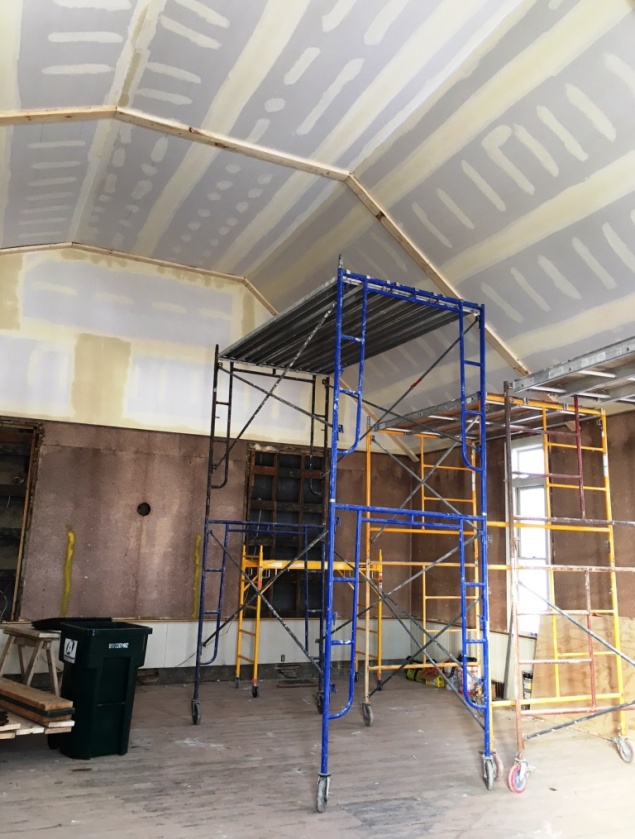
drywall
Nothing like the smell of new construction in the morning.

# # #

Tomorrow: Did you say foam? Or Faux? Read about it here.


We are all in the gutter, but some of us are looking at the stars

Our story so far: Deliveries of nails and lumber were evidence that we were now building things inside the old Methodist church we were turning into a home instead of tearing things down. 

# # #

Right around that time, the gutter guys showed up to upgrade the rain gutters on the front of the church. Thanks to a few warm days in January, Tyler determined the occasional water in the basement was seeping through a seam on the front wall of the basement. The way the old gutters were arranged allowed a significant portion of roof run-off to drop into one area in front of the church. Tyler suspected he would also have to do some excavation in front of the church at some point to improve underground drainage there, but that project could wait until spring.

In a few hours, we had new gutters. OK, we had to write a check for it, but it was immensely satisfying when someone else did the work, especially when it was twenty feet off the ground.

# # #

Today’s headline is a quote from Oscar Wilde, one of London’s most popular playwrights in the the 1890s, the decade our church was constructed.

Tomorrow: A delivery like Jimmy John’s: Freaky fast. Read about it here.

Wooden’t it be nice?

Our story so far: Activity began to accelerate, as evidenced by the volume of building materials accumulating inside the old Methodist church.

# # #

lumber
That’s a lot of lumber.

Two days after the nail delivery, a Mack truck with a hydraulic fork lift on the back arrived in front of the church and left behind two enormous piles of lumber on our sidewalk. In a biting 20 mph wind, Tyler’s hired man St. Johnny and I carried in 113 two-by-fours of various lengths, 30 two-by-sixes, 10 two-by-eights, 30 two-by-tens, 20 sheets of plywood and five LVLs (that would be laminated veneer lumber typically used for headers, for those of you who don’t handle industrial deliveries of lumber every day).

Oh joy.

Fortunately, it wasn’t snowing or raining.

All that lumber was evidence that we were now building things instead of tearing things down. This reality buoyed Tyler’s spirits considerably. He and his hired man St. Johnny had toiled for many weeks in relative isolation while they had demoed the interior of the church. Now Tyler could watch real progress as skilled workers made the church look better rather than looking worse.

# # #

Tomorrow: Get your head out of the rain gutter. Read it here.

Nailed it

Our story so far: My husband and I bought a 126-year-old Methodist church to turn into our dream home, and we–with a little help–spent nine weeks demolishing the interior.

# # #

Chapter 16

Activity at the church began to accelerate, as evidenced by the number of checks being written and the volume of building materials accumulating in the church.

2000-nails.jpg
This is what 2,000 nails looks like

One day, a relatively small box—Amazon’s smallest shipping box—was delivered to the front door. I tried to bring it inside, but I discovered abruptly I couldn’t lift it.

“What is that?” I asked Tyler later. “It’s as heavy as a thousand screws.”

“Two thousand, actually. Two thousand nails,” he replied nonchalantly.

So we were embarking on a construction phase requiring at least two thousand nails.

# # #

Tomorrow: “Wood”n’t it be nice? Read it here.

When in doubt, hire it out

Our story so far: After demolishing the interior of most of the old Methodist church we hoped to turn into a home, my husband Tyler wondered how to safely tear down the 20-foot ceiling of the sanctuary.

# # #

After much backing and forthing, which included negotiating with two different rental companies for motorized “man lifters,” stalking the sellers of used scaffolding on Craig’s List, briefly contemplating temporarily building out the loft floor across the entire sanctuary and me volunteering to climb scaffolding and use a hammer, Tyler met with a local drywaller.

We intended to drywall the ceiling of the sanctuary, and we also intended to hire out that role.

Fortunately, the drywaller was willing to work with us. Not only was he willing to demo the ceiling, he was willing to rent us his scaffolding so our electrician could run wiring and Reroofer could install the faux wood beams on the sanctuary ceiling. All within budget. Score!

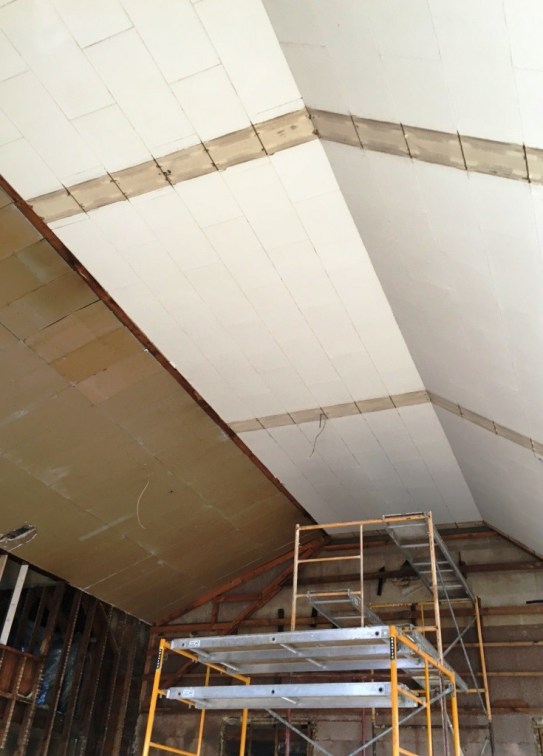
After all those weeks of hand wringing about demoing the ceiling, in an hour our three drywallers had assembled scaffolding to reach to the ceiling and climbed aboard. They climbed up and down like children on a jungle gym. Down came the false ceiling on the balcony side of the sanctuary, the trimmed-out beams (thoughtfully constructed by some church woodworker, but just not the style we were going for—we saved the pieces for reuse), the fiberboard paneling and the ceiling tiles of the angels.

So simple.

By the end of the day, the demo phase of the church renovation was officially complete. Our ceiling had never looked so clean and pristine.

Tyler and I admired it from the safety of the floor.

pristine ceiling

# # #

Tomorrow: Nailed it! Read the story here.

The solution to sag: Structural support

Our story so far: We took steps to be careful as we demoed the interior of the old Methodist church, including hiring a structural engineer to look at the building’s support system and prescribe a fix.

# # #

Tyler and Reroofer with sag
Tyler and Reroofer preparing the space for the new header in the space between the sanctuary and the overflow area.

In the space of about eight hours over two days, Tyler and his help, Reroofer, got the header constructed and put in place, and they reconstructed the choir loft wall (I helped by renting a couple of heavy-duty adjustable floor jack posts and transporting them to the church—I’m handy like that). When they jacked up the floor, the wood gave a great creak and wail, but it cooperated. The second floor was suddenly a lot more level and the opening where the kitchen would be constructed was no longer saggy.

header after
Here’s the space after the new header was installed. You can also see the doorway, above center, where one will exit the second floor onto the to-be-built balcony.

With that task completed, I could put to bed my nightmares of bathing in the upstairs tub—me in my birthday suit relaxing among a cloud of bubbles and a hundred gallons of water—and falling through the ceiling. We were structurally sound now. But we still had to demolish the 20-foot sanctuary ceiling without killing our project foreman.

# # #

Tomorrow: Chapter 15 concludes with a solution to the sanctuary ceiling problem. Read it here.

To rats, bats are angels

Our story so far: Reroofer, the guru who helped us fix the roof of the church belfry, showed up to help Tyler install a new header in the space where we intend to build a balcony into the sanctuary.

# # #

Coincidentally, we had another visitor: A bat, circling the ceiling of the sanctuary.

Um, where did he come from?

We went nine weeks without a sighting of anything alive in the church beyond a few spiders. Reroofer repaired the belfry with much noise and commotion. No bats then.

But now, a bat appeared out of nowhere.

Somehow, the bat got into the basement (if you know anything about the flight of bats, you know this is possible, but difficult to describe, what with all the squeezing tight of your eyes and the screaming). St. Johnny and I chased him around for a few minutes, randomly waving brooms in the air and shooing him out of window wells a couple of times, but he refused to find the exit. Suddenly, he flew into the furnace room.

The dark, duct-filled furnace room with a million nooks and crannies where black bats could hide.

“Are you going in there?” St. Johnny asked me.

It was clear St. Johnny wasn’t going in there.

I peeked inside only long enough to determine the bat wasn’t flying around and wasn’t in the window wells, and slammed shut the door. St. Johnny helped me secure it, and I returned upstairs to where Tyler and his helper, Reroofer, were conferring about the header.

“We trapped it,” I said breathlessly.

“Great,” Tyler said, barely looking up from the architect’s drawings. He was focusing on the bigger picture.

Then I spotted the holes in the floor of the sanctuary. The holes led to the furnace room.

Fortunately, we were surrounded by scrap wood in all shapes and sizes. I gingerly slid a couple of boards over the holes.

belfry demo no bat
Initially, we theorized the bat came from this area of the belfry (the second floor of the belfry is behind that shiplap), which St. Johnny demoed the day before the bat appeared, but upon further investigation, there was no evidence, guano or otherwise, that he lived here.

“Well,” I said, dusting off my hands. “I guess he’s the HVAC guys’ problem now.”

I quickly developed three suppositions to comfort me.

One, out of sight, out of mind. The bat was in the furnace room, and I wasn’t.

Two, a bat, which navigates the night with echolocation, is a guide through the darkness. No one wants a bat in their house, but maybe he was a sign. A good sign. A symbol that we were on the right track.

And three, the bat was in our furnace room. He was not in our belfry.

Then the bat disappeared as mysteriously as he had appeared. Days later, the HVAC guys tore apart the furnace room to prepare for the new ducting, but the bat was gone.

# # #

Tomorrow: Tyler and Reroofer proceed with installing a new header on the main floor of the church. Read it here.

The smallest detail can hold up the whole structure

Our story so far: We crossed a number of items off the “proceed with caution” list as we demolished the interior of the old Methodist church we were planning to turn into a home.

# # #

saggy center
You want Oreos to be soft in the center. Not houses.

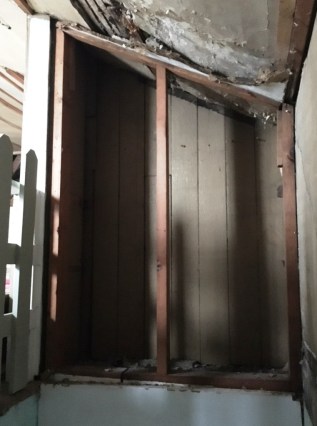
Early on, Tyler suspected the opening between the sanctuary and the overflow area might need shoring up. The archway looked as if it bowed a bit, and not in a quaint or historical way. Further evidence that something was awry: The second floor wasn’t level.


Tyler had installed headers in the past so this discovery didn’t alarm him but I, trained by HGTV remodeling shows, saw dollar signs. Many an open-floor plan had been scuttled by expensive header requirements.

Initially, we believed we could figure out how to design the interior of the church by ourselves. Before we’d closed, we played around with various layouts using freehand drawings and software programs. And we figured people like plumbers and building inspectors would prevent us from doing anything stupid like installing a toilet too close to a vanity or building a hallway too narrow.

But Tyler knew a lot about construction, including what he didn’t know, so he elected to hire an architect with structural engineering knowledge to help him determine precisely where the structural issues were and how to resolve them. We also needed to know how to safely construct the balcony, which hung off this same opening. (When the architect paid us a visit, he also climbed up into the belfry to give it the once over and prescribed new pilings.) After much measuring and calculations and consultation, the architect recommended a new header and a bunch of other technical stuff I didn’t understand. But Tyler did, and we got the design plans to help him carry it out.

After Tyler ordered the specified header, I figured out why they’re costly: It’s not the header itself, it’s the engineering required to prescribe it.

In any case, the header arrived in three parts along with a thousand other pieces of lumber (you think I’m kidding).

Reroofer, the guru who repaired our belfry roof, agreed to help Tyler install the new header. As Reroofer walked into the sanctuary one Friday afternoon, all smiles because he was going to help build something, I think, or maybe he was just happy that day, he pointed up and asked, “What is that?”

# # #

Tomorrow: “That” could be a sign. Read about it here.

The texture of water

Our story so far: We wanted to renovate the 126-year-old Methodist church in a responsible manner since we were going to live in at some point.

# # #

Since we were getting so good at these tests of safety and otherwise, we sprang for a few more.

The Roto-Rooter man scoped our sewer pipes, and his water-proof camera determined our pipes were as clear as a baby’s arteries—no tree roots or obstacles.

So our inside plumbing was in good shape (the little we had of it, what with only a kitchen sink and a half bath). We had our expensive city water tested to reassure ourselves about the quality of the pipe connecting the church from the street. Returning a six-page report, the lab proclaimed our water safe. Yay! (For the price, it should be.) But we also learned it was “very hard” at 25.56 GPG (grains per gallon) and was close to the upper limit set by the Environmental Protection Agency in estimated total dissolved solids. This meant it had a lot of stuff in it (think: dirt). None of the “stuff” was considered a contaminant, but let’s just say it had a little more texture than one might like in a quality glass of water.

drinkpod
The instructions that came with the Drinkpod recommended getting a plumber involved, but Tyler was proud he installed it at our rental house without one.

This meant we would be investing in a total house filtration system and a Drinkpod purification appliance. A Drinkpod is a countertop water cooler with a four-part filtration system and ultra-violet sterilization system. This appliance would become the centerpiece of our beverage bar, the section of our kitchen devoted to all things drinkable, from coffee and sparkling water to beer and wine.

And we weren’t done testing yet. We tested for radon in the basement. Radon is a colorless, odorless radioactive gas that is the No. 1 cause of lung cancer in nonsmokers. Our result was only 1.2 pCi/L (picocuries per liter of air), well below the EPA action level of 4 pCi/L.

Ah, deep breaths.

When we were done, we’d spent more than $300 on various safety equipment and that much again on various safety tests. But our final test wasn’t about particles and particulates. It was about structural support.

# # #

Tomorrow: Old houses are like old ladies: They get saggy. Read about it here.

Well, I have good news and bad news

Our story so far: We tried to be careful and responsible as we demolished the interior of the old Methodist church we intended to turn into our home.

# # #

We also were warned we had asbestos in the walls.

If one thought lead and mold were bad, exposure to asbestos was known to cause lung cancer. And eliminating it was expensive. In fact, it was asbestos that had scared us off from going through with the purchase of a church in Pecatonica at one time.

On this project, however, we’d gotten such a good deal on the church, we figured if we found asbestos, we could afford to pay to get rid of it.

One former parishioner reassured us that only love flowed from those walls, and we believed her. But unlike some matters related to a church, this one we could test. We sent three samples to the laboratory: main floor ceiling tile, main floor wall sample and basement flooring, which looked a little suspicious to us. Within twenty-four hours, we’d learned the ceiling and walls on the main floor were mostly cellulose with no asbestos. Cause for celebration!

basement floor tile
This was an attractive and durable floor covering in its time. But it was not “rustic transitional” and would have to go.

The avocado green basement floor tiles lovingly installed by a couple who were active members of the church when avocado green was in vogue, however, were 3% chrysotile, a Category 1 asbestos-containing material. Category 1 was the least bad of the three types of asbestos, that is, not brittle, breaks by tearing rather than fracturing and does not easily release asbestos fibers upon breaking.

We got a reasonable quote for professional asbestos abatement, but since our structure was now privately owned, we could legally get rid of it ourselves. When we were ready to refloor the basement, we had the Tyvek suits, goggles and respirators to scrape up the flooring if we decided to go that route. But in the meantime, as long as we didn’t disturb the floor tile, we’d be fine.

# # #

Tomorrow: Hey, this testing business is fun! Read about it here.