Our story so far: Five tons of drywall was delivered to the 126-year-old Methodist church we were turning into our dream home.
# # #
Day Two of drywall was less efficient than simple delivery. Our drywaller had subcontracted our job to another team. When they arrived and discovered the job was at a 126-year-old, not-perfectly straight church, and it required five-eighth-inch-and-therefore-heavier drywall, the B Team promptly left.
They left. The dour-faced workers got into their pickup truck and left the scene with nary a word.
I saw them driving away as I walked up to the church. Only I didn’t know they were our workers.
“Where are drywallers?” I asked Tyler, who was busying himself with one of the other thousand details requiring attention.
“They left.”
“Are they coming back?”
“I don’t know,” he said.
Well, they didn’t come back.
After regrouping with Tyler and explaining what the B Team didn’t verbalize before departing, our drywaller agreed to use his A Team, the same men who’d had so skillfully finished our sanctuary ceiling, but it would take longer. Despite hearing echoes of “Two weeks! Two weeks!” in my ears, we readily agreed.
# # #
Today’s headline is a quote often attributed to Leonardo Da Vinci and sometimes to Pablo Picasso. And the message in the church sign is a paraphrase from a sermon by Pope Francis.
Tomorrow: The walls made by drywall. Check it out here.
Our story so far: Spring arrives, and with it, a new phase in the more than five-month-long renovation of the 126-year-old Methodist church into our home: Drywall.
# # #
Upon mentioning the advent of drywall, friends in Great Britain who coincidentally were renovating their kitchen remarked on the differences in English terminology. In Wisconsin, drywall came in panels made of gypsum plaster pressed between thick sheets of paper. In Great Britain, a dry wall was a wall of stones without mud in between them. Brits, my friend informed me, use either wet plaster brick or block external walls; plasterboard—the equivalent of drywall panels—is used on internal stud walls. I was reminded of the old days when I visited London frequently for work, stuffing my luggage in the boot (that is, the trunk) and dining on lunches of prawn sandwiches garnished with rocket (shrimp sandwiches with a side of arugula).
The church gulps in sheet after sheet of drywall.
Day One of drywall was delivery day. Tyler removed windows on the first and second floors, and two fully equipped guys pulled five tons of drywall from a flatbed truck into the church in a couple of hours.
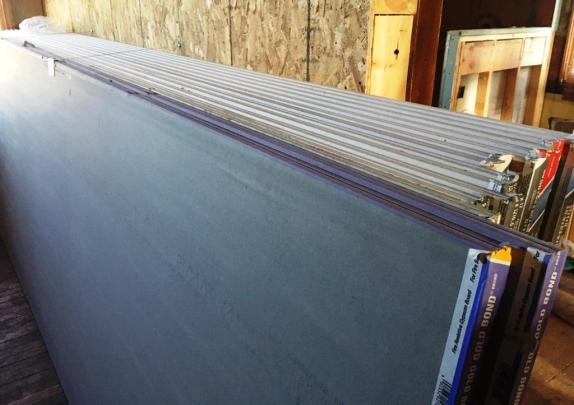
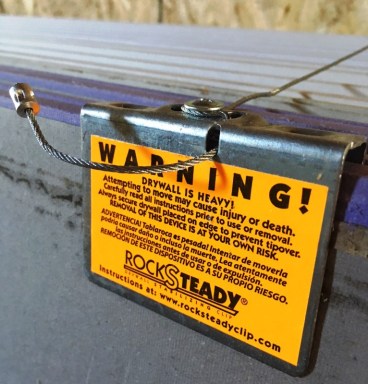
This stack represents only about one ton of drywall.Kudos to the guy (or gal) who developed this brand name: RockSteady. For a drywall stabilizing company. Clever.
We got rid of two thirty-yard dumpsters full of extra weight, and now we were replacing all it and then some. Drywall was so heavy, as a matter of fact, it was dangerous. The delivery guys wired stacks of four-by-twelve-foot sheets against the walls of the church with little warning clips: “Warning! DRYWALL IS HEAVY! Attempting to move may cause injury or death.”
Not that I needed another reminder of the weight of construction materials. There is a reason you don’t see old ladies with no upper body strength working in the construction industry. I struggled to lift pretty much everything. (Except insulation. That was easy to lift. Hard to manipulate.) Lumber was heavy. Five-gallon buckets of paint were heavy. Tile was really heavy. Sledgehammers? Solid-wood doors? Drywall? Rebar? Brick? Well-constructed cabinets? All of it reminded me how little strength I had ever, let alone now in my fifties. Before our construction project, I puffed up my chest when I was able to open a bottle of spaghetti sauce by myself. I wasn’t built for this.
# # #
Tomorrow: Day Two of drywall doesn’t go so well. Read about that fiasco here.
Our story so far: After months of demolition, framing and mechanicals, spring arrived at the church we were turning into our home, and we looked forward to the next phase: Drywall, Paint & Flooring.
# # #
The final task Tyler completed before the drywall was hung was to install the front doors. Remember? The doors for the man’s home that is his castle? We’d purchased them off Craig’s List months ago now, and they were stored in the basement, awaiting their final home. Initially, we thought we’d wait until everything else was finished, but Tyler thought it better to let the drywallers work around the castle doors, rather than pull apart their careful work later only to do it again.
The enormous arched door frame was so large, we couldn’t fit through the basement door, so it had been moved around the sanctuary fifteen times while various contractors worked around it. Now Tyler pulled off the exterior siding on the front entryway, and You-Can-Call-Me-Al helped him slide the door frame into place. Tyler’s hired man St. Johnny helped hang the heavy doors in the frame, and You-Can-Call-Me-Al performed the required cosmetic surgery so they swung smoothly.
All winter and early spring, the only evidence of any activity inside the church was the string of pickup trucks parked outside of it. Now, the whole world could see a hint of the transformation in store for the rest of the structure.
Our rustic castle doors with operational speakeasy portals were absolutely the perfect doors for the church. Even before we put back the siding and installed the exterior lights or even door handles, we earned compliments from friends and passing strangers on this exceeding public design choice.
They made me so happy.
# # #
Tomorrow: Drywall delivery day. Read about it here.
Our story so far: The building inspector approved the rough-in in our renovation of the old Methodist church into a home.
# # #
As we neared the end of the Framing & Mechanicals phase of construction, Tyler was on box seven of nails for his air nailer. A box, you might recall, had a quantity of two-thousand nails.
And two-by-fours? He estimated we’d used at least one-hundred-and-fifty in constructing walls and ceilings inside the church. The Framing & Mechanicals phase had dragged on nearly twelve weeks, four weeks longer than demolition which had felt like it would never end. We were excited for the phase that signaled the most dramatic physical changes in the church.
Besides nails, lumber and lassitude, a measure of the effort we’d put into our construction project was Tyler’s belt.
During the first three months, he tightened his belt by about a notch a month. By Month Four, he had to bore a new notch in his belt, and that was apparently still not enough. One day, he had one hand on his air nailer and the other on a ceiling joist to hold it in place while he secured it. In front of an audience of St. Johnny, the carpenter helper, our electrician and an HVAC guy, Tyler’s pants fell to his ankles.
He ho-ho-hoed his way through a situation that would have mortified anyone else, but thank goodness he was wearing his new, snugly fitting underwear.
Another measure of our effort? Splinters and gloves.
Tyler picked wooden splinters out of his digits nearly every night as he sat on the couch decompressing from another long day. I wasn’t so rugged; I wore gloves.
Tyler had purchased a big box of cotton brown jersey gloves for me and his hired man to use. They were handy (get it? Handy gloves?) but too big for my slender (some might say bony) fingers. During the demolition phase, I’d run across a pair of work gloves that had belonged to the “DCE,” as evidenced by the Sharpie marker labeling. The only DCE this Lutheran had ever heard of was the Director of Christian Education, so I imagined the Methodist DCE had left them behind. They fit perfectly, so I commandeered them.
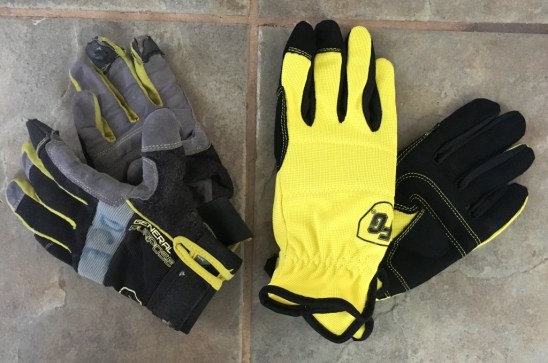
Four months and countless nails, pieces of wood and rolls of insulation later, the seams began splitting. I’d never worn out a pair of work gloves before. Before the church, I’d never even owned a pair of work gloves. I was never a gardener, and my hobby involved using writing utensils, not hammers. When more of my fingertips were bare than protected, I complained to the foreman that I needed a new pair of gloves “like these,” I said holding up my threadbare DCE gloves. Two days later, Tyler returned home from another trip to Home Depot with not one, not two but three pairs of work gloves eerily similar to my DCE gloves.
I would not be able to complain about my work gloves again.
My old gloves went into the trash right after I took this picture.
# # #
Tomorrow: Last-minute installation. Read about it here.
Our story so far: A new phase of construction arrived with spring as we renovated a 126-year-old Methodist church into our home.
# # #
The renovation phases in our project didn’t always have clearly defined beginnings and endings. Phase One, demolition, clearly began the day we purchased the church, but it continued into the mechanicals phase and beyond as we discovered new walls, windows and cubbies that required dismantling before we installed something new.
Similarly, Phase Three of drywall, paint and flooring began as soon as the drywallers finished demoing the sanctuary ceiling. They immediately drywalled and painted it, and the ceiling simply overlooked all the work being done during Phase Two of framing and mechanicals.
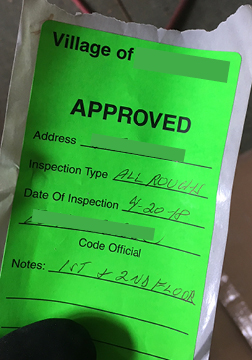
But we treasured a clear marker at the end of framing and mechanicals. The building inspector officially approved our rough-in. Approval! This was necessary in order to proceed with covering the studded walls which contained all the precious and expensive—but unimaginative—plumbing, wiring and HVAC ducting. Finally, the dirty demolition phase and boring mechanicals phase were behind us. Let the fun begin!
# # #
Tomorrow: Measures of our success. Read about them here.
Our story so far: While Tyler built walls and ceilings, the HVAC guys, the plumber and the electrician worked their magic in the 126-year-old Methodist church we were turning into our dream home.
# # #
Chapter 23
Notwithstanding a late-spring snowstorm that left inches of heavy, wet snow behind in Old Man Winter’s ridiculously long wake, spring arrived and so did Phase Three of our renovation: Drywall, Paint & Flooring.
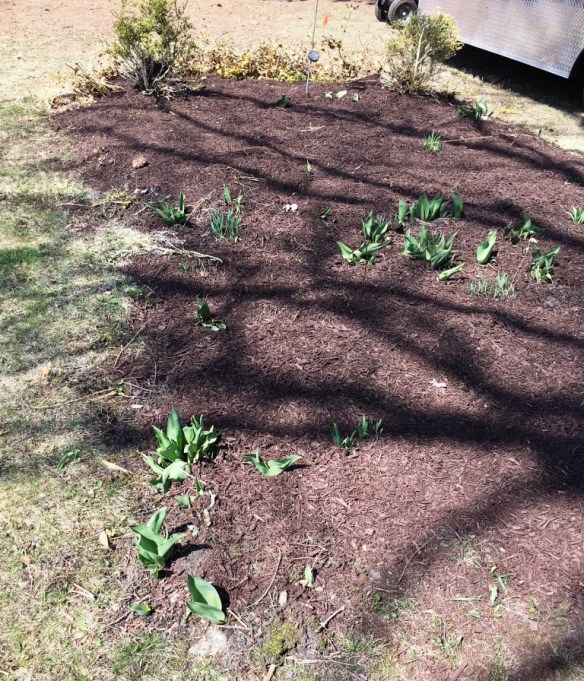
Could those be tulips growing in my yard?
Long, sunshiny days replaced months of gray skies. Slivers of green poked through dirty snow. Though strange to hear birds singing as I tramped over snowy sidewalks no one bothered to shovel because they knew it would melt soon enough, I shed my fleece scarf as I inhaled the frosty air on my way from the rental house to the church in the morning. Spring was my favorite season of the year, and ever-widening sidewalks were as distinctive a turning point to me as robins. Growing up, I walked to school in north-central Minnesota; in winter, it was a slippery trudge in boots, but in springtime, I could skip over clean concrete in my Nike tennies.
You can see the sap dripping from this cut in our maple tree.
Earlier, before the snowstorm, Tyler made note of the maple tree in our front yard that was dripping sap like mad. In another spring when we weren’t so preoccupied by construction, he planned to tap the tree for its sweet syrup. Leafy green perennials in every corner of the yard toughed out the white stuff. It looked like we’d have blooms of some sort soon. Tyler’s hired man St. Johnny spread a load of mulch around trees and over the flower bed once tended by members of the church.
Our freshly mulched flower garden.
Soon, we would have to mow. Tyler also snapped up a deal on eBay for a riding lawnmower he intended to teach me to use. I preferred the push variety, and I scoffed that we’d have any yard left after he poured concrete for the driveway and garage, but I couldn’t complain too long. The practically new mower was a good deal, and we picked it up from the seller less than forty minutes away.
# # #
Tomorrow: We pass the test. Read more about it here.
Our story so far: As reality has caught up with this blog about converting a 126-year-old Methodist church into our home, I’ve run across a few odds and ends that occurred after I wrote about the subject initially. That’s how it goes with a real-time memoir. Sometimes stuff happens after publication. So this week, I’m sharing a few little stories that will ultimately be integrated into the relevant location in the memoir. Think of this as the time in the novel—especially a mystery novel—when you page back to reread a few passages to remind yourself about what’s going on. Here’s an update for Chapter 21.
# # #
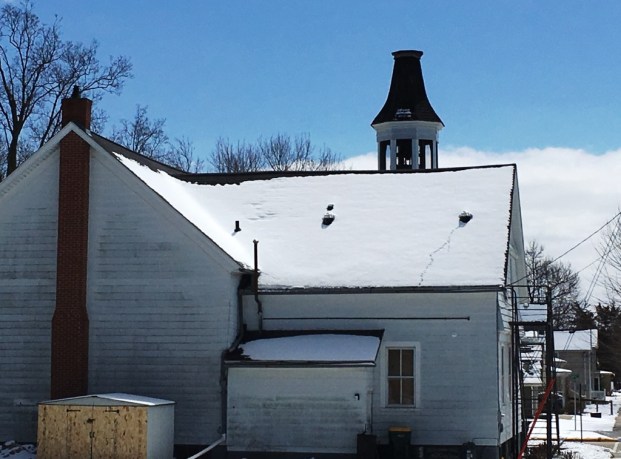
As demoralizing as it was to see snow in April, it was nice to see how long it lasted on our well-insulated roof.
With the assistance of Reroofer, our agile roof walker, we pumped a thousand dollars of blow-in-insulation into the roof of the 126-year-old Methodist church. The proof was in the pudding, or in this case, in a late spring blizzard. Thanks to all that insulation keeping the heat inside, our house was the last one in the neighborhood with snow on the north roof.
# # #
Tomorrow: We return to the real-time memoir with the opening of Chapter 23. Finally, spring arrives. Read it here.
Our story so far: As reality has caught up with this blog about converting a 126-year-old Methodist church into our home, I’ve run across a few odds and ends that occurred after I wrote about the subject initially. That’s how it goes with a real-time memoir. Sometimes stuff happens after publication. So this week, I’m sharing a few little stories that will ultimately be integrated into the relevant location in the memoir. Think of this as the time in the novel—especially a mystery novel—when you page back to reread a few passages to remind yourself about what’s going on. Here’s an update for Chapter 21.
# # #
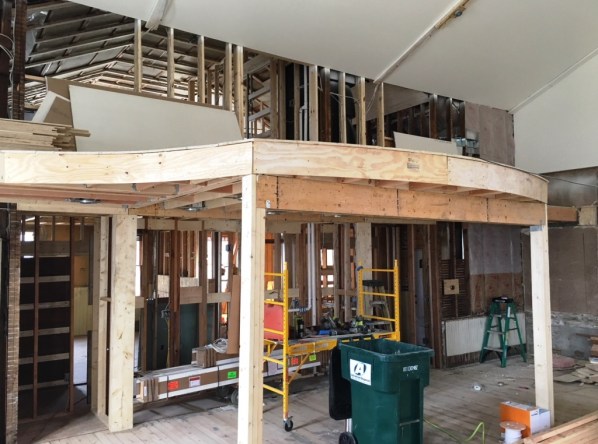
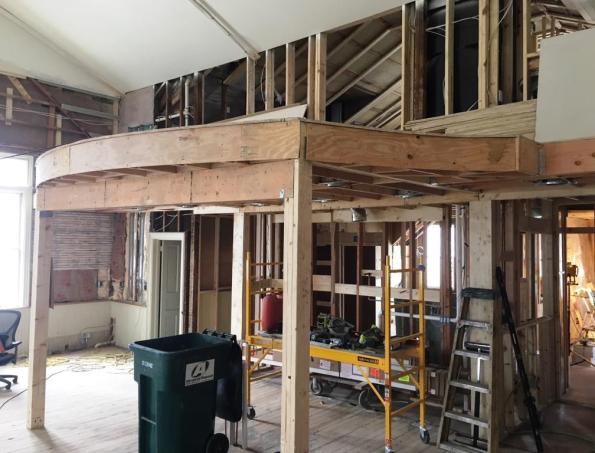
To wrap up the balcony, Tyler constructed cross joists from the pergola to the north and south walls of the church. These were narrower than the center part of the balcony in order to clear the spiral stairway on the north side and the front window on the south. With the science part complete, a bit of art was necessary to draw the main part of the balcony together with the narrow part; Tyler planned a dramatic scallop and swoop to soften the edges of the balcony.
You-Can-Call-Me-Al was an even better carpenter than he was tiler. He picked up in execution where Tyler’s grand plans left off, and he built the most graceful sweeps constructed of wood you’ve ever seen.
South scallop and swoop.View of the sweeping balcony from the north.
Our story so far: As reality has caught up with this blog about converting a 126-year-old Methodist church into our home, I’ve run across a few odds and ends that occurred after I wrote about the subject initially. That’s how it goes with a real-time memoir. Sometimes stuff happens after publication. So this week, I’m sharing a few little stories that will ultimately be integrated into the relevant location in the memoir. Think of this as the time in the novel—especially a mystery novel—when you page back to reread a few passages to remind yourself about what’s going on. Here’s an update for Chapter 20.
# # #
Those cute niches flippers always build into the shower wall on HGTV look so pretty when the house is staged with candlelight and floral arrangements, but in practical use the shower niche is an eyesore of mismatched face wash and deep conditioners.
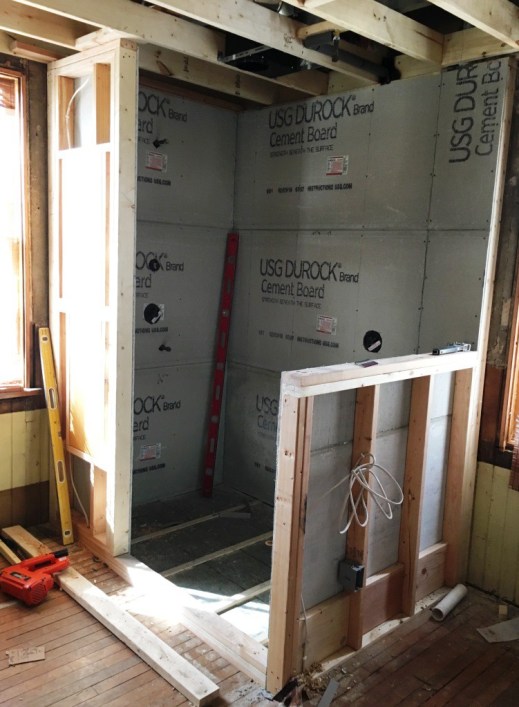
This image of the shower-in-the-rough is taken from the bathroom doorway. Initially, the shampoo niche was planned for the wall hidden by the floor-to-ceiling partial wall.
In the initial design of our custom shower, we intended to hide our extra-large shower niche in the corner, mostly hidden by the wall to which the glass door would be attached. At least our shampoo would be mostly obscured to looky-loos poking their heads inside our master bath to get a look.
Instead, the shower niche (extra large, of course) would be hidden inside the partial wall, completely hidden from the bathroom doorway.
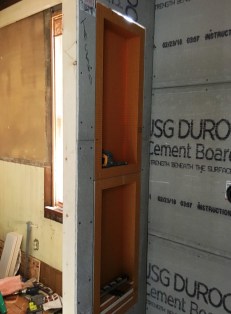
But then we discovered the pre-engineered insets wouldn’t fit between the studs on that wall. You-Can-Call-me-Al offered to create a custom niche, which was a reasonable solution until Tyler discovered the inserts would fit neatly inside the glass-door wall. Even better, our niche would only be visible from the shower. Ta-da! No more ugly shampoo cluttering the impressive view of the shower.
Happy accident.
# # #
Tomorrow: What do you mean, balcony swoop? Check it out here.
Our story so far: As reality has caught up with this blog about converting a 126-year-old Methodist church into our home, I’ve run across a few odds and ends that occurred after I wrote about the subject initially. That’s how it goes with a real-time memoir. Sometimes stuff happens after publication. So this week, I’m sharing a few little stories that will ultimately be integrated into the relevant location in the memoir. Think of this as the time in the novel—especially a mystery novel—when you page back to reread a few passages to remind yourself about what’s going on. Here’s a little more for the story in Chapter 20.
# # #
The tiler I met at the post office, You-Can-Call-Me-Al suggested we buy our tile from a Big Box home improvement store so if he ran short we could easily and quickly resupply him. So the tile I chose was off the shelf. Only our nearest Home Depot did not have enough of the shower floor tile on its shelf, so I ordered the twenty-four tiles we needed from the warehouse to arrive Monday.
The basketweave pattern for the shower base was elusive.
They didn’t arrive Monday. And it didn’t arrive the following Monday either. By now, You-Can-Call-Me-Me-Al was assembling the foundation and waterproofing for the shower. He couldn’t begin tiling until he had the shower floor tile. The entire project was about to come to a standstill because the warehouse couldn’t deliver on the promise.
Tyler bawled out the store manager who ultimately offered us a 20 percent discount on another choice of tile. But we didn’t want another choice. Some pointed questioning led us to discover nearby Home Depots carried the tile but none of them had the volume we needed.
But a brief trip to Minnesota to visit family during a rare spring blizzard offered up an answer. I visited four Home Depots in the Twin Cities metro area to piece together enough square footage to keep You-Can-Call-Me-Al in tile for the duration of the project.
Our timeline was saved by mass production and suburban convenience.
 They left. The dour-faced workers got into their pickup truck and left the scene with nary a word.





 Church Sweet Home