Our story so far: We’re waiting (and waiting) to close on the 126-year-old Methodist church we intend to renovate into our home.
# # #
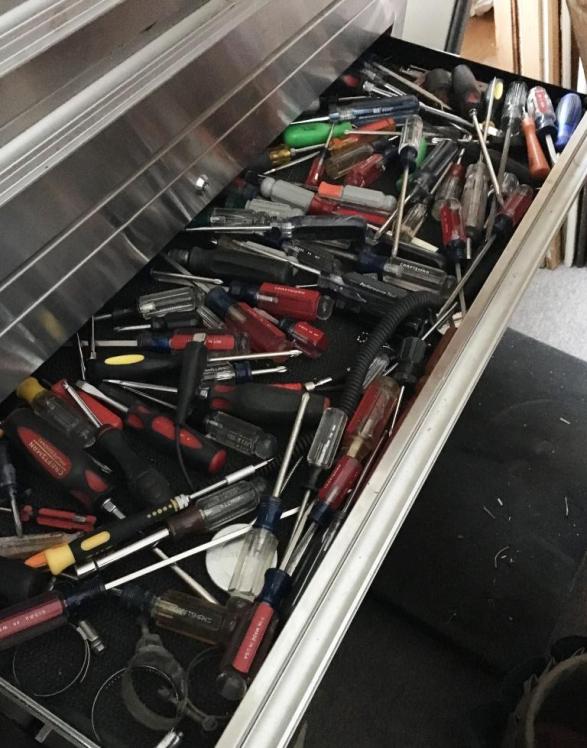
On Black Friday, Tyler got up before the sun did to wait in line at the nearby Home Depot. He arrived back at the rental house before I’d had my first coffee with orders:
“Help me get this thing unloaded.”
The thing was a tool chest. Or, more precisely, another tool chest. If I had a thing for books (and I did), Tyler had a thing for tools. Every time he used one of his tools to fix something or save us the cost of hiring someone to do the work, he reminded me: “I couldn’t have done that without the thingy-whatsit, you know. Aren’t you glad I have so many thingy-whatsits?” Only he didn’t say thingy-whatsit. All his tools had specific names and uses that somehow eluded me. I understood hammers and screwdrivers; I could even differentiate between a flat-head screwdriver and a Phillips screwdriver. But I could never remember the difference between a wrench and a pliers. And God help me if he started lauding the values of various kinds of saws.
All of these various implements required storage (of course—what’s jewelry without a jewelry box?). We might need a screwdriver or a wrench or a pliers (or a measuring tape or a sledgehammer) to transform our church into a house so thank goodness he found a tool box at Home Depot, right?
“It was too good a deal to pass up.”
Sort of like the church, I suppose.
# # #
Tomorrow: Are you as tired of waiting for us to close on the church as we were? Then don’t miss tomorrow’s segment. Read it here.
Our story so far: My husband Tyler picked up a lot of experience when he undertook a mammoth project back in the early 1990s to renovate an old tobacco farmhouse without any modern amenities into his house.
# # #
One of the things I like to say about my enterprising husband is that he is one to go big or go home. He likes big steaks, big trucks and, fortunately for me, big women (or at least tall ones; I’m 5-foot-10). Our RV is among the biggest on the road, and of course, he’s fond of big houses, too.
Tyler’s addition to his reno house nearly doubled the original square footage.
This first renovation project was no different. Once Tyler had the old tobacco farmhouse livable, he decided he needed more space. So he built a 24-by-36-foot two-story addition; the main floor was the family room and above it was the master bedroom. (He deconstructed the Swedish wood stove and moved it to heat the addition.) And then he built a three-car garage on the other side of the farmhouse.
When I say “he built it,” I’m being literal. He would frame one wall and invite a buddy or a relative over to help him stand it up. People who know Tyler won’t be surprised he paid his buddies in beer. A lot of beer.
The entire project took just less than two years to construct. Five years after he and his wife bought it, they moved to Minnesota. They sold the old tobacco farm for ten times what they’d paid to purchase it.
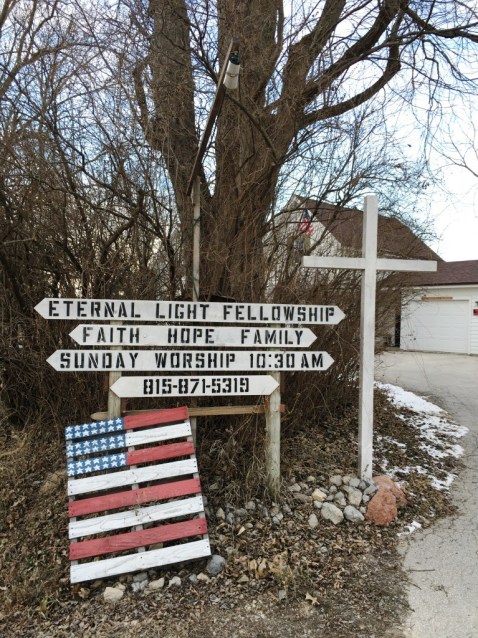
Ironically, Tyler’s old tobacco farmhouse transformation was big enough to house a whole congregation—let’s call it cathedral big. We drove by it not long ago, and there’s cross, a flag and a rustic sign out front that reads “Eternal Light Fellowship/Faith Hope Family/ Sunday Worship 10:30 a.m.”
That’s Tyler first renovated house, er, church, in the background.
# # #
Tomorrow: Chapter 8 opens with a moment of gratitude. Read it here.
Our story so far: My husband Tyler intends to draw on his previous experience in the early 1990s transforming an old house on a tobacco farm as he faces the renovation of a 126-year-old Methodist church into our dream home.
# # #
When Tyler acquired the property, the first step was emptying the place of the decades of cigarette rolling papers and other assorted junk accumulated by two old bachelors. The unfinished half-story had two old iron beds with four-inch thick mattresses. Tables on each side of the bed were piled high with identical clothing for the brothers: Bib overalls, stained V-neck T-shirts and union suits in varying degrees of being worn out. Behind the tobacco barn, near a plow and disc (put into use in their time by mules) stood a stack of aluminum pie tins as tall and as wide Tyler.
“There must have been more than a thousand,” Tyler mused when he told me about his project. Here his story deviated a bit from renovation concerns to memories of this property.
“Back there was a stump, too, the brothers used for butchering chickens,” he recalled. “I did, too. There was a broad-head axe hanging in the tobacco barn that I still have, and I used it to cut the heads off the chickens I grew in the yard. My grandma Blair helped me. I chopped the heads off, dipped them in a caldron of boiling water, and Grandma did the feathers. I can still see her there in a lawn chair plucking feathers.”
“Did they taste good, those chickens?” I asked, thinking of a book I’d read recently about how free-range chickens in decades past have so much more flavor than mass-market chicken breasts of today.
“They were the best chickens I’ve ever eaten,” he remembered.
Tyler at work on his first reno, circa 1992.
Tyler returned to remembering his renovation experience and the difficult physical labor required to pull off such an undertaking. After cleaning up the property, he knocked all the horsehair plaster and lathe off the walls of the farmhouse, installed 100-amp electrical service and wired the whole house. Tyler had taken vocational classes on electrical and picked up real-world experience by wiring rental housing and cabins with his grandfather. He installed a high-tech (at the time) Swedish wood stove outside and ran HVAC channels to heat the entire house.
Then he ran PVC pipe throughout the structure in order to bring running water (from a new well) inside to the kitchen, two bathrooms and a second-floor laundry. As the days turned into weeks, he put in his own septic system. The neighbor dug the trenches with a backhoe, Tyler laid the pipe and rock, and a guy came out to set the tank.
The septic system passed inspection. The plumbing passed inspection. The electrical passed inspection. Now it was habitable.
The basement was another phase. Years before, his parents figured out a masterful method for keeping the teen-aged Tyler busy: He dug out their entire basement by hand. So he put that experience to good use by digging out the tobacco farmhouse basement the same way, moving out the dirt with a little elevator into the back of a pickup truck. Once it was deep enough to stand up in, he poured a cement floor.
# # #
Tomorrow: Tyler’s first whole-house renovation comes to a surprising and possibly ironic conclusion. Read it here.
Our story so far: We’re waiting impatiently for the seller of the church we want to buy and turn into our home to conjure up the paperwork necessary to provide a clear title.
# # #
In retrospect, I believe God was giving us a break. An opportunity to catch our breaths and think. A few weeks of rest. But at the time, the delay was maddening. Here we’d finally gotten our heads around the idea that we weren’t going to live in the camper and travel the country indefinitely, and we’d decided to jump back into the real estate market. We’d found a property we were pretty confident we couldn’t lose money on no matter what Wall Street did to Main Street. We’d created a renovation plan. We’d determined we could agree on the style of our kitchen backsplash, the fireplace mantel and the color of the paired sectionals with which we planned to furnish the great room. But we couldn’t actually do anything other than shop.
This was problematic since we no longer owned a garage in which to store the amazing deals Tyler scored on Amazon Prime and Craig’s List. On a brief business trip, we visited an expansive architectural salvage store with historic doors and unique bathroom fixtures, but we couldn’t buy any of it. Nowhere to put our treasures. Tyler found an amazing store of used construction materials in greater Chicago selling 23 pieces of solid wood kitchen cabinets in the perfect shade of cream. Upon inspection, they were the perfect shade of yellow so we didn’t invest in them, but we were awed by bathroom vanities in every shade of the rainbow and the doors in widths from 27 inches to 32 inches. Too bad we didn’t know exactly how wide we’d need our doors. Or how many for that matter.
The visits to seconds shops cemented our decision to pursue this renovation with as many pieces of recycled materials as we could find. We’d sold most of our furniture when we vacated our home a year before, and we were horrified by how little other people valued our belongings. We’d vowed never to buy new unupholstered furniture again (upholstered furniture of unknown origin, not so much).
Our lack of storage space didn’t prevent Tyler from stopping at an estate sale and finding an ornate Mirror, Mirror on the Wall for the front entryway. He also scored a bathroom faucet, sink and vanity from Craig’s List. He purchased two-by-fours and built eight saw horses. All of these finds, he stashed in the garages of his cousin and his mother (sometimes over their objections).
# # #
Tomorrow: Chapter 4 concludes with the creation of a new plan. Read it here.
Our story so far: We’re filling our time waiting to close on the church we plan to convert into our home by creating budgets and making plans.
# # #
As the prospect of freezing temperatures became ever more real in our camper, we debated how long it would take for us to acquire a habitation permit from the village.
The building inspector told Tyler he required an operational bathroom, kitchen and bedroom before he would allow us to occupy the church. So simple! Just three rooms!
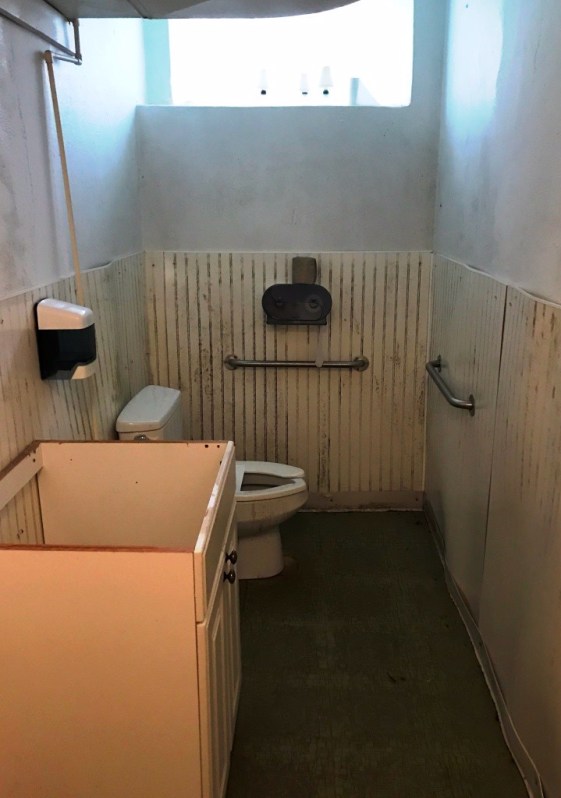
Check out that sweet bathroom. Just kidding. It’s hard to see but that’s not one, not two, but three room deodorizers on the window ledge.Well, we had a toilet in the basement.
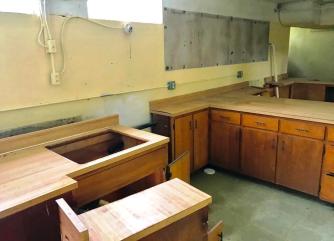
The church kitchen in the basement in all its “before” glory.At this point, we didn’t even have running water. The congregation had turned it off sixteen months before when they vacated the church building to merge with another congregation in a nearby city. They took all the pews, the pulpit, the altar and both the bathroom and kitchen sinks. The basement kitchen countertops existed but were unmoored from the walls.
On the third showing at the church when we found Stan the squirrel, we discovered puddles of water in the basement. The caretaker, who noticed us at the church as he drove by, came inside to tell us the basement always got water when it rained. Shouldn’t a caretaker do something about that? I wondered silently.
A basement prone to flooding was probably not a great place for a bed.
Tyler spent a month scheming about plumbing in order to construct a bathroom shower and install new (or newish) sinks. He consulted with an electrician. He called an HVAC guy to schedule a furnace check. And he pondered how we might keep our sleeping area free of construction dust. We could take our time once we were living inside the church, but speed was of the essence in getting it livable.
Every day the church failed to conjure up the necessary documents for closing the deal put us more on edge. Tyler would lay awake at 2 a.m. thinking about 100-year-old lead pipes and drain vents. For me, the sleeplessness came at the beginning of the night. I would watch HGTV for hours before retiring for the evening, and then I’d lay awake re-arranging the location of the main floor laundry and dining room table. Or I’d scroll through pages on Pinterest looking at rustic accent walls, vaulted bedroom ceilings and DIY entryways only to dream about them later.
# # #
Tomorrow: Chapter 4 continues with a description of the wonders of architectural salvage. Read it here.
Our story so far: A cursory inspection reveals the roof of the belfry in the church we planned to buy was in terrible, possibly dangerous condition.
# # #
Stairway to heaven? These were the exterior stairs Tyler described using to repair the belfry.
Initially, in the privacy of our bed in the early morning hours as we dreamed of our church, Tyler cooked up the idea that he could use the emergency stairs that were attached to a different side of the house to repair the belfry himself. He described in alarming detail how he could move the stairway around the building, climb up twenty-five feet, deconstruct the belfry piece by piece around the bell and rebuild the roof.
In November.
I forced him to recount his brilliant plan in excruciating detail to both of our children in the hopes that they would dissuade him of such lunacy (again with the crazy!).
The light of day and after the encounter with Stan the mummified squirrel when Tyler had gotten a good look at the damage, he realized we needed to get professionals involved.
# # #
Tomorrow: A mummified squirrel is nothing compared to the terror of a quote on belfry repair. Read it here.
Our story so far: The owners of the church struggle to come up with the paperwork to sell it.
# # #
When our offer was about to expire on Halloween, the seller ominously requested two more weeks. All Hallows’ Eve, or the evening before All Saints’ Day known popularly as Halloween is the time in the liturgical year dedicated to remembering the dead, including saints (“hallows”), martyrs and all the faithful departed. Though frustrated, we didn’t want our deal to die. We were faithful. But the “two more weeks” sounded like a warning.
Home remodeling fans surely recall the infamous line from Tom Hanks in the movie “The Money Pit.” Everything was going to take two weeks. Construction. Reconstruction. Repairs. Finishing. Everything was “two weeks.” In the beginning, the unfortunate home owner played by Hanks asks a contractor, “When I do get the permits, how long will the job take?”
“Two weeks,” the contractor says.
“Two weeks? Two weeks?”
“You sound like a parakeet there. ‘Two weeks! Two weeks!’” the contractor mocks.
“Well, two weeks. It—it’s amazing,” says Tom Hanks’ character, shaking his head.
“’It’s amazing’ nothing,” the contractor says under his breath as he drives away in a pickup truck. “It’ll be a regular miracle.”
At this point in the game, we were depending on that miracle. Because without it, our water lines in the camper were going to freeze and we’d be two shivering homeless grandparents-to-be.
# # #
Tomorrow: Chapter 2 opens with a meditation on the meaning of crazy. Click here to read.
Our story so far: We make an offer on the church and set a closing date of no later than Oct. 31.
# # #
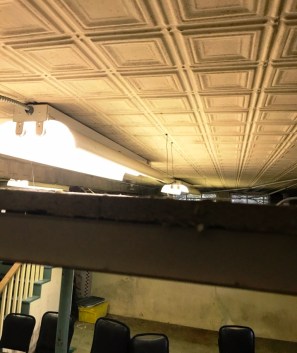
One of the “exciting pictures” Tyler studied shows the tin ceiling in the basement hidden behind a suspended ceiling.
We spent days dreaming of lighting fixtures and polished hardwood floors and furniture layouts. Truth be told, my husband also spent many hours studying the pictures we’d taken of the interior of the church and thinking up ways to run the plumbing and electrical. Because he was the real brains of this operation. I was just the grunt labor and, on good days, the window dressing. He even met with the building inspector and talked about rezoning regulations and building permits and water meters.
But as good as he was at construction projects, he was no good at waiting. We were living in a camper, and the nights in northern Illinois were getting cooler. And then colder. If we couldn’t get into the church and make it habitable, we would have nowhere to live while we worked. As the days turned to weeks, he began calling every day our real estate agent (who was earning only a tiny commission on our miniscule offer). And then he began calling the title company. And finally, he called the pastor directly.
Tracking down the proper paperwork to sell a 126-year-old building that been owned by a church that’s changed affiliations at least once and then merged with another congregation abandoning the building is tricky, it turns out. How tricky? About two months and half months of tricky.
# # #
Tomorrow: Chapter 1 concludes with an ominous request that feels like a warning. Click here to read.