Inch by inch, and row by row

Our story so far: We closed the real estate deal on an old Methodist church, and embarked on weeks of interior demolition to turn it into our house.

# # #

Near the end of demolition, progress was being measured inch by inch. Tyler pulled up the carpeting in the main sanctuary, cut it into four big hunks, and it was all we—Tyler, the hired man St. Johnny and I—could do to haul/drag each dusty, unwieldy piece to the dumpster. Then, what we were left with was about five thousand carpet staples stretching out to infinity across the floor’s horizon, each one securing a piece of carpet padding to the Douglas fir hardwood flooring.

staples before and after

I spent hours pulling staples, and carefully feeling the floor with my fingertips to make sure I got all of them. It wouldn’t do to have any staples or nails in the flooring when we were ready to sand and restore the hardwood to glory.

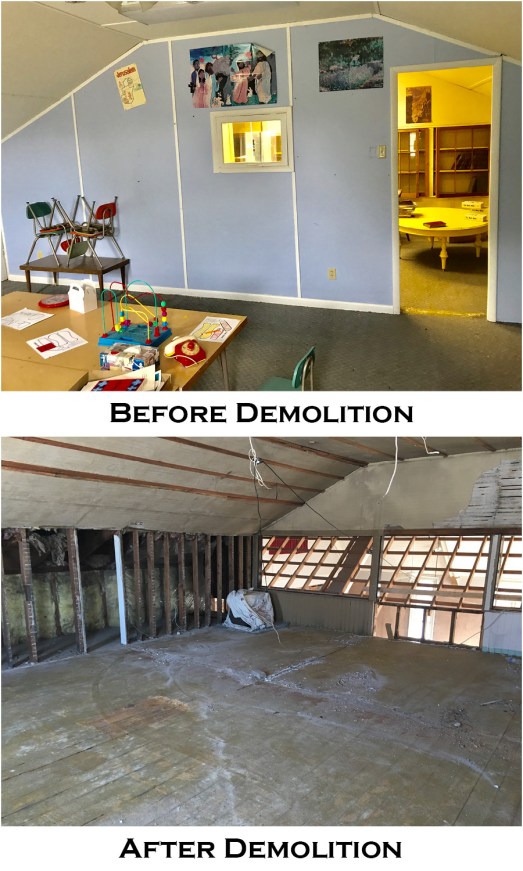
About six weeks into the project, we’d cleared the second floor. Gone were closets under the eaves, the walls, a sweeping swath of the choir loft ceiling and the carpeting. We were down to the studs as they say in the business. The only thing left was a gas heat stove in the corner, which could not be removed until after the plumber went to work and disconnected the gas line.

Second Floor Before and After

I longed to sweep (and I never longed to clean anything as more than one roommate can attest), but Tyler put me to work on other tasks; he didn’t want any more dust in the air and he knew there were weeks of dust ahead of us. Still, the area that would someday soon be a bathroom, a bedroom and my office looked great. Finally, we’d uncovered the blank slate for which we were looking.

# # #

Tomorrow: Chapter 12 opens with an ode to public utilities. Read about it here.

How to get rich selling demolition waste

Our story so far: The demolition phase of converting our old Methodist church into a home included a couple of dumpsters and a lot of trips to Goodwill.

# # #

We tried to be good stewards of our unwanted demolition waste. To avoid filling a landfill, we gave away a lot of things, but when the opportunity to presented itself, we were open to selling items. With mixed results.

I packed up a box of Christian books and tried to sell them at Half Price Books. I got $2.80. I immediately invested in a $3 copy of The Complete Idiot’s Guide to the World’s Religions. I figured any woman who thought living in a church was a good idea really ought to educate herself on all things spiritual.

Then, after the second guy in a beat-up pickup truck stopped to ask if he could haul away the scrap metal we’d piled up outside next to the church, Tyler and I took it upon ourselves to see how much it was worth.

One warmish afternoon in January, Tyler and I piled all the siding Reroofer tore off the belfry and about a hundred miles of suspended ceiling grid into the back of our beat-up pickup truck and drove to a scrap metal yard about ten miles away.

We stopped for lunch. Because we worked up an appetite filling up the truck.

We spent $14.23 on a couple of bowls of homemade soup and a salami club sandwich, which we split. And, because it was a bakery, Tyler got a dynamite apple fritter for dessert.

We proceeded to the scrap metal yard where a couple of overall-clad fellows helped us separate the more valuable aluminum siding from the steel scrap. Our booty was weighed, and they handed us a check for $30.24.

After factoring in the gas required to transport our scrap metal, we each earned roughly $7 an hour plus lunch.

Which was a vast improvement compared to how we spent the next two hours. We priced bathtubs, kitchen cabinets and flooring to use on the ceiling of the second floor. Big price tags, them all.

We still hoped to sell the exterior staircase at some point. Surely someone—with a cutting torch or a long trailer—needed a fire escape.

exterior staircase
For sale: One fire escape, barely used.

# # #

Tomorrow: What we didn’t find during demo. Click here to read it.

Of two minds on the divider

Our story so far: If we couldn’t repurpose the things we found in our old church during demolition, there were three ways to get rid of items we had no use for: Throw them away, give them away, sell them.

# # #

During demo, I made several trips to Goodwill and Habitat for Humanity’s Restore. Some furniture, light fixtures and even Christmas trees were our trash, but some other man’s treasure.

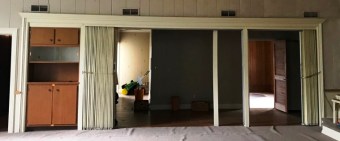
built-in
Though difficult to see in this picture, the built-in cabinet on the right has crosses carved into the upper doors.

On an early trip to the Restore (which accepts construction materials and operational appliances and resells them for Habitat for Humanity’s housing program), I tried to talk the manager into taking the built-in cabinet and accordion room divider that had been between the sanctuary and the overflow space.


Tyler and the hired man St. Johnny loaded them into our pickup and secured them for the 20-mile journey to a new life, and I was assigned transportation responsibilities.

I pulled up to the drop-off just as a garbage truck pulled into the lot to empty the store’s dumpster. While the truck’s beep-beep-beep created background music, the Restore manager eyed my goods.

“The bad news is, we’re not interested,” he said. To be fair, the accordion divider had seen better days and the built-in was designed for, well, a church. “The good news is, I can try to talk to the trash guy into taking them. I’ll help you move them from your truck to his.”

The garbage man agreed. It being a couple of weeks before Christmas, I hurriedly dug ten bucks in cash out of my purse and thanked the dump truck driver profusely. I was sorry to be further filling a landfill, but grateful for serendipity.

# # #

Tomorrow: I find a couple of motley manger families living in the Christmas closet. Click here to read it.

Dust, old nails and scrap wood

Our story so far: The demolition phase of our church renovation included unearthing interesting treasures and repairing the belfry roof.

# # #

Chapter 11

The dirty part of demolition began to wear us down. There’s a reason home improvement television devotes five minutes or less of every show to the demolition process and usually punctuates it with crazy demolition antics. The work is necessary, but most of the time, it’s just plain dirty work: Dust, sawdust, insulation dust and construction waste served with a side of tedium.

Tyler was supervisor and handler of power tools. St. Johnny, the hired man, did any work that required kneeling or heavy lifting, skills neither Tyler nor I relished exercising. I was assigned to menial, monotonous jobs like removing nails from trim and flooring.

coal picker
Yet another arcane but useful tool in Tyler’s collection.

One of our goals was to recycle as much of the church as possible. Those pieces of trim and flooring would live new lives as trim or repaired floor or accent walls in the remodeled interior. But one can’t safely saw pieces of wood riddled with nails. Oh, those church builders of yore loved their nails! A single piece of hardwood flooring might have thirty nails (plus a few carpeting staples thrown in for good measure). Tyler invested in a new Air Locker gun, a device powered with compressed air that niftily forced nails out from the bottom. He also dug a strange but effective device from one of his tool boxes that looked like it once was used by an iron welder from the Old West to move coals; I used this to yank stubborn nails from boards that could not be coaxed out by the Air Locker gun. I spent many hours using these amazing tools and acquired a bad case of tennis elbow but I became an expert. A few tips:

  • Wear work boots. Those nails are being forced out with highly compressed air pack a punch when they hit your feet.
  • Wear eye protection. Those nails fly everywhere.
  • Wear gloves. Recycled wood has splinters.
  • Admire the sparks: Yes, sometimes there are sparks.
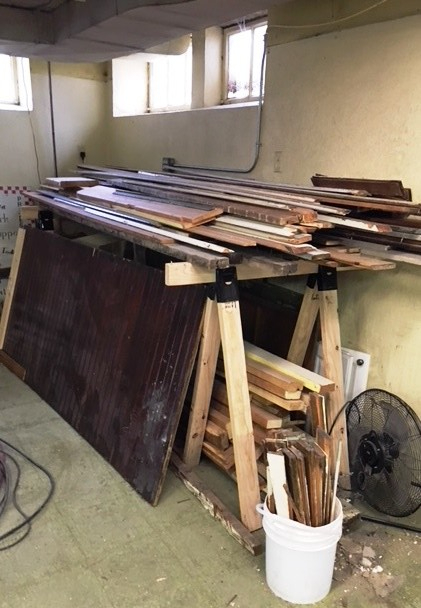
  • Organize your recycled wood by type. In a five-thousand-square-foot structure, you’re gonna recycle a lot of wood. Separate the trim, the baseboards and the flooring, or you’re never gonna find the wood you want when you’re ready to reuse it.
neatly stacked scrap
One of our more neatly stacked piles of scrap wood.

# # #

Tomorrow: Wanted: One dumpster. Cheap. To read it, click here.

Seek and ye shall find

Our story so far: We were in the midst of demolishing the interior of our 126-year-old Methodist church with grand plans to turn it into our home.

# # #

Even though we could have waited, one major purchase we sprung for during demolition was a set of new doors for the entryway to the church. Tyler found a deal on Craig’s List we just couldn’t pass up.

Earlier, while we waited to close on the church, we admired an exterior door on display at Home Depot. As soon as I saw it, I knew Tyler would love it, and when I led him away from the plumbing fixtures to the front door display, I knew I was right.

We exchanged one of those looks like a couple does when they happen upon the perfect name for their first-born and they both know it.

This was it.

It was a rustic knotty pine with an operable speakeasy door behind a grille. It looked like it belonged on a castle, which was perfect, since a man’s home is his castle. And it could be special ordered as a 96-inch-tall pair. The existing entry to the church included two 80-inch-tall doors, and we knew we wanted a footprint at least as large.

Naturally, a special-order set of front doors from a big-box store exacts a king’s ransom. We’d allotted something for the front entryway in the Tequila Budget, but not that much.

But Tyler being Tyler took that as a cue to snoop around architectural salvage joints and online, and wouldn’t you know it, in a couple of weeks, someone in a nearby kingdom placed a listing on Craig’s List for just such a set of doors with the title: “Remodel reject.” Asking price: $1,000 less than new.

“Whaddya think?” Tyler asked.

“They’re perfect,” I said. The Craig’s List doors even had the speakeasy portal, and they were arched. “We should at least go and look.”

# # #

Tomorrow: Chapter 9’s revelations conclude with a description of how we got our doors home again, home again, jiggity jog. Click here to read it.

Lofty ideas

Our story so far: Under layers of carpeting, paneling and ceiling tiles, we discovered the original finishes of the 126-year-old Methodist church we are demoing in order to turn it into our home.

# # #

But the best thing we discovered during demolition was the choir loft.

The old saying, “Man plans, God laughs” was evident in this church renovation. We had planned to close a week or two after we made an offer on the church, and we all know how that worked out. Now, our plans for the second floor were changing with every swing of the sledge-hammer.

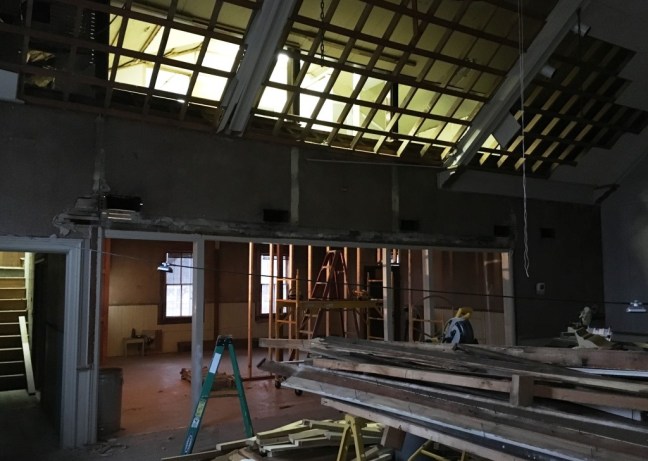
One of the members told us the second floor used to be the choir loft, and as we (“we” being Tyler and his hired man St. Johnny) began pulling down the shelves and closets and walls upstairs, the balcony opened up like sunshine through the clouds. Tyler poked and prodded, and then smashed and crushed, to reveal the original, higher ceiling in the sanctuary and the huge opening into the second floor.

choir loft
Readers will have to use their imagination here. The lighted area above is the choir loft, overlooking the scrap wood pile in the sanctuary of the church.

Tyler was inspired.

He called me (I was fiddling with some sort of paperwork back at the rental property) and said, “I have a great idea, hear me out.” He described extending the balcony floor into the great room and constructing the kitchen underneath it which would create more space for our master bedroom in the overflow area behind it.

It was indeed an inspired concept.

For a number of days, we had been walking around the overflow area looking for ways to incorporate the kitchen, an entry from the to-be-built garage, a guest bath, the master bedroom, the master bathroom, a walk-in closet and a main-floor laundry. It was a lot to ask of 600 square feet.

No matter how I turned it around in my dreaming mind at night or on paper during daylight hours, I couldn’t figure out how to pull it off without sacrificing a shower or a laundry room or a walk-in closet (or all three).

Tyler’s concept would make room for all our creatures comforts, keep the kitchen we wanted and fill up some of the excess space in the great room.

# # #

Tomorrow: Tyler’s inspired idea requires a custom feature. Of course. Click here to read it.

The floor beneath our feet (and layers of carpeting)

Our story so far: The first phase of our church conversion is demolition, and we found a number of interesting items as we cleaned up and tore down.

# # #

Demolition is 5 percent revelation and 95 percent dirty work. In those first few heady days of demolition, we were still in the revelation phase, and it was fun.

pine floors
Tyler scrapes away the carpet glue so we can see what the original sanctuary floor looked like.

As we peeled away layers of carpeting, carpet padding, paneling and ceiling tiles, we discovered the beautiful original finishes of the old Methodist church. That moment in a DIY television show when a flipper discovers hardwood floors and swoons? That’s real. We did a little dance when Tyler pulled back the carpeting in the main sanctuary and found wide pine hardwood; Tyler suspected it might be Douglas fir. If we weren’t so old, we would have done a breakdance when we revealed the oak floors in overflow area, the room we intended to turn into our master suite.

beadboard
In this image, you can see the original pine floor (front and right) and the oak flooring (left) as well as the beadboard we exposed in the future master bedroom (left) and beadboard that rings the main sanctuary (it’s painted above where the altar area flooring used to be).

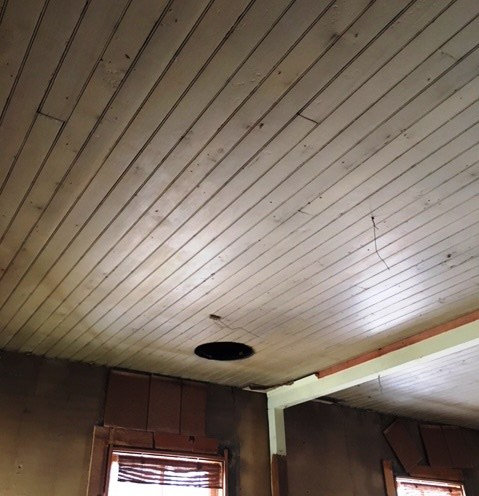
Under the 1970s wood paneling, beadboard—the kind that was installed a single board at a time instead of with today’s monolithic sheets—lined the master suite area up to the chair rail (or, at least, where the chair rail used to be). The ceiling in the master bedroom was also narrow-slated wood of some sort. We imagined a fantastic tray ceiling with the wood revealed in the center.

ceiling
This ceiling in the future master bedroom was hidden behind a suspended ceiling and a layer of fiberboard ceiling tiles.

# # #

Tomorrow: We find an interesting architectural feature we think we can incorporate into our floor plan. Click here to read it.

Hairy landscaping requires a trim

Our story so far: Tyler recruits a hired man to help us renovate the 126-year-old Methodist church we intend to turn into our home.

# # #

As if to illustrate His countenance upon us, the first few days we owned the church, the sun shined brightly. The weather was unseasonably warm for the end of November in Wisconsin, so we made hay while the sun shined. Well, brush. We made brush.

We’d had the opportunity to drive by the church a hundred times (or so) while we waited to close on it. Without the keys to get inside, we focused our attention on the exterior, and we came to detest the arborvitae (over)growing near the entryway. They needed more than a trim; an extraction was called for. A chainsaw (one of Tyler’s many saws) was put into service, and down came the overgrown bushes. Tyler’s new hired man Johnny and I scurried around like little ants, hauling the pieces of trunk and greenery to the backyard burn pile.

arborvitae before and after

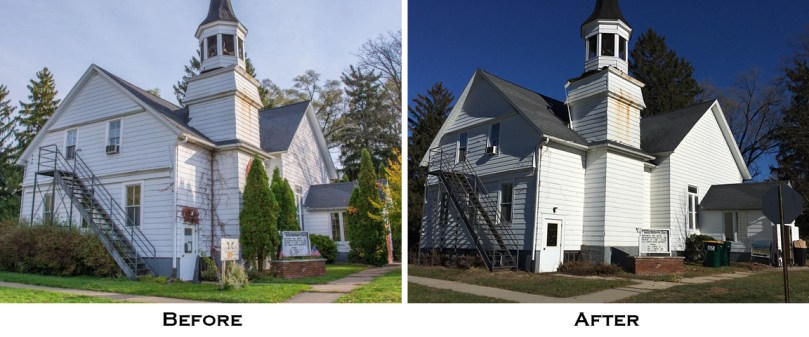
Tyler then turned his attention to the row of bushes lining the sidewalk (and growing through our exterior staircase to the second floor). Even Tyler (yes, he also has a green thumb) couldn’t determine their species, but we knew we wanted to keep them for aesthetics and privacy, but, oh, they needed a trim.

bushes before and after

At the end of the row, Tyler revealed something he could identify: A lilac bush. Oh, I loved lilac bushes! So fragrant! I distinctly remember the lilac bushes in the alley of the home in which I grew up in Central Minnesota. One May afternoon when I was about 14, I grudgingly performed the chore of taking out the garbage and, to my delight, discovered the aromatic flowers crowding out the scent of potato peels in the garbage can. Being the trash man that day was a gift.

That bush was spared of trimming. Please let it bloom in the spring, I prayed.

When we were done, the brush pile was twenty feet wide and six feet high.

A few days later, Tyler called the fire department and alerted them to an imminent bonfire. The firemen gave him the equivalent of a shrug, and Tyler burned up two years worth growth in a few hours. Our first before-and-after project: Immensely satisfying.

# # #

Tomorrow: Chapter 9 begins with a few revelations. Read it here.

Shared work is half the work

Our story so far: We began the demolition phase at the 126-year-old Methodist church we acquired to turn into our house.

# # #

Churches have saints, and our saint was St. John.

Even Jesus couldn’t do everything by himself. He gathered twelve apostles, among the first was John, one of the sons of Zebedee. Our St. John was a follower, too, an excellent follower of Tyler’s orders.

The third time we visited the church, after making an offer on it but two months before we actually closed the deal, Tyler and I visited the local grocery store. It was really just a glorified convenience store that had made a name for itself selling bacon-wrapped beef tenderloins, but hey, we could get sugar or a can of soup or, heck, a beer in a pinch. Tyler quizzed the cashier as we departed.

“Do you know anyone looking for work?”

She gave him a bewildered look. Maybe she thought he was asking something nefarious.

“I’m renovating a building, and I need some help.”

“Help? Like what kind of help?”

“You know carrying things, moving things around, demolition. That kind of thing.”

“Hmm, I don’t know.” She made a show of looking like she was thinking about various fellows who would be willing to carry things.

“Well, if you think of anyone, would you give them my number?”

“Sure,” she said, taking Tyler’s name and number on a slip of paper. “Maybe I know someone.”

I chided Tyler as we left the store. “Why do you think the cashier is the only person in town who knows people who do manual labor?” I asked.

“She’s the only person in town I talked to!”

“No one is ever going to call you. She threw that piece of paper away as soon as we left the store.”

“Well, maybe so, but it can’t hurt to ask.”

Lo and behold, a guy called Tyler a few days later. Introduced himself as Johnny and said he heard Tyler needed some help on a building project.

“See!” Tyler told me later.

At the time, we were hoping to close on the church in a matter of days. We didn’t know it would take weeks. So he told Johnny to give him a call in three or four days. Every single time, Johnny followed through. He called three or four days later, and Tyler filled him in on the latest delay.

We couldn’t be so lucky, I thought, to find a guy in the very town we were buying a property who would be willing to be Tyler’s hired man.

But sure enough, Johnny showed up in his work clothes on Day Two, and boy, could he work. And best of all, he was the most cheerful order taker I’d ever seen.

“Move that.” “Take that over there.” “Help me pick this up.” “Take that apart.”

Whatever Tyler asked, Johnny carried out.

While carrying loads of garbage, I lowered my voice and told Johnny I hoped it was OK, taking Tyler’s orders (I’m not implying I was irked to be taking orders, please don’t misunderstand).

“No, we get along great,” Johnny chirped. “We’re on the same wavelength.”

If Johnny wasn’t a saint, he was an angel.

# # #

Tomorrow: Check out our first before-and-after pictures. Read it here.

Oodles of tools

Our story so far: Finally (finally!) we closed on the 126-year-old Methodist church we intended to renovate into the home of our dreams.

# # #

The list of “first things to do” at our old church was long.

First, there was demolition.

First, we had to pick up and clean.

First, we had to do some yard work.

First, we needed to address the deteriorating belfry.

But what happened first—really first—was moving in all of Tyler’s tools.

For the regular handy man, this might take a few hours. With Tyler, it took at least three or four days.

First we fished all of his tool boxes from our cargo trailer where they had been stored since January when we moved out of our previous house. Then we transported all the tools that had arrived at our little rental house via the productive guys at UPS and the Postal Service in the time we’d been there; thanks to Amazon Prime, Tyler was on a first-name basis with the UPS guy on Day Two. We retrieved saw horses Tyler had built and stored at his cousin’s house and his mother’s. And then he made a couple of trips to Home Depot for various sheets of plywood, doodads and, of course, locking mechanisms to secure everything.

When he was done (or as done as any man with a penchant for tools who still had money in his pocket), the sanctuary of the church (a 26-by-36-foot space) was filled with tool boxes, plywood work tables, saw horses, saws and duplicates of just about every tool known to man. Or at least known to woman.

screwdriver drawer
This is Tyler’s screwdriver drawer.

Just the array of screwdrivers boggled this woman’s mind.

At one point in the demolition process, Tyler needed a very heavyweight hook. A little bit of digging revealed exactly the hook he needed, a medieval-looking device suitable for hanging a dead knight from the rafters.

“What is that?!”

“It’s a come-along.” (I didn’t ask what a come-along was. I looked that up later: It’s a hand-operated winch.)

“Why do you have that?”

“We needed it for the race car.”

Of course. For the race car.

Yes, the Renaissance Man who was my husband was a bit of a grease monkey, too. A few years before, he and his brother raced stock cars on the dirt racetrack in northern Illinois near our home at the time. Every weekend all summer long, they’d spend their evenings driving a $500 piece of junk around a quarter-mile race track wearing out tires. Invariably, by the end of the night, the vehicle would be inoperable for one reason or another (an encounter with another beat-up race car operated by a competitive wild man will do that), and the hunk of metal would have to be loaded onto a trailer so it could be returned home for repairs. This is why my husband had an enormous, scary-looking come-along.

Please do not ask why he still had an enormous, scary-looking come-along, four years after he quit racing. But the answer to that explains why it took us three or four days to unpack his tools.

# # #

Tomorrow: An angel joins our team. Read it here.