Oodles of tools

Our story so far: Finally (finally!) we closed on the 126-year-old Methodist church we intended to renovate into the home of our dreams.

# # #

The list of “first things to do” at our old church was long.

First, there was demolition.

First, we had to pick up and clean.

First, we had to do some yard work.

First, we needed to address the deteriorating belfry.

But what happened first—really first—was moving in all of Tyler’s tools.

For the regular handy man, this might take a few hours. With Tyler, it took at least three or four days.

First we fished all of his tool boxes from our cargo trailer where they had been stored since January when we moved out of our previous house. Then we transported all the tools that had arrived at our little rental house via the productive guys at UPS and the Postal Service in the time we’d been there; thanks to Amazon Prime, Tyler was on a first-name basis with the UPS guy on Day Two. We retrieved saw horses Tyler had built and stored at his cousin’s house and his mother’s. And then he made a couple of trips to Home Depot for various sheets of plywood, doodads and, of course, locking mechanisms to secure everything.

When he was done (or as done as any man with a penchant for tools who still had money in his pocket), the sanctuary of the church (a 26-by-36-foot space) was filled with tool boxes, plywood work tables, saw horses, saws and duplicates of just about every tool known to man. Or at least known to woman.
screwdriver drawer
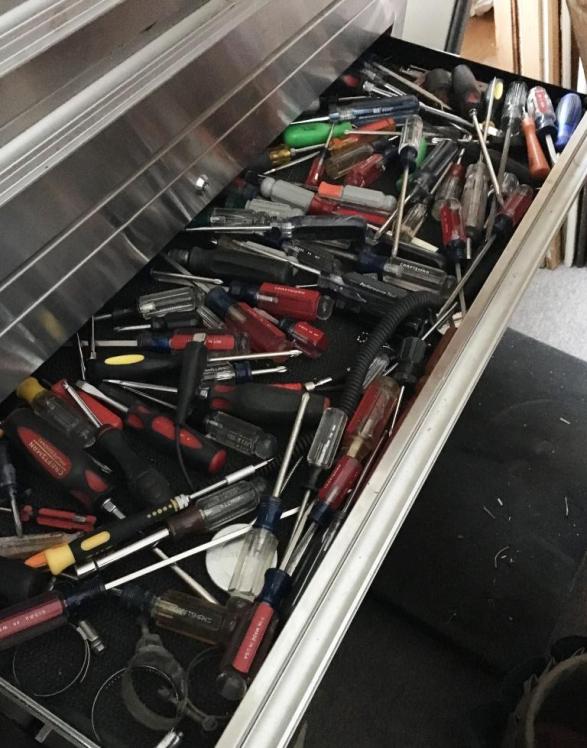
This is Tyler’s screwdriver drawer.

Just the array of screwdrivers boggled this woman’s mind.

At one point in the demolition process, Tyler needed a very heavyweight hook. A little bit of digging revealed exactly the hook he needed, a medieval-looking device suitable for hanging a dead knight from the rafters.

“What is that?!”

“It’s a come-along.” (I didn’t ask what a come-along was. I looked that up later: It’s a hand-operated winch.)

“Why do you have that?”

“We needed it for the race car.”

Of course. For the race car.

Yes, the Renaissance Man who was my husband was a bit of a grease monkey, too. A few years before, he and his brother raced stock cars on the dirt racetrack in northern Illinois near our home at the time. Every weekend all summer long, they’d spend their evenings driving a $500 piece of junk around a quarter-mile race track wearing out tires. Invariably, by the end of the night, the vehicle would be inoperable for one reason or another (an encounter with another beat-up race car operated by a competitive wild man will do that), and the hunk of metal would have to be loaded onto a trailer so it could be returned home for repairs. This is why my husband had an enormous, scary-looking come-along.

Please do not ask why he still had an enormous, scary-looking come-along, four years after he quit racing. But the answer to that explains why it took us three or four days to unpack his tools.

# # #

Tomorrow: An angel joins our team. Read it here.
If plastic cups could clink: ‘Here’s to the church’

Our story so far: We made an offer on a 126-year-old Methodist church with the intention of converting it to our home, but we became impatient when the closing was delayed twice and drawn out two and half months.

# # #

For all the buildup to closing day, the closing meeting itself was uneventful. We arrived at the designated location for the hand-off of the keys, and within 45 minutes, we’d paid our cash, signed the papers, shook hands with our long-suffering real estate agent and the poor pastor who just wanted to write sermons not track down 100-year-old paperwork, and we were done.

We drove straight back to our rental house, where Tyler dropped me off so I could change into something more … suitable for demo.

“Grab a couple of cups,” he instructed as her put the truck into gear. “I’ll meet you at the church.”

IMG_8859
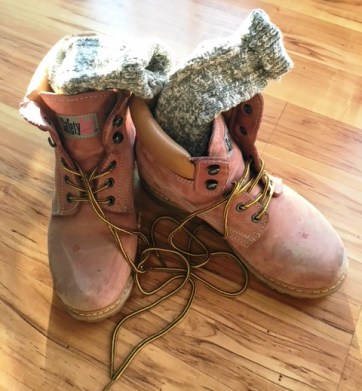
Pink boots from Safety Girl: Fashion first.

I changed into my new pink work boots (yes, because if I’m going to get dirty, I might as well do it in style) and grabbed two red Dixie cups. I put poopy puppy, our 10-year-old miniature schnauzer, on a leash, and we walked the two blocks to the church.

Meanwhile, Tyler stopped at the liquor store (conveniently, only two blocks from the church in the other direction) and invested in the finest bottle of champagne, er, sparkling wine, the village had to offer.

Tyler was fingering the key to the front door when I arrived.

“Oh, you waited for me.” I smiled.

And then we were sitting on an abandoned office chair and a 25-year-old padded banquet chair in the middle of our sanctuary, sipping champagne from red Dixie cups.

“Here’s to the church,” Tyler said.

“The church,” I said, looking around the quickly dimming room. We’d turned on the electricity (and, glory be, it worked) but we couldn’t find switches to the sanctuary lights, so as the winter sun began to set, the room took on a romantic atmosphere.

“Are you ready for this?” he asked.

Methodists don’t have confessionals, so I had to own up in the dimming light of the sanctuary.

“Now I’m scared.”

# # #

Tomorrow: First things first. Read it here.

A place for every thingy-whatsit and every thingy-whatsit in its place

Our story so far: We’re waiting (and waiting) to close on the 126-year-old Methodist church we intend to renovate into our home.

# # #

On Black Friday, Tyler got up before the sun did to wait in line at the nearby Home Depot. He arrived back at the rental house before I’d had my first coffee with orders:

“Help me get this thing unloaded.”

The thing was a tool chest. Or, more precisely, another tool chest. If I had a thing for books (and I did), Tyler had a thing for tools. Every time he used one of his tools to fix something or save us the cost of hiring someone to do the work, he reminded me: “I couldn’t have done that without the thingy-whatsit, you know. Aren’t you glad I have so many thingy-whatsits?” Only he didn’t say thingy-whatsit. All his tools had specific names and uses that somehow eluded me. I understood hammers and screwdrivers; I could even differentiate between a flat-head screwdriver and a Phillips screwdriver. But I could never remember the difference between a wrench and a pliers. And God help me if he started lauding the values of various kinds of saws.

All of these various implements required storage (of course—what’s jewelry without a jewelry box?). We might need a screwdriver or a wrench or a pliers (or a measuring tape or a sledgehammer) to transform our church into a house so thank goodness he found a tool box at Home Depot, right?

“It was too good a deal to pass up.”

Sort of like the church, I suppose.

# # #

Tomorrow: Are you as tired of waiting for us to close on the church as we were? Then don’t miss tomorrow’s segment. Read it here.

A peaceful moment before the chaos to count blessings

Our story so far: The closing date on the old Methodist church we intend to convert into our home is delayed again.

# # #

Chapter 8

Every Thanksgiving, I make Tyler verbalize all the things he’s thankful for in the past year. I hate to think of the holiday as only an opportunity stuff oneself, watch football and read the ads for Black Friday. Usually, on our way to a feast of turkey and pecan pie, we count down the Top 10 people and experiences for which we’re grateful.

This year, Thanksgiving fell smack in the middle of our two-week hiatus from getting our hands on the keys to our new old church. So we had to be thankful for finding the church, if not grateful for getting started on the project. We had no choice but to travel to enjoy a feast. Our little rental house was so small, it didn’t have room for a table, and I don’t think anyone would have enjoyed standing around the kitchen island to dine. So we drove to Tyler’s mother’s house and counted our blessings along the way: Very happy to have sold our house in the suburbs. Grateful for becoming grandparents. Thankful we had the opportunity to travel around a bit before settling down again. Excited to begin work on our little 126-year-old church.

# # #

Tomorrow: Chapter 8 continues with a description of a Black Friday score. Read it here.

Go big or go home

Our story so far: My husband Tyler picked up a lot of experience when he undertook a mammoth project back in the early 1990s to renovate an old tobacco farmhouse without any modern amenities into his house.

# # #

One of the things I like to say about my enterprising husband is that he is one to go big or go home. He likes big steaks, big trucks and, fortunately for me, big women (or at least tall ones; I’m 5-foot-10). Our RV is among the biggest on the road, and of course, he’s fond of big houses, too.

finished house
Tyler’s addition to his reno house nearly doubled the original square footage.

This first renovation project was no different. Once Tyler had the old tobacco farmhouse livable, he decided he needed more space. So he built a 24-by-36-foot two-story addition; the main floor was the family room and above it was the master bedroom. (He deconstructed the Swedish wood stove and moved it to heat the addition.) And then he built a three-car garage on the other side of the farmhouse.

When I say “he built it,” I’m being literal. He would frame one wall and invite a buddy or a relative over to help him stand it up. People who know Tyler won’t be surprised he paid his buddies in beer. A lot of beer.

The entire project took just less than two years to construct. Five years after he and his wife bought it, they moved to Minnesota. They sold the old tobacco farm for ten times what they’d paid to purchase it.

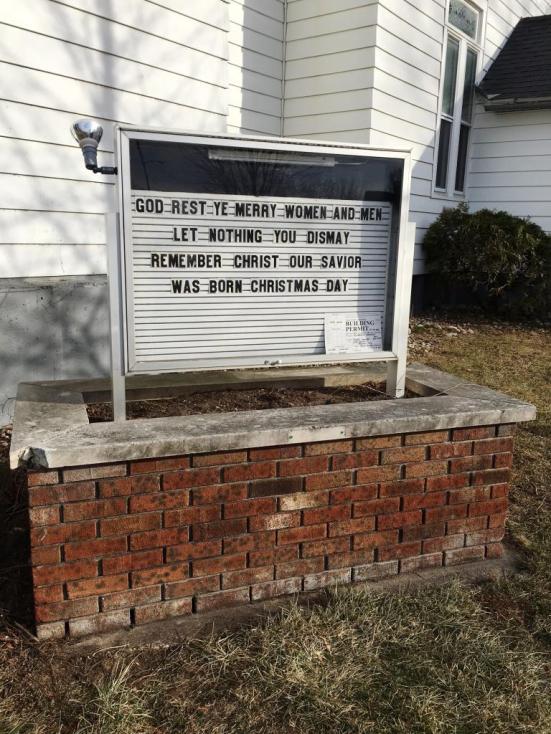
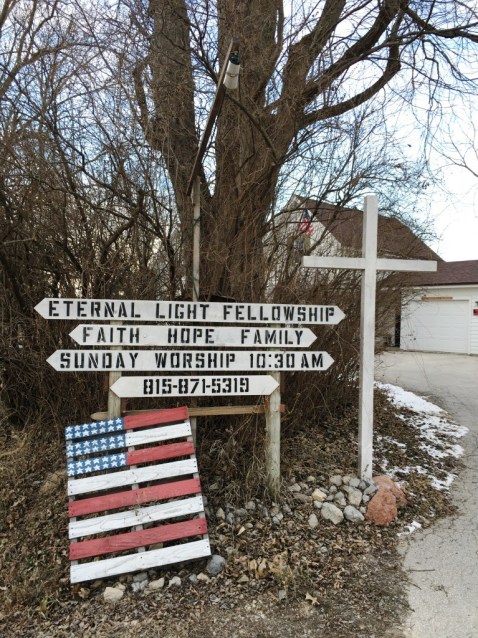
Ironically, Tyler’s old tobacco farmhouse transformation was big enough to house a whole congregation—let’s call it cathedral big. We drove by it not long ago, and there’s cross, a flag and a rustic sign out front that reads “Eternal Light Fellowship/Faith Hope Family/ Sunday Worship 10:30 a.m.”

fellowship church
That’s Tyler first renovated house, er, church, in the background.

# # #

Tomorrow: Chapter 8 opens with a moment of gratitude. Read it here.

One splinter of experience is worth a whole fixer upper of warning

Our story so far: Are you willing to take on a fixer upper? My husband and I thought we were, and we made a plan to renovate a 126-year-old Methodist church into our dream home.

# # #

Chapter 7

My beloved husband Tyler knew well what it meant to renovate a house and why anyone about to tackle such an undertaking should proceed with caution.

Nearly thirty years ago, Tyler’s first whole-house renovation project began with Boone County’s oldest operational tobacco farm.

He and his wife at the time purchased the property in Northern Illinois for just the price of a new car in the 1980s from the two bachelor brothers who had grown tobacco there for decades. Now in their 80s, one of the brothers was in ill health and living in a nursing home; the other planned a move to join him.

tobacco farm
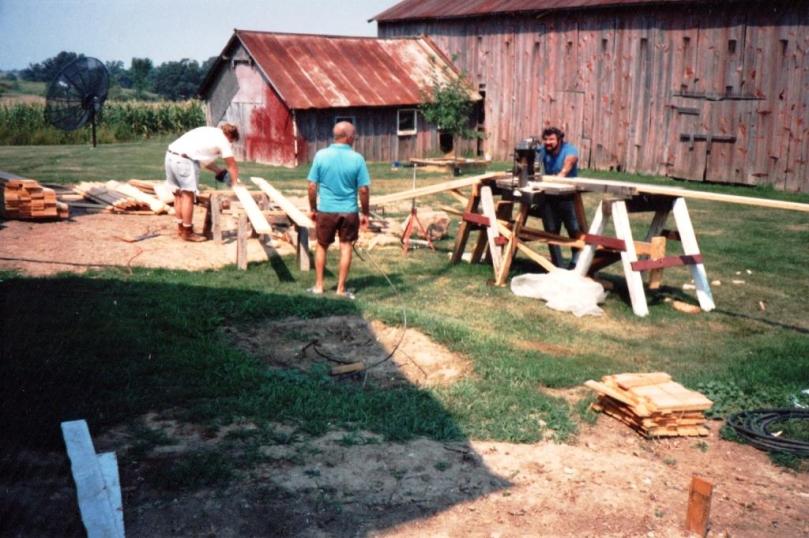
That’s Tyler there on the left, sawing. His grandfather, in the middle, and a buddy lend a hand to the construction project. The old tobacco barn is in the background.

One of the buildings on the farm was a distinctive tobacco barn with hinged foot-wide openings. They all locked from the inside with a wooden peg. The slates were opened to dry the tobacco hanging inside.

The brothers smoked their product. Every out building had Zig Zag cigarette rolling paper packages stuffed in every crevice.

The farmhouse had no heat except a warm-morning stove connected to a fuel oil tank. There was one light switch in every room connected to a single bulb hanging from the ceiling. Old horsehair plaster was on all the walls and ceilings. The flooring and trim was basic Douglas fir that could be refinished; the baseboards were distinctive. The main floor consisted of three rooms, and a steep stairway led to the second half-story. The basement was a five-foot-deep hole with a dirt floor.

There was no plumbing. The “running water” was a well pump outside. The brothers pumped water and brought it inside for drinking and bathing. When Tyler had the well tested, it was like death syrup, the levels of live bacteria and chloroform so high as to be practically toxic (chloroform was used an anesthetic in the Civil War). The “bathroom” was a two-hole outhouse on skids so the brothers could move it when the pit beneath it filled.

# # #

Tomorrow: Hard physical effort transforms the old tobacco farm. Read it here.

The timeline for closing on a church is not ordained

Our story so far: We moved into a rental house two blocks from the church, ready to get to work renovating it into our dream home.

# # #

It was two weeks after we originally planned to close on the church (two weeks!), and no closing had been scheduled. The church still didn’t have the paperwork it required to designate authorized signatures.

Tyler had had it. He was anything but understanding at this point.

Sure, we were protected from the elements now, but really! We wanted to close on the church two months ago! Should we walk away from the deal?

Though we entertained a few conspiracy theories that the congregation really didn’t want to sell the church, we knew in our hearts they just weren’t as motivated to wrap things up as we were. So we decided to give them some incentive. We offered to extend our offer for two more weeks (admitting to ourselves it would be a regular miracle if we closed in two weeks), but we also lowered our offering price. Now our good deal was even better!

We sweated it out for twenty-four hours while we awaited a response, but the church accepted. So now we had a few thousand more in our budget and two more weeks to plan how to use it.

As we relaxed in front of the TV one evening in our little rental house, I asked Tyler how he was feeling about things.

“Excited,” he said right away. “And scared.”

# # #

Tomorrow: Tyler is knows very well what he’s in for. Read it here.

What is an air bed without air? A sack

Our story so far: We begin moving into a rental house two blocks from the church so we have a warm place to clean up and crash while we renovate.

# # #

On Days Two and Three of our move, we transferred our meager belongings from the camper and the urgent items from the cargo trailer into our tiny rental house. Our most critical need: A bed. We would need restful slumber if we ever hoped to survive renovating the church.

We’d packed our big, beautiful king-sized Sleep Number bed into the cargo trailer the day before we moved out of our cardboard box in the suburbs. The camper had room for only a queen-sized bed, so we bid farewell to the best bed upon which either of us had ever slept when we moved out.

Unlike a standard mattress and box spring, a Sleep Number bed is a unique combination of foam, air pillows, zippered compartments and an inflation device. We’d carefully packed it all away in the cargo trailer. The last thing to go in was the first thing to come out.

Amid sleeting flurries in southern Wisconsin, we cajoled the pieces of the bed out of storage and hauled them into the little house. We slammed shut the cargo trailer doors and parked it on the now-muddy gravel driveway inside the garage foundation. A garage had once stood on this lot, but now, only the cement-block foundation remained. After much cold-handed grunting and groaning, we affixed a boot on the tire and paddle-locks on the trailer doors.

Tyler had built a platform for the bed in our new bedroom out of two-by-fours and plywood (the original platform remained in the trailer). We set to work assembling our bed.

After sorting out all the pieces, we realized we were missing one: The inflation device.

An air bed isn’t much of a bed without air.

Ugh.

Back to the cargo trailer to pinpoint the apparatus.

“What does it look like?” I implored, while climbing over boxes and craning to see the labels on bins.

Clearly, I wasn’t paying attention eleven months before when we disassembled the bed.

“It’s the size of a bread box,” Tyler instructed.

Believe me, a bread box is a needle when the 30-foot cargo trailer is the haystack.

Especially when the air is filled with ice-cold wet sleet.

Eventually, we found the contraption, repacked and re-secured the trailer, and retreated to the warmth of our little rental house. Once we had all the pieces, the parts went together pretty easily. As we lay on our beloved king-sized bed looking at the spiderweb-free ceiling of our warm little house, we were content. I was amazed at how quickly I felt comfortable in our little rental. It felt like a mansion compared to the RV, and I swiftly reacclimated to house living.

In three days, we would close on the church, and we could start our project at long last.

Or so we thought.

# # #

Tomorrow: Chapter 6 concludes with a twist any fan of “The Money Pit” could have predicted. Read it here.

Of all we survey

Our story so far: After a delay in closing, we decided to rent a house near the church to live in while we renovate it into our house.

# # #

Chapter 5

As we waited impatiently for the church to gather the necessary closing documents, we got a look at the freshly minted survey for our lot.

front door
Our front door in the right of way.

To our surprise, we were about to become owners of three lots. Together, our triangle-shaped property comprised about a third of an acre. The church building was situated on the corner where two streets intersected (there had never been a parking lot, at least not in recent history; apparently parishioners used street parking or the elementary school’s lot kitty corner to the church). This positioning would allow us to build a garage in the back yard with a curb cut on the west side of the lot, avoiding the ugly maw of a double garage door overwhelming our front door as so many suburban homes without alleys have. (Before we purchased our former residence, I’d vowed never to buy such a monstrosity, but alas, that’s how modern houses are plated and constructed nowadays.)


There would be no welcoming porch though. Our front door was 3.78 feet over the property line. Technically, our light sconces on either side of the front door were street lights. Instead, we planned a screen porch off the to-be-built garage overlooking our side yard.

# # #

Tomorrow: I’m of two minds about the amount of square footage in which we’re about to invest. Read it here.

# # #

Did you used to worship at this church? If you have memories you’d like to share, I’d like to include some of them in our story about renovating the church into our house so others can appreciate its history. Simply click on “Contact” above and send me your story.