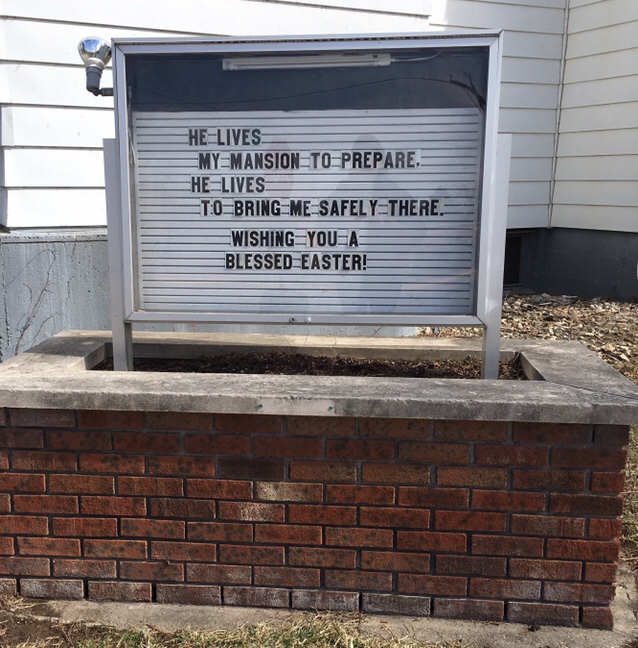
We interrupt our storytelling to observe the holiday and wish our readers well.
Tomorrow: Our story continues with the somewhat frenzied conclusion of Chapter 20. Read it here.
We interrupt our storytelling to observe the holiday and wish our readers well.
Tomorrow: Our story continues with the somewhat frenzied conclusion of Chapter 20. Read it here.
Our story so far: While juggling other projects, we worked on the bathrooms in the 126-year-old Methodist church we were turning into our home.
# # #
Meanwhile, Tyler ordered the fiberglass shower surround and corner tub for the upstairs bathroom from two different big-box retailers (each cost roughly $1,000, which goes to show how much less were cookie-cutter options than custom ones). We needed to have these before we constructed the walls because they both were too large to get through the doorway. Fortunately when they arrived by delivery truck, the odd assortment of contractors on site at the time helped get them upstairs.
We (by “we,” I mean mostly Tyler) built the walls for the bathroom on the second floor. Like our other bathrooms, this one featured a pocket door.
Besides the pockets provided in the form of a kit from Home Depot, these pocket doors required doors. For the second-floor bathroom and the powder room on the main floor, we were using the doors that had been on the basement bathroom and utility room. They were beautiful solid wood covered by layers of paint (and other gunk).
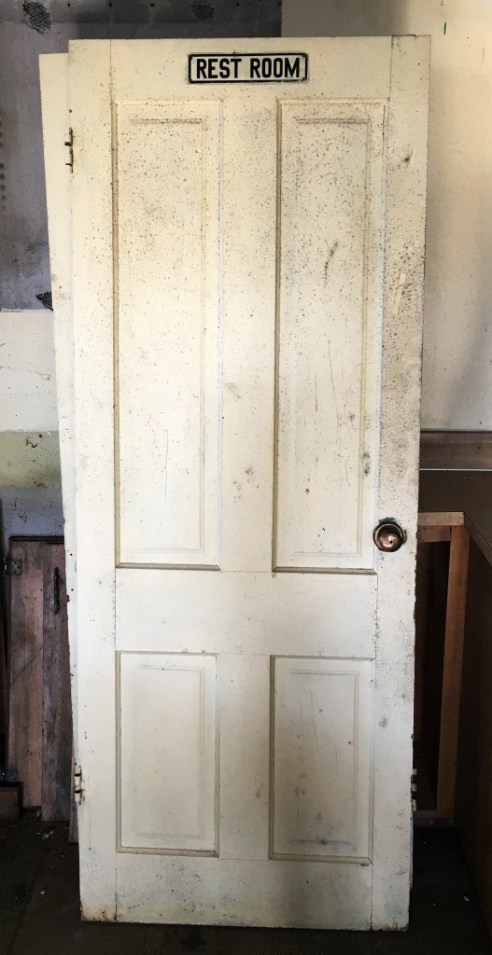
Tyler tried using a non-caustic stripper, but he got nowhere with it.
So we endeavored to have them dipped. Dip stripping is when wood is placed in a large vat of solvent to help remove paint and varnish before refinishing. A nearby antiques dealer hooked us up with her dipper.
The doors were free because they came with the church. But dipping them cost $200 each.
Oof. You know that sound Skipper makes when Gilligan accidentally hits him in the gut? Yeah, that.
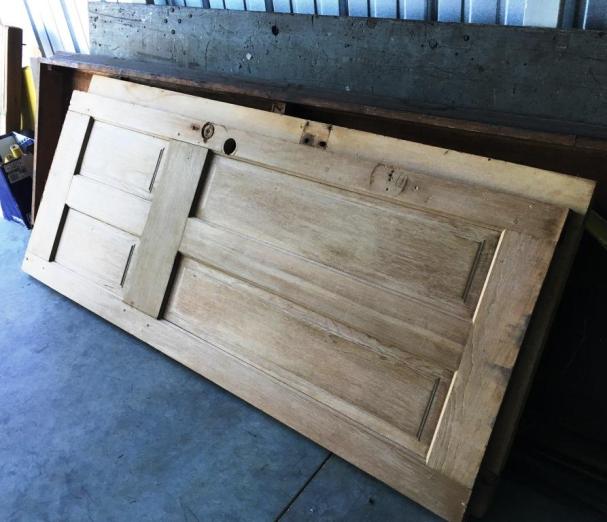
But in any case, they turned out beautifully. All they would require is a bit of light stain and some polyurethane. And a couple of cool plates to cover the door knob holes.
# # #
Monday: Speaking of holes … Read about it here.
Our story so far: We were preoccupied by bathrooms as the plumber worked and we renovated the 126-year-old Methodist church we were turning into our home.
# # #
But nothing could be as bad as the contractors’ bucket.
Shortly after Glimfeather the plumber began work, the only piece of operational plumbing in the church was decommissioned in order to move around pipes or drains or vents or something.
But like other bodily functions, pee happens. The parade of contractors through the church were exclusively men so Tyler could get away with establishing a five-gallon bucket in the back entryway as a temporary urinal. Who needs a porta-potty when ya got a bucket?
I, of course, opted out. Way out. I wouldn’t even volunteer to empty the thing. But I also had to plan my coffee consumption and work breaks in order to make a trip back to the rental house to relieve myself when necessary.
For a month, the guys carried on with nary a complaint (guys are like that).
As Glimfeather wrapped up his work, the original toilet in all its porcelain glory and running water was reinstalled in the basement bathroom which, I should mention, still lacked an operational vanity sink and a door, but still—a toilet! Applause—with unwashed hands—erupted in the crowd.
# # #
Tomorrow: We take a dip. Read it here.
Our story so far: Tyler and I struggled to acquire a custom shower in budget, but we agreed to keep it simple with most of bathroom fixtures in the old church we were turning into our home by selecting polished chrome.
# # #
The bathroom fixtures in the rental house were brass, and apologies to brass fans, they were ugly, not retro, not trendy. The whole room was a lesson in how not to finish a bathroom.
We had been living in the little rental house for four months. It was cozy. And infinitely cleaner than the church-in-renovation (despite my poor housekeeping). But as we obsessed about the finishing details in the church, I couldn’t help but notice all the little mistakes in our rental.
Case in point: The bathroom.
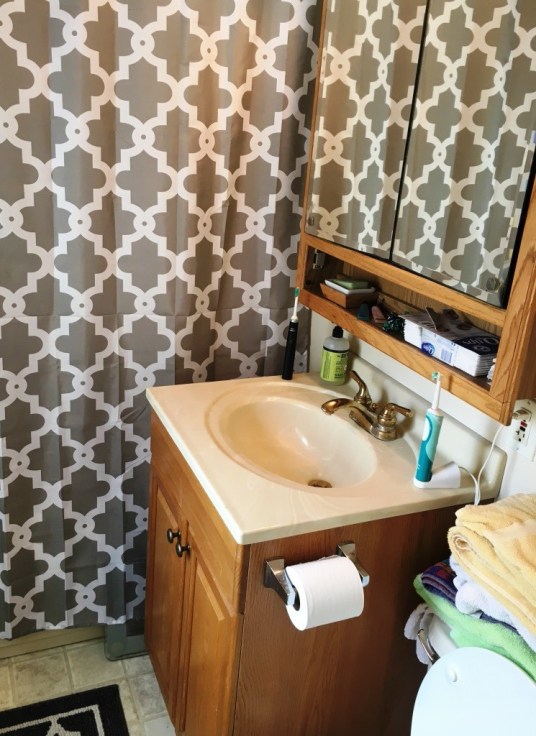
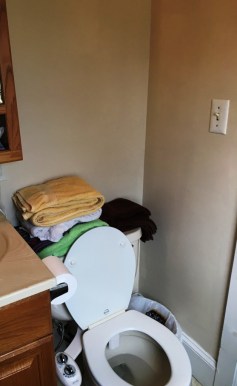
The rental house had only one closet—in the bedroom. Not having a linen closet makes one appreciate this simple luxury. Especially when the bathroom features only a single-sink vanity. It was impossible to fit all the towels, first aid supplies, toiletries, cleaning products and extra toilet paper we used in the vicinity of the bathroom. I found a beat-up over-the-tank storage system in the basement, so someone had tried to improve the bathroom storage but someone else gave up on it. Someone should have built permanent shelves over the toilet, but we were not someone—we were going to focus our energy on projects in the church.
Only one outlet? Just our electric toothbrushes used this up. And I still had a Waterpik, curling iron, blow dryer. Often, we plugged in bathroom appliances in the kitchen, which was neither handy or appetizing. We were planning to have so many outlets in our bathrooms, we’d never run out!
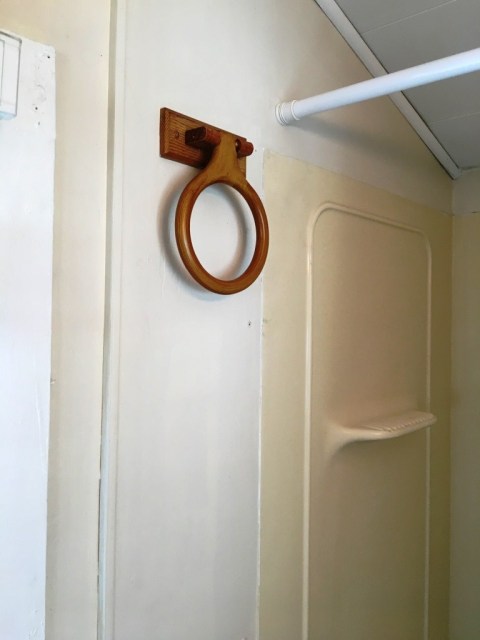
Speaking of one, there was one lonely towel ring in the bathroom. Situated strangely at eye-level next to the shower.


Not only where the brass fixtures in our rental bath better suited to King Midas, but the faucet handle was loose, and the replacement shower head didn’t match. Ugh.
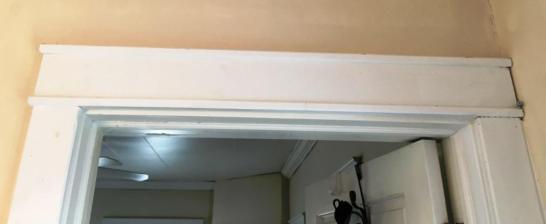
The trim was poorly planned. This kind of lack of attention to detail drove me mad. Builders should never have to cut corners on door trim or skip portions of baseboard for no apparent reason. And why were the screws around the tub surround exposed? Even pre-formed shower walls could use proper trim. And this. The tiny vanity was level (I guess), but only because of a shim that showed under the kick plate. So sloppy.


As we planned our own bathrooms in the church, we hoped to avoid similarly poor workmanship. Because instead of tolerating it for a few months, we’d be living with it long-term. And if it reflected poor workmanship, we’d only have ourselves to blame.
# # #
Tomorrow: But nothing could be as bad as the contractors’ bucket. Read about it here.
Our story so far: A chance encounter led me to a tiler who was willing to take on our extra-large master bathroom shower in the old Methodist church we were turning into our home.
# # #
After a little back and forth over the course of a week or two, we agreed to provide all the materials per You-Can-Call-Me-Al’s specs, and he would perform the work to be paid by the hour.
This meant we would have to buy a custom glass door and have it installed. Which meant visiting with another contractor. One lead led to another, but after I defined my wishes with a glass expert, he sent me a quote. Besides the door, another half wall was included which was more affordable than two glass walls but still lux.
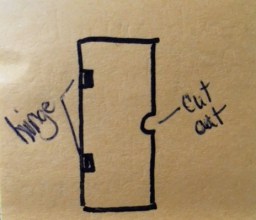
In the middle of these negotiations, we saw a “Fixer Upper” episode in which the shower door had a cut-out in the glass instead of the handle. Very trendy. I inquired about this, and by gum, the glass expert could do such a thing. For a price, of course.
In the end, we’d have nearly exactly the master shower we’d envisioned: Extra-large and airy.
The only do-it-yourself part would be the shopping.
You-Can-Call-Me-Al suggested buying tile at a Big Box store because if he ran short, it would be easy to get more. If, on the other hand, we found something special-order from Spain, well, then we might have problems.
So I went to Home Depot (again) and made like Christina El Moussa from “Flip or Flop.” I juggled samples on the floor of the store and settled on three: One for the floor of the shower, one for the walls, and one as ribbon accent. I bought one of each and brought them home to the rental house to sell the salesman on them. He was no Tarek, but then he had no reason to gripe—let’s be honest, I choose options available at a Big Box store—Tyler agreed to my vision.
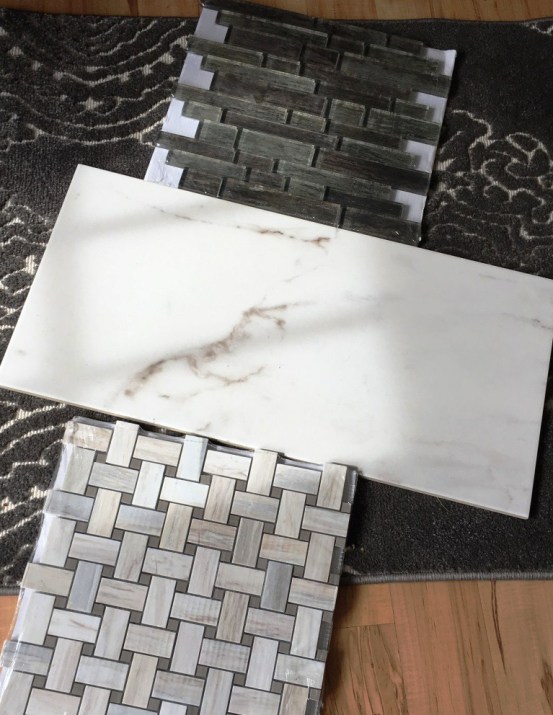
All told, our extra-large master shower would cost us about $7,000. Plus plumbing and fixtures.
# # #
Tomorrow: Ah, the fixtures. Like everything else in a home remodeling project, the choices can overwhelm. Read about it here.
Our story so far: We had established we weren’t willing to tile our own shower in the old church we were renovating into our home, but we were going to take a bath on the project if we accepted some of the stratospheric contractors’ quotes we received.
# # #
Then I experienced another one of those moments of serendipity that had been blessing us throughout this project.
I went to the post office to ask about whether we were the getting a mail box or post office box. I had already been there four times and had left without a clear answer.
As I was about to step into line, the man who held open the door for me motioned to let me in line before him.
“No, go ahead,” I said.
But he was a gentleman of the generation when etiquette demanded ladies first (let’s be honest, he looked to be my age). I accepted his offer.
I explained my problem to the man behind the counter, beginning with this description that had become familiar to my lips: “I bought the old Methodist church, and we’re turning it into our home.” Etc, etc.
During a pause in our conversation, the gentleman behind me asked, “You’re remodeling a church?”
“Yup, we are.” I smiled.
“Do you need any help?” he asked.
“Yes! You know anyone?”
“Yeah, me,” he said. “I’m a master carpenter. And I do other things.”
“Do you know any tilers?”
“Yes, I do tiling.”
“Do you have a card?”
He fished a card out of his pocket. By now I was ignoring the postal employee. I read the card, and an old Paul Simon song floated into my head.
“Al? Can I call you Al? Do you have time now? My husband is at the church. He handles all the contractors. You could go talk to him now.”
“Sure,” You-Can-Call-Me-Al said. “Where’s the church?”
And the polite gentleman went to the church, introduced himself to Tyler—You-Can-Call-Me-Al—and told him, yes, he could tile a shower for us, he did it all the time.
Meanwhile, I nailed down an answer on about our mail: We would be getting a box at the post office, not a mailbox.
# # #
Tomorrow: We piece things together. Read about it here.
Our story so far: In the midst of the framing and mechanicals phase of renovating the 126-year-old church into our home, we tackled showers. And it was like having a cold shower—a real wake-up call. The first quote was a doozy.
# # #
We would have to make some compromises. We started by eliminating custom showers on the second-floor and in the basement; we could go with fiberglass surrounds for those showers—only our guests would be using them anyway. We also relegated the basement shower to Phase Eight when we tackled that level; we needed to get the main floor habitable first.
So Tyler went back to the acrylic shower guy and got a quote on the master bathroom shower only: Still $8,728 plus plumbing and fixtures.
Uff-da.
We had two insurmountable hurdles for this shower. It was extra-large so we couldn’t go with a standard insert. And we wanted to maintain an openness in the bathroom that demanded two glass walls. “Extra large” and especially “extra large glass” were pricey.
OK, let’s get another quote, this time for tile. We approached a well-known area remodeler who sent a knowledgeable and efficient estimator to the church. He asked informed questions, performed detailed measurements amidst our dusty church and returned a professional, detailed quote: $12,500. Plus fixtures and plumbing.
Oh, boy.
Well, unless we left out a toilet and sinks, such a beautiful shower was still more than we budgeted for a master bath in the Tequila Budget.
This was a problem.
While shopping for cabinets elsewhere in the church, Tyler spied a do-it-yourself shower option that wouldn’t require us to tile. The material for the shower walls came in full sheets that could be cut to size.
Price for this do-it-yourself option? $7,414 plus plumbing and fixtures.
Well, we were getting warmer, I guess.
# # #
Tomorrow: Serendipity in the form of a gentleman pays us a visit. Read about it here.
Our story so far: In the midst of the framing and mechanicals phase of renovating the 126-year-old church into our home, we were called upon to make some decisions about the bathrooms.
# # #
Chapter 20
Showers, as it turns out, are expensive. And we planned to have three of them in the church, one on every floor.
Even while discussing the Tequila Budget, we agreed we weren’t going to be tiling our own showers. Oh, we were happy to do demolition, sand the wood floors, install our own kitchen cabinets, but tiling? Forget it.

Tyler and I had attempted a tiling project in our former home, replacing the carpeting (yuck!) in the master bathroom. It turned out OK, but it was difficult work and perfect corners were tricky to accomplish. Perhaps ironically, Tyler was not a tiler. For the church, we knew we wanted an expert to handle the tiling.
Then we saw acrylic showers at a home show, and we were intrigued. No seams to leak, easy to clean and long-lasting. But when we got the quote on the showers—$19,050 plus plumbing and fixtures for all three—we learned they cost as much or more than tiling. The bottom line forced us to confront our means and the end: How much was beauty worth?
# # #
Tomorrow: We explore other options. Read about them here.
Our story so far: A doorway in our lives closed when our beloved miniature schnauzer died in the midst of our church renovation project. But God was on duty. A window opened.
# # #
Our granddaughter was born. She was a week overdue, but she arrived late one afternoon in a swirl of snowflakes like Elsa from “Frozen.” She was perfect. We became frequent guests at the nearby house of my stepdaughter and son-in-law where they were as obsessed with burp rags and diapers as we were with two-by-fours and floor plans. Nearly every day, our phones would light up with an adorable pink-punctuated picture. Our granddaughter was a beautiful distraction from the gap created by the dog’s demise and from the overwhelming amount of work represented by the church. As any parent or grandparent knows, it’s hard to think about much else when one is holding a crying or contented baby—she simply demands all your attention.
About a month later, a neighbor and former member of the church who had already gifted me with a number of photos and an old box of Christmas cards picturing the church, called me over to her house. “I have something for you,” she said when I arrived.

She handed me a tiny wooden chair.
“These used to be the Sunday school chairs in the area in the church you’re turning into your bedroom,” she said. “I have vivid memories of these chairs in a circle in that room.”
The Sunday school room, of course, was the room where we were removing the doorway, the one where there once was a row of coat hooks. And my benefactor knew very well her gift would someday soon be the perfect sized seat in the church for my new granddaughter.
# # #
Tomorrow: Chapter 20 opens. Showers, as it turns out, are expensive. Read about it here.
Our story so far: “When God closes a door, he always opens a window.” It’s the line a friend uses to impart hope in the face of loss, which appears on the scene in every life occasionally. This was the case in the old Methodist church, too, literally if not metaphorically.
# # #
As in our renovation project, February brought closing and opening doors in real life, too.
Our aging miniature schnauzer, the poopy puppy who walked with me to the church that first evening after the closing, died.
Back then, in late November, we knew our beloved dog who had lived with us for ten years and traveled all over the country probably wouldn’t make it to live in the church with us. She had been ill all autumn, and the veterinarian ultimately diagnosed lung cancer. So we had been keeping her comfortable for months when she finally passed away the day after Valentine’s Day.
Even if she couldn’t live long enough to run the steps of the church and sniff every corner, I had hoped she could hang on long enough so we could bury her in the yard. But she died when the ground was frozen, and I had no interest in keeping her body around long enough to wait for the spring thaw.
So the day I watched her leave this earth as peacefully as she could given her poor health, I left the veterinary clinic empty-handed and broken-hearted.

I cried hot, angry tears while I gathered up every last dog toy, dog treat and dog coat crowding the corners of the rental house to dump in the garbage so I wouldn’t be reminded of her adorable tail wag, distinctive miniature schnauzer beard and stinky breath I had come to love.
It didn’t work, of course.
Every morning as I was lying in bed planning my day, I would think fleetingly I had to get up to walk the dog who no longer existed. Every day at two o’clock, I would unnecessarily remember to give my sweet, absent dog her epilepsy pill. Every time I returned to the rental house after an errand to the church, I would look at a shaft of sunshine coming through the French doors and wish I could see my pretty dog standing up in her bed looking expectantly at me.
A door had closed.
But God was on duty. A window opened.

# # #
Tomorrow: How a little chair from the past represents the future as Chapter 19 concludes. Read it here.
 Church Sweet Home