An open door is the universal welcome

Our story so far: Our to-do list at the old Methodist church we were turning into a home was long with tasks related to installing trim and painting it. Chapter 35 continues …

# # #

front doors flung open
If you look closely, you can see the enormous fan at the top of the steps inside the front doors.

Being that it was summer, and hot, humid days were many, and sawdust or paint fumes were always in the air, Tyler began most days by flinging open the double castle doors and leaving them open all day. An enormous industrial fan Tyler found on sale in the scratch-and-dent aisle of one of the big box stores we frequented was running constantly, spewing our dust into the street or cooling the men working inside.

The open doors had an ancillary benefit: They welcomed visitors. We had so many, in fact, our castle doors could have been revolving doors. I wouldn’t have guessed sawdust could have such an upside.

Our ongoing work at the church continued to bring interested former church members, neighbors and other curious observers to our door, and we rarely let anyone get away without a grand tour. It was so much more fun showing people around to see the work we had actually performed instead of simply waving our arms around, pointing to where we planned custom vanities, a spiral staircase, leaded glass windows and a grand balcony.


plant gift
A gift of plants for our yard.
hostas around flagpole
The hostas found a home around the flagpole and the relief stone left behind at the church.

Some visitors came bearing gifts. A woman who lived nearby—not a neighbor, exactly, and not a former church member, just a village resident who had heard what we were up to—dropped by to offer us some of the abundant perennials in her yard. Tyler was thrilled. She gave him directions to her home, and he excitedly told me about her offer later in the day. But we were concentrating on sanding floors at the time so we didn’t make it to her house right away. A couple of weeks later, she dropped by with a trunkload of divided hostas and something called 4’Clock Flowers she had harvested herself; all we had to do was plant them (which St. Johnny dutifully did on our backyard garden by the flagpole that was producing cucumbers and tomatoes like mad). I imagined my mother, an active member of her local garden club, might do something similar for a foreign sojourner, and I found the woman’s gift to be such a generous gesture of welcome. And hers wasn’t the only one. Other friends, old and new, offered intangible cheerleading about the house and tangible additions to it. Far-flung friends talked about making trips just to see us (and the house, let’s be honest). It was just the encouragement we needed after so many months of hard work.

four oclock flowers
Here is the 4-Clock Flowers plant gifted to us (and behind that, an overgrown patch of basil of my own making).
tomatoes
Our patio table, abundant with tools and tomatoes.

# # #

Tomorrow: The sanctuary windows get a facelift. Read about it here.
Dancing light

Our story so far: Room by room, our painter transformed semi-finished spaces into finished ones in the old Methodist church we were converting into a home.

# # #

In order for Low Talker to paint the rest of the second floor, You-Can-Call-Me-Al got busy installing trim. I’d chosen a simpler trim style for the second floor than what we were using in the sanctuary; I wanted more of a farmhouse look up there.

leaded glass with al
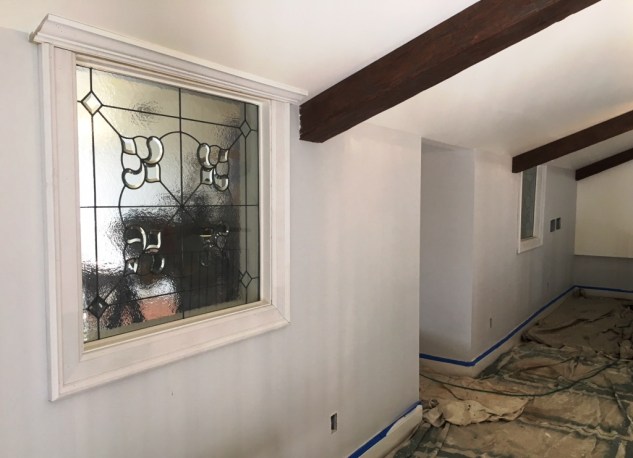
If you look carefully, you can see the ghostly figure of You-Can-Call-Me-Al working behind the leaded glass window.

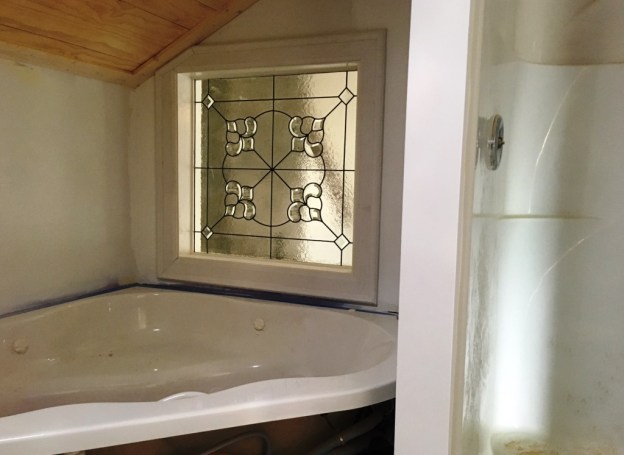
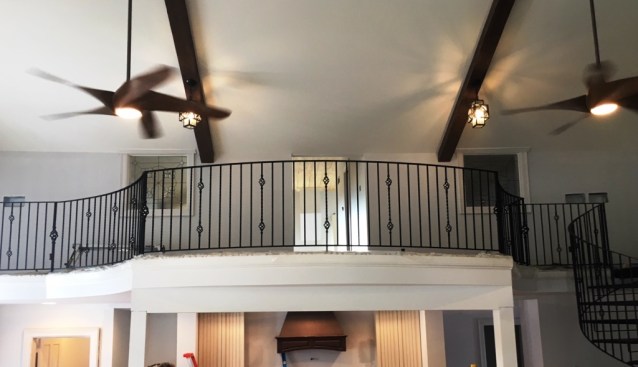
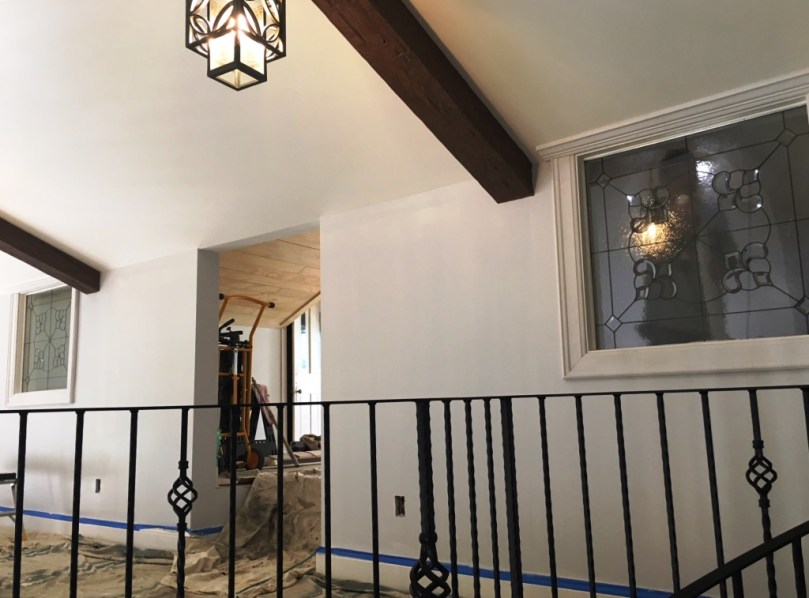
Among the items You-Can-Call-Me-Al trimmed out was the interior leaded glass windows Tyler and I selected months before to add decoration to the balcony wall while adding natural light from the second story to the sanctuary. Tyler was quickly emptying one of our rental units, and these carefully packed leaded glass windows were transferred to the church to be installed. The windows had the simple farmhouse trim on the inside and more ornate trim on the balcony side. The glassy artwork transformed the gaping holes in the drywall into light-dancing features over the tub in the second floor bathroom and along the balcony wall, and their installation confirmed we were making progress, yes, beautiful progress.

leaded glass closeup
The trim on the balcony side of the leaded glass window required clever use of crown moulding on top to accommodate the angle of the sanctuary ceiling.
leaded glass over tub
The trim on the bathroom-bedroom side of the leaded glass window was simpler.
leaded glass over balcony
Here you can see how the leaded glass windows flank the doorway of the second story. Eventually, barn doors will decorate that doorway.

# # #

Tomorrow: We should have considered a revolving door. Read about it here.

When I was 15 I used baby oil to tan; in my 50s, I learned baby oil is good for renovation

Our story so far: As we proceeded with renovating the old Methodist church, we purchased twenty-three gallons of paint for our painter, who I’d nicknamed Low Talker for his soft-spoken manner.

# # #

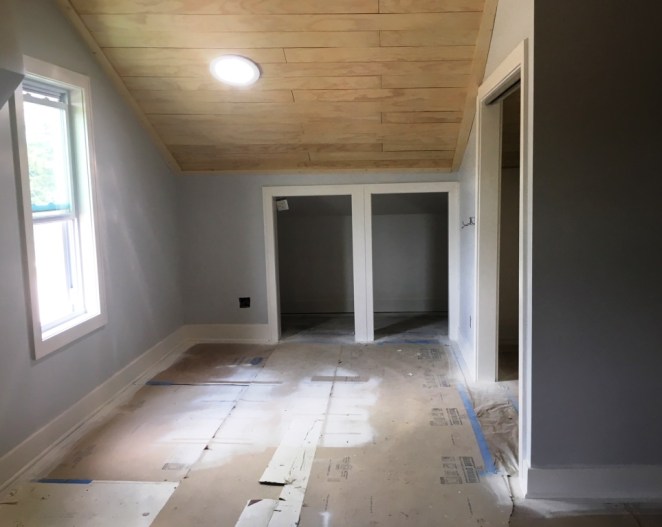
The painter then moved on to the second floor, where he began by spraying a couple of coats of polyurethane on the pickled plywood ceiling. Spraying the stuff around a horrible, stinky job. At first, I thought he was just a sweaty guy—painting was hard work. But eventually, after I asked St. Johnny about how hot it must be on the second floor, we both realized Low Talker wasn’t covered in perspiration. It was much easier for him to get clean at the end of the day of spraying paint around when he first coated exposed parts of his body—like his flowing locks—with baby oil. No wonder his hair looked as soft as his voice sounded.

upstairs and ceiling
This is my future office on the second floor. Our finished wood floors are covered up, but here you can see the ceiling with polyurethane, the trim and all the paint.

# # #

Tomorrow: Interior windows. Read about them here.

Love prefers twilight to daylight

Our story so far: As we progressed on the renovation of the old Methodist church into our home, Tyler hired a painter with experience and attention to detail. And a soft voice.

# # #

wall color
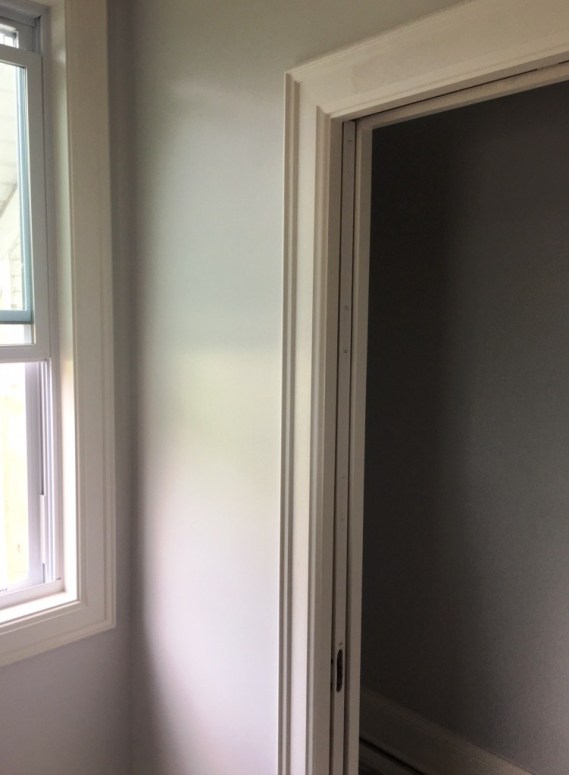
Here’s a look at a window and the door frame for the water closet in the master bath.
paint colors
Top to bottom: Walls in Evening White, trim in Bleached Linen and wainscoting in Arid Landscape.

Low Talker began work in the master suite, specifically the laundry room, which we were—I was—eager to get operational. After he’d covered several walls with paint, instead of the little patches I’d created, I knew I’d chosen the right color of gray, a light gray inspired by Behr’s Evening White but mixed by Sherwin Williams. It made me happy just walking through the rooms any time of day. The trim, a white inspired by Behr’s Bleached Linen, popped against the gray. And the wainscoting, a tan inspired by Behr’s Arid Landscape, brought warmth to the scene.

vaulted ceiling
That tin ceiling looks like new!

Low Talked also painted the tin inside the master bedroom tray ceiling with Arid Landscape, and it looked so good when he was done I decided not to distress it.

# # #

Today’s headline is a quote from Oliver Wendell Holmes Sr., a 19th century American physician and poet.

Tomorrow: Painter’s trick for Breck hair. Read about it here.


Talking with quiet confidence will always beat screaming with obvious insecurity

Our story so far: Drywall. Check. Flooring. Check. We were making progress on renovating the old Methodist church we were converting into our home.

# # #

Chapter 35

As we wrapped up the flooring part of Phase Three: Drywall, Paint & Flooring, the painter arrived. Truth be told, he showed up a little sooner than was convenient as You-Can-Call-Me-Al was still nailing trim in place, but this was not something we were going to grouse about after some of the flaky contractors we had dealt with. He showed up, first of all, and he showed up sooner rather than later, so we were happy.

Early on, I imagined Tyler and I would be painting the interior of the church ourselves. We had succeeded in just such a task together before when we painted the first floor of the first house we owned. Tyler hired out the work of painting the ceiling, and then he pretty much painted all the walls, leaving me to haul paint and ladders around, fetch more buckets and paint inconspicuous walls in the closets and the powder room.

But Tyler was tired—he had so many other things he could do, and he didn’t trust me to precisely cut in the line between the walls and the ceiling (I had proven to have an unsteady hand). We decided to pay a professional to do it right and more quickly than we could accomplish it ourselves. He collected quotes from a couple of men who came on recommendation, and settled on the one with the thick, wavy gray hair of a Greek god. This one had dropped by more than once to inspect the church, and when he chatted with me about the features of the old trim around the sanctuary windows, I was impressed with his attention to detail (and noticed nothing unusual about the volume of his voice).

It wasn’t long, however, before he earned a nickname: Low Talker.

Low Talker derived his name from a character on the ‘90s TV sitcom “Seinfeld.” Her lips would move, but Seinfeld and Elaine couldn’t hear what she said. To be polite, they would just smile and nod. As the plot of the episode evolved, Jerry smiled and nodded in agreement to something Low Talker uttered, only to find out later to his horror he agreed to wear one of her designer puffy shirts on a TV appearance. Ha, ha, ha.

This character trait was probably not a good one with any contractor, but certainly not with the painter who frequently consulted the spouse he perceived to be in charge of paint color decisions. If you smile and nod in agreement to something, you better be sure you heard correctly or pretty soon you’ve got a wall that’s the wrong color.

So I said, “What?” A lot.

For the record, Tyler conversed with Low Talker without any communication problems. Only I said “what?” after every sentence. So was it Low Talker’s soft voice or my poor hearing that caused the problems? Those with intimate knowledge of my family health history might pin the fault on me, but I maintain Low Talker was one of those men who speak softly and carry a big paintbrush.

It was a good thing he used a big paintbrush because it became apparent very early on that we would be using a lot of paint. We started with eleven gallons of wall paint, five gallons for the trim and two gallons for the wainscoting. Only a few days in, I was sent back to the paint store for another two gallons for the wainscoting and three more for the trim.

If you’re counting, we were up to twenty-three gallons of paint.

If that number didn’t make me glad I wasn’t the one doing the painting, I don’t know what would. That’s a lot of paint.

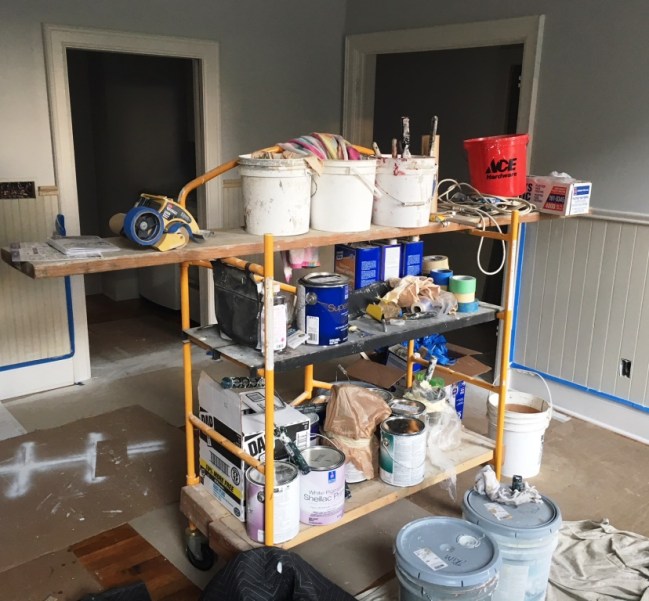
painters desk
What a painter’s desk looks like.

# # #

Tomorrow: We chose better with paint colors than we did initially with floor stain. Read about it here.

You have to leave space for God to walk into the room

Our story so far: We stained the floor of the old Methodist church sanctuary in Acorn Brown, and it looked great. We were ready to move on to tasks that didn’t involve sanding or staining for a while.

# # #

We needed to protect the beautiful flooring because the old church required a lot more work and a lot of contractors would be traipsing around. Tyler invested in a couple hundred dollars worth of Ram Board, heavy-duty cardboard that can be rolled out like a red carpet to provide temporary floor protection, and on Monday we rolled it over most of the sanctuary floor.

Monday evening about 11 o’clock, just after I retired for the night, Tyler’s phone pinged, indicating there was some motion detected inside the church. Sometimes headlights from passing vehicles set off the motion detector so this was not entirely unusual, but I was lying wide awake, so I looked at his phone notification and was alarmed to see a pile of trim scattered all over our newly stained sanctuary floor.

I shook Tyler awake. “Something happened,” I said as I dressed with the clothes on the floor.

“Huh? What? What happened?” he said.

“The trim fell down! Our floors!”

I ran over the church (Tyler chided me later for not letting him lead the way), and he followed a minute later. I flipped on the sanctuary lights, and we took in the scene. The sixteen-foot-long trim stored on a temporary shelf in the sanctuary was all over the floor. Our beautiful finished floor! The weight of the trim broke not the shelf but the window trim to which it was screwed. It had fallen with a mighty clatter.

broken trim shelf
The disaster scene in the cold light of day.

We went back to bed, a little crestfallen, but when we cleaned everything up the next morning, we found only one big ding in the floor and only one broken piece of trim. As with so many events on our reconstruction, timing was everything. Fortunately, the shelf yielded in the middle of the night when no one was around and the floors were thirty-six hours post-staining so they were dry and covered by Ram Board. Divine Providence was overseeing our project.

Back to work.

# # #

Today’s headline is a quote from American musician and producer Quincy Jones who, among other things, produced Michael Jackson’s “Thriller” album. “Under the mooooooonlight, you see a sight that almost stops your heart. … ‘Cause this is thriller.”

Tomorrow: Chapter 35 opens with a new character joining our saga. Read about it here.

One of life’s greatest pleasures is the satisfaction of a job well done

Our story so far: After much equivocation, my husband and I chose an alternative stain color to the Golden Oak we first stained the sanctuary floor in the old Methodist church we were turning into a home.

# # #

And then Tyler and I spent ninety minutes on a Saturday afternoon applying Acorn Brown to the sanctuary floor. Unlike stain alone or polyurethane alone, this stain + poly was a two-person job. Tyler smeared on the stain with a lamb’s wool mop, and I followed behind him with a synthetic deck paint pad making sure it was evenly applied (and sometimes I just held the dripping lamb’s wool mop over the bucket while he used the paint pad—because he was not interested in doing this a third time). The stain-poly was a little tricky to work with because unlike clear polyurethane, you see exactly where you got sloppy. If you miss a spot or drip it, you will see it.

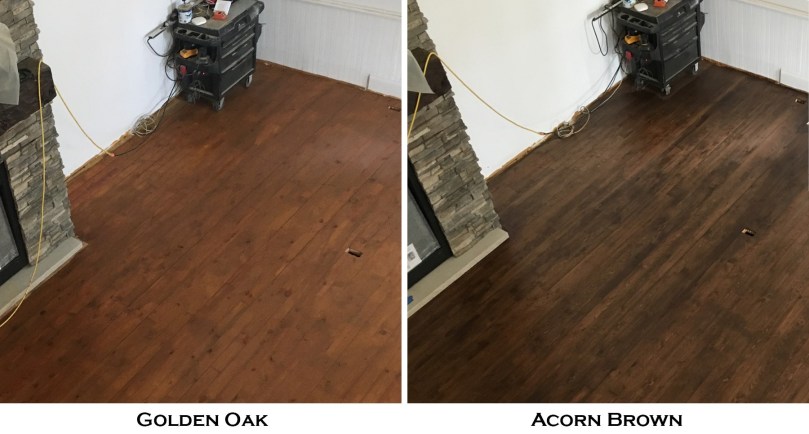
But we turned on an eclectic mix of ‘80s pop and classic rock music, embraced the sweat and used only two gallons of Acorn Brown on the floor. It was dark. But brown. Not golden. Not red. And thank goodness, not orange.

golden oak vs acorn brown

I thought we were done (finally!), and I planned to relax the next day—a Sunday. We had just finished using a product that described itself as 1-Step, after all.

As usual, Tyler got up before me and inspected our work in the quiet morning with sunlight pouring into the windows. I stayed in bed, thinking about how good my first cup of coffee would taste.

He returned to the bedroom and announced that we would have to apply another coat. Right. Now.

I tried to talk him out of it. The rest of the world was going to church or sleeping off a hangover or reading the Sunday paper, and I wanted to join the rest of the world in a typical Sunday morning activity. But after pouring the first cup of coffee, inspecting the floor myself and consulting the fine print which clearly stated two coats might be required (1-Step, ha!), I agreed. Our showplace wood floor needed another careful coat.

So Tyler turned up the music again (jazz this time), and we commenced getting sweaty. I never got breakfast—only coffee so I was extra grumpy when we finished. But we were really and truly finished. It looked pretty good.

acorn brown floor
Ta da!

# # #

Tomorrow: When out from the church there arose such a clatter! Read about it here.

The tallest oak in the forest was once just a little nut that held its ground

Our story so far: We stained the floor of the main room in the old Methodist church we were converting into a home with Golden Oak. And we hated the orangey result. So we went back to the drawing board.

# # #

Tyler and his hired man St. Johnny spent another week—and the money to rent sanders and buy sanding paper—sanding away a thousand square feet of Golden Oak. (At least the seams were filled—we wouldn’t have to perform that step again.)

rejected stains
The colors of stain we’d already rejected filled a shelf in the basement.

Another stain color was required. The Douglas fir by itself was too red, so we couldn’t go with the natural polyurethane-only look we chose for the maple in the bedroom and the pine upstairs.

This time, we went to Sherwin Williams together. With a sample of Douglas fir flooring. The clerk—the one who had already mixed three different samples for me—was fresh out of gallons of clear base stain. He couldn’t mix any colors for us. He sent us down the road to the next Sherwin Williams, and along the way, Tyler suggested we try a stain-polyurethane mix which, in theory, would be more sheer than stain alone.

We took our wood sample into a Menards (which still carried the Minwax brand that Home Depot was feuding with Sherwin Williams about), and we asked the clerk in the paint department (who was surprisingly well-versed about staining wood floors) to test a couple of colors of 1-Step wood stain + polyurethane on our sample of Douglas fir.

We walked out with five gallons of Acorn Brown 1-Step.

It was significantly darker than Golden Oak, but definitely not orange. It did not dawn on me until much later that, huh, acorns grow into oaks (hopefully not golden oaks).

acorn brown
“Complete projects 2X faster!” Where have you been all these months?

# # #

Tomorrow: The sanctuary floor in Acorn Brown, revealed. Check it out here.

An orange without a peel

Our story so far: We successfully sanded and finished the original wood flooring in the master suite and second floor of the old Methodist church we were turning into our dream home. And then we got to the former sanctuary floor we were converting into our great room.

# # #

Wait, back up, Driftwood turned the floor orange?

Not exactly.

We thought we had settled on Driftwood stain after testing a small area. After investing in a gallon of it, Tyler tried it on a larger area and judged it to be too green. So he sent me back to Sherwin Williams to get more samples. His uncle and I spent nearly two hours there getting three more quarts of custom mixed stain, and still Tyler didn’t like them. Too dark, he decided.

At this point, I refused to go back to get more stain just to have him reject it, so Tyler went. He was a man on a mission, determined to get this enormous floor stained so he could move to another task, so when he was told he’d have to wait a couple of hours to get a custom mix, he chose what he perceived to be a lighter colored stain from off the shelf: Golden Oak. And he had had enough with quarts to test; he bought two gallons of it.

It was our first mistake. It was the wrong color.

He applied Golden Oak to one thousand square feet of 126-year-old sanctuary floor. That was perhaps our second mistake, not taking into account the age and dryness of the floor. It drank up that stain like it was the Sonoran Desert. One hundred percent saturation.

After it had dried and we looked at it the next morning, it was … well, golden oak. Not exactly what we were going for, but not too dark, either. Okay.

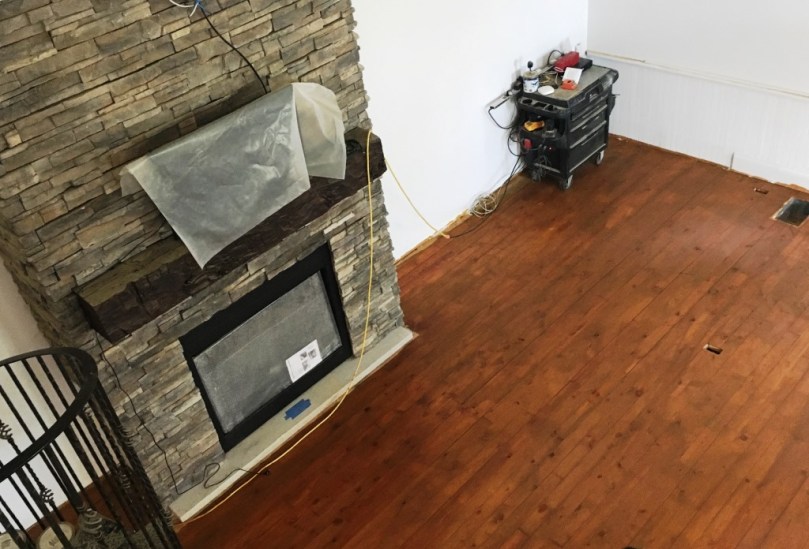
So Tyler applied his sticky concoction of Douglas fir sawdust and polyurethane to fill the cracks. That was our third mistake. The polyurethane emphasized the red in the Douglas fir. If you remember your third grade color wheel, you know what you get when you combine yellow and red: Orange. We had combined Golden Oak and red Douglas fir, and the result was as orange as my stepson’s fingers after eating a bag of Cheetos.

orange floor
Here’s a shot from the balcony of our sanctuary floor after a coat of Golden Oak stain and a coat of sawdust-mixed polyurethane.

We tried to like it. We told ourselves it would improve after Tyler light-sanded again. We were committed. We could make this work. I even applied Golden Oak to the edges of the fireplace and the base of the spiral stairway while lying on the floor with a watercolor brush.

After getting an ant’s eye view of the entire expanse during that tedious task, I called Tyler who had stolen a few moments away from the work of the church to attend a local mud bog race.

“I’m sorry, honey, I just have to tell you this,” I said as gently as I could over the roar of the off-road engines. “I hate the floor in the great room. It’s orange. That’s all there is to it. And orange isn’t part of our color scheme. We have to do something about it.”

“You know what this means, don’t you?” he asked with as little rankle as he could pull together. “It means sanding the floors down to the wood again. Is that what you want to do?”

“There are no other options?” I pleaded. “Can’t we try another coat in a different color?”

“No,” he said. “I applied poly to the floor. We’re past the point for another stain. We have to sand it all away.”

“Well, then, yes, I guess so,” I said. “We have to. I hate it. I can’t live with an orange floor.”

It was a mistake that cost us hundreds of dollars in wasted Golden Oak stain, floor sander rental and sandpaper.

Frustrating, no doubt, but not the end of the world.

# # #

Today’s headline could be a punchline in a joke, because if you can’t laugh at yourself, someone else will, right? So this orange walks into a bar. Bartender looks him over, thinks about it and says, “You know, I like you. You got a lot of a peel.”

Tomorrow: If not Driftwood and not Golden Oak, then what color stain? See what we chose here.

There’s a fine line between looking tan and looking like you rolled in Cheetos

Our story so far: We spent months renovating an old Methodist church to turn into our home/ We finally finished sanding the floors, and we were beginning to see some finishing details come to fruition.

# # #

Chapter 34

Chapter 34At some point in eighth grade, my stepson was assigned by his English teacher an exercise to create similes for every color of the rainbow. My stepson is smart as a whip (see what I did there?) but not exceptionally creative. So his first attempt was something like “as green as grass” and “as yellow as the sun.” I pushed him to try again—to think of unique similes. I recall being inordinately proud of his teenage simile for orange: “As orange as my fingers after eating a bag of Cheetos.”

Pretty descriptive, right? You know that unnatural orange, made of neon seasonings and various dyes that are named with numbers. It’s lethal to clean clothes and furniture. Very clever. As orange as that.

Well, that’s sort of what color our sanctuary floor turned into after we stained it.

# # #

Tomorrow: Wait, back up. Driftwood turned the floor orange? Read the missteps that caused this here.