Knobby

Our story so far: Shortly after we moved into the church we turned into our home, my parents paid us visit.

# # #

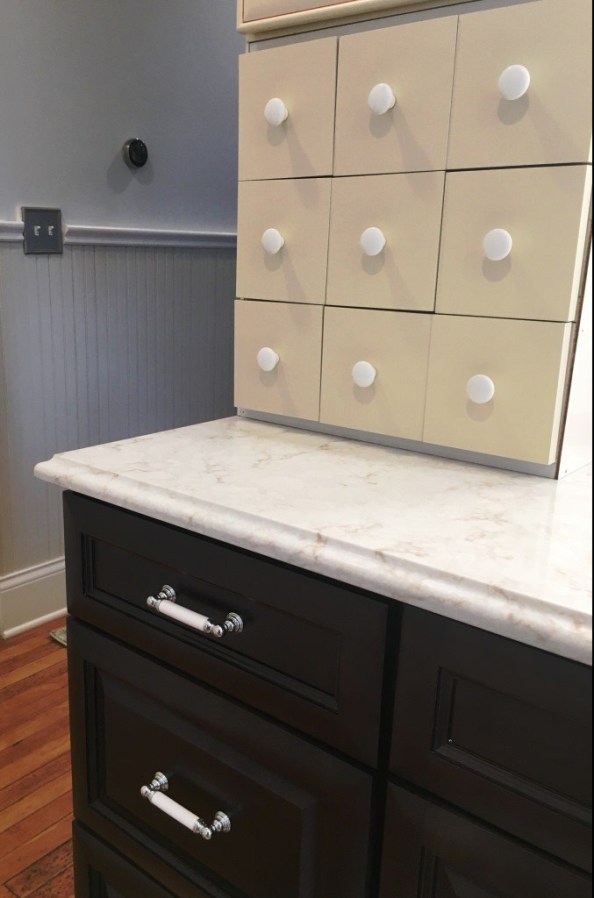
bathroom knobs
I ended up going with white porcelain knobs in the bathroom. The drawer pulls are accented with polished chrome, like the sink faucets.

A more enduring gift than the abundant harvest was my dad’s expertise with a cabinet hardware jig, a device that makes it easier to install cabinet knobs. He spent his “free” time during my parents’ visit installing more than fifty cabinet knobs throughout the church. When we moved into the church and I asked Tyler about when he would put on all our knobs, he said, “Rome wasn’t built in a day.” Rome wasn’t finished when Dad left, but at least I could open all my cabinets properly.

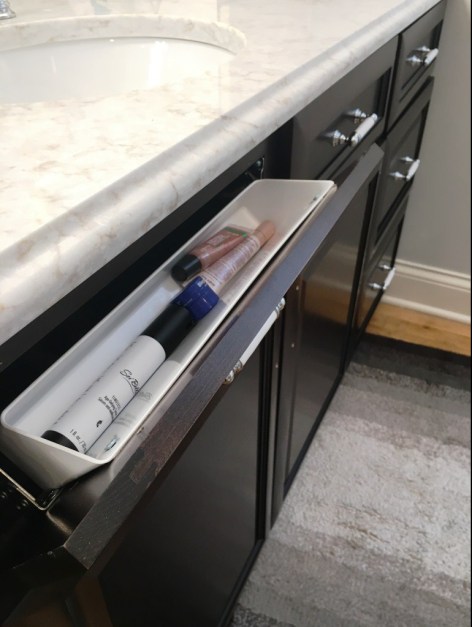
When I pulled bags of knobs out of the bathroom cabinets for Dad to install, I ran across a couple of boxes of tip-out sink-front trays that turn false drawer fronts into usable storage.

“Oh, maybe you can install these while you’re at it,” I said off-handedly, not fully grasping the enormity of the task I was asking Dad to perform.

tip out drawers
How handy!

In his typical fashion, he did not complain (much). He figured out how to remove the false drawer fronts and install the trays (and the knobs!). Two cautionary tips: Dad told Tyler it would have been much easier to do before the quartz counter top had been glued on (impossible in our situation since we couldn’t find them then, but a useful note for you future DIYers). And, if you have a Dad as clever as mine who installs such handy drawers, you better put them to use. Because he will check when he visits at a later date and grouse about it to your sister when he discovers he put in all that effort and they’re not even used. I filled mine immediately with tooth floss and lip gloss.

kitchen knobs
The knobs for the beverage bar cabinets came from the drawers originally in the display kitchen but which ended up in the master bath.
mudroom knobs
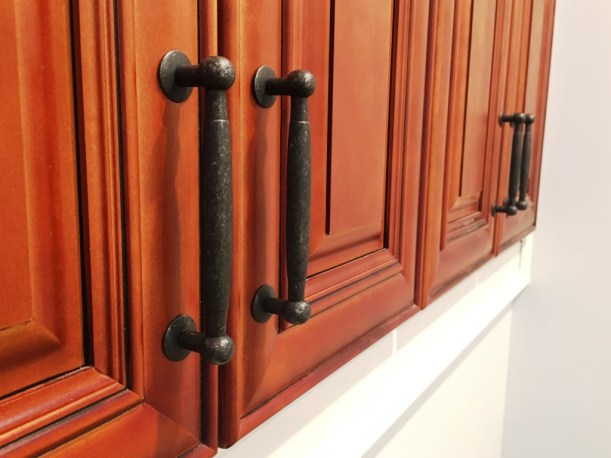
The knobs for the mudroom cabinets were a perfectly rustic.
linen closet knobs
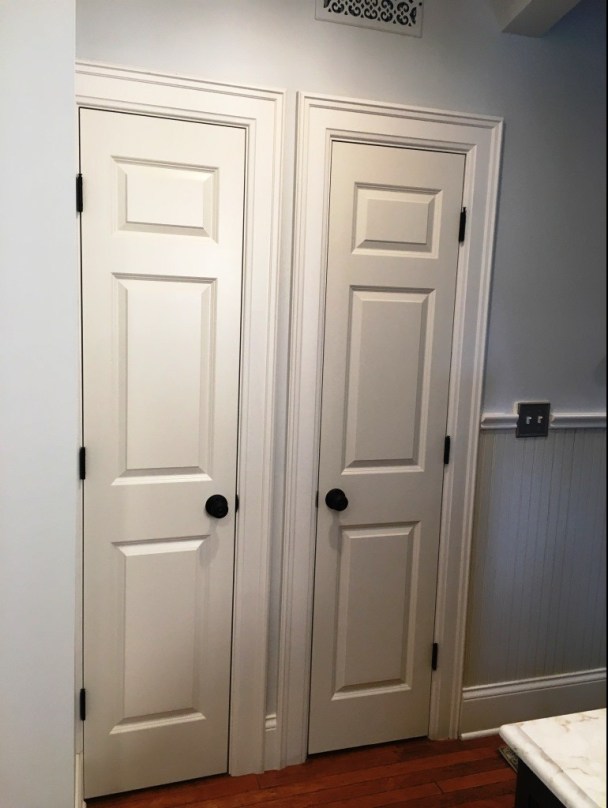
After my linen closet doors hung ajar for a couple of weeks, Dad solved the problem by installing the door knobs. Bingo!
laundry room knobs
The knobs on the laundry room cabinets were my favorite. They matched the plumbing pipe we used for the closet rods.

# # #

Tomorrow: The balcony, unveiled. Check it out here.

Wine is sunlight, held together by water

Our story so far: While my husband was working on the big and noisy work of constructing an adjoining garage on the church we converted into a home, I was working on smaller and quieter projects.

# # #

I also unpacked box after box of cookware and serving ware. Cast iron, stainless steel, non-stick, porcelain. Crystal, ceramic, glass, bamboo. Oval, round, rectangular, decorative. All the large, fancy and heavy pieces we didn’t bring with us in the RV but couldn’t bear to part with were now unpacked and homes found. When we entertained, I pulled out a butter knife with quiet satisfaction. Such an inconsequential but lovely flourish I could offer guests once again. For the butter. Which was served in a ceramic butter dish instead of a Tupperware one. This small thing made me happy.

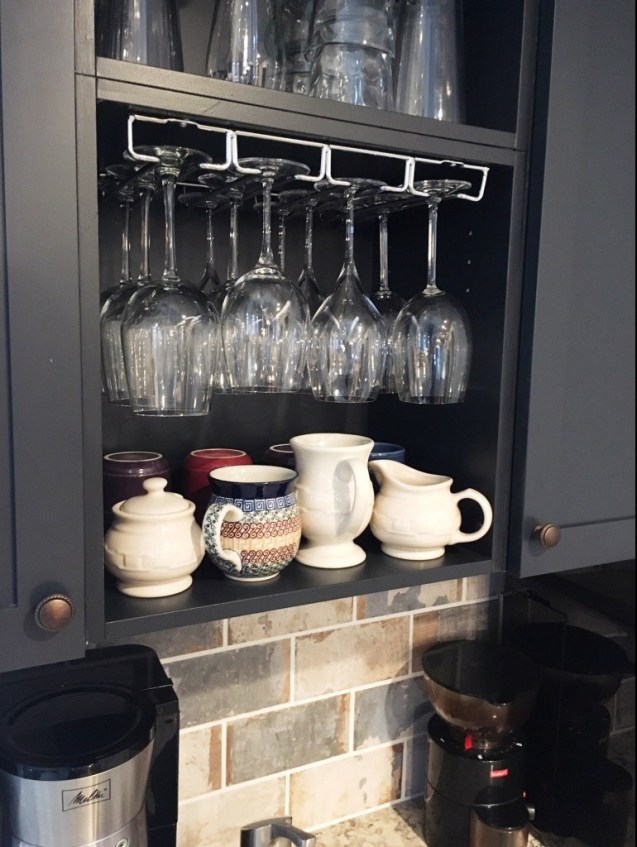
And glass wine glasses! Oh, the simple joy of a real wine glass. For many months while we had traveled in the RV, I drank wine from plastic glasses unless I dined out (and, believe me, I appreciated using glass when I had the opportunity). Glass glasses were so much more civilized, sophisticated and aesthetically pleasing than plasticware. I unpacked all but one of our glass wine glasses intact and stowed them in the cabinets of our new beverage bar. A few days into the garage construction project, my parents paid us a visit, and my clever father installed a plethora of cabinet organizers, including the stemware holding rack that turned my wine glasses from functional pieces into art.

stemware rack
My new stemware rack in use.

I was still surrounded by boxes when Mom and Dad arrived, but with their help over the course of seventy-two hours, we made much progress. They arrived bearing news: “When we drove by Home Depot,” Dad said, “they had a sign that said, ‘Tyler and Monica, We Miss You!’”

Oh, ha, ha. Yes, our visits to the store had reduced in frequency but had in no way come to an end (shortly after Mom and Dad left, I ended up making two trips to Home Depot in a single morning).

When I offered Mom a drink and recited the options, she said, “Oh, your aunt will be pleased. She thought your beverage bar only offered coffee, beer and wine, and she doesn’t drink any of those, but I didn’t know you had water, too.” Indeed, the DrinkPod had been installed and dispensed filtered water in three temperatures: cold, room temperature and hot. Mother learned its ease of operation and helped fulfill drink requests for the remainder of her visit.

My parents also came bearing delicious gifts of harvest: Fresh buttercup squash from their Minnesota garden, two kinds of apples from Dad’s orchard, honey from their property they rented out on the plains of North Dakota, jars of homemade applesauce, homemade chokecherry jelly, and real maple syrup collected and cooked by the pastor who had once confirmed me in church.

# # #

Today’s headline is a quote from Galileo Galilei, the 17th century Italian scientist who discovered Jupiter had moons revolving around it, among many other physical and astronomic observations. He was twice accused of heresy by the church. And apparently he was a fan of wine, which he, alas, most likely drank out of a vessel made of something other than glass.

Tomorrow: Dad does a jig. Read about it here.

Happiness can be found even in the dark if one only remembers to turn on the light

Our story so far: We moved into the mostly finished converted church, and Tyler worked on adding a garage.

# # #

While Tyler and his crew worked on a big and noisy project, I worked on projects small and quiet.

Switch plates and outlet covers, for example. Rather than paying the electrician to install dozens of switch plates, which required no particular talent, Tyler put me on the job. On the main floor, we chose a sleek metal-look alternative to standard white. I spent ninety minutes screwing on plates before I ran out of the right shapes and energy. I was half done.

switchplates
A distinctive switch plate.

# # #

Tomorrow: The simple joy of a real wine glass. Read about it here.

Question: Why did the roofer go to the doctor?

Our story so far: The foundation was poured and walls were built for the garage addition to the old Methodist church we had turned into a home.

# # #

During the course of a week, the skeleton walls were built just in time for the delivery of the roof trusses. These, too, had plans of a sort. Tyler specified the size, and the factory constructed the triangle-shaped roof supports in an engineeringly correct manner (“engineeringly” is not a word, but you get the point—they wouldn’t fall to fiddlesticks). Because the garage was not small, these trusses were not small either. They were forty-four feet long, and when they were delivered, the pile filled nearly the entire driveway. The weatherman also delivered: The day dawned sunny and clear, if a little more breezy than one might like.

The morning we set the trusses, Tyler—who had dreamed of this huge garage for the better part of a lifetime and after months of renovating the church was getting sick and tired of constructing anything and wanted to see progress—said, “If we get through today without anyone getting hurt, I’ll be happy.”

I knew then this work was tricky, trickier than most of what we had performed in our little, some might say big, project. If Tyler was measuring success by lack of injury rather than by dumpsters filled or two-by-fours used or square footage sanded, then this must be serious business indeed.

truss no 1
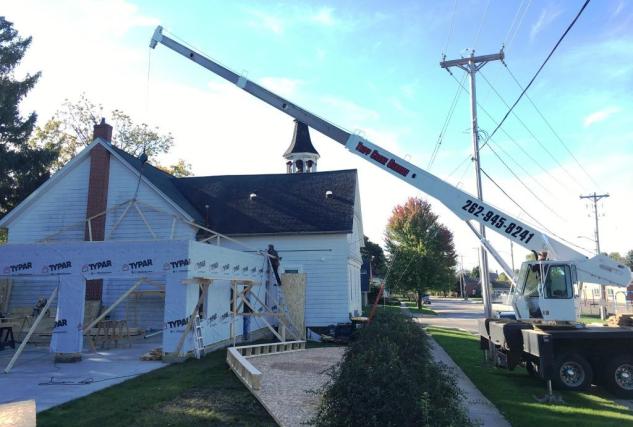
The first truss is placed.

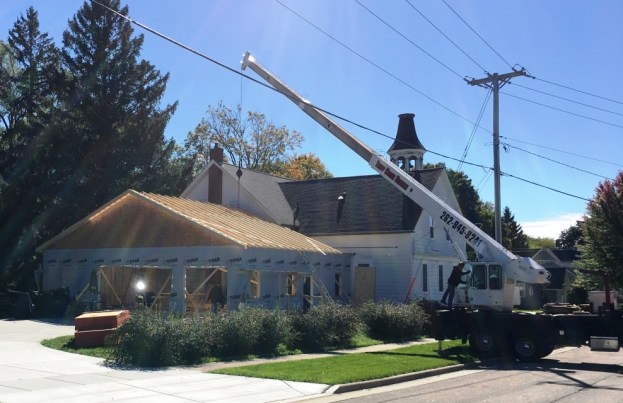
The enormity of the roof trusses required the use of a crane to lift them from the ground, one by one, and set them on the walls. A full crew of men—five plus Tyler and the crane operator—had been summoned. You-Can-Call-Me-Al and Reroofer straddled ladders and makeshift footings to help place them and then secure them, while the other men dashed around on the ground. Because cranes and skilled crane operators are, shall we say, not inexpensive to rent, everyone was moving fast and efficiently so as not waste time, which was money.

For the most part, I couldn’t watch. I sat at my computer in my upstairs office, one wall of which bordered the garage. I heard the regular sounds of engines and hammering and men yelling, praying I wouldn’t hear anything more urgent or worrisome than that.

I didn’t. The crane left to do crane-type work elsewhere in less than four hours. No one was injured. The trusses were properly in place.

Tyler was happy.

trusses
After the last truss was set.

# # #

Today’s headline is the first line from a joke. Answer: Because he had a bad case of shingles.

Tomorrow: In the meantime… Read about what kept me busy here.

Footprints on the sands of time are not made by sitting down

Our story so far: We’d moved into the old Methodist church we’d turned into a home, and now my husband turned his attention to the garage.

# # #

Naturally, this was no basic two-car garage. Fiddlesticks! What would my go-big-or-go-home husband do with such a tiny structure? He couldn’t even contain all his screwdrivers to a single drawer in his tool chest! He certainly couldn’t contain all his man-cave dreams—and tools for a lifetime—to a standard garage.

To be fair, Tyler created plans for the footprint of the extra-deep four-car garage in order to acquire a building permit. This allowed us to pour the cement foundation in the spring, and it had the opportunity to cure all summer. As we enjoyed happy hour drinks around a picnic table on the what became our temporary summer patio, we marveled at how well the water drained off the driveway. So we knew we had a good foundation.

While Reroofer worked on the roof of the belfry, You-Can-Call-Me-Al and Tyler began constructing ten-foot-tall garage walls out of two-by-sixes. In what I imagined an old-fashioned barn raising to be like, the two men would fold in helpers when necessary to set up a wall. One morning Tyler roped in a couple of railing fabricators who stopped by to measure for an interior railing, and often Reroofer, You-Can-Call-Me-Al’s son and St. Johnny would lend a hand.

Here’s a slide show of the transformation of the back yard from cement pouring in the spring to wall construction in the fall:

This slideshow requires JavaScript.

# # #

Tomorrow: A crane and a roof. Check it out here.

How to build a garage in 10 easy steps

Our story so far: We worked ten months to make the old Methodist church habitable, and now Tyler turned his attention to the garage in order to get it done before winter.

# # #

Chapter 42

How to build a garage in ten easy steps:

  1. Pour concrete.
  2. Nail together and erect two-by-six walls.
  3. Sheet walls with plywood and wrap with air-and-water repellent building wrap.
  4. Order roof trusses.
  5. Hire crane to set roof trusses.
  6. Sheet roof with plywood, roof felt and ice-and-water barrier.
  7. Shingle.
  8. Install soffit and fascia.
  9. Install doors and windows.
  10. Install siding.

If it were as easy to do as it was to write about it, everyone would build their own garage. Not everyone does. But Tyler was not everyone.

As he prepared to turn his attention to his garage, Tyler discussed the project with You-Can-Call-Me-Al, the man whose experience and execution skills had turned him into Tyler’s right-hand man. You-Can-Call-Me-Al, who had been willing through months of construction to work without written plans, was nonetheless more comfortable using them.

“Don’t you have blueprints for the garage?” You-Can-Call-Me-Al asked.

“No,” Tyler said. “I’ve never had plans for any other garage I’ve built.”

Tyler and I joked later than I should draw his ideas on a piece of notebook paper with blue ink, hand them to You-Can-Call-Me-Al and say, “Here’s our blue prints.”

Thus, Tyler and crew embarked on forming a garage from the ether of ideas.

back yard when we bought it
Here’s how the back yard of the church looked when we bought it. That little shed by the chimney? Tyler resurrected it to store tools through the spring and summer, but Tyler spared it of an inferiority complex by razing it when he started building the garage.

# # #

Tomorrow: Garage raising. Read about it here.

Love handle

Our story so far: We reinforced the pilings on the belfry of the old Methodist church we’d turned into a residence so that we could safely ring the church bell. Which we did, much to our delight.

# # #

Rope on second floor
Here’s our bell rope from our belfry hanging down to the second floor.

We had a lot of leftover rope, which I asked Tyler about. I wondered if this was his typical “go big or go home” approach to buying in abundance or something else. He said he was pondering threading the rope through the closet to the main level.

bell pull
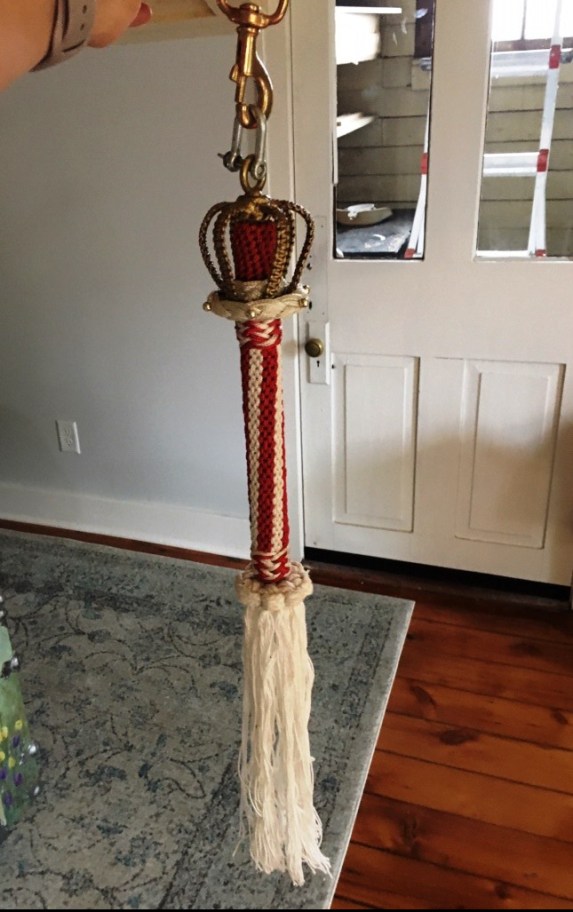
The bell pull is about a foot long, with another eight inches of fringe. You can see the door to the belfry in the background.
crown
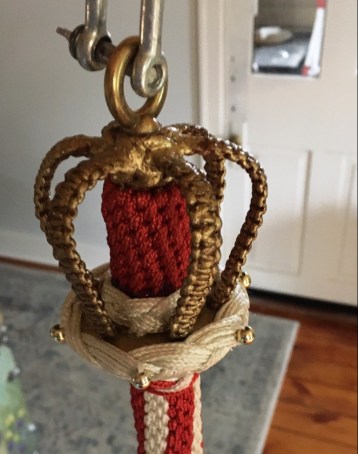
Close-up on the “crown.”


At some point, he intended to attach to the end of the rope an ornate bell pull he’d found on Ebay. The designer, a sailor with a knack for knots, lived in the United Kingdom and had fashioned a crown at the top of the elaborate bell pull. “This particular crown most resembles the King George crown having six legs and an ermine fur cuff,” he wrote in his description. All of it was made of nylon rope, some of it painted. It would be a dignified ornament for our bell rope.

Outside on the belfry, we had determined that we would reroof the tip-top of the structure, replace the second-story window and install siding either later in the season (if Mother Nature cooperated) or, more likely, in the spring.

For now, Tyler wanted to concentrate on a different project: The garage.

# # #

Tomorrow: Chapter 42 opens, and it all about the garage. Read about it here.

A bell’s not a bell ’til you ring it

Our story so far: A team of men shored up the pilings of the belfry on the old Methodist church we had converted into a residence.

# # #

Reroofer now went to work in what he specialized—finishing the flat roof beneath the bell. He performed this work once already, back in the autumn, but all that had been pulled apart to repair the pilings. He spent a solid week traipsing up the ladder with various construction materials—plywood, aluminum, waterproof sheeting and more—to do whatever a good and proper roofer does. He dodged a recalcitrant squirrel who’d taken possession of the nook above the bell and insisted Reroofer was trespassing. For the most part, Reroofer simply ignored the squirrel’s chattering, but he made a note to himself and to us that the roof above the bell would have to be filled in to deter squatters.

Reroofer also attached the rope to the wheel of the bell so one did not have to stand on the roof to ring it. The day he did this, a pair of my friends paid me a visit so I celebrated by inviting them to ring it with me. They demurred. “You really ought to be the one to ring it the first time,” one said.

I yanked on the rope once, and I could feel that it wasn’t hard enough to get the clapper to make contact. I was too timid.

“Do it again!” they said.

I pulled again, this time with gusto, and the bell rang out. My eyes grew as wide as my grin, to the delight of my friends.

Later that day, Tyler climbed the steps to the second floor with a single intention: To ring the bell himself. He was not so timid as I had been. He pulled the rope and rang the bell three or four times, satisfied with all the work that got him to this reward.

bell front door
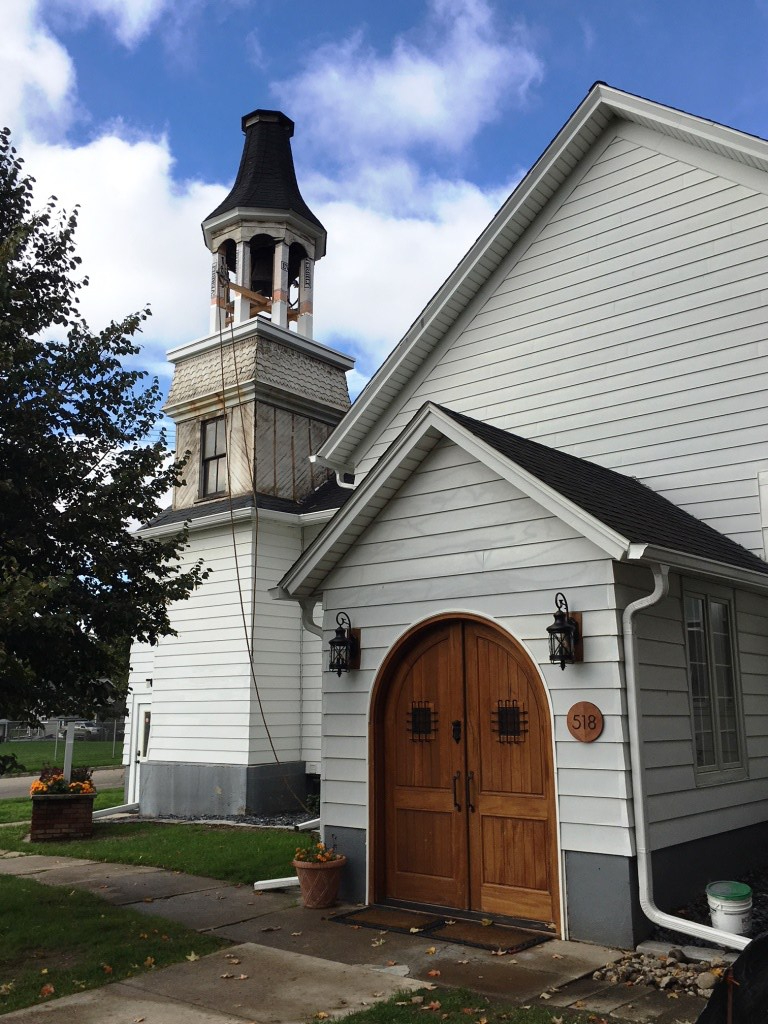
Here’s a shot of our belfry after sheathing the pilings and after Reroofer finished the flat roof beneath the bell. You can also see our front door with the new lighting and street number.

Church bells, of course, are not usually rung just for fun. In the strictest sense, the primary purpose of ringing a church bell is to call parishioners to services. “In a broader sense the bells produce a pure musical sound that stirs the hearts of all who hear them,” according to an FAQ I found on the internet about ringing bells. “The uplifting sound transcends any artificial boundaries of sect or religion. Most of us love to hear them whatever our beliefs—because they stir something deep, perhaps something deeply spiritual, in all of us. And we are grateful and want to continue the tradition.”

Since it was the sort of signal that could be heard across town, I felt as though I ought to develop some sort of guidelines for ringing our bell. Traditionally, bell ringing was used to announce or signal special events such a weekly services, according to the FAQ. They were also used as flood or fire warnings, messages to douse fires for the evening, warn that the town water supply had been polluted (perhaps by a drowned animal), or to signal the harvest or new year. Bells also were used to announce times of great joy, such as weddings, or to express sorrow, such as at funerals. I thought perhaps we could get away with ringing the bell in welcome to visitors (so we could show it off, of course), for family birthdays (though I wasn’t sure I trusted ringing it once for every year—I had a 103-year-old grandmother after all) and for new year’s (because that could be expected).

# # #

Today’s headline is a partial quote from Tony award-winning songwriter Oscar Hammerstein, who said, “A bell’s not a bell ’til you ring it. A song’s not a song ’til you sing it. Love in your heart wasn’t put there to stay. Love isn’t love ’til you give it away!”

Tomorrow: Chapter 41 wraps up with future plans for the belfry. Read about them here.

Ring my bell, ding-dong-ding

Our story so far: After moving into the old Methodist church we had converted into a home, we mounted repairs to the belfry with the intention of ringing the bell, which had sat silent for some time because parts of the tower were rotted.

# # #

wrapped pilings
That’s a wrap.

The following day, You-Can-Call-Me-Al and Reroofer climbed back up into the belfry to wrap the now heftier pilings in waterproof net. And as long as he was up there, You-Can-Call-Me-Al decided to test the heft by ringing the bell.

rope
If you can’t find it on Amazon or eBay, you don’t need it.

Reroofer rang the bell when he was repairing the roof beneath it the previous fall, but he did it carefully and by hitting the stationary bell. Now, You-Can-Call-Me-Al stood on the ledge of the bell tower, grabbed the circular crank and pulled (this is the mechanism to which a rope is usually tied—we removed the worn-out old rope intending to replace it with a new one of impressive diameter). The bell swung, and the clapper made contact.

Tyler and I stood on the ground, watching to see if the tower swayed. Standing on the tower and confident of his work, You-Can-Call-Me-Al assured us it was solid.

He rang the bell wildly.

The tower stood immovable.

Our bell sounded full and melodious. It was lovely. I watched, smiling widely.

A passersby on a nearby sidewalk asked me if we planned to ring the bell at three o’clock in the morning. Maybe she was worried.

“No,” I said. “But maybe at midnight on New Year’s Eve.”

“That would be OK,” she said.

OK? That would be awesome!

You-Can-Call-Me-Al tested our bell a few more times. No police showed up, so the neighbors must have been either happy to hear it or willing to bear it.

# # #

Tomorrow: You-Can-Call-Me-Al shouldn’t have all the fun. Read about our first bell-ringing here.

Teamwork makes the dream work

Our story so far: Having moved into the old Methodist church we’d renovated into our home, my husband Tyler worked to make the belfry winter-ready.

# # #

lumber delivery
Oh, happy day!

A nice, warmish day in September, Day Three of the belfry reconstruction project dawned with a lumber delivery. A truck with a crane dropped a literal ton of lumber in our back yard, most of it for building the garage but some of it for the belfry.

The goal of the day was to sheath the eight pilings of the belfry with new lumber, thereby reinforcing them and adding back the strength sapped by decades of weather and animals.

belfry four men
Coming right up! Tyler and St. Johnny on the ground, You-Can-Call-Me-Al and Reroofer up top.
belfry bricklayer wheel
This is a little blurry, but it’s probably because You-Can-Call-Me-Al working on that ledge was making me nervous. You can see the bricklayer’s pulley hanging off that horizontal board.

This was a four-man job. You-Can-Call-Me-Al was Nail Man. Standing on the narrow ledge outside the bell tower with a nail gun, he called measurements down to Tyler. Tyler was Cut Man. He cut lengths of wood with a table saw on the ground. He then attached these pieces of lumber to a rope on a bricklayer’s wheel acquired and installed by You-Can-Call-Me-Al. You-Can-Call-Me-Al pulled up the planks and attached them at the top of the pilings. Meanwhile, Reroofer was the Middle Man. He stood on the ladder all day attaching the planks inside the belfry. St. Johnny helped Tyler on the ground and frequently ran smaller items and tools that couldn’t be hoisted up to the second-floor, where Reroofer retrieved them.

At some point in the afternoon, Tyler sent me to the hardware store to buy more bolts, enormous pieces of metal bigger and longer than my fingers. I paid more for each bolt than I would have for most fancy drinks at Starbucks. These were substantial fasteners that meant business.

belfry close up of piling
This is an inside view of a sheathed piling. You can see one of those $4.50 bolts in the center there.

None of the men sat for more than a few minutes all day. You-Can-Call-Me-Al balanced on the narrow ledge, Reroofer stood on a ladder, Tyler maneuvered mighty planks on the ground and St. Johnny scurried around, picking up after them.

Four o’clock, the customary quitting time, came and went. Five o’clock came and went. These guys had a system going, and they were determined to finish the job. Six o’clock, and my stomach rumbled. Even I, who had been sitting at a desk most of the day handling arcane paperwork, was hungry.

The men wrapped things up about half past six. All eight pilings now sported new sheathing all the way around. The belfry had a new-car smell about it.

I attended an evening class nearby and returned an hour later. I found evidence that Tyler had fixed himself his favorite comfort food—macaroni and cheese—and I peeked in the bedroom: Tyler was snoring softly.

# # #

Tomorrow: Ring my bell. Here it here.