Too big, too small and juuuuust right

Our story so far: As we waited impatiently for the church to gather the necessary closing documents, we got a look at the freshly minted survey for our lot.

# # #

Some math revealed we were about to be owners of 5,033 square feet of livable space, including the basement, in the church we intended to convert into a house; this was roughly fourteen times the size of the camper in which we’d resided for nine-going-on-ten months.

Part of me felt guilty for giving up the minimalist lifestyle. When people asked why we’d moved in the first place, we often told them our house had gotten too big; we rarely walked into entire rooms.

But the truth was, we just hated that house. It didn’t start that way—it was a home to raise a teenager in a decent school district. But we’d paid more for it than it was ever worth, and then the 2008 Recession hit and stole even more equity from us. Spending any money on it at all to make it more our own and less mass market felt wasteful and pointless. The teenager grew up. The longer we stayed there, the less it felt like home, which is opposite the way it should have been. Getting out was a relief.

The part of me that didn’t feel guilty about taking on so much house felt positively giddy about it. Living in a camper for a season had proven to be problematic when it came to entertaining. There was too little room to prepare meals much less serve them. Overnight guests slept in our living room and were forced to awaken at the first grind of the coffee. I was excited to create inviting guest spaces in our new home, and with a grandchild on the way, I wanted plenty of space to spread out the crib, toys and other paraphernalia accumulated by modern parents.

I also longed for our king-sized bed. The camper only had room for a queen, and Tyler and I together more than filled it. Cozy had started to become cramped.

Tyler also began to resent the landmines I’d created everywhere by stuffing our belongings into every conceivable space; I longed to have cupboards to organize dishware, toiletries and shoes without having to pull every last thing apart to get to the bottom of a pile.

There were a lot of coordinates and numbers, but what the survey didn’t capture was how that square footage was going to create a sanctuary for a family.

# # #

Tomorrow: We begin the move into our temporary rental. Read it by clicking here.

Of all we survey

Our story so far: After a delay in closing, we decided to rent a house near the church to live in while we renovate it into our house.

# # #

Chapter 5

As we waited impatiently for the church to gather the necessary closing documents, we got a look at the freshly minted survey for our lot.

front door
Our front door in the right of way.

To our surprise, we were about to become owners of three lots. Together, our triangle-shaped property comprised about a third of an acre. The church building was situated on the corner where two streets intersected (there had never been a parking lot, at least not in recent history; apparently parishioners used street parking or the elementary school’s lot kitty corner to the church). This positioning would allow us to build a garage in the back yard with a curb cut on the west side of the lot, avoiding the ugly maw of a double garage door overwhelming our front door as so many suburban homes without alleys have. (Before we purchased our former residence, I’d vowed never to buy such a monstrosity, but alas, that’s how modern houses are plated and constructed nowadays.)


There would be no welcoming porch though. Our front door was 3.78 feet over the property line. Technically, our light sconces on either side of the front door were street lights. Instead, we planned a screen porch off the to-be-built garage overlooking our side yard.

# # #

Tomorrow: I’m of two minds about the amount of square footage in which we’re about to invest. Read it here.

# # #

Did you used to worship at this church? If you have memories you’d like to share, I’d like to include some of them in our story about renovating the church into our house so others can appreciate its history. Simply click on “Contact” above and send me your story.

Sometimes Plan B offers A+ luxuries

Our story so far: We decide to convert a 126-year-old Methodist church into a house. The first closing date—October 31—came and went as the seller struggles to track down the detailed closing documents.

# # #

After six weeks of scheming and waiting, on November first, the day after we agreed to an extension of our closing date, Tyler began shopping for an apartment. He’d toyed with, then rejected the idea a couple of times based on the trouble of the moving and demands for long-term leases and long commuting distances to the work site of the church, but now, after purchasing propane in three-figure volumes, he was serious.

After he lowered his standards enough to entertain all options however unsavory, he found something we thought could work: A one-bedroom house that allowed pets (to accommodate our aging miniature schnauzer), and it was situated only two blocks from our church. We completed the application and scheduled a time to look at the place in person. And not a moment too soon. The morning of our walk-through, the garden hose supplying water to our camper (which was necessary not only for drinking and showering but for flushing the toilet, too) froze. Campers don’t plan trips to northern Illinois in November for a very good reason.

The rental house was tiny but functional. There was room enough for our king-sized bed, lots of natural light and, unbelievably, a wine refrigerator and jetted tub. In this case, “cozy” was a mansion compared to the meager 358 square feet in our RV. Judging by the dirt in the corners, it was clearly a rental property, but who needed pretty? We were going to build pretty into the church. And as with all things related to real estate, it had the three things we most wanted: Location, location, location. We agreed to the terms on the spot and scheduled a day to move in: November eleventh, four days before we planned—hoped?—to close on the church.

While we were town, we accomplished our first maintenance task, an act the church granted us permission to do even though we weren’t officially owners: Tyler extended the downspouts on the church to coax water away from the foundation and the basement.

# # #

Tomorrow: Chapter 5 opens with a look at the lot survey.

# # #

Did you used to worship at this church? If you have memories you’d like to share, I’d like to include some of them in our story about renovating the church into our house so others can appreciate its history. Simply click on “Contact” above and send me your story. Read it here.

Nothing like a blank slate to inspire interest in reusing, recycling, repurposing

Our story so far: We’re waiting impatiently for the seller of the church we want to buy and turn into our home to conjure up the paperwork necessary to provide a clear title.

# # #

In retrospect, I believe God was giving us a break. An opportunity to catch our breaths and think. A few weeks of rest. But at the time, the delay was maddening. Here we’d finally gotten our heads around the idea that we weren’t going to live in the camper and travel the country indefinitely, and we’d decided to jump back into the real estate market. We’d found a property we were pretty confident we couldn’t lose money on no matter what Wall Street did to Main Street. We’d created a renovation plan. We’d determined we could agree on the style of our kitchen backsplash, the fireplace mantel and the color of the paired sectionals with which we planned to furnish the great room. But we couldn’t actually do anything other than shop.

This was problematic since we no longer owned a garage in which to store the amazing deals Tyler scored on Amazon Prime and Craig’s List. On a brief business trip, we visited an expansive architectural salvage store with historic doors and unique bathroom fixtures, but we couldn’t buy any of it. Nowhere to put our treasures. Tyler found an amazing store of used construction materials in greater Chicago selling 23 pieces of solid wood kitchen cabinets in the perfect shade of cream. Upon inspection, they were the perfect shade of yellow so we didn’t invest in them, but we were awed by bathroom vanities in every shade of the rainbow and the doors in widths from 27 inches to 32 inches. Too bad we didn’t know exactly how wide we’d need our doors. Or how many for that matter.

The visits to seconds shops cemented our decision to pursue this renovation with as many pieces of recycled materials as we could find. We’d sold most of our furniture when we vacated our home a year before, and we were horrified by how little other people valued our belongings. We’d vowed never to buy new unupholstered furniture again (upholstered furniture of unknown origin, not so much).

Our lack of storage space didn’t prevent Tyler from stopping at an estate sale and finding an ornate Mirror, Mirror on the Wall for the front entryway. He also scored a bathroom faucet, sink and vanity from Craig’s List. He purchased two-by-fours and built eight saw horses. All of these finds, he stashed in the garages of his cousin and his mother (sometimes over their objections).

# # #

Tomorrow: Chapter 4 concludes with the creation of a new plan. Read it here.

How to inhabit a church in just three easy steps

Our story so far: We’re filling our time waiting to close on the church we plan to convert into our home by creating budgets and making plans.

# # #

As the prospect of freezing temperatures became ever more real in our camper, we debated how long it would take for us to acquire a habitation permit from the village.

The building inspector told Tyler he required an operational bathroom, kitchen and bedroom before he would allow us to occupy the church. So simple! Just three rooms!

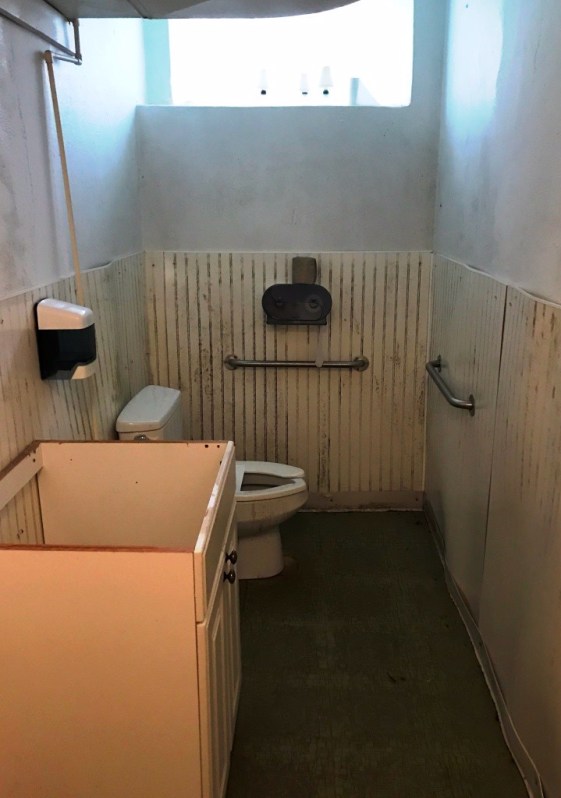
bathroom.jpg
Check out that sweet bathroom. Just kidding. It’s hard to see but that’s not one, not two, but three room deodorizers on the window ledge.
Well, we had a toilet in the basement.

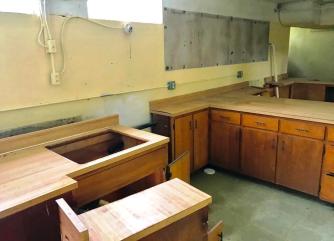
Kitchen Before
The church kitchen in the basement in all its “before” glory.
At this point, we didn’t even have running water. The congregation had turned it off sixteen months before when they vacated the church building to merge with another congregation in a nearby city. They took all the pews, the pulpit, the altar and both the bathroom and kitchen sinks. The basement kitchen countertops existed but were unmoored from the walls.

On the third showing at the church when we found Stan the squirrel, we discovered puddles of water in the basement. The caretaker, who noticed us at the church as he drove by, came inside to tell us the basement always got water when it rained. Shouldn’t a caretaker do something about that? I wondered silently.

A basement prone to flooding was probably not a great place for a bed.

Tyler spent a month scheming about plumbing in order to construct a bathroom shower and install new (or newish) sinks. He consulted with an electrician. He called an HVAC guy to schedule a furnace check. And he pondered how we might keep our sleeping area free of construction dust. We could take our time once we were living inside the church, but speed was of the essence in getting it livable.

Every day the church failed to conjure up the necessary documents for closing the deal put us more on edge. Tyler would lay awake at 2 a.m. thinking about 100-year-old lead pipes and drain vents. For me, the sleeplessness came at the beginning of the night. I would watch HGTV for hours before retiring for the evening, and then I’d lay awake re-arranging the location of the main floor laundry and dining room table. Or I’d scroll through pages on Pinterest looking at rustic accent walls, vaulted bedroom ceilings and DIY entryways only to dream about them later.

# # #

Tomorrow: Chapter 4 continues with a description of the wonders of architectural salvage. Read it here.

Now here’s a home contractor you’ve probably never heard of before

Our story so far: My husband Tyler agrees with me that his DIY solution to the disintegrating belfry in the church we planned to convert into our house was ill-conceived.

# # #

First Tyler called three area roofers. Roofers have no fear of heights. Or, at least, they have the equipment to mount such a repair on a 30-foot high belfry. Keep in mind, we didn’t even officially own the property yet. Tyler, with his salesman-like charm, persuaded the roofers to have a look. One of them actually followed through, submitting a quote by email for reroofing the entire church.

Um, that’s not what we want. We wanted you to reroof the belfry.

Tyler was undeterred (which is what we would need if we ever hoped to finish this project). He discovered an entire profession created for just such a project: Steeplejacks.

A steeplejack is a craftsman who scales tall buildings to carry out repairs on chimneys, church spires, cupolas, clock towers and, fortunately for us, bell towers. And they have an association, too. Alleluia!

The first steeplejack Tyler contacted looked at the pictures of the belfry and provided a highly detailed quote within a week for ten times what we’d estimated in our Tequila Budget.

We wanted to cry. That figure was more than we were paying for the entire church building!

Tyler didn’t give up, though, and the second steeplejack—a pro with a mission who signed his quote with “in His Service”—confessed he couldn’t promise he could do it for less than the first quote until he could climb up there and see what was going on. Just erecting the scaffolding would take a day to accomplish. Besides paying for him and two assistants (at $2,400 a day), we’d have to shell out for the materials of course.

Of course.

But we loved our bell tower (or, at least, the bell tower that would soon be ours). And I loved my husband. Avoiding having his broken body at the bottom of a set of rickety steps was worth $2,400 a day to me.

And, as if guided by a divine scheduler, the pro with a mission would be available in November.

This coincidental schedule opening only made us more impatient to close on the church. But perhaps the divine scheduler could see a bigger picture than we could.

# # #

Tomorrow: Chapter 4 opens with a debate about our plan to get the church livable. Read it here.

Real DIYers don’t shy away from rotted belfries

Our story so far: A cursory inspection reveals the roof of the belfry in the church we planned to buy was in terrible, possibly dangerous condition.

 # # #

stairs
Stairway to heaven? These were the exterior stairs Tyler described using to repair the belfry.

Initially, in the privacy of our bed in the early morning hours as we dreamed of our church, Tyler cooked up the idea that he could use the emergency stairs that were attached to a different side of the house to repair the belfry himself. He described in alarming detail how he could move the stairway around the building, climb up twenty-five feet, deconstruct the belfry piece by piece around the bell and rebuild the roof.

In November.

I forced him to recount his brilliant plan in excruciating detail to both of our children in the hopes that they would dissuade him of such lunacy (again with the crazy!).

The light of day and after the encounter with Stan the mummified squirrel when Tyler had gotten a good look at the damage, he realized we needed to get professionals involved.

# # #

Tomorrow: A mummified squirrel is nothing compared to the terror of a quote on belfry repair. Read it here.


Tools required to check for rot in a belfry: Haz-mat suit and courage

Our story so far: The seller of the church we wanted to buy and convert into our house disclosed the belfry was “rooted.”

# # #

On our third showing of the church, which occurred while we were still waiting for the title to clear and we talked our real estate agent into letting us in again despite the prospect of the tiny commission, my enterprising husband packed a hazardous materials suit, goggles, a face mask and a big flashlight. Oh, and a hammer.

He donned his apparel—what a dashing figure, not too unlike the Stay Puft Marshmallow Man—and climbed a step-ladder in the closet on the second floor that led to the belfry. A couple of whacks at the trap door, and he was inside.

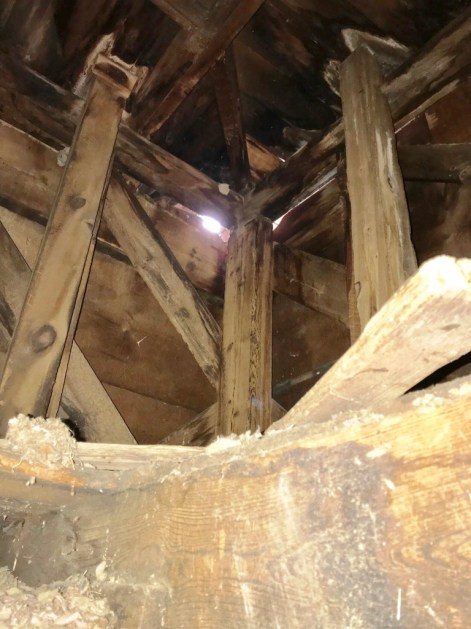
daylight in the belfry
Here’s what the inside of a very old belfry looks like. That bright light in the center of the picture? Daylight shining through the roof beneath the bell.

Unfortunately, he could see the sky. Coffee-can sized holes dotted the perimeter of the roof around the bell. On days with worse weather, rain was probably pouring into those holes. And who knows what else!

Well, we found out what else.

Stan
Here’s what a very mummified squirrel looks like.

Stan the squirrel.

The mummified and dust-covered rodent’s wide-open mouth betrayed the terror he must have felt in his last moments.

The real estate agent and I were standing along the far wall while Tyler poked around. We had no interest in coming face to face with a bat.

Tyler found Stan. But he didn’t find any bats.

Oh, joy! We didn’t have bats in our belfry after all! (I told that joke ad nauseam for days afterward. And I’m not promising I won’t use it again.)

# # #

Tomorrow: Tyler cooks up a plan to repair the belfry. Read it here.

Not every dream home features a belfry, but ours did

Our story so far: We found the home of our dreams, only it was a 126-year-old Methodist church that needed a lot of work, so much work, in fact, our friends thought we had bats in our belfry.

# # #

Chapter 3

The belfry had the potential to be our first money pit.

A belfry is the part of a bell tower or steeple in which bells are housed.

Ask not for whom the bell tolls. It tolls for thee.

Bells toll. Pay the toll. Bad things take a toll. Was there a message here?

Originally, the seller wanted the bell excluded from the sale of the church building. But with a little bit of research on eBay, my husband convinced the congregation that removing the bell would probably cost more than it was worth. So when they accepted our offer, which included the bell, we were thrilled to become its new owners. But it was going to exact a toll.

our-rooted-belfry.jpg
Our “rooted” belfry was in visibly poor condition, especially the roof just beneath the octagonal bell tower.

Without any inspection, we knew the belfry had problems. The seller had disclosed it was “rooted.” We hoped it was “rooted,” actually. My husband, ever the insurance agent, had visions the tower would fall down and we’d be liable for killing someone. Being solidly rooted is what we wanted in a good belfry.

But the roof of the belfry was indeed problematic, which was obvious even from 25 feet away on the ground. Shingles were curling all around the edges, and a piece of flashing was tearing away.

# # #

Tomorrow: A closer inspection is in order. Click here to read.

As it turns out, a fatalist finds a home in this church

Our story so far: Despite the raised eyebrows of our friends, I was sure a converted church would make a divine home, and I talked my husband into taking on the project.

# # #

I especially scoffed at the notion that a church might be haunted. One naysayer asked if I was going to burn sage.

Harumph. Sage. No.

Why would ghosts want to haunt a church? Only someone who didn’t attend church would suggest such a thing.

Church buildings are places of joy. Babies get baptized in churches. Couples get married. Children sing songs, and people celebrate holidays and anniversaries. Yes, people have funerals in churches, too. Funerals are sad. But people who have church funerals believe they’re going to heaven; they’re not going to hang around a church pissed off about the afterlife. And we had established, as definitively as you can without breaking ground, that no cemetery had ever been part of the property so we were confident we wouldn’t have a Poltergeist incident.

(Then I looked up what a sage smudging ritual involved. Sage smoke absorbs conflict, anger, illness or evil, according to Google. Couldn’t hurt to take an metaphysical shower, right?)

I have been accused of being naïve Pollyanna, so maybe when I said I was convinced we could successfully tackle this job, save money in the process and love our new digs, well, maybe I was wrong.

But I was also a fatalist who believed it did no good to resist the inevitable. Any house we purchased, or any lifestyle we adopted for that matter, could get us killed or cost us money or make us miserable if that’s what the future had in store for us. Not to mix my metaphors, but if we were going to go down in flames, we were going down in a church.

# # #

Tomorrow: Chapter 3 opens with a look into the maw of our first potential money pit. Click here to read.