‘The world is my country, all mankind are my brethren, and to do good is my religion’

Our story so far: From Sunday school room tables to manger scenes, we gathered, sorted and gave away many of the items cluttering the interior of the old Methodist church we were demoing in order to turn into our dream home.

[I cannot claim authorship of today’s headline. It is a quote from Thomas Paine, an English-born political philosopher and author of “Common Sense,” the first pamphlet to advocate American independence.]

# # #

Some things were simply too sacred to throw away indiscriminately. But they weren’t worth keeping either.

Like the flags. The American flag hanging on the flagpole when we took ownership was decrepit beyond salvage. That one and another we found were donated to the local American Legion post for proper retirement (i.e., burning). I also found a half-dozen desk flags that I donated to Goodwill. The United Methodist Church flag, we returned to the nearby congregation with whom the former members of our church had merged.

Then there were the hymnals. We found boxes of them, probably a few issued by every Methodist hymnal committee in a century.

I kept four of them with the intention of making a unique light fixture for a reading nook somewhere. The rest, I gave to Goodwill in hopes someone would find a creative use for them.

Bibles
These Bibles are becoming useful again in the hands of prison inmates.

And the Bibles. We unearthed more than two dozen Bibles in various conditions from falling apart to pretty nice. I kept one in excellent condition, respectfully tossed two whose bindings were disintegrating and packed up twenty-six others. Those I shipped to Christian Library International. CLI’s mission is to advance Christ’s light in prisons by distributing Bibles and offering Bible study.

# # #

You can help Christian Library International, too, by collecting Bibles at your church, contributing money for shipping and prayer.

# # #

Tomorrow: Like good American capitalists, we make the big bucks by selling some of our construction waste. Read it here.


Little things matter

Our story so far: As we demo the interior, we found a multitude of items in our old church to toss or give away.

# # #

Two and a half weeks after we closed on the church, Tyler’s hired man St. Johnny tackled the closet I had once told Tyler I would clean out first. So many other priorities had pushed their way to the front of the line.

The closet was a single door along the eave on the second floor. When we’d first toured the church, a hand-lettered sign was posted on the closet door warning: “Do not open!” Of course, I opened it. Inside I found a couple of paint cans and a whole lot of dirty insulation.

“Oh, I think I read somewhere they had a wild animal in here. Maybe it was in there,” the real estate agent said.

But Stan the squirrel found a final resting place elsewhere.

Now, St. Johnny was demolishing the whole wall; my procrastination had become his opportunity. We hoped to create storage there, maybe enclosed by short, sliding barn doors.

St. Johnny found a whole lot more than old paint (but no live animals). The single closet door led to a long space along the eave, filled with Christmas decorations. Ah, so the church had already been using it as storage. Unfortunately, all of it was covered in a thick layer of dust and insulation.

As usual, St. Johnny moved boxes to my sorting station, and I sorted through them to determine what was garbage, what was worth donating and what was worth keeping.

All of the tinsel, the Easter basket stuffing and a box of Christmas manger costumes some Sunday School class in 1970 wore went into the dumpster. Some talented mom (or a moms) had turned a passel of second graders into proud shepherds watching a flock of kindergarteners by night. But the costumes had seen better days. At least three hundred dollars worth of multi-colored Christmas lights went to the basement; at some later date we would determine if these lights could be used to decorate the exterior of the church.

I found two manger scenes. One included a lighted plastic three-foot tall Holy Family. I couldn’t bear to relegate the miniature family to the dumpster, so I situated them on the curb. It was an unseasonably warm day in the middle of December, and only an hour went by before a passing van determined they had room at the inn.

“Hey, are you giving these away?”

“Yup,” I called out from inside the church, “they’re all yours.”

At the other manger-scene extreme was a cardboard stable filled with little figurines. The disintegrating barn went into the dumpster. But like their bigger relatives, I couldn’t bear to toss the figurines. So I brought them home, intent on at least washing them before giving them away.

three marys
Three Marys, one baby.

As I scrubbed their faces gently in the soapy dishwater (the “gently” part came after I erased a Wise Man’s face—ugh), I determined the figurines came from at least three different crèche scenes. I had three Marys but only one baby Jesus; this evoked a memory of my little brother who repeatedly stole Baby Sweets from my Mattel Sunshine Family back in the late 1970s—babies can be so compelling. Still, maybe someone was missing a Mary. So on the last day of the year I used my final opportunity to claim a tax deduction for a charitable donation, and I transported my motley manger family to Goodwill. Maybe someone would find a treasure in an expressionless Wise Man, or maybe not. But at least I tried.

defaced wise man
Tell me I’m not the only one reminded of the man whose face melted when he looked at the contents of the Ark in “Raiders of the Lost Ark.”

# # #

Tomorrow: Some things are even more sacred than figurines of the Holy Family. Click here to read it.

Of two minds on the divider

Our story so far: If we couldn’t repurpose the things we found in our old church during demolition, there were three ways to get rid of items we had no use for: Throw them away, give them away, sell them.

# # #

During demo, I made several trips to Goodwill and Habitat for Humanity’s Restore. Some furniture, light fixtures and even Christmas trees were our trash, but some other man’s treasure.

built-in
Though difficult to see in this picture, the built-in cabinet on the right has crosses carved into the upper doors.

On an early trip to the Restore (which accepts construction materials and operational appliances and resells them for Habitat for Humanity’s housing program), I tried to talk the manager into taking the built-in cabinet and accordion room divider that had been between the sanctuary and the overflow space.


Tyler and the hired man St. Johnny loaded them into our pickup and secured them for the 20-mile journey to a new life, and I was assigned transportation responsibilities.

I pulled up to the drop-off just as a garbage truck pulled into the lot to empty the store’s dumpster. While the truck’s beep-beep-beep created background music, the Restore manager eyed my goods.

“The bad news is, we’re not interested,” he said. To be fair, the accordion divider had seen better days and the built-in was designed for, well, a church. “The good news is, I can try to talk to the trash guy into taking them. I’ll help you move them from your truck to his.”

The garbage man agreed. It being a couple of weeks before Christmas, I hurriedly dug ten bucks in cash out of my purse and thanked the dump truck driver profusely. I was sorry to be further filling a landfill, but grateful for serendipity.

# # #

Tomorrow: I find a couple of motley manger families living in the Christmas closet. Click here to read it.

Garbage clutters the house that has no dream

Our story so far: The demolition phase of our church conversion drags on.

# # #

If we couldn’t repurpose a material ourselves, there were three ways to get rid of items in the old Methodist church we had no use for: Throw it away, give it away, sell it.

IMG_8952Only a few items were worth the trouble of reselling, so we opted to giveaway many miscellaneous objects, but unfortunately, we created a literal ton of garbage that was of no use to anyone.

Initially, the plan was to use the regular garbage bins to get rid of refuse. Thirty-yard dumpsters, as it happens, are expensive. And we didn’t budget for any dumpsters in the Tequila Budget. So we deluded ourselves into thinking we’d just fill our garbage cans full every week and eventually, we’d get rid of everything.

Ha!

It was clear after the first week, we would get rid of all our garbage in about 2071 at that rate.

Then Tyler thought he could just bring a few overflowing truckloads to the dump.

But the nearest dump was forty miles away.

Then he thought he could order a dumpster after the first of the year. We’d just walk around our construction debris inside the church.

dumpster.jpg
Dumpster No. 1, half filled.

When the walking around became wading, he knew he’d lost the good fight. Two weeks into our demolition, Tyler gave in and ordered a dumpster. A thirty-yard dumpster was delivered the next day and filled within a week. St. Johnny, Tyler’s hired man, spent a lot of time hauling ceiling tiles, lathe and plaster to the dumpster, and even though we identified a number of items for repurposing, the basement pass-through where undoubtedly thousands of hot dishes and pies were served and the sanctuary communion rail where who knows how many sins were forgiven found their final destinies in the dumpster.

It was difficult to write a check for almost $500 just to haul away our garbage, but we ordered another dumpster to be delivered just after the New Year. Such was the price of expunging the suspended ceilings, the old carpeting and all that plaster lathe from our landscape.

# # #

Tomorrow: A donation attempt goes awry. Read about it here.

Dust, old nails and scrap wood

Our story so far: The demolition phase of our church renovation included unearthing interesting treasures and repairing the belfry roof.

# # #

Chapter 11

The dirty part of demolition began to wear us down. There’s a reason home improvement television devotes five minutes or less of every show to the demolition process and usually punctuates it with crazy demolition antics. The work is necessary, but most of the time, it’s just plain dirty work: Dust, sawdust, insulation dust and construction waste served with a side of tedium.

Tyler was supervisor and handler of power tools. St. Johnny, the hired man, did any work that required kneeling or heavy lifting, skills neither Tyler nor I relished exercising. I was assigned to menial, monotonous jobs like removing nails from trim and flooring.

coal picker
Yet another arcane but useful tool in Tyler’s collection.

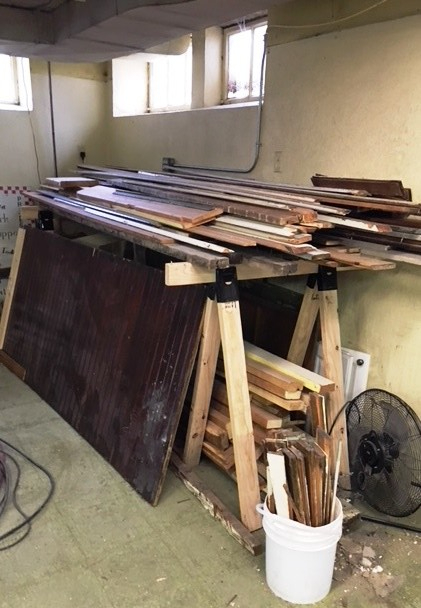
One of our goals was to recycle as much of the church as possible. Those pieces of trim and flooring would live new lives as trim or repaired floor or accent walls in the remodeled interior. But one can’t safely saw pieces of wood riddled with nails. Oh, those church builders of yore loved their nails! A single piece of hardwood flooring might have thirty nails (plus a few carpeting staples thrown in for good measure). Tyler invested in a new Air Locker gun, a device powered with compressed air that niftily forced nails out from the bottom. He also dug a strange but effective device from one of his tool boxes that looked like it once was used by an iron welder from the Old West to move coals; I used this to yank stubborn nails from boards that could not be coaxed out by the Air Locker gun. I spent many hours using these amazing tools and acquired a bad case of tennis elbow but I became an expert. A few tips:

  • Wear work boots. Those nails are being forced out with highly compressed air pack a punch when they hit your feet.
  • Wear eye protection. Those nails fly everywhere.
  • Wear gloves. Recycled wood has splinters.
  • Admire the sparks: Yes, sometimes there are sparks.
  • Organize your recycled wood by type. In a five-thousand-square-foot structure, you’re gonna recycle a lot of wood. Separate the trim, the baseboards and the flooring, or you’re never gonna find the wood you want when you’re ready to reuse it.
neatly stacked scrap
One of our more neatly stacked piles of scrap wood.

# # #

Tomorrow: Wanted: One dumpster. Cheap. To read it, click here.

The price of peace of mind

Our story so far: The contractor we hired to fix the flat roof of the bell tower in the old church we’re converting figured out how to not only save our 1,000-pound bell but ring it, too.

# # #

reroofer
Our roofing expert, hard at work.

The bearded contractor I renamed Reroofer worked tirelessly on our bell tower for three days, fueled only by cigarettes and king-sized Snickers bars. He reinforced the framing, installed new decking and replaced the backer board and aluminum fascia. He put a new ice-and-water shield all around, wrapped all eight pilings with shielding and built a new trap door.

More work—to the eight original pilings holding up the structure—was required in order for us to ring the bell reliably and regularly, but that would have to wait for heavier equipment and better weather.

Reroofer finished the initial work to the belfry just in time. A thirty-mile-per-hour wind was whipping up, and the forecast called for temperatures in the teens. It was December in Wisconsin after all. When he was done, the belfry actually looked worse. Oh, it was more solid by a long shot, but aesthetically, ye olde belfry looked half-dressed without her siding. We’d agreed Reroofer would come back in the spring to make the belfry pretty, but for now, it was structurally sound and waterproof (also, squirrel free).

When he climbed down and cleaned up his tools, he handed Tyler a bill: $1,500.

After the initial extravagant quotes we got for belfry work, I was so relieved I could have cried tears of joy.

There were many nights between the time we first saw the holes in the roof of the belfry and the day we closed when the rain on the roof of the camper made me cringe. I hated thinking of all that water coming into the church unimpeded.

The night our Reroofer made the belfry water tight, I lay in bed listening to cold spiky drops of rain hitting the windows of our little rental house. The rain sounded like rice being thrown against the windows. I turned over and smiled as I drifted back to sleep.

# # #

Tomorrow: Chapter 11 opens with a few tips on saving scrap wood, a valuable commodity in our renovation. Click here to read it.

Not everyone likes church bells, ding dong

Our story so far: We hired a nimble reroofer to repair the rotting belfry in the 126-year-old church we intend to renovate into our dream home.

# # #

At one point on Day Two of repairs, Reroofer rang our bell. Oh, what a beautiful sound! Full and melodious. I dreamed of ringing the bell on special familial occasions like birthdays and anniversaries and, of course, New Year’s Eve. Some grandmothers bake cookies or plant gardens with the grandkids; I wanted to be that special grandmother no one else had who offered bell-ringing responsibilities to her grandchildren.

belfry mid construction
Our belfry, mid construction.

In sharing these fanciful notions with interested listeners, I heard more than one story about kampanaphobia: The fear of bells. The phobia is triggered by a negative experience with bells.

“What will your neighbors think of you ringing your bell?”

I’d never considered the possibility that anyone wouldn’t like our bell.

When I looked up the village noise ordinance, I discovered, to my dismay, it applied to residential properties, which of course is what we hoped to be rezoned as: “All noise shall be muffled or otherwise controlled as not to become objectionable due to intermittence, duration, beat frequency or shrillness.” A church bell that belonged to a residence was required to abide by different rules than a church bell that belonged to a church. I prodded Tyler to discuss this with the building inspector who asked, “Well, are you planning to ring it at midnight every night?”

No, no, of course not.

It seemed the noise ordinance was enforced much like whatever rules applied to bonfires in our little village: Be responsible, don’t get carried away and be conscious of your neighbors.

# # #

Tomorrow: Reroofer presents the bill for his services. Click here to read it.

‘It’s worse than I thought’

Our story so far: After two and half months of waiting to close on a 126-year-old church we intend to turn into our home, we finally get inside and start demolition revealing its odd and interesting wonders.

# # #

Chapter 10

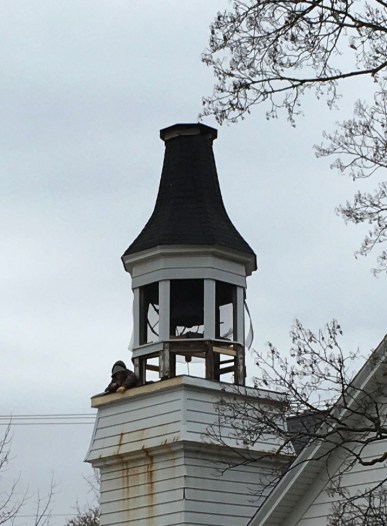
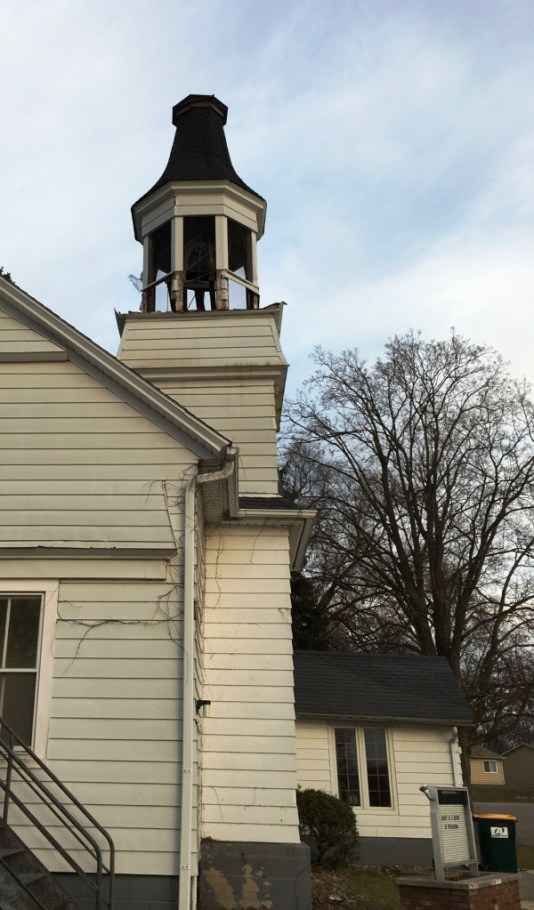
Five days after we closed on the church, the roofer showed up. Securing the bell tower was high on the to-do list after the seller had disclosed the roof was “rooted” and our pre-closing inspection revealed it was indeed rotted. With winter was closing in fast, so was our window of opportunity.

belfry definedAfter a couple of different bids from roofers of various talent, we went with not a steeplejack, but a friend of a friend with a good reputation for flat roofs. For the purposes of clarity, a few definitions might be in order. The bell turret on our church—the ornamental feature above the bell chamber—appeared to be in decent condition and shingled with materials at least as new (or old) as the rest of the church roof. It was the flat roof floor of the bell chamber (beneath the bell) that was falling apart.

The roofer was a young man with a deceivingly slight build and a long reddish beard. He had a name, but in my imagination, I called him Reroofer, sort of the fairytale contractor version of Repunzel: “Reroofer, Reroofer, let down your beard!” Unlike Repunzel, though, he would not have been trapped in any castle towers; Reroofer had the agility of a monkey climbing around the belfry thirty feet off the ground.

Initially, Reroofer thought he could fix the holes in the roof in two days. After he was there a couple of hours, tearing off disintegrating shingles and ancient pieces of wood, Tyler called up to him from the ground and asked him how it was going.

“It’s worse than I thought.”

Uh-oh.

The bell, it turns out, was three-inch thick cast iron, weighing a thousand pounds, we guessed without the benefit of a scale. Some carpenter in the past had cobbled together a solution to the aging bell supports, and now the old fix was worse for wear.

Working mostly from the inside (which made it more bearable to watch), Reroofer needed to transfer the weight of the bell while replacing the supporting structure, so he did so with an ingenious system of straps and come-alongs (and an equally gymnastic helper on Day Two of repairs). The supports were replaced with new, treated four-by-fours. When he finished, the bell hung a foot higher than before his work.

# # #

Tomorrow: Another definition: kampanaphobia. Click here to read it.

Some assembly required; moat not included

Our story so far: My husband Tyler, an excellent online shopper, found a set of front doors for our church on Craig’s List in exactly the style we had admired at a nearby big-box store.

# # #

So we drove 90 minutes south one Sunday after church to check ’em out.

They were indeed only slightly used and exactly what we were looking for. Tyler the Negotiator wrangled the owner to the ground in a metaphorical wrestling match (“We have cash. And we’ll take them off your hands today”) and claimed a pin; the seller accepted an offer of less than half of what we would have paid for new.

The only challenge was the “we’ll take them off your hands today” part. Remember, these were eight-foot double doors. And they came with the frame. Doing the math, you’ll realize they were larger than any pickup truck bed.

Fortunately, Tyler planned ahead for that.

He’d brought along two-by-fours, a saw (a cordless Skilsaw circular saw, if you must know—another one of Tyler’s many cutting devices), an electric drill and a box of screws. In a matter of minutes, he’d built a frame to carry the doorframe on top of the pickup truck. Then we wrapped the doors in the biggest, most royal furniture blanket you’ll ever see: The 12-foot red velvet curtain that until very recently had been hanging in the front of the church.

A few bungee cords later, and we were off.

We returned safely and in one piece to the church and, with a little help, carried our new entryway inside, to be installed much later when the weather was warmer and the moat had been filled (just kidding about the moat).

castle doors safely home
Our nearly new castle doors, in storage until they can be installed.

# # #

Tomorrow: Chapter 10 opens. Belfry redux. Read it by clicking here.

Seek and ye shall find

Our story so far: We were in the midst of demolishing the interior of our 126-year-old Methodist church with grand plans to turn it into our home.

# # #

Even though we could have waited, one major purchase we sprung for during demolition was a set of new doors for the entryway to the church. Tyler found a deal on Craig’s List we just couldn’t pass up.

Earlier, while we waited to close on the church, we admired an exterior door on display at Home Depot. As soon as I saw it, I knew Tyler would love it, and when I led him away from the plumbing fixtures to the front door display, I knew I was right.

We exchanged one of those looks like a couple does when they happen upon the perfect name for their first-born and they both know it.

This was it.

It was a rustic knotty pine with an operable speakeasy door behind a grille. It looked like it belonged on a castle, which was perfect, since a man’s home is his castle. And it could be special ordered as a 96-inch-tall pair. The existing entry to the church included two 80-inch-tall doors, and we knew we wanted a footprint at least as large.

Naturally, a special-order set of front doors from a big-box store exacts a king’s ransom. We’d allotted something for the front entryway in the Tequila Budget, but not that much.

But Tyler being Tyler took that as a cue to snoop around architectural salvage joints and online, and wouldn’t you know it, in a couple of weeks, someone in a nearby kingdom placed a listing on Craig’s List for just such a set of doors with the title: “Remodel reject.” Asking price: $1,000 less than new.

“Whaddya think?” Tyler asked.

“They’re perfect,” I said. The Craig’s List doors even had the speakeasy portal, and they were arched. “We should at least go and look.”

# # #

Tomorrow: Chapter 9’s revelations conclude with a description of how we got our doors home again, home again, jiggity jog. Click here to read it.