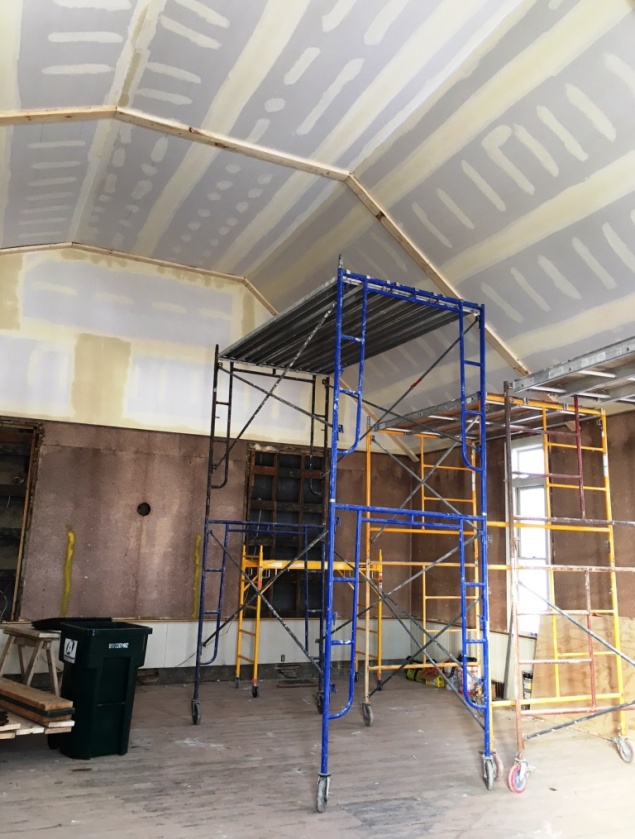
Our story so far: The drywallers were making quick, satisfying progress on the ceiling of the sanctuary of the Methodist church we were turning into our home.
# # #
Along with the Sheetrock panels, the drywallers erected on the sanctuary ceiling the two-by-sixes to which our faux beams would be attached.
In this extreme close-up of our faux beam, you can see the wood grain and the foam interior.
Tyler had decided to have a look at rigid polyurethane foam beams—lighter and more durable than actual wood beams and more affordable, they were advertised as being “virtually indistinguishable from real wood.” But seeing was believing. Ordering a couple of one-foot samples of the faux beams, like choosing any finishing details in a house, was an odyssey. We ordered them online, of course (because that was Tyler’s mall of choice), where the array of options was dazzling.
L beam or U beam?
Rough sawn or hand hewn (or any of eight other textures)?
How wide? How high? How long? Do you need endcaps?
What color? We knew we wanted “brown” but we could choose from among eleven shades of brown. We finally settled on samples of pecan and antique cherry.
The antique cherry sample beam is on the left, pecan on the right.This close-up shows how the faux beam attaches to the two-by-six on the ceiling.
A couple of weeks later, our sample beams arrived, and Tyler stuck them on the two-by-sixes on the ceiling of the sanctuary (from the safety of the choir loft).
Remarkable. They were virtually indistinguishable from real wood beams. And they were as light as cappuccino foam, which would make them easier to install.
The beams would add just the distinction we wanted in the centerpiece of our great room: Our cathedral ceilings.
# # #
Tomorrow: Wall of fame. Or possibly shame. Read it here.
Our story so far: After what seemed like an eternity of demolition, we were beginning to build inside the old Methodist church we were turning into a home instead of tear down.
# # #
A few day after the drywallers tore down the ceiling tiles in the sanctuary of the church, as I was making the bed back at the rental house after doing laundry, Tyler called, frantic.
“What are you doing right now?”
“Um, making the bed?”
“We’re out of drywall screws. You need to go get some. Three-inch drywall screws.”
OK, this was a task I could pull off. I now had visited the nearby Home Depot so many times, I knew exactly which door to enter to find the “screws and nails” aisle.
“How many?” I asked.
“Um,” he said, apparently eyeing the ceiling where the drywallers were working. “Five pounds.”
Okey, dokey. Five pounds of drywall screws, coming right up.
When I got there, screws in hand, the church sounded like a real construction zone.
Men’s voices and hammers echoed in the sanctuary. St. Johnny made noise with the Air Locker pulling nails out of boards in the basement. The HVAC guys moved a truckload of shiny ventilation ducting into the basement of the church. A boom box was tuned to a rock station playing “Superstition” by Stevie Wonder, which includes the line “very superstitious, ladders bout to fall.”
Fortunately, the drywallers were using scaffolding, not ladders.
Superstition ain’t the way.
The drywallers were making quick, satisfying progress on the ceiling of the sanctuary. The place was beginning to take on the sheen of new construction, a nice change from insulation dust.
Nothing like the smell of new construction in the morning.
# # #
Tomorrow: Did you say foam? Or Faux? Read about it here.
Our story so far: Electricity, heat and water—we were ticking basic utilities off our list as we demolished the interior of the church we planned to turn into our home.
# # #
Plumbers weren’t the only recalcitrant contractors. Tyler was the general contractor on our project, and I learned quickly (I say “I” because Tyler probably already knew) that a general contractor’s primary responsibility is dogging subcontractors.
Roughly eight weeks into our project, Tyler estimated he’d called sixty different contractors for various projects from plumbing and electrical to concrete and storm gutters. He guessed that about a third of those called him back, and only about ten actually showed up to provide bids.
Just when Tyler lost his last shred of patience and understanding with flaky contractors, a warm day in January dawned.
The effects of global warming, or climate change, or whatever label you’d prefer, were causing deadly mudslides in California, but in the Midwest, we were experiencing a 50-degree day in January, and that’s just not normal. We took advantage of it, and we weren’t the only ones.
Tyler put me to work on reorganizing the garden shed behind the church. He wanted me to clean it out and make room for some of our construction materials we hoped to repurpose. While I wrangled about a hundred muddy garden hoses into submission, Tyler met with a parade of contractors who actually showed up.
First there was the concrete guy who eyeballed our proposed driveway and garage pad. When I asked Tyler later what the contractor said about it, he told me, “He said it was a lot of concrete.”
Then a pair of HVAC experts stopped by and toured our mess. Tyler had recently pulled down the primary ductwork on the main floor in anticipation of running plumbing and electrical, and it looked like a squarish metal snake on the floor.
Even with shorter skirts, those trees have a lot of flounce.
Meanwhile, one of Tyler’s cousins stopped by to see our project, and he gave us a gift. With an expertise in trimming trees, he offered to trim ours. So he climbed up the trunks of our enormous pine trees, and trimmed away a forest of low-hanging branches. (We’d found an old picture of the church that showed one of those pine trees as a seedling; now the biggest one had a four-foot circumference and was fifty feet tall.)
Then a contingent of window contractors showed up with a display trailer. We climbed inside the trailer, me in my muddy jeans and garden-hose tousled hair, to see life-sized windows, cut-aways that showed their construction and plenty of custom shapes and designs. The samples were beautiful and covet-worthy.
But as I walked down the sidewalk away from the church admiring the tree-trimmer’s work, I could have sworn I saw dollar bills flying out the open windows and doors of the church.
Ten days later, we had another bumper crop of contractors who actually bothered to show up, all in one day: Tiler, drywaller, another pair of HVAC experts, the electrician and our now-good friend, Reroofer.
We were entering Phase Two of our church conversion project: Utilities and mechanicals.
# # #
Tomorrow: Some things are inevitable. Read about it here.