Our story so far: As we pondered how to wire and plumb the old Methodist church we planned to turn into our home, we created some guidelines for designing it.
# # #
Our brand personality would be a balance of necessity and luxury, of industrial and homemade, of modern and classic, of masculine and feminine, leaning toward economical, casual and subdued.
And then I wrote down ten design rules:
Details matter.
This door, formerly on the basement bathroom, could be reused as the powder room pocket door on the main floor. After it gets some TLC. That’s the plan anyway.
Recycle, reuse and repurpose whenever possible.
Natural lighting brings the outdoors indoors.
Build storage into every room. Two closets, two cupboards, two hooks, two nooks are better than one.
Accent walls create a center of focus.
Doors and doorways should be beckoning and give some clue as to what’s behind them (think: frosted glass with the word “laundry” and design that reflects the room within).
Artwork should be graphic, realistic (think: photographs) or abstract. Large object art and quote art—words, saying and verses—should be used liberally.
Flooring should be hardwood and/or tile with durable rugs made of natural fiber, jute and sisal.
The two rooms we spend the most time in—kitchen and master suite—should be most luxurious and elegant.
Curb appeal is worth spending money on. The front door sends a message. Our entryway should be functional and welcoming.
# # #
Tomorrow: We wrap up Chapter 13 with the color story. Read about it here.
Our story so far: We developed a mission statement for our design style in the converted church that emphasized comfort and order.
# # #
After researching interior designs styles on the internet and being tempted but ultimately rejecting words like bohemian and eclectic, I settled on this summary of our style:
Our decorating style is rustic transitional
punctuated with elements of
warehouse,
farmhouse,
barn house and
house of worship.
Rustic transitional: Note that transitional is the noun, rustic the modifier. Transitional is defined as bridging contemporary and traditional design with inspiration from the industrial era, heavy emphasis on an open floor plan and leaning toward clean, straight lines but incorporating thoughtful details. Refined would be balanced by raw. The adjective rustic suggests elements such as exposed bricks, stone, raw steel, rough-hewn or distressed wood and metal, especially tin, aluminum and wrought iron or rusted metal.
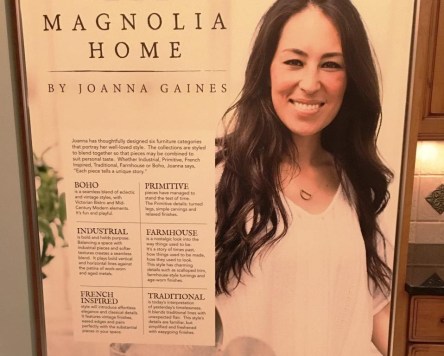
“Fixer Upper” star Joanna Gaines combines a variety of distinctive styles in her furniture line, I discovered in this banner at a furniture store I happened by.
What was warehouse? Think of a warehouse loft with open space, exposed steel, exposed brick and industrial light fixtures. Salvaged architectural pieces, especially antique doors. What parts of warehouse did I want to avoid? Nothing cold, greasy or noisy.
For me, farmhouse was an antique flea market look showing signs of wear. Distressed wood. Oversized clocks. Vintage mirrors. Candlesticks. Elements needed to be functional but should be soft and opulent. Not: Mason jars, cute cows or country tchotchkes.
Converted barns had that same open space as lofts and warehouses, but barns also had exposed wood beams, hearths, barn doors and large chunky pieces. Oh, and animals, which I would incorporate with faux animal hides. What of barns did I reject? Anything dirty. Not our aesthetic. Especially not for a Virgo.
And naturally, the inside of our home would have to reflect the outside. It was a house of worship, so we would adopt the belfry and bells of all kinds, organ and piano elements, pews, niches, large windows, stained glass and flowing water (which brings to mind to baptism and new beginnings). Crucifixes were OK, I decided, but not to excess; no Virgin Mary statues in the garden.
# # #
We can thank poet Robert Louis Stevenson for today’s post title.
Tomorrow: Our design style even had a personality. And ten commandments. Read about them here.
Our story so far: On the verge of making irreversible decisions about everything from lighting to flooring, I set out to write a design guide for my husband and I to follow as we transform the old Methodist church into our home.
# # #
I began with a mission statement:
We strive to create a comfortable sanctuary in the modern world, built solidly and maintained orderly.
Comfort was the first adjective for a reason; my husband and I didn’t want an art house that required ramrod posture and scared visitors away. Sanctuary was a good word with two meanings: Churches had sanctuaries, and sanctuaries were places of peace. With this intention, I created my first mantra to carry me through the construction phase when things got tough: “We live in a church. Let’s practice peace.”
After living in what we repeatedly referred to as a cardboard box for a decade, Tyler and I both lusted for solidity. Hollow-core doors, paper-thin walls and plain vanilla details were created for the masses; we wanted something a craftsman from a century ago would have created to persevere through a F5 tornado.
Though I was a slob to my core, I knew my husband was a Virgo who valued order so creating an orderly home with lots of storage and easy ways to hide away mess was important.
# # #
Tomorrow: Our design style, summarized. (I tell you, it’s like poetry.) Read it here.
Our story so far: My husband Tyler and I bought an old Methodist church to renovate into our home, and after the lion’s share of interior demolition to create a blank slate, we are faced with ten thousand decisions about finishes.
# # #
Up until I turned 50, I was happy to let my first husband decorate the house during my first marriage, and then with Tyler, we literally outfitted the first home we purchased together in the space of six weeks by shopping mostly at big-box stores. We were busy people then, and raising a teenager was our priority.
Now, as I pondered the design of our new home, I decided a vision board was in order. The array of options on display at Home Depot, Overstock.com, lighting stores and the various architectural salvage warehouses we visited overwhelmed us. We needed a method of narrowing down our options so we could actually make decisions when the time came. While Tyler pondered ways to install plumbing and electrical when we began our project, I meditated on the finishing details.
I began with my tool of choice: Words.
When I was a brand manager for a major scrapbooking company some two decades before, I had created style guides for logo use, brochure creation and scrapbook page design. These guides helped far-flung marketers and designers all over the world adhere to a coherent brand message about the company’s products. So I drew on that experience to write a style guide for our new house that would help Tyler and I create a home with a unified design.
First, I channeled my inner Joanna Gaines. She was the design guru behind HGTV’s “Fixer Upper” who managed to infuse her modern farmhouse spaces with clean lines, airy color palettes and recycled shiplap. Her “less is more” attitude inspired me, and her home design jibed with the way I had learned to design newspaper pages back when I was a newspaper copy editor: Form follows function. This principle says the shape of something (a building or a brochure or whatever) should be primarily related to its intended function or purpose. In other words, regarding architecture, don’t design a ballroom for a couch potato, and do build bookshelves for a bibliophile.
Then I invested in an armload of home decorating magazines and spent hours flipping through ideas on Pinterest [I have a Church Sweet Home board on Pinterest you can follow if you’re interested—just click on the Pinterest logo in the right column].
With my concepts in mind, I interviewed Tyler. After all, he was going to live here, too. A focus group is simple to assemble when there are only two people in the group. I asked him questions like “How do you want your kitchen to look?” “How to you want to feel when you walk in the front door?” “What colors do you hate?” and “What one word would you use to describe your style?”
Then I put pen to paper (fingers to keyboard, actually), and began.
# # #
Tomorrow: The mission statement of our home style. Read it here.
Our story so far: My husband and I bought an old Methodist church with the intent of converting it into our dream home. Weeks of demolition revealed the bones, and now we were working on mechanicals like plumbing and electrical.
# # #
Chapter 13
Besides playing office as a child, I treasured my Fashion Plates. Fashion Plates was an artsy toy from the late 1970s that allowed you to design your own fashions with interchangeable plates embossed with outlines of shirts, skirts and pants. The young artist, or designer, would rub the embossed shapes to get the outlines, then color in the clothes with fashionable colored pencils. Voilà! A new fashion design! I was a fashion designer!
When I began earning money by babysitting, nearly every dollar went into my fall shopping fund. I pored over magazines and catalogs, spent days shopping at malls to find the trendiest fashions and created details plans of what I would wear every day to impress my rivals at school.
I grew into a 5-foot-10 woman who could pull off a wide variety of looks, and I filled every closet I ever owned to overflowing with my fashionista finds.
But when I turned 50 and acquired a muffin top and wrinkles, spending money on beautiful clothes and dressing my aging body became, well, less satisfying. It became clear I could no longer pull off miniskirts and sleeveless tanks and body-skimming shapes.
So maybe that’s why I became transfixed with dressing my home. I enjoyed the creative thrill of combining various pieces into a unique look, and when I showed it off, I didn’t have to suck in my gut.
# # #
Tomorrow: How to create a style guide for your home. Read about it here.
Our story so far: We entered the utilities and mechanicals phase of our home renovation project.
# # #
Demolition had revealed the bones of our old Methodist church, and now we needed to run the veins and arteries and intestines through the structure.
This required detailed planning in order to know where to put sinks and drains, electrical boxes and outlets, heating vents and cold-air returns. Tyler and I had been scheming and debating for eight weeks (well, and two and half months before that), and by now, we had a fairly complete plan in place, both on paper and in spray paint on the floors of the church. By “fairly complete,” I mean we would show a plumber providing a bid exactly where we wanted a shower, and then he would ask us, “what kind of shower head do you want?” and we’d look at each other like, “Hmm, what kind of shower heads are there?” Or the electrician would ask, “Are you going to light your bookshelves?” and we’d look at each other like, “What a great idea! Lighted bookshelves!”
Our floor plan had another missing piece, I learned at a regional home improvement show one weekend in January.
A home and garden show is like a chocolate chip cookie. The boring but necessary ingredients like vendors for basement waterproofing, excavators and roofing materials are punctuated by the chocolate chip hucksters of granite countertops, acrylic shower stalls and designer garage doors. Real DIYers like us passed on the booths populated custom home builders, but we were impressed with innovations on otherwise boring details such as solar tubes, remote control operated shades and automatic lawn mowers.
It was at the garage door vendor where I learned Tyler was planning a thirty-six-foot bar along one side of the garage with a clear glass garage door opening. (Didn’t I mention he was a “go big or go home” kind of guy?).
“What?!” I said, my mouth falling open. “This is the first I’ve heard of this!”
“Some things are on a need-to-know basis,” Tyler said, and resumed discussing the options in tempered glass for garage doors and related costs with the salesman.
Over dinner, I pressed Tyler for details on his man cave and encouraged him to draw up a detailed plan. He obliged, and I learned what he thought I needed to know. (A week later, he was forced to rethink his fantasy garage plans. Alas, the zoning set-back requirement would mean a smaller garage would be necessary; a thirty-six-foot bar might not make the cut.)
In any case, we had some semblance of a plan, so now we would spend weeks running plumbing, wiring and all-new ductwork for the heating and air conditioning through the exposed floors and ceilings of the church. The work of all these skilled laborers would commit us to the floor plan and certain fixtures. We’d better know what we wanted, because once all the mechanicals were sealed behind drywall, changes would be costly. We needed a style book and design plan in order to help us make good decisions, and fortunately, I’d had plenty of time to develop one.
# # #
Tomorrow: Chapter 13 opens with the background to our design plan. Read about it here.
Our story so far: We turned on the furnaces, flushed the toilet and requested a number of bids from contractors as we demolished the interior of the old Methodist church we intended to turn into our dream home.
# # #
Nothing is certain but death and taxes, Benjamin Franklin once said. Of course, he lived before homes had indoor plumbing and electrical wiring.
But definitely taxes. They’re certain.
I can imagine a tongue flickering out of the open maw of this duct-work snake, but fortunately it was inanimate. We crushed it anyway to haul to the scrap heap.
It was another unseasonably warm day in January, and St. Johnny, the hired man, had just filled the back of the beat-up pickup with most of the basement ductwork. The HVAC guys had declared every bit of it was incorrectly positioned for the new layout and it would all have to be replaced (the Tequila Budget would take a big hit as we had not planned for that), so Tyler and I were headed to the scrap metal recyclers for a second time.
Just as we were about to pull away from the curb, the tax assessor showed up.
I felt a little sorry for him because as he introduced himself, he looked a bit skittish, as if he wasn’t always greeted warmly by homeowners. But for us, his timing was perfect since the church looked a fright near the end of demolition.
Some of our friends joked we should just continue to offer Sunday services in order to avoid paying property taxes—Tyler had a gift for gab and who minds sharing a bottle of wine with friends? Heck, we still had the collection plates. But, alas, that’s not how it works.
We ended up in the assessor’s queue to be paid a visit because the church had changed hands into private ownership and we had pulled a building permit. He explained our property would be valued at its sale price (a good thing for us) and its condition at the first of the year (as it was uninhabitable, that was also good for us, at least for the time being).
We invited him inside (I gathered from his response that this wasn’t what usually happened) but unlike our other visitors, we didn’t give him the dreams-and-quartz-countertops tour.
After he took a few exterior measurements, he was on his way. And so were we. Another day, another trip to the scrap yard.
One might think mail service is as inevitable as taxes, but no. At least not for a residence that formerly was a church. I don’t know how the Methodists received mail, but there was no mailbox. I stopped in at the post office no less than four times in eight weeks but I still had no answer about whether we would have a mailbox on the street or at the post office. Neither snow nor rain no heat nor gloom of night stays these couriers from the swift completion of their appointed rounds, but I guess the volume of Christmas deliveries delays answers about mailbox location.
If I couldn’t get an answer during Phase One: Demo, Maybe I’d get an answer during Phase Two: Utilities.
# # #
Tomorrow: I discover a black hole in our building plans. Read about it here.
Our story so far: Electricity, heat and water—we were ticking basic utilities off our list as we demolished the interior of the church we planned to turn into our home.
# # #
Plumbers weren’t the only recalcitrant contractors. Tyler was the general contractor on our project, and I learned quickly (I say “I” because Tyler probably already knew) that a general contractor’s primary responsibility is dogging subcontractors.
Roughly eight weeks into our project, Tyler estimated he’d called sixty different contractors for various projects from plumbing and electrical to concrete and storm gutters. He guessed that about a third of those called him back, and only about ten actually showed up to provide bids.
Just when Tyler lost his last shred of patience and understanding with flaky contractors, a warm day in January dawned.
The effects of global warming, or climate change, or whatever label you’d prefer, were causing deadly mudslides in California, but in the Midwest, we were experiencing a 50-degree day in January, and that’s just not normal. We took advantage of it, and we weren’t the only ones.
Tyler put me to work on reorganizing the garden shed behind the church. He wanted me to clean it out and make room for some of our construction materials we hoped to repurpose. While I wrangled about a hundred muddy garden hoses into submission, Tyler met with a parade of contractors who actually showed up.
First there was the concrete guy who eyeballed our proposed driveway and garage pad. When I asked Tyler later what the contractor said about it, he told me, “He said it was a lot of concrete.”
Then a pair of HVAC experts stopped by and toured our mess. Tyler had recently pulled down the primary ductwork on the main floor in anticipation of running plumbing and electrical, and it looked like a squarish metal snake on the floor.
Even with shorter skirts, those trees have a lot of flounce.
Meanwhile, one of Tyler’s cousins stopped by to see our project, and he gave us a gift. With an expertise in trimming trees, he offered to trim ours. So he climbed up the trunks of our enormous pine trees, and trimmed away a forest of low-hanging branches. (We’d found an old picture of the church that showed one of those pine trees as a seedling; now the biggest one had a four-foot circumference and was fifty feet tall.)
Then a contingent of window contractors showed up with a display trailer. We climbed inside the trailer, me in my muddy jeans and garden-hose tousled hair, to see life-sized windows, cut-aways that showed their construction and plenty of custom shapes and designs. The samples were beautiful and covet-worthy.
But as I walked down the sidewalk away from the church admiring the tree-trimmer’s work, I could have sworn I saw dollar bills flying out the open windows and doors of the church.
Ten days later, we had another bumper crop of contractors who actually bothered to show up, all in one day: Tiler, drywaller, another pair of HVAC experts, the electrician and our now-good friend, Reroofer.
We were entering Phase Two of our church conversion project: Utilities and mechanicals.
# # #
Tomorrow: Some things are inevitable. Read about it here.
Our story so far: We acquired hook-ups for electricity, natural gas, heat and wifi in the old Methodist church we plan to turn into our dream home.
# # #
Our next hurdle was like parting the red sea. We needed something close to a miracle. You might think water service would be as easy to get as electricity—register your name, your credit history and your first born with the utility, and voilà, power. Water in a property formerly used as a church is a different story.
The Methodists had been getting unmetered water for the past eighty years (or however long they had indoor plumbing). After all, the church was only in use once a week plus an occasional funeral. Some former members told us a few bachelor pastors in history had actually lived in the church, but they were bathing elsewhere because the bathroom had only a toilet and a sink.
In order for us to get water, we needed a water meter, and by code, the only person who could install a water meter was a plumber licensed in Wisconsin.
This was a trick. Tyler called at least a half-dozen plumbers for this seemingly simple task. If they called him back (a big if), they frequently couldn’t fit us in the schedule until February.
Unacceptable.
Tyler took to snapping pictures of plumbing vans he happened to drive by in the area and calling the numbers advertised on the side panels. He asked everyone he encountered for referrals.
Finally, two weeks after we closed on the church, a plumber showed up when he said he would and installed a water meter. Now the village allowed us to turn the water on, and look at that, the toilet flushed. This was all well and good, except one couldn’t wash one’s hands because we still didn’t have a bathroom sink (and we wouldn’t be getting one for many more weeks).
# # #
The title of today’s post is a quote from Thomas Fuller, a 17th century English churchman and historian.
Tomorrow: Contractors can be flaky. If you didn’t know. Read about it here.
Our story so far: Long baths taught us water was an expensive commodity in the community where we purchased an old Methodist church to convert into our home.
# # #
Modern homes—at least the ones on the grid—require a plethora of utility services, and our church was no exception.
We acquired accounts for natural gas and electric immediately; the church was already hooked up and the service providers only needed to know whom to bill. So lights were as easy as the flip of a switch. Then we pursued heat. Three days after we closed, an HVAC guy turned on the gas, checked for leaks and tweaked out both forced-air furnaces to make sure they worked properly. Cost: $170, a fraction of what we might have paid if there were issues. The furnaces were housed in the basement, which was sometimes wet, and we feared the furnaces might be toast (or perhaps oatmeal is a better metaphor here). But glory be, they worked.
Next up: Wireless internet. The church might have been built in the 19th century, but we were living in the 21st, and we needed technology. The internet provider required the church to have a business contract (which was more costly) because when we signed up, we were still zoned as a church; we would have to change that later. Tyler installed not one but two wifi-connected thermostats (because two furnaces require two thermostats).
Not long after, an unseasonable cold spell hit the southwestern Wisconsin landscape (and the rest of the Midwest), but between the body heat we generated by hard work and the furnaces, we didn’t shiver inside our new home.
# # #
Tomorrow: Getting the water hooked up is another story. Read it here.