Usual, customary and reasonable

Our story so far: We turned on the furnaces, flushed the toilet and requested a number of bids from contractors as we demolished the interior of the old Methodist church we intended to turn into our dream home.

# # #

Nothing is certain but death and taxes, Benjamin Franklin once said. Of course, he lived before homes had indoor plumbing and electrical wiring.

But definitely taxes. They’re certain.

duct work
I can imagine a tongue flickering out of the open maw of this duct-work snake, but fortunately it was inanimate. We crushed it anyway to haul to the scrap heap.

It was another unseasonably warm day in January, and St. Johnny, the hired man, had just filled the back of the beat-up pickup with most of the basement ductwork. The HVAC guys had declared every bit of it was incorrectly positioned for the new layout and it would all have to be replaced (the Tequila Budget would take a big hit as we had not planned for that), so Tyler and I were headed to the scrap metal recyclers for a second time.

Just as we were about to pull away from the curb, the tax assessor showed up.

I felt a little sorry for him because as he introduced himself, he looked a bit skittish, as if he wasn’t always greeted warmly by homeowners. But for us, his timing was perfect since the church looked a fright near the end of demolition.

Some of our friends joked we should just continue to offer Sunday services in order to avoid paying property taxes—Tyler had a gift for gab and who minds sharing a bottle of wine with friends? Heck, we still had the collection plates. But, alas, that’s not how it works.

We ended up in the assessor’s queue to be paid a visit because the church had changed hands into private ownership and we had pulled a building permit. He explained our property would be valued at its sale price (a good thing for us) and its condition at the first of the year (as it was uninhabitable, that was also good for us, at least for the time being).

We invited him inside (I gathered from his response that this wasn’t what usually happened) but unlike our other visitors, we didn’t give him the dreams-and-quartz-countertops tour.

After he took a few exterior measurements, he was on his way. And so were we. Another day, another trip to the scrap yard.

One might think mail service is as inevitable as taxes, but no. At least not for a residence that formerly was a church. I don’t know how the Methodists received mail, but there was no mailbox. I stopped in at the post office no less than four times in eight weeks but I still had no answer about whether we would have a mailbox on the street or at the post office. Neither snow nor rain no heat nor gloom of night stays these couriers from the swift completion of their appointed rounds, but I guess the volume of Christmas deliveries delays answers about mailbox location.

If I couldn’t get an answer during Phase One: Demo, Maybe I’d get an answer during Phase Two: Utilities.

# # #

Tomorrow: I discover a black hole in our building plans. Read about it here.

There’s always room for improvement

Our story so far: Electricity, heat and water—we were ticking basic utilities off our list as we demolished the interior of the church we planned to turn into our home.

# # #

Plumbers weren’t the only recalcitrant contractors. Tyler was the general contractor on our project, and I learned quickly (I say “I” because Tyler probably already knew) that a general contractor’s primary responsibility is dogging subcontractors.

Roughly eight weeks into our project, Tyler estimated he’d called sixty different contractors for various projects from plumbing and electrical to concrete and storm gutters. He guessed that about a third of those called him back, and only about ten actually showed up to provide bids.

Just when Tyler lost his last shred of patience and understanding with flaky contractors, a warm day in January dawned.

The effects of global warming, or climate change, or whatever label you’d prefer, were causing deadly mudslides in California, but in the Midwest, we were experiencing a 50-degree day in January, and that’s just not normal. We took advantage of it, and we weren’t the only ones.

Tyler put me to work on reorganizing the garden shed behind the church. He wanted me to clean it out and make room for some of our construction materials we hoped to repurpose. While I wrangled about a hundred muddy garden hoses into submission, Tyler met with a parade of contractors who actually showed up.

First there was the concrete guy who eyeballed our proposed driveway and garage pad. When I asked Tyler later what the contractor said about it, he told me, “He said it was a lot of concrete.”

Then a pair of HVAC experts stopped by and toured our mess. Tyler had recently pulled down the primary ductwork on the main floor in anticipation of running plumbing and electrical, and it looked like a squarish metal snake on the floor.

trimmed trees
Even with shorter skirts, those trees have a lot of flounce.

Meanwhile, one of Tyler’s cousins stopped by to see our project, and he gave us a gift. With an expertise in trimming trees, he offered to trim ours. So he climbed up the trunks of our enormous pine trees, and trimmed away a forest of low-hanging branches. (We’d found an old picture of the church that showed one of those pine trees as a seedling; now the biggest one had a four-foot circumference and was fifty feet tall.)

Then a contingent of window contractors showed up with a display trailer. We climbed inside the trailer, me in my muddy jeans and garden-hose tousled hair, to see life-sized windows, cut-aways that showed their construction and plenty of custom shapes and designs. The samples were beautiful and covet-worthy.

But as I walked down the sidewalk away from the church admiring the tree-trimmer’s work, I could have sworn I saw dollar bills flying out the open windows and doors of the church.

Ten days later, we had another bumper crop of contractors who actually bothered to show up, all in one day: Tiler, drywaller, another pair of HVAC experts, the electrician and our now-good friend, Reroofer.

We were entering Phase Two of our church conversion project: Utilities and mechanicals.

# # #

Tomorrow: Some things are inevitable. Read about it here.


We never know the worth of water ’til the well is dry

Our story so far: We acquired hook-ups for electricity, natural gas, heat and wifi in the old Methodist church we plan to turn into our dream home.

# # #

Our next hurdle was like parting the red sea. We needed something close to a miracle. You might think water service would be as easy to get as electricity—register your name, your credit history and your first born with the utility, and voilà, power. Water in a property formerly used as a church is a different story.

The Methodists had been getting unmetered water for the past eighty years (or however long they had indoor plumbing). After all, the church was only in use once a week plus an occasional funeral. Some former members told us a few bachelor pastors in history had actually lived in the church, but they were bathing elsewhere because the bathroom had only a toilet and a sink.

In order for us to get water, we needed a water meter, and by code, the only person who could install a water meter was a plumber licensed in Wisconsin.

This was a trick. Tyler called at least a half-dozen plumbers for this seemingly simple task. If they called him back (a big if), they frequently couldn’t fit us in the schedule until February.

Unacceptable.

Tyler took to snapping pictures of plumbing vans he happened to drive by in the area and calling the numbers advertised on the side panels. He asked everyone he encountered for referrals.

Finally, two weeks after we closed on the church, a plumber showed up when he said he would and installed a water meter. Now the village allowed us to turn the water on, and look at that, the toilet flushed. This was all well and good, except one couldn’t wash one’s hands because we still didn’t have a bathroom sink (and we wouldn’t be getting one for many more weeks).

# # #

The title of today’s post is a quote from Thomas Fuller, a 17th century English churchman and historian.

Tomorrow: Contractors can be flaky. If you didn’t know. Read about it here.

See the light, feel the heat

Our story so far: Long baths taught us water was an expensive commodity in the community where we purchased an old Methodist church to convert into our home.

# # #

Modern homes—at least the ones on the grid—require a plethora of utility services, and our church was no exception.

We acquired accounts for natural gas and electric immediately; the church was already hooked up and the service providers only needed to know whom to bill. So lights were as easy as the flip of a switch. Then we pursued heat. Three days after we closed, an HVAC guy turned on the gas, checked for leaks and tweaked out both forced-air furnaces to make sure they worked properly. Cost: $170, a fraction of what we might have paid if there were issues. The furnaces were housed in the basement, which was sometimes wet, and we feared the furnaces might be toast (or perhaps oatmeal is a better metaphor here). But glory be, they worked.

Next up: Wireless internet. The church might have been built in the 19th century, but we were living in the 21st, and we needed technology. The internet provider required the church to have a business contract (which was more costly) because when we signed up, we were still zoned as a church; we would have to change that later. Tyler installed not one but two wifi-connected thermostats (because two furnaces require two thermostats).

Not long after, an unseasonable cold spell hit the southwestern Wisconsin landscape (and the rest of the Midwest), but between the body heat we generated by hard work and the furnaces, we didn’t shiver inside our new home.

# # #

Tomorrow: Getting the water hooked up is another story. Read it here.

I’ll scratch your back if you install a low-flow shower head

Our story so far: We bought an old Methodist church to turn into our home, and we demolished most of the interior.

# # #

Chapter 12

The dust and debris generated by demolition was overwhelming. About two weeks into tearing down the interior of the structure, Tyler and I both marveled about how we had planned to live in the church during demolition. What a ridiculous ambition that had been! Further proof that the delay in closing (which drove us to rent a house nearby during destruction) had actually been a blessing instead of simply frustrating.

Many evenings (or late afternoons), Tyler would walk through the back door of our rental house, remove his clothing (usually while bellowing, “Close the blinds!”) and go straight into the shower. On particularly physically taxing days (like when he razed the banquet bar in the basement or the plaster in the sanctuary), he’d draw a bath. On those days he’d summon me to bring him a beer and wash his back, which I always obliged. I had usually returned home hours before him to tend to our dog, handle some business paperwork, throw in a load of laundry and start supper, so I was in a better position to provide a little tender loving care.

Those long showers and full tubs taught us a lesson: Water was an expensive commodity in our little village. Compared to the little village in which we’d formerly lived, water and sewer service cost about 40 percent more.

Fortunately, we learned this utilities quirk before we invested in appliances and fixtures for the church. Tyler immediately began researching online for low-flow dishwashers, washing machines, toilets and shower heads. Of course, they existed in a wide variety. I’m ashamed we didn’t pursue these opportunities without the stick of cost, as the carrot of being environmentally responsible should have been inspiration enough, but we didn’t.

# # #

Tomorrow: Come on baby, light my fire. Read about it here.

Inch by inch, and row by row

Our story so far: We closed the real estate deal on an old Methodist church, and embarked on weeks of interior demolition to turn it into our house.

# # #

Near the end of demolition, progress was being measured inch by inch. Tyler pulled up the carpeting in the main sanctuary, cut it into four big hunks, and it was all we—Tyler, the hired man St. Johnny and I—could do to haul/drag each dusty, unwieldy piece to the dumpster. Then, what we were left with was about five thousand carpet staples stretching out to infinity across the floor’s horizon, each one securing a piece of carpet padding to the Douglas fir hardwood flooring.

staples before and after

I spent hours pulling staples, and carefully feeling the floor with my fingertips to make sure I got all of them. It wouldn’t do to have any staples or nails in the flooring when we were ready to sand and restore the hardwood to glory.

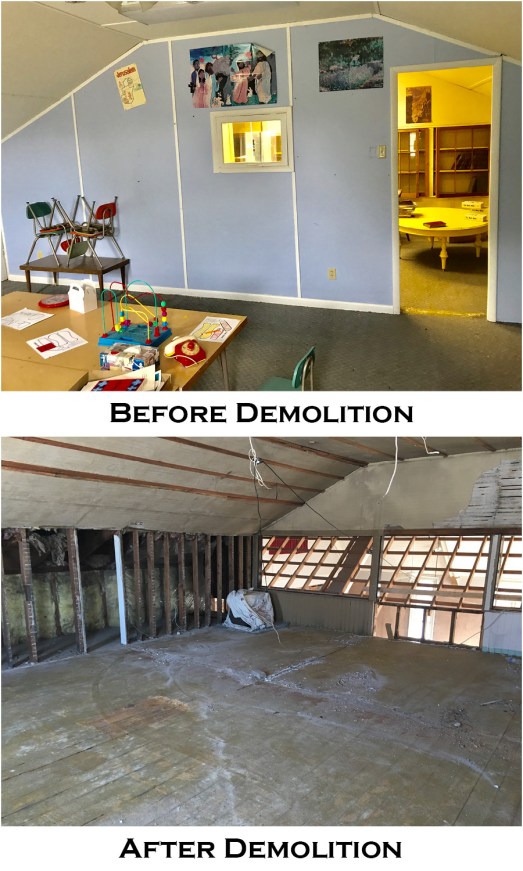
About six weeks into the project, we’d cleared the second floor. Gone were closets under the eaves, the walls, a sweeping swath of the choir loft ceiling and the carpeting. We were down to the studs as they say in the business. The only thing left was a gas heat stove in the corner, which could not be removed until after the plumber went to work and disconnected the gas line.

Second Floor Before and After

I longed to sweep (and I never longed to clean anything as more than one roommate can attest), but Tyler put me to work on other tasks; he didn’t want any more dust in the air and he knew there were weeks of dust ahead of us. Still, the area that would someday soon be a bathroom, a bedroom and my office looked great. Finally, we’d uncovered the blank slate for which we were looking.

# # #

Tomorrow: Chapter 12 opens with an ode to public utilities. Read about it here.

‘What can I say? I’m sorry. See ya next time’

Our story so far: My husband Tyler and I discovered jewels and junk in the demolition phase of converting our old Methodist church into a house.

# # #

One of the final places we demolished was the area beneath the entryway steps.

Based on old photos we found, we determined the steps were not original to the church. The original entry was beneath the belfry; the current entry had been constructed in the early 1940s.

Leading to the opening beneath the carpeted wood steps, a cupboard door of sorts without a knob had been sealed with foam and painted over (maybe more than once). In other hiding places in the church, we’d found old Christmas decorations (disappointing) and a plethora of old doors (thrilling!), so Tyler and I were curious what might be hidden under the steps.

He chipped away at the trim around the door, discarding pieces in all directions. “I feel like Geraldo Rivera!” he said, and I giggled.

Readers of a certain age may remember Rivera, who hosted a 1986 special on The Mystery of Al Capone’s Vaults during which he spent an hour hyping the potential discoveries of a secret vault beneath the Lexington Hotel in Chicago. When the vault was finally opened on live TV, the only things found inside were dirt and several empty bottles. [Rivera’s last words of the episode are the title of this post.]

beneath the stairs
Ta-da!

Like Rivera, our discovery was disappointing. The members of the church had left behind only a pile of scrap wood and a Bible comic book from 1962. The best thing, in fact, was the cupboard door: Solid beadboard.

beadboard cupboard
The back of the vault door was the best part.

# # #

Tomorrow: Chapter 11 concludes with a look at what we accomplished during demo. Read it here.

The church itself soothes moments of doubt

Our story so far: As we prepared the blank slate in the old Methodist church we were renovating into our home, the 95 percent of demolition that was dirty was beginning to wear us down.

# # #

After weeks of demolition, we were practicing self-therapy.

“Wow, we’ve made so much more progress than I thought we would.”

“Well, we knew the belfry had problems. It’s no surprise to us.”

“You know, we can bring in an expert to discuss headers if we need one.”

“I need a break, too. Breaks are good. We can’t work seven days a week.”

We needed to be cheerleaders for ourselves because everywhere we looked, we were surrounded by dust and old nails, and around every corner was more to do. As Tyler walked contractors of various sorts through the building for quotes, more than one said, “You have quite a project here.”

Anyone who’s ever done a remodeling project already knows: Many contractors cannot be depended upon for anything, but least of all, encouragement.

Right about then, we took to heart a battle cry uttered by master carpenter and host Ben Napier in an episode of HGTV’s “Hometown,” who surely had faced mammoth home remodeling projects of his own: “That’s the way the great ones all start. People doubt them. Everyone doubts them, and honestly that’s how I think you become great. You prove them wrong. You prove the doubters wrong.”

So yes, it was a big project. Thank you for pointing that out. We were going to persevere and invite the doubters to the open house to show it off when we were done.

Patience sign
Patience is a virtue.

I also was attempting to let the church itself reassure to me during those quiet moments of uncertainty. There was this sign left behind on what was perhaps a Sunday School room door: “Please be patient. God isn’t finished with me yet.”

And the message painted over the inside of the entrance, to be seen by exiting parishioners and witnessed by me every time I carried another load of tools or wood upstairs or downstairs: “Go now in peace.”

go in peace sign
Sending forth message.
peace banner
On a background of falling snow. How could it be more perfect?

This was reinforced by a little quilted banner I found among the Christmas decorations which said simply “Peace.” I brought it home, washed it gently (more gently than the poor Wise Man I’d defaced) and admired the excellent stitchery. And the appliquéd bell. It had a bell! This gem would find a spot back in the church.

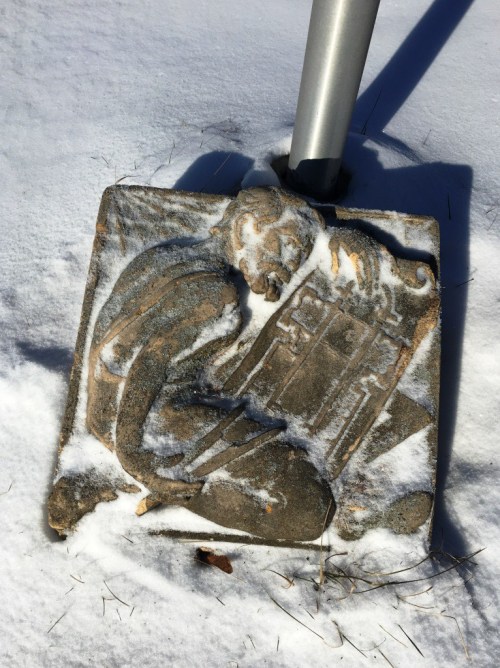
And then there was the rock at the foot of the flagpole. I’m not sure what it was telling me but I found it compelling. It might have been a image of Moses with the Ten Commandments (or half of them? See? Moses was a writer, too), but it might also have been a saint or a significant Methodist figure. I think he was sticking out his tongue. I did a reverse image search for it on the computer, and I learned it was a relief, that is, a sculptural technique where the sculpted elements remain attached to a solid background. I went literal with my findings, as in “relief,” a feeling of reassurance and relaxation following release from anxiety or distress. Finding the church and working on it a little bit every day could be considered a relief: We found home.

flagpole sign
What a relief.

# # #

Tomorrow: We make like Geraldo Rivera and go on an expedition. Read about it here.

Church demolition: Creepy, horror edition

Our story so far: Roughly six weeks into the demolition phase of project, we were pleased with the treasures we’d revealed in the old Methodist church we planned to turn into a home, but we’d also found a lot of dust and debris.

# # #

For all the junk and debris we found in the church, we were delighted not to find two things: Rot and vermin. Besides the rotted roof in the belfry, all the wood we found in the church both hidden and exposed was astonishingly sound.

I was also pleasantly surprised by the lack of insects. Sure, there were a few spiders and spider webs in many corners, but none of those disgusting millipeds had taken up residence in the basement, and even the Asian lady beetles and box elder bugs that were infesting our nearby rental house were few and far between at the church.

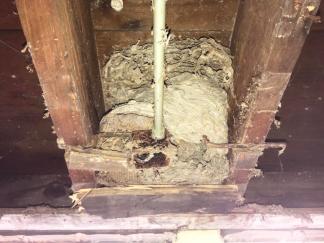
wasp nest
One of three wasp nests built between the floor joists of the basement.

As Tyler was carefully removing the tin ceiling in the basement, he found three enormous wasp nests built between the exterior wall and the floor joists of the first floor. Shortly thereafter, he found another one in the false roof of the entryway. But the honeycombed structures were at least a decade old, and their creators had taken up residence elsewhere long ago.

It seems only squirrels had been unwanted squatters in ye olde Methodist church (with five extremely mature pine trees on the lot, we shouldn’t have been surprised). I’d take dead squirrels over live bats any day.

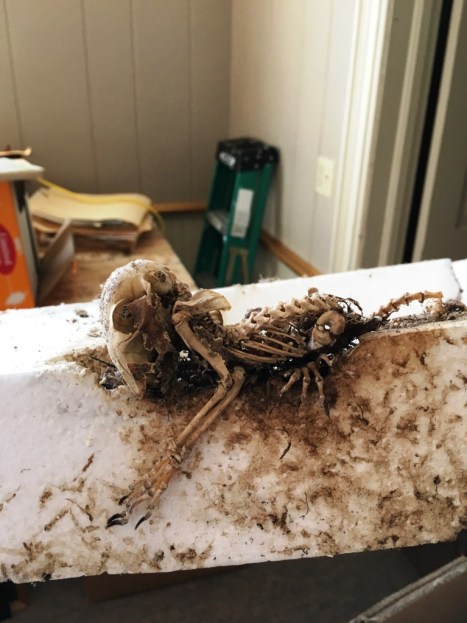
stans wife
Skeletal squirrel.

Besides Stan, whose mummified remains we found in the belfry during one of the early showings, Reroofer also found a number of squirrel carcasses in the bell tower during his reconstruction foray. And I discovered an almost perfectly preserved squirrel skeleton in a box of plastic chandelier crystals that had been stored on the second floor.

I imagined her to be Stan’s dearly departed mate, tempted but ultimately doomed by the packing Styrofoam in the box that would become her coffin. Her creepy beauty transfixed me. I texted a picture of it to my stepdaughter who, with a degree in biophysics, I thought might find it scientific. Her response? “Ewwwww!”

# # #

Tomorrow: The self-therapy begins. You can read about it here.

How to get rich selling demolition waste

Our story so far: The demolition phase of converting our old Methodist church into a home included a couple of dumpsters and a lot of trips to Goodwill.

# # #

We tried to be good stewards of our unwanted demolition waste. To avoid filling a landfill, we gave away a lot of things, but when the opportunity to presented itself, we were open to selling items. With mixed results.

I packed up a box of Christian books and tried to sell them at Half Price Books. I got $2.80. I immediately invested in a $3 copy of The Complete Idiot’s Guide to the World’s Religions. I figured any woman who thought living in a church was a good idea really ought to educate herself on all things spiritual.

Then, after the second guy in a beat-up pickup truck stopped to ask if he could haul away the scrap metal we’d piled up outside next to the church, Tyler and I took it upon ourselves to see how much it was worth.

One warmish afternoon in January, Tyler and I piled all the siding Reroofer tore off the belfry and about a hundred miles of suspended ceiling grid into the back of our beat-up pickup truck and drove to a scrap metal yard about ten miles away.

We stopped for lunch. Because we worked up an appetite filling up the truck.

We spent $14.23 on a couple of bowls of homemade soup and a salami club sandwich, which we split. And, because it was a bakery, Tyler got a dynamite apple fritter for dessert.

We proceeded to the scrap metal yard where a couple of overall-clad fellows helped us separate the more valuable aluminum siding from the steel scrap. Our booty was weighed, and they handed us a check for $30.24.

After factoring in the gas required to transport our scrap metal, we each earned roughly $7 an hour plus lunch.

Which was a vast improvement compared to how we spent the next two hours. We priced bathtubs, kitchen cabinets and flooring to use on the ceiling of the second floor. Big price tags, them all.

We still hoped to sell the exterior staircase at some point. Surely someone—with a cutting torch or a long trailer—needed a fire escape.

exterior staircase
For sale: One fire escape, barely used.

# # #

Tomorrow: What we didn’t find during demo. Click here to read it.